 Chunlei Mining Machinery
What is a ball mill?
Whether it’s for mining, manufacturing or building infrastructure and hydro construction, ball mills are perfect for converting raw materials into finely ground powders or granules.
Offering efficiency and convenience to a wide range of industries, ball mills have become indispensable in a variety of industries.
If you’re curious about how ball mills work, their advantages, and how they differ from other grinders, chunlei machinery will help you learn the ins and outs of ball mills from the basics.

What is a ball mill?
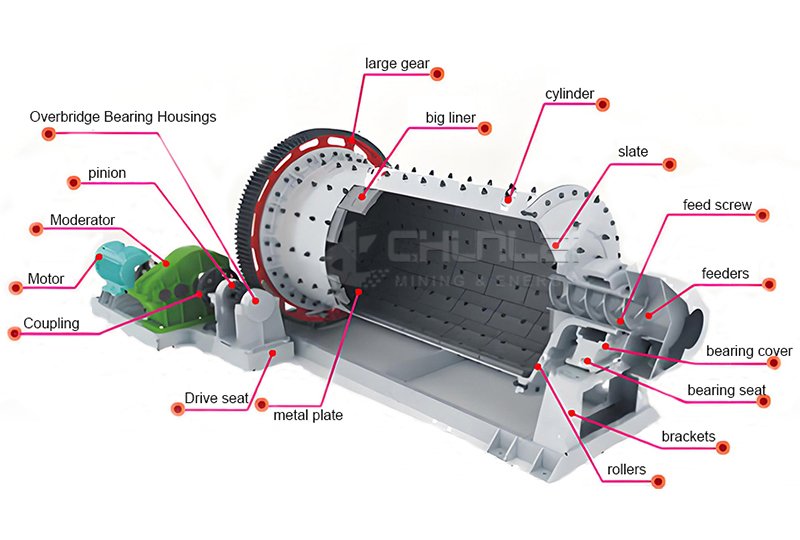
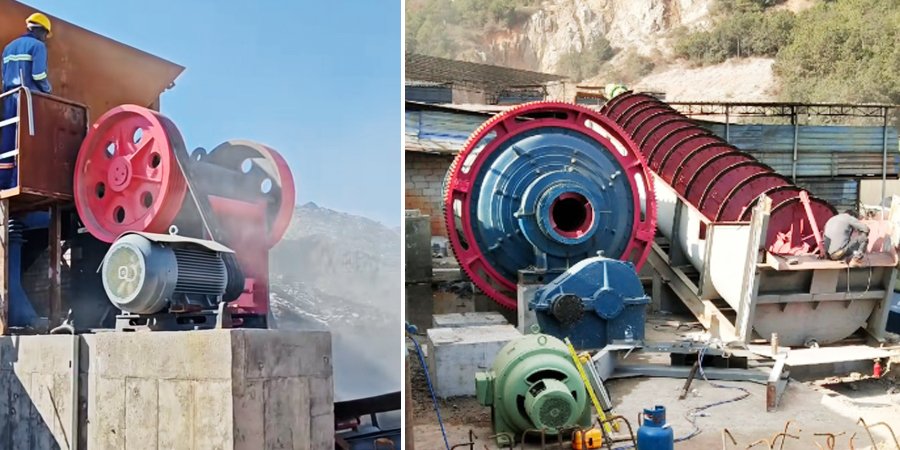
Ball mill is a kind of grinding equipment, which is mainly composed of cylinder, mill liner, bearing, gear and motor. According to the media can be divided into steel ball mill and ceramic ball mill, which is used to grind materials into very fine powder. When the raw material is loaded into the ball mill cylinder, it is mixed with the grinding media – steel balls. As the ball mill rotates, the balls repeatedly tumble, collide and create impact and friction, which squeezes and breaks down the material into finer particles.
The Chunlei ball mill provides excellent performance, which is mainly based on the impact force generated when the balls fall on the material, and the friction force generated when the balls and the material rub against each other. Whether you are dealing with brittle or fibrous materials, the dual action of impact and friction results in fine grinding.
What is ball mill used for?
Ball mills are so hot, many people want to know what exactly can ball mills do? Now I’ll tell you the answer!
Ball mills are commonly used in industries such as mineral processing, cement production, chemicals, ceramics and fertilizers. Ball mills pulverize ores and grind minerals and raw materials, and these ground finished products are used in the mining or manufacturing industries. Whether it is a wet ball mill or dry ball mill, ball mills process the required material to the required particle size.
What is the difference between a ball mill and a rod mill, and the difference between a tube mill?
- Rod mill is commonly used for steel rods with a diameter of 50-100mm as grinding media; while ball mill is using steel balls as grinding media.
- The ratio of rod mill cylinder length to diameter is generally 1.5-2.0, and the inner surface of the liner plate on the end cap is a vertical plane; the ratio of the cylinder length to diameter of the ball mill is smaller, and in most cases the ratio is only slightly greater than 1.
- The rotational speed of rod mill cylinder is lower than the working speed of ball mill of the same specification, so as to make the media in the cascade state work.
- The process of rod mill is characterized by the product is rougher, but the intensity of uniform, containing coarse particles and sludge less or crushed lighter. Commonly used in rare metal re-election or magnetic separation.
- Ball mill performance is characterized by high production capacity, strong adaptability to the material, material fineness, fine particle size, easy to fine grinding, energy saving is more significant, but prone to over-crushing phenomenon, and is not suitable for metal beneficiation in the re-election production line.
- Tube mill is also called Steel pipe internal grinding machine, is widely used in steel pipe manufacturing industry, it is a special equipment for trimming the outer diameter and inner diameter of steel pipe. The equipment adopts full automatic control, high grinding precision and good surface quality.
| Rod mill | Ball mill | |
| Grinding Media | Steel rods with a diameter of 50-100 mm | Steel ball |
| L/D ratio | 1.5-2.0 | Slightly larger than 1 |
| Rotation speed | Lower than the same specification ball mill | |
| Performance Characteristics | The product is rougher, but the strength is uniform, containing coarse particles and sludge less or less crushed, commonly used in rare metal re-election or magnetic separation | High production capacity, strong adaptability to materials, high degree of fineness of materials, fine particle size of discharged materials, easy to fine grinding, energy saving is more significant. |
What are the advantages of a ball mill?
1. High Grinding Efficiency
Advanced grinding technology ensures high pulverization efficiency and increased productivity through impact and friction of the grinding media.
2. Adjustable particle size
By adjusting the ratio of steel balls and rotating speed, the discharge particle size can be easily controlled to meet different production requirements.
3. Continuous operation
High-quality materials and advanced manufacturing technology ensure the stability and reliability of the ball mill during long-time continuous operation, which is suitable for mass production.
4. Energy-saving and environmental protection
Optimized power system and energy-saving design can reduce energy consumption and minimize environmental pollution, in line with green production standards.
5. Strong adaptability
It can be used for dry and wet grinding, and can deal with materials of various hardnesses, adapting to different process requirements.
How Does a Ball Mill Work?
Working Principle of Ball Mill: Ball mill is a kind of external gear, double-compartment horizontal drum mill. The material enters the first hopper from the feeding equipment through the hollow shaft spiral. The hopper has trapezoidal sheath or corrugated sheath, which is equipped with steel balls of different specifications, which fall under the centrifugal force of the cylinder to grind the materials. After rough grinding in the first hopper, the material enters into the second hopper through a single partition plate, the second hopper has a flat graduated plate with steel balls for grinding the material. The ground material is discharged through the discharge plate to complete the grinding process.

Latest News

Bulk Density of Sand: Test Methods & Equipment Selection Guide
800If you work in the sand and gravel processing industry, you’ve probably heard the term “bulk density”—but do you know how it directly impacts your equipment selection? Choosing the wrong feeder or crusher based on inaccurate density data can le…
-
2026 Zimbabwe Gold Mine Ball Mill Buyer’s Guide: Avoid Costly Mistakes & Choose the Right Model
805Decades of experience in global gold mining reveals a common, costly mistake: Zimbabwe mine owners waste tens of thousands of dollars on mismatched ball mills. A machine that works for a South African hard rock mine will fail in Zimbabwe’s dust…
-
7 Common Ball Mill Faults & Quick Fixes for Mining Sites
805If you are responsible for operating a gold or ore beneficiation production line, you undoubtedly understand just how frustrating it is when a ball mill suddenly malfunctions—whether the issue involves vibration, overheating, a drop in output, …
-
Case Study: 100TPD Gold Processing Line with Ball Mill in Africa
801If you are planning to establish a 100-ton-per-day (100 TPD) gold beneficiation production line in Africa, you are likely facing a common dilemma: Which type of ball mill is best suited for processing African gold ores? Can the equipment effect…
loading…
已经是到最后一篇内容了!