 Chunlei Mining Machinery
7 Common Ball Mill Faults & Quick Fixes for Mining Sites
If you are responsible for operating a gold or ore beneficiation production line, you undoubtedly understand just how frustrating it is when a ball mill suddenly malfunctions—whether the issue involves vibration, overheating, a drop in output, or a complete shutdown. Every minute of downtime results in financial loss, particularly in round-the-clock operations.
Today, I will provide a detailed breakdown of the seven most common ball mill malfunctions encountered in the field, along with quick, actionable solutions that can be implemented immediately. As Chunlei Mining Equipment—a specialist in gold beneficiation lines and heavy-duty ball mills—we will also demonstrate how our machinery is designed and manufactured to minimize the occurrence of these issues right at the source.
In this article, we will introduce:
- 1. Ball Mill Fails to Start or "Cannot Turn Over"
- 2. Excessive Main Bearing Temperature
- 3. Excessive Shell Vibration and Abnormal Noise
- 4. Grinding Fineness Fails to Meet Requirements
- 5. Abnormal Noise During Gear Meshing
- 6. Slurry Leakage at the Feed or Discharge Port
- 7. Abnormal Motor Current Fluctuations
- Conclusion
1. Ball Mill Fails to Start or “Cannot Turn Over”
Symptoms:
Upon pressing the start button, the motor emits a humming sound; the mill cylinder either fails to rotate or rotates sluggishly, or the circuit breaker trips immediately.
Quick Troubleshooting:
- First, check for voltage stability—mining power grids often experience significant fluctuations, and if the voltage drops more than 10% below the rated value, starting difficulties are likely to occur.
- Check the motor wiring for loose connections or a phase loss.
- Manually “bar over” (rotate) the mill to feel for any signs of jamming or binding.
Quick Remedies:
If the issue is voltage-related, try staggering the startup times of other high-power equipment within the plant to avoid simultaneous load spikes. If manual rotation is difficult, it is highly probable that the mill cylinder was not fully emptied of material and grinding balls prior to a prolonged shutdown; this must be done before extended downtime, otherwise the starting load will be excessive during the next startup attempt.
Chunlei ball mills come standard with a soft-start control cabinet. This system limits the starting current to 2–2.5 times the rated current—a reduction of over 40% compared to traditional direct-start methods—making it particularly well-suited for mining sites with unstable power supply conditions. If your equipment utilizes an older control system, we recommend considering an upgrade.
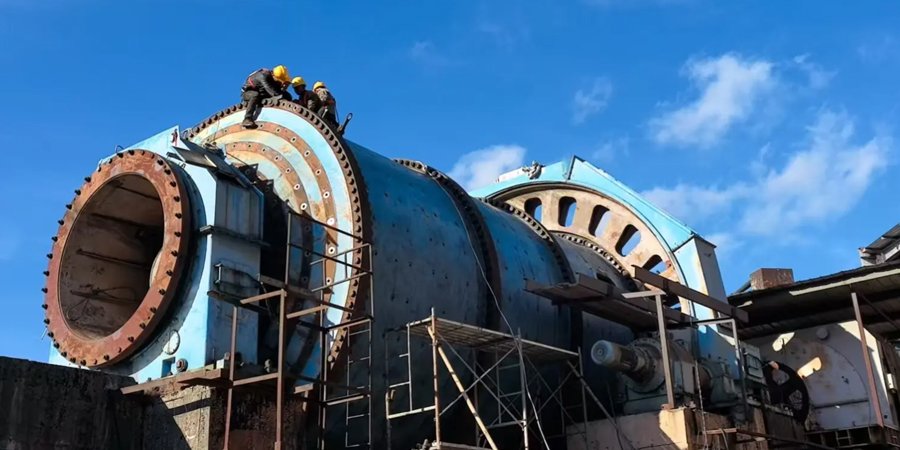
2. Excessive Main Bearing Temperature
Symptoms:
The bearing temperature exceeds 65°C; it feels noticeably hot to the touch, and in severe cases, smoke may even be observed.
Quick Troubleshooting:
- Check the lubricant level—both excessive and insufficient levels can lead to a temperature rise.
- Inspect the lubricant to see if it has degraded or become contaminated with impurities.
- Verify that the cooling water system is flowing freely and is unobstructed.
Immediate Action:
First, shut down the equipment to allow it to cool; do not attempt to continue operating under these conditions. Next, inspect the lubrication lines—many on-site temperature issues are actually quite simple, often stemming from a clogged oil nozzle or the use of an incorrect type of lubricant. After clearing the oil lines and replacing the lubricant with the appropriate grade, the temperature will typically drop significantly.
Bearings are one of the most expensive wear parts in a ball mill. It is recommended that during routine inspections each shift, operators briefly touch the bearing housing with the back of their hand—making this a habit ensures that any abnormal temperature rise is detected immediately.
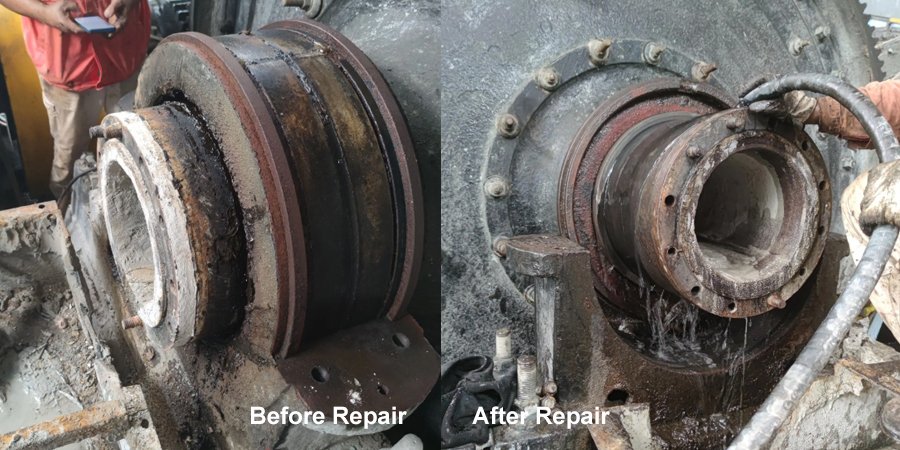
3. Excessive Shell Vibration and Abnormal Noise
Symptoms:
During operation, the machine emits a distinct “thumping” sound (impact noise), or noticeable ground vibration can be felt.
Quick Troubleshooting:
- Check if the foundation bolts are loose—this is the most common cause.
- Inspect the liners to see if any have detached or are severely worn.
- Verify that the gear mesh clearance is within the normal range.
Quick Resolution:
After shutting down the machine, use a wrench to retighten all foundation bolts, paying particular attention to those located near the motor and the reducer. If the vibration persists, open the inspection door to check the liners; if a specific liner has detached, the steel balls will strike the shell directly—producing a very jarring noise—and the detached liner must be replaced immediately.
Chunlei ball mills utilize high-manganese steel liners, featuring an optimized balance of hardness and toughness. Under normal operating conditions, these liners offer a service life that is 20% to 30% longer than that of standard liners. We recommend inspecting the liners for wear every three months and keeping spare wear parts on hand to prevent unplanned downtime caused by liner-related issues.
4. Grinding Fineness Fails to Meet Requirements
Symptoms:
The discharge particle size is too coarse, or the fineness is unstable—fluctuating between coarse and fine.
Quick Troubleshooting:
- Check if the steel ball charge gradation is appropriate—balls that are either too large or too small in diameter will negatively impact grinding efficiency.
- Verify that the feed rate is stable.
- Confirm that the classification equipment (hydrocyclones or screens) is operating correctly.
Quick Fixes:
If the fineness suddenly becomes coarser, first inspect the classification equipment—often, the issue is a worn-out hydrocyclone apex nozzle; replacing the nozzle will restore proper operation. If the classification equipment is functioning correctly, consider adding smaller steel balls—the fine grinding stage requires small-diameter balls, rather than simply increasing the ball diameter indiscriminately.
It is recommended to record daily data regarding steel ball additions and grinding fineness to identify the optimal ball charge ratio best suited to the specific characteristics of your ore. Empirical data often proves more effective than theoretical calculations.
5. Abnormal Noise During Gear Meshing
Symptoms:
A periodic “clicking” or “clacking” sound emanating from the gears, or a high-pitched metallic grinding noise.
Quick Troubleshooting:
- Check the lubrication status of the gear teeth—insufficient lubrication directly leads to accelerated wear.
- Verify whether the gear clearance (backlash) has shifted due to foundation settlement.
- Check for any foreign objects that may have entered the gear meshing zone.
Quick Fix:
Shut down the equipment to clean the gear surfaces, then reapply a sufficient amount of gear lubricant. If the gear clearance has changed, it must be readjusted—this procedure is best performed by an experienced maintenance technician, as improper adjustment can actually accelerate gear wear.If ignored, the condition can escalate from a minor anomaly to a broken gear tooth in a matter of just a few days.
6. Slurry Leakage at the Feed or Discharge Port
Symptom:
Slurry seeps from the feeder or the discharge end, causing the floor to become wet and slippery, thereby compromising the site environment.
Quick Troubleshooting:
- Check if the seals are aged or damaged.
- Inspect the connecting bolts to see if they are loose.
- Verify whether the feeder body itself shows signs of wear or perforation.
Quick Fix:
If the leakage is minor, try tightening the bolts first; many slurry leakage issues can be resolved this way. If the seals are damaged, they must be replaced—we recommend keeping a spare set of seals on-site. These parts are inexpensive, but lacking a spare when a failure occurs can put operations in a very difficult position.
Chunlei ball mills utilize a multi-layer composite sealing structure at both the feeder and discharge ends to effectively minimize slurry leakage issues. Furthermore, our seals feature a standardized design that facilitates easy replacement; on-site personnel can complete the swap in under 15 minutes.
7. Abnormal Motor Current Fluctuations
Symptoms:
The ammeter needle swings frequently and violently, or the current suddenly surges during operation.
Quick Troubleshooting:
- Check for uniformity in the feed rate—an inconsistent feed (fluctuating between heavy and light) is a common cause of current fluctuations.
- Inspect the ratio of material to grinding balls inside the mill drum.
- Verify whether there are any loose connections or poor contacts within the electrical system.
Quick Resolution:
First, stabilize the feed rate—manually adjust the feeder and observe whether the current begins to steady out. If the current remains consistently high, it indicates an excessive material load inside the drum; in this case, appropriately reduce the feed rate until the current drops back to normal levels, then resume standard feeding operations.
The motor current serves as the ball mill’s most intuitive “dashboard.” Operators are advised to cultivate the habit of closely monitoring the current—a stable current indicates that the mill is operating normally, whereas sudden changes in current often serve as a precursor to other potential malfunctions.
Conclusion
These seven types of malfunctions are encountered on-site almost every day. However, what truly impacts production output is not the malfunction itself, but rather the ability to resolve it quickly once detected.
To our mining clients, our key message is this: selecting the right equipment is merely the first step; comprehensive after-sales service and support are the true keys to success.
Chunlei Equipment — Your Reliable Partner for Mining Mills
Chunlei Equipment has dedicated years to deep specialization within the field of mining machinery. Our ball mill product line encompasses a wide variety of models—including dry and wet mills, as well as grate-type and overflow-type designs—featuring drum diameters ranging from 1.2 to 4.5 meters to meet the mineral processing needs of mines of all scales.
Key Technical Highlights:
- Processing Capacity: 0.5–200 t/h; supports customized design solutions.
- Liner Materials: Options include high-manganese steel, rubber, or magnetic liners, adaptable to various ore types.
- Drive System: Choice of edge-drive or center-drive configurations, equipped with soft-start devices.
- Control System: Intelligent PLC control for real-time monitoring of critical parameters such as current, temperature, and vibration.
We provide more than just equipment; our comprehensive service package includes on-site installation guidance, operator training, a readily available inventory of common wear parts, remote technical support, and rapid troubleshooting via phone or video conferencing.
Latest News

Case Study: 100TPD Gold Processing Line with Ball Mill in Africa
786If you are planning to establish a 100-ton-per-day (100 TPD) gold beneficiation production line in Africa, you are likely facing a common dilemma: Which type of ball mill is best suited for processing African gold ores? Can the equipment effect…
-
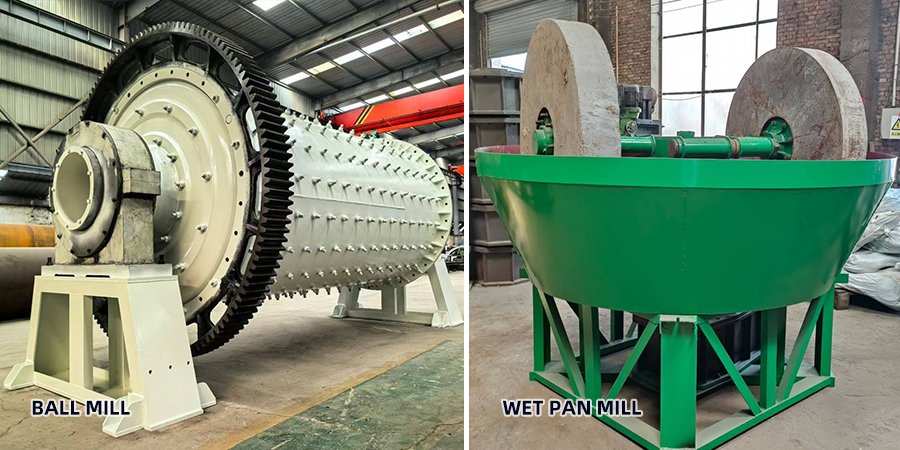
Ball Mill vs Wet Pan Mill: Which Is Better for Gold Mining?
807In gold mining operations, deciding whether to opt for a ball mill or a wet pan mill machine is one of the most challenging questions clients frequently ask me. I have spoken with dozens of mine owners who wasted money because they selected th…
-
Types of Leaching Process in Gold Mining: Simple Guide for Miners
781Anyone in the mining industry knows that finding the right methods for processing low-grade ores and refining refractory ores is a key factor in determining a mine’s profitability. As metallurgists often joke, “Leaching isn’t a cure-all, but wi…
-
Gold Milling Machine Price: Choose the Right Complete Line for Your Mining Project
778If you’re searching for “gold milling machine price,” you’re probably looking for more than just a single piece of equipment. You need a reliable, efficient solution that scales with your mining operation—one that delivers consistent gold recov…
loading…
已经是到最后一篇内容了!