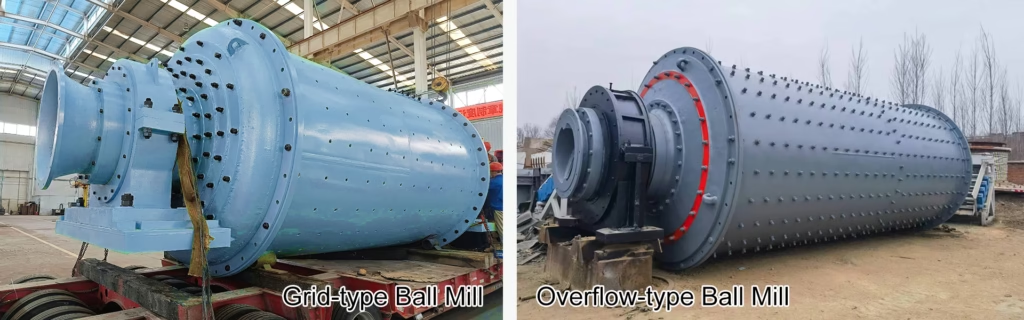
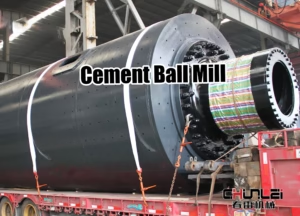
A continuous ball mill is a grinding equipment that enables continuous feeding, continuous discharge, and continuous material pulverization and grinding, achieving continuous and automated grinding production. It is widely used in mining, building materials, and chemical industries. Based on different discharge methods, it can be classified into two types: grate-type ball mills and overflow-type ball mills. Grid-type ball mills employ a grid plate for forced discharge, making them suitable for coarse grinding operations. Overflow-type mills utilize the material’s own gravity for overflow discharge, making them more appropriate for fine grinding or as the second stage in two-stage grinding processes.
Structure of Continuous Ball Mills
Continuous ball mills primarily consist of a grinding cylinder, feed and discharge devices, a drive support system, and grinding media. At its core is a horizontally positioned, rotatable cylinder lined with refractory plates. Inside, steel balls or other grinding media of varying sizes are loaded. Both ends of the cylinder are supported by mounting structures, with an electric motor and reducer driving the entire cylinder rotation.
Here, we focus on the discharge device, a critical component of the continuous ball mill. Common types include grate-type and overflow-type, which control particle size and discharge velocity.
Working Principle of Continuous Ball Mills
The working principle of continuous ball mills is similar to that of conventional ball mills, both utilizing the rotation of the grinding chamber to drive internal grinding media (typically steel balls) to impact and grind materials. The sole distinction lies in the “continuous” operation mode, primarily manifested in three aspects of “continuity”:
Continuous Feeding: Raw materials are continuously and uniformly fed into the grinding chamber from the mill’s feed end.
Continuous grinding: As the material slowly moves from the feed end toward the discharge end under the combined action of the rotating cylinder and internal grinding media, it undergoes intense impact and friction from tumbling grinding media, achieving pulverization and fine grinding.
Continuous discharge: Material meeting the required fineness reaches the discharge end of the cylinder and is continuously discharged through specific discharge devices (such as grate plates, overflow weirs, etc.) to enter the next process.
Differences Between Grid-Type and Overflow-Type Ball Mills
Grid-type and overflow-type ball mills represent the two primary classifications of continuous ball mills based on their discharge mechanisms.
Grid-type ball mills
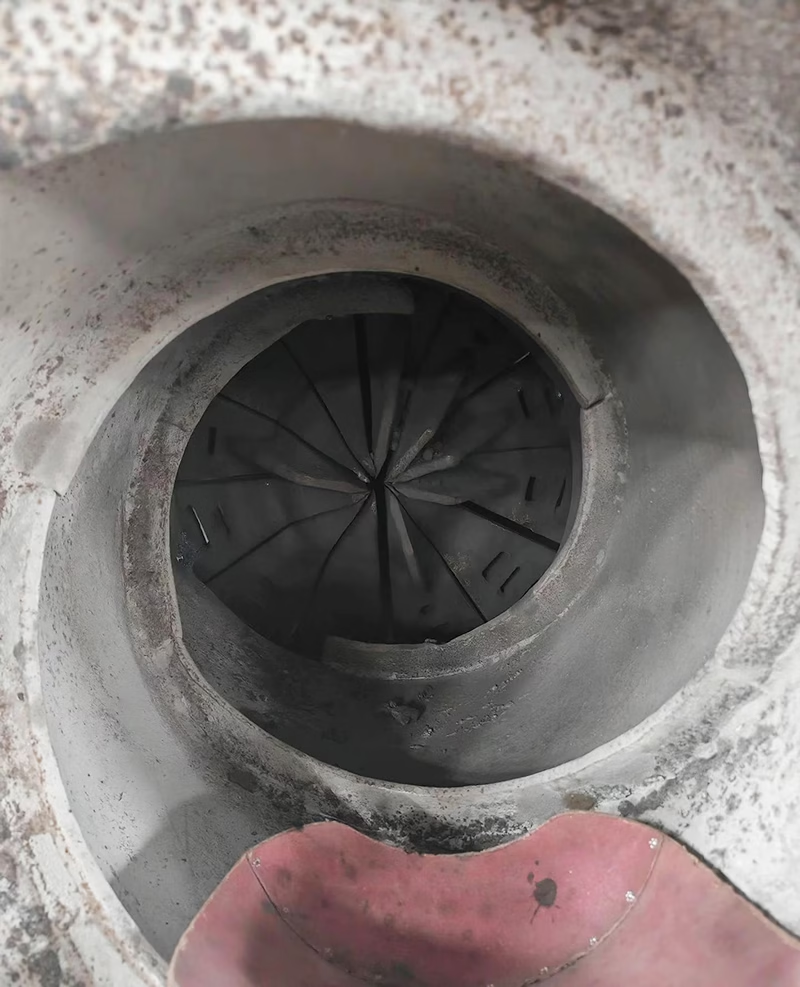
Grid-type ball mills feature a grid plate installed at the discharge end, allowing only particles smaller than the grid plate gaps to be lifted to a higher elevation for discharge. This forced discharge mechanism results in shorter residence time within the mill, higher production efficiency, and uniform product particle size. However, the structural walls of grid-type mills are more complex.
Overflow ball mills
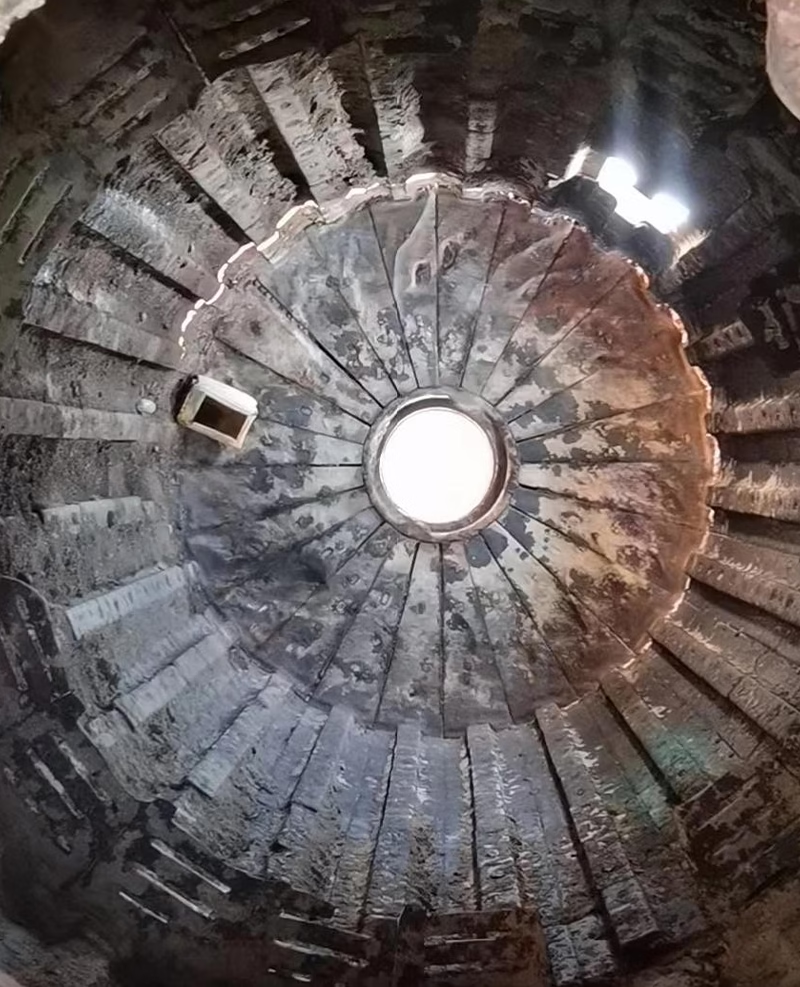
Overflow ball mills automatically discharge material once it accumulates to a certain height at the discharge end. This accumulation-based discharge allows for longer grinding times, resulting in finer particle sizes but lower efficiency and a higher risk of overgrinding.
Grid-Ball-Mill-Discharge-Opening
Overflow-Type-Ball-Mill-Discharge-Opening
How to Choose Between Grid Type and Overflow Type Ball Mills?
Grid-type ball mills are more suitable for the first stage of coarse grinding, where coarser grinding products are required but high throughput and efficiency are needed.
Overflow-type ball mills are typically used in the second stage of fine grinding or regrinding, where finer product particle size is required and throughput demands are less stringent. If your investment and maintenance costs are key considerations, then the overflow-type ball mill is the optimal choice.
Differences Between Continuous and Batch Ball Mills
Continuous Ball Mill
Batch Ball Mill
Working Method
Continuous feeding and discharge, functioning like an assembly line.
Batch operation, functioning like a “washing machine.” Load → Grind → Stop → Unload, repeating cyclically.
Structural Design
Equipped with feeding and discharging devices at both ends, featuring a relatively complex structure that facilitates material flow.
Simple structure, typically featuring only a single cylinder with no dedicated feeding or discharging mechanisms.
Automation Level
Highly compatible with automated production lines, enabling unmanned operation.
Low efficiency, requiring manual intervention for loading and unloading each batch.
Production Efficiency
Very high, with no idle time, suitable for large-scale continuous production.
Relatively low energy consumption, with significant non-grinding time spent on loading, unloading, and startup.
Product Consistency
Stable and uniform, ensuring consistent residence time within the mill and a concentrated particle size distribution.
Potential variability: Grinding conditions (e.g., material volume, media wear) may vary slightly between batches.
Energy Consumption
Low energy consumption per unit product, smooth operation, and minimized motor starts.
High energy consumption per unit: Motor must restart for each batch.
Flexibility
Poor, requiring thorough cleaning when switching product types, which is highly inconvenient.
High flexibility: Ideal for small-batch, multi-product production; easy to clean.
Investment and Maintenance
High initial investment, complex system, and demanding maintenance requirements.
一. Determined by Production Process Requirements If your entire production process is continuous, then for efficiency, the grinding stage must also be continuous. This is the fundamental decision point.
Some factories (e.g., large cement plants, modern mineral processing plants, large ceramic factories) operate production lines 24/7. From raw material intake to finished product output, the entire line runs on a closed assembly line. If the intermediate grinding stage is intermittent, it forces the entire production line to start and stop frequently. This is unacceptable in terms of both labor costs and equipment maintenance.
Additionally, during wet grinding, a closed-circuit system must be formed with classifiers (such as spiral classifiers or hydrocyclones). This highly efficient circulation can only be achieved through continuous ball mill operation.
二. Determined by Investment Scale When your production volume requires large-scale, high-intensity operations—such as processing millions of tons of iron ore or copper ore annually, or operating cement production lines yielding thousands of tons daily—the continuous feeding and discharging capabilities of continuous ball mills can meet these massive capacity demands.
三. Determined by Final Product Particle Size
After crushing metal ores, they must be ground to a specific particle size (typically around 0.074 mm) for subsequent separation processes like flotation and magnetic separation. This represents the most common application scenario for continuous ball mills.
For non-metallic minerals used in industries like papermaking, coatings, and plastics—such as grinding heavy calcium carbonate powder, kaolin, or silica fume—continuous grinding mills are required.
Continuous ball milling is essential for grinding mixed materials like limestone, clay, and iron powder into raw meal powder, or for grinding cement clinker into finished cement.
In ceramic slurry production, raw materials like feldspar, quartz, and clay are mixed with water in specific proportions. Only continuous ball mills can grind these into uniform slurries.
For thermal power generation, continuous ball mills grind raw coal into fine coal powder, which is then sprayed into boilers for complete combustion.
When is a continuous ball mill not suitable?
Batch ball mills are typically chosen in the following scenarios:
Small-batch, multi-product production requiring frequent changes in material type and color, such as in laboratories, specialty ceramics plants, and pigment factories. Batch ball mills facilitate cleaning and material switching.
Applications demanding high product purity and special properties but with low output requirements, such as grinding electronic ceramics, magnetic materials, or certain pharmaceuticals.
Production processes where continuous feeding cannot be guaranteed. Forcing the use of a continuous ball mill in such cases may lead to unstable operation and fluctuating product quality.
If you are interested in ball mills or have any inquiries, pleasecontact us—we are available 24 hours a day to address your questions. your free solution now!
Quartz Sand Dressing Production Line
Process Introduction The quartz sand beneficiation process is mainly for purification, removing small or trace amounts of impurities in quartz sand to obtain refined quartz sand or high-purity q...
Zircon Ore Beneficiation Process
Process Introduction Zircon beneficiation process is the process of removing impurities and increasing the content of zircon ore. According to the characteristics of the original ore, Chunlei design...
Sand is one of the most fundamental materials in construction, manufacturing, and industry. Yet its properties—particularly its density—vary dramatically based on particle size, composition, and moisture content. Understanding these variations is...
Weight: 14-370 tonsOutput: 1.5-110 tons/hourPower: 55-3550 kWAdvantages: Fully automatic, high efficiency, etc.
A cement ball mill is a type of cement grinding machine, also known as a cement grinder. It is primarily u...
Welcome to Chunlei machinery website. We are a leading manufacturer and exporter of mining machinery in China with more than 30 years history in China.
We offer you one-stop solutions: online consultation --- customized solutions --- fast delivery --- comprehensive after-sales service
 Chunlei Mining Machinery