In the field of barite processing, have you ever faced these challenges: subpar equipment performance, inconsistent product fineness, or persistently high overall operating costs? As a cornerstone material for drilling, chemical, and coating industries, barite’s value hinges on its processing stage. Transforming barite into premium products involves a complex process route. How can you ensure precise investment and efficient, stable production line operation? CHUNLEI Machinery is dedicated to providing comprehensive equipment solutions spanning primary crushing to final refining. We deliver a clear process blueprint to build a production line that aligns precisely with your business objectives, transforming your barite resources into maximum commercial value.
Complete Guide to Selecting Barite Processing Equipment
In the field of barite processing, have you ever faced these challenges: subpar equipment performance, inconsistent product fineness, or persistently high overall operating costs? As a cornerstone material for drilling, chemical, and coating industries, barite’s value hinges on its processing stage. Transforming barite into premium products involves a complex process route. How can you ensure precise investment and efficient, stable production line operation? CHUNLEI Machinery is dedicated to providing comprehensive equipment solutions spanning primary crushing to final refining. We deliver a clear process blueprint to build a production line that aligns precisely with your business objectives, transforming your barite resources into maximum commercial value.
Barite Equipment Configuration: The Key to Project Success
Selecting barite processing equipment is more than a simple procurement task. The right choice directly impacts profitability, determines whether a mine’s value is maximized, and ultimately affects a company’s economic performance. Purchasing the wrong configuration due to lack of knowledge or price considerations leads to frequent production line issues, accelerated equipment wear, low recovery rates, and unstable product purity. This not only squanders initial investments but also inflates subsequent labor and maintenance costs. Conversely, a well-considered choice avoids these pitfalls while generating remarkable returns. Therefore, thorough research is essential during barite equipment selection to make the wisest investment decision. This will pave the way for sustained profitability in your business.
Understanding Raw Ore Characteristics: Selecting the Right Equipment
Before considering equipment purchases, it is essential to thoroughly understand your project—this is the first step toward successfully selecting barite processing equipment. I always tell my clients that clarifying the raw ore is the only path to optimal results. Numerous subsequent factors also come into play, each interlinked with later stages. Before selecting equipment, five core questions must be addressed:
1. Raw Ore Properties Analysis
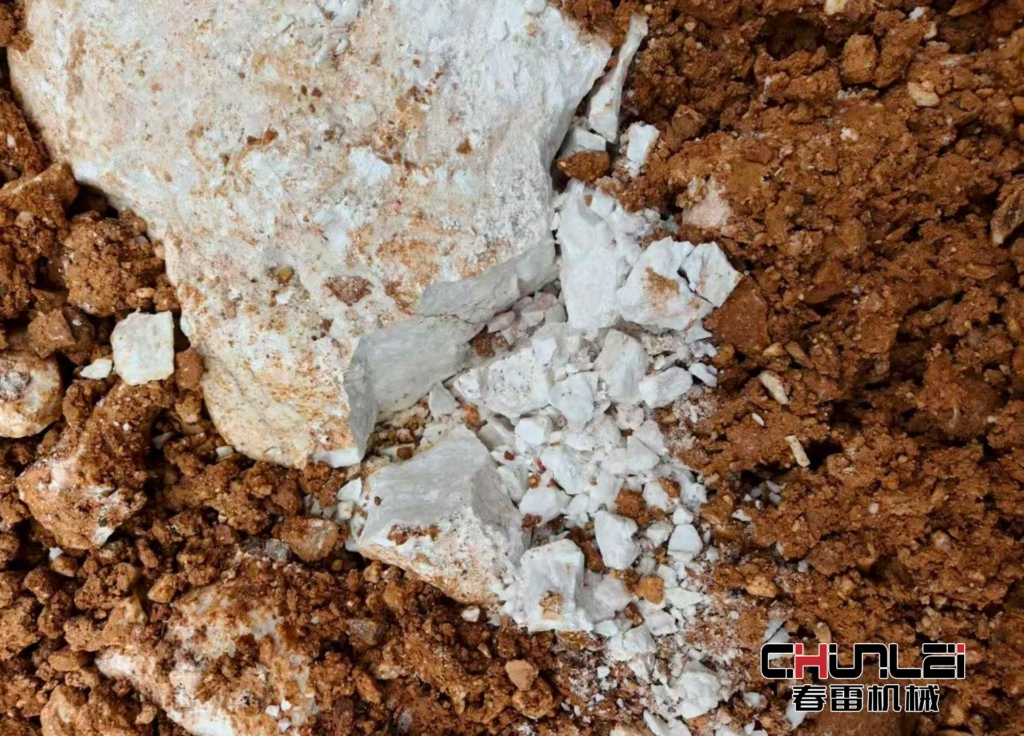
Comprehensively understanding the mineral composition within the ore is the fundamental basis for designing the mineral processing flow. Particle size distribution, hardness and abrasiveness, and moisture content directly determine the selection of equipment for each stage.
Key Properties of Ore
Impact on Processing Techniques
Equipment Considerations
Mineral Composition and Impurities
Determines pre-treatment and sorting methods
Contains clay? → Requires a mineral washer
Contains iron minerals? → Requires magnetic separators or flotation machines
Simple composition? → Process can be simplified
Hardness and Abrasiveness
Determines equipment wear rate and durability requirements
High hardness/abrasiveness → Requires cone crushers, high-chromium alloy grinding rollers
Low hardness → Can opt for impact crushers, standard Raymond mills
Disintegration Particle Size
Determines grinding fineness and energy consumption levels
Coarse particle liberation → Can opt for Raymond mills, lower energy consumption
Determines feasibility and efficiency of gravity separation
Significant density difference from gangue → Jigging machine highly efficient
Small density difference → Consider flotation or other methods
2. Target Product Specifications
Target product specifications ultimately determine equipment selection. In barite processing projects, the final equipment configuration does not arise arbitrarily—what is produced dictates how it is produced. Defining product positioning is the primary step to avoid investment waste, optimize processes, and maximize economic returns. First, clarify what you intend to produce:
Drilling-Grade Barite: To meet API 13A standards, a “jaw crusher + cone crusher” combination is typically employed for efficient primary crushing, ensuring uniform feed size for subsequent grinding. Raymond mills are commonly selected for grinding. If the raw ore grade is insufficient, a jigging machine should be installed before grinding to pre-concentrate minerals and ensure final specific gravity compliance.
Chemical-grade barite: This product demands extremely high chemical purity, which cannot be achieved through simple crushing alone. A complete flotation system (including agitators, flotation machines, etc.) is essential. Consequently, the grinding stage preceding flotation becomes critically important. Ball mills not only reduce particle size but also create conditions for mineral liberation during flotation.
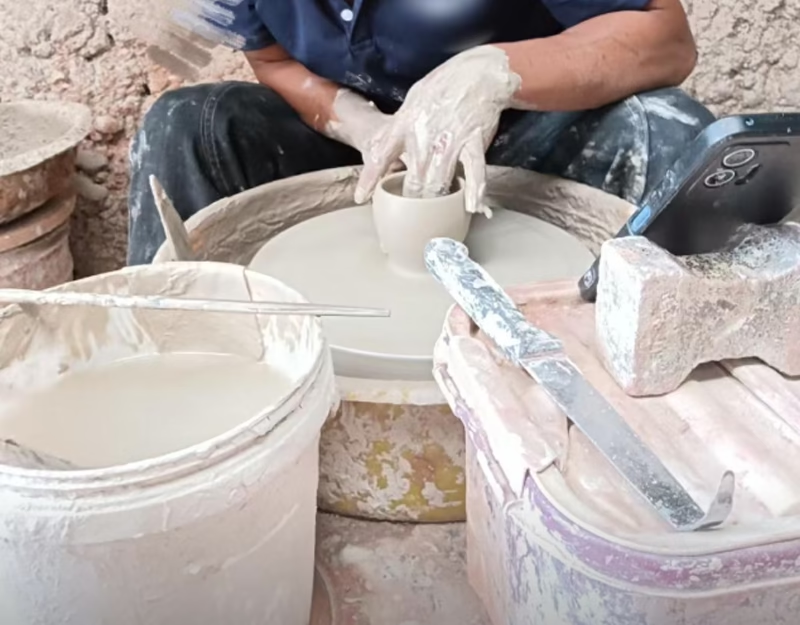
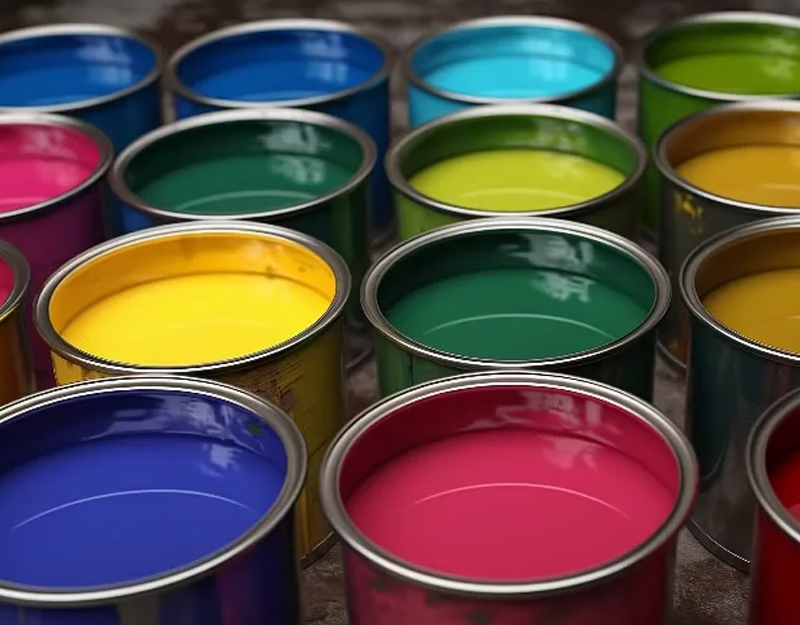
Filler/Pigment-Grade Barite: This product demands strict whiteness, brightness, and ultrafine particle size. Typically, a combination of ultrafine grinding and precise classification is employed, making the ball mill + ultrafine classifier the preferred setup. Additionally, if special whiteness requirements exist, a magnetic separator must be introduced to remove metallic impurities or a rotary kiln to enhance whiteness, constituting a more complex integrated process line.
Drilling-grade-barite
Chemical-grade-barite
Filler-grade-barite
3. Production Capacity Requirements
Production capacity requirements determine the overall scale positioning of the production line. Do you need to process 50 tons or 200 tons of raw ore per hour? While seemingly simple, these figures dictate the crusher model, grinding mill power, and the processing capacity of the entire sorting system. Improper equipment selection will reduce the efficiency of the entire line, while over-speculation will result in significant investment waste.
4. Investment and Operational Budget
Opting for low-cost equipment with high energy consumption and low efficiency may seem to save initial costs, but it will steadily erode profits over the long operational period through high electricity bills and frequent maintenance. Conversely, investing in technologically advanced, energy-efficient equipment, though requiring higher upfront investment, delivers superior overall economic benefits through lower energy consumption per unit, longer wear part lifespans, and greater stability. The correct choice should be based on a comprehensive assessment of purchase costs, installation expenses, projected energy consumption, regular maintenance and wear-and-tear replacement costs, as well as potential losses from downtime—not merely the purchase price of the equipment.
5. Site and Environmental Factors
Site size dictates production line layout, determines whether stationary or mobile equipment is suitable, and influences requirements for dust control, wastewater discharge, and noise mitigation. These seemingly minor details, if poorly managed, can lead to significantly higher costs down the line.
Process Flow Determines Equipment Configuration
Based on the above analysis, determine whether the process involves simple “crushing-grinding” or complex “mineral washing-crushing-jigging-grinding-flotation.” Key Equipment Selection Matrix:
Target Product Fineness
Recommended Preferred Equipment
Alternative Options
Key Considerations
200-325 mesh
Raymond Mill
High-Pressure Suspended Roller Mill
Highest cost-effectiveness, mature technology
400-800 mesh
High-Pressure Suspended Roller Mill
Ball Mill
Balancing fineness and cost
800-1500 mesh
Ball Mill + Classifier
Large Vertical Mill
Large-scale, high efficiency
Above 1500 mesh
Ball Mill + Fine Classifier
Air Mill
Ultrafine, high purity, high investment
Conclusion
Beyond the factors mentioned above, it is also crucial to evaluate whether the supplier possesses experience in handling similar materials like barite, and whether they can provide process design, installation and commissioning, technical training, and long-term spare parts supply. Do not focus solely on the equipment quotation; also examine the material quality and manufacturing processes of core components, as well as the equipment purchase cost, installation fees, power consumption, replacement frequency and cost of wear parts, and labor maintenance expenses. CHUNLEI has specialized in mining machinery for decades, excelling not only in pricing but also in delivering equipment with low energy consumption and extended wear part lifespans. Remember: The most suitable is the best. This suitability stems from a deep understanding of your own needs and a rational assessment of long-term value.
Construction and demolition debris—concrete, asphalt, wood, and metals—is the planet's largest waste stream by volume. For decades, the standard solution was simply hauling it to a landfill. However, with tightening environmental regulations an...
Mineral processing equipment and systems primarily include jaw crushers and cone crushers, ball mills and hydrocyclones, agitators and flotation machines, thickeners, plate filters, dryers, and more. The processing flow mainly involves crushing, ...
Existing for millennia with its dazzling, alluring luster, galena has been mined and processed since ancient times. As the primary ore of lead—a metal that propelled the electronics industry while posing deadly hazards to humanity—galena has long...
Whether it's for mining, manufacturing or building infrastructure and hydro construction, ball mills are perfect for converting raw materials into finely ground powders or granules.Offering efficiency and convenience to a wide range of industries...
Welcome to Chunlei machinery website. We are a leading manufacturer and exporter of mining machinery in China with more than 30 years history in China.
We offer you one-stop solutions: online consultation --- customized solutions --- fast delivery --- comprehensive after-sales service
 Chunlei Mining Machinery