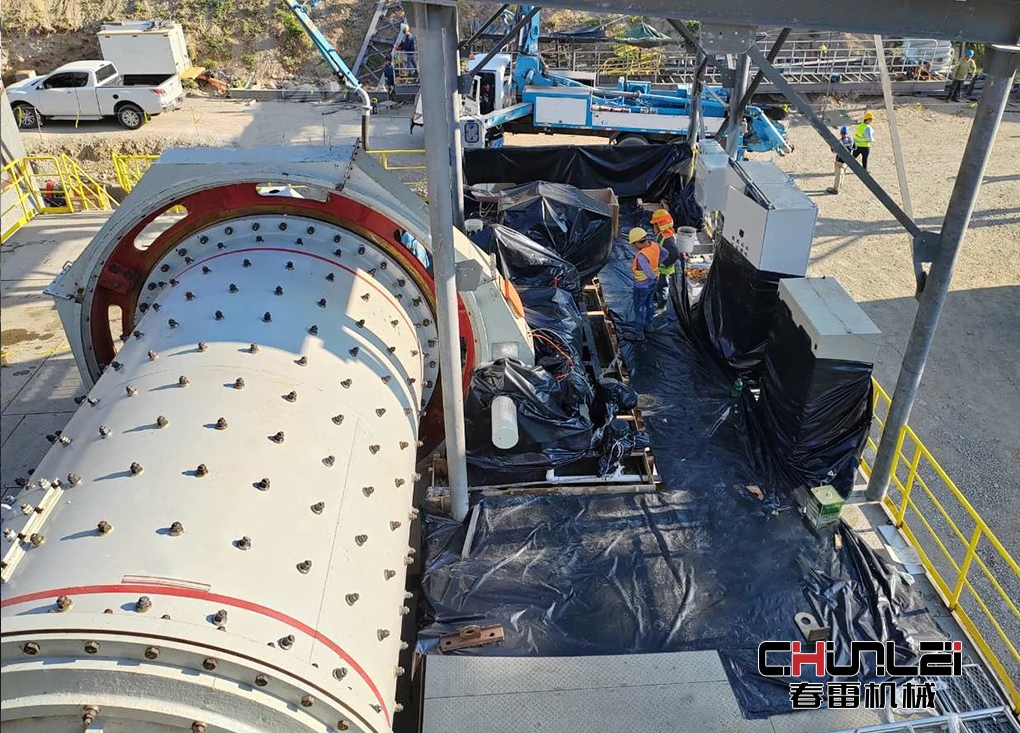
As a central grinding device, ball mills are extensively utilized in mining, construction materials, and chemical industries. However, prolonged high-load operation often leads to frequent malfunctions during practical use. This guide analyzes common failure causes and solutions for four critical components—bearings, gears, liners, and transmission systems—based on industry experience and technical expertise.
The main bearings of a ball mill serve as the core support components of the entire equipment. Common failures include abnormal noises, temperatures exceeding 75°C, smoke emission, motor overload, or even melting, all of which can accelerate wear.
Causes:
Failures stemming from the lubrication system, such as using incorrect lubricant grades, degraded oil, insufficient oil volume, or blocked pipelines, leading to oil film failure.
Improper bearing or coupling alignment, excessive/insufficient clearance between journal and bearing shell, damaged oil grooves.
Insufficient cooling water flow or excessively high water temperature for main bearings.
Contamination of lubricating oil with foreign particles (e.g., sand, metal debris) intensifying friction.
Solutions:
Select lubricating oil compatible with the equipment, replace regularly, and clean oil chambers with kerosene before refilling.
Maintain oil level at 2/3 of the gauge mark to prevent overfilling or depletion; install oil level monitoring devices if necessary.
During installation, ensure motor-to-gearbox shaft alignment deviation ≤0.1mm and bearing clearance between 0.1-0.15mm.
Periodically inspect lubricating oil for metal debris; immediately shut down and clean upon detection.
Failure 2: Gear Wear and Transmission Failure
Symptoms:
Although the ball mill’s motor operates at high speed, it cannot directly drive the massive cylinder. Therefore, a reducer transmits power to the pinion gear, which drives the ring gear and the entire connected cylinder to rotate, ultimately converting the motion into grinding operations.
Causes unstable transmission, generating vibration and impact, damaging the coupling, and even transmitting abnormal loads to the internal gears and bearings of the reducer.
Produces vibration and abnormal noise, compromising the rotational precision of the output shaft, leading to deteriorated meshing between the pinion and ring gear, and accelerating their wear.
Poor Alignment of Transmission System
Centerline misalignment between motor-gearbox-pinion assembly
Causes abnormal wear on the coupling while transferring additional stress to the reducer and pinion, triggering gear imbalance and abnormal wear.
Simultaneously damages internal gears within the reducer and exposed pinion/ring gears, ranking among the most common causes of gear pitting, scoring, and wear.
Solution:
During installation, ensure precise alignment of the motor, reducer, and pinion shafts. This is the most fundamental and critical step.
Use compatible lubricating oil, apply oil at regular intervals and in specified quantities. Consider installing an automatic lubrication system to prevent uneven manual oiling.
Regularly inspect gear tooth surfaces for contact spots, pitting, spalling, cracks, and abnormal wear. Periodically monitor vibration levels and temperatures of the reducer and main bearings.
Replace gears with over 30% wear with high-hardness alloy materials. Gears with minor wear can be flipped for continued use to extend service life.
Failure 3: Liner Detachment and Material Leakage
Symptoms:
Detached liners repeatedly impact the cylinder walls and other components, causing deformation and cracking. The detachment of a single liner disrupts the stability and stress balance of surrounding liners, leading to further loosening. Flying liner fragments contaminate the material, potentially causing environmental pollution.
Causes:
Liner detachment stems from bolt loosening, seal failure, excessive clearance between liners and cylinder, or material erosion enlarging bolt holes.
Solutions:
Immediately shut down for inspection.
Thoroughly inspect all liner plates, bolts, and cylinder wall damage inside the cylinder.
Repair or replace detached liner plates. Ensure new plates are securely fastened during installation; spot-weld bolt heads if necessary.
Analyze and identify the root cause of detachment to develop preventive measures.
Replace liners when wear reaches 2/3 of original thickness; never force operation.
Avoid running the mill under no-load or under-feed conditions, as this intensifies direct impact of grinding balls on liners.
Failure 4: Primary Impacts of Transmission System Failures on Ball Mills
Impact Dimensions
Specific Manifestations and Consequences
Consequential Issues
Production Efficiency
1. Reduced/Unstable Rotational Speed: The cylinder speed falls below the set value or fluctuates erratically.
Grinding time is forced to extend to achieve target fineness.
2. Difficulties in Starting/Stopping: High motor startup load, or even failure to start.
Output (tons/hour) significantly decreases.
3. Decreased Effective Power: Partial power loss occurs during transmission.
Energy consumption per unit product (kWh/ton) sharply increases.
Product Quality
1. Uneven Grinding Efficiency: Material fails to achieve optimal free-falling motion within the cylinder.
Fails to meet downstream processes’ (e.g., mineral flotation) stringent particle size requirements.
2. Widened Particle Size Distribution: Product contains both coarse, unground particles and over-ground fine powder.
Product qualification rate declines, potentially leading to quality claims.
Equipment Wear and Tear
1. Abnormal Gear and Bearing Wear: Caused by slippage, impact loads, or inadequate lubrication.
Reduced lifespan of critical components (large gears, pinion gears, bearings) leading to soaring maintenance costs.
2. Coupling Damage: Resulting from prolonged misalignment or torsional vibration exposure.
Potential escalation from transmission component failures to damage in core structural elements like the cylinder and bearing housings.
3. Motor overload: Prolonged operation under high load or frequent starts.
The impact of the transmission system is comprehensive. To maintain its healthy operation, it is essential to shift from reactive maintenance to proactive prevention.
Establish a lubrication management system: Regularly test gear lubricant viscosity, moisture content, and metal particle levels—these are the “lifelines” of gears.
Implement vibration and temperature monitoring: Install sensors at critical points such as bearing housings and reducers. Data trends provide better early-failure indicators than single-point alarms.
Perform regular alignment calibration: Equipment operation and thermal expansion affect alignment, making this a mandatory standard procedure during periodic maintenance.
Conclusion
Chunlei Company has consistently led the mineral processing industry. We provide complete crushing equipment, mineral processing equipment, and solutions. Serving clients worldwide, our equipment is renowned for reliability, efficiency, and superior performance. We offer end-to-end support encompassing design, manufacturing, installation, and after-sales service.
If you could describe your ball mill drive system (e.g., edge drive or center drive, V-belts or gear reducers) and any recent specific anomalies (such as unusual noise patterns or vibration locations), I can provide more targeted analysis.
Copper-Lead-Zinc Ore Beneficiation Process
Process Introduction Copper-lead-zinc beneficiation process adopts mixed flotation-concentrate regrinding process, which can reduce the cost of milling and is easy to manage, and at the sa...
How do you transform hard ore into powder as fine as flour? How do you uniformly blend different raw materials down to the molecular level? Do you need to achieve extremely fine particle sizes for mineral extraction or industrial applications? Ar...
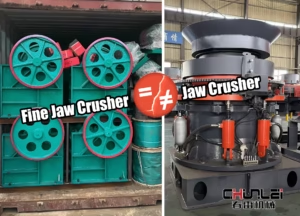
To be precise, a “fine jaw crusher” is a specific type of “Jaw Crusher.” Jaw crushers constitute a broad category, primarily divided into two main types based on their output particle size and application: Primary Jaw Crusher: This is the most ...
Weight: 14-370 tonsOutput: 1.5-110 tons/hourPower: 55-3550 kWAdvantages: Fully automatic, high efficiency, etc.
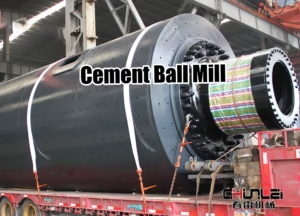
A cement ball mill is a type of cement grinding machine, also known as a cement grinder. It is primarily u...
Welcome to Chunlei machinery website. We are a leading manufacturer and exporter of mining machinery in China with more than 30 years history in China.
We offer you one-stop solutions: online consultation --- customized solutions --- fast delivery --- comprehensive after-sales service
 Chunlei Mining Machinery