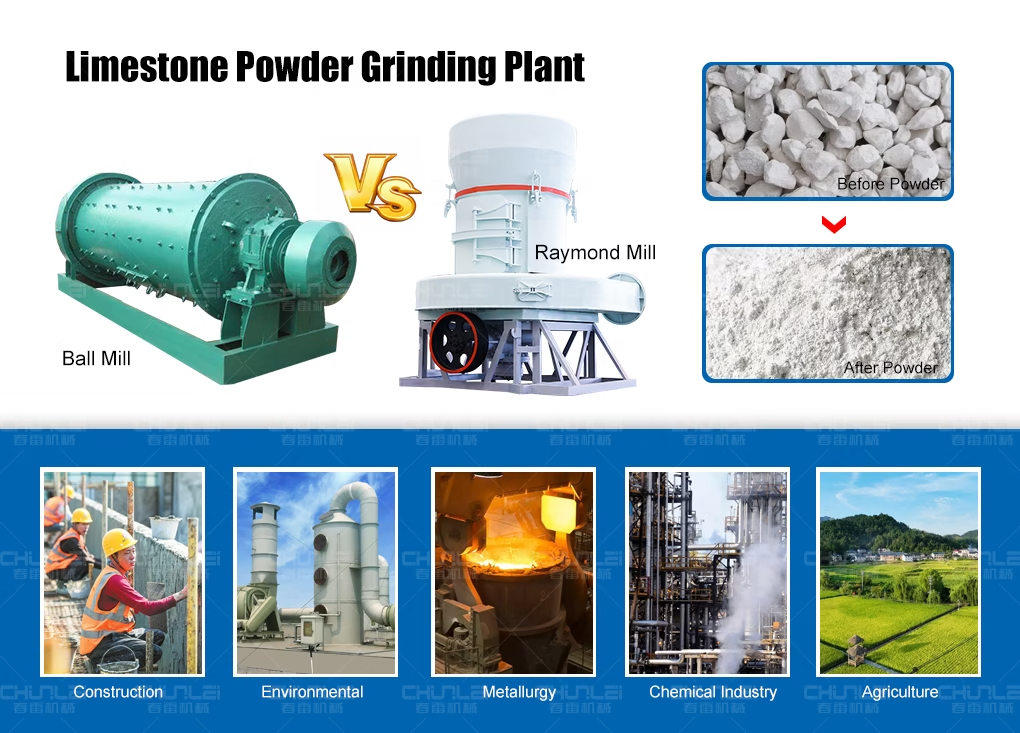
Lime powder is a fine white or grayish-white powder primarily produced through processes such as high-temperature calcination, digestion, and refining of limestone. Widely used in construction, environmental protection, metallurgy, chemical engineering, agriculture, and other fields, lime powder plays a vital role in supporting the operation and development of modern society.
Lime Grinding System
Lime grinding plants typically employ a “crushing + grinding + classification + collection” grinding system, which is the key process transforming limestone from bulk material into high-value powder. A complete lime grinding system involves far more than a single mill; it is an integrated engineering system encompassing crushing, conveying, grinding, classification, collection, and automated control. It generally includes the following core systems:
● Crushing System: Large raw material is reduced to suitable grinding size via jaw crushers or impact crushers, ensuring uniform and stable feed particle size into the mill—the foundation for subsequent grinding.
● Grinding System: This constitutes the core process stage. Different types of mills are selected based on the required fineness of the final product.
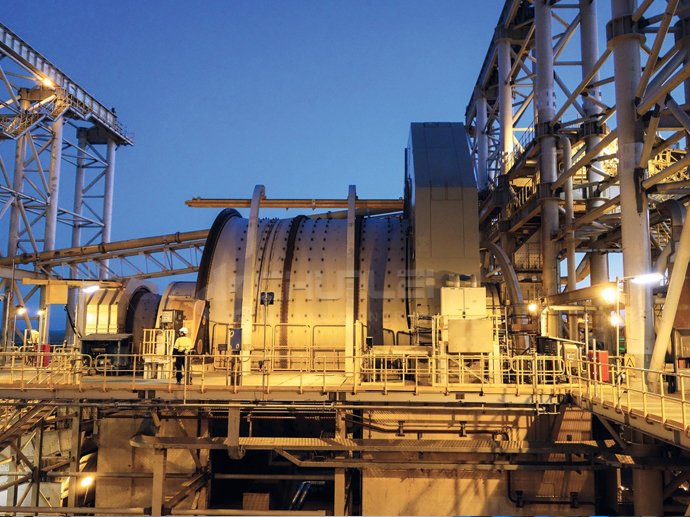
Ball Mill: A crucial piece of equipment for producing lime powder, capable of grinding lime into powder finer than 200 mesh. It is particularly suitable for processes requiring extended grinding times.
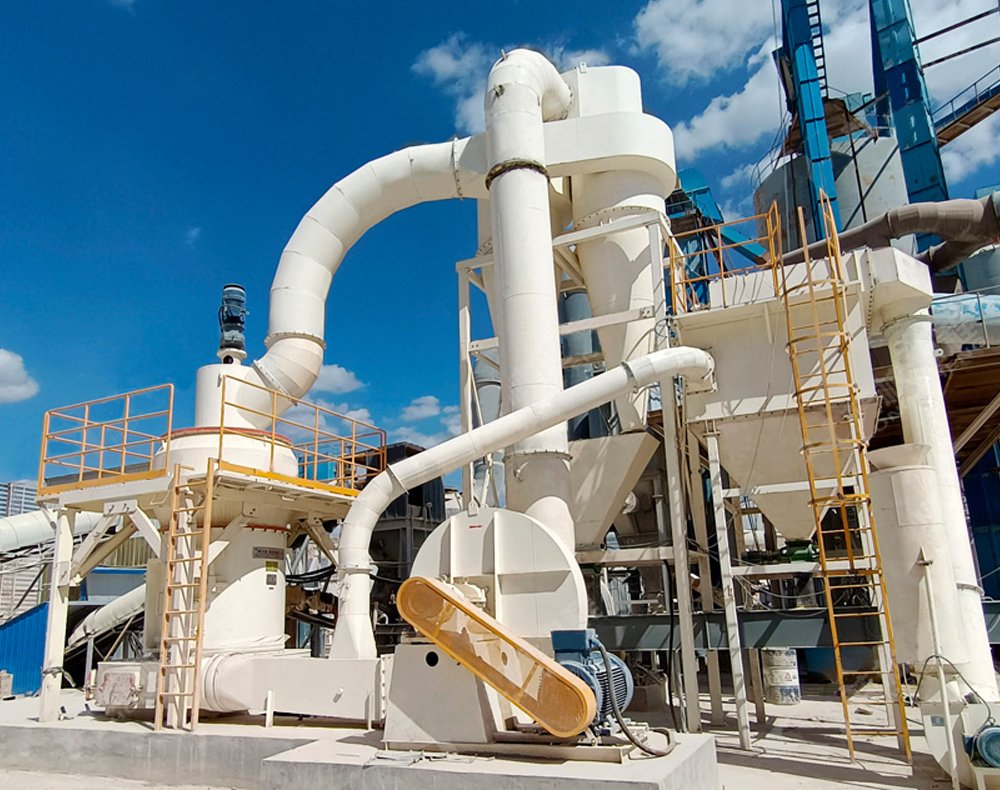
Raymond Mill: An earlier and common grinding equipment, it can grind lime powder to a fineness between 80-325 mesh. Integrating grinding, classification, and collection, it is suitable for small to medium-scale production with moderate fineness requirements.
● Classification System: The powdered material enters a high-efficiency cyclone classifier with the airflow, precisely separating the finished powder that meets the fineness requirements.
● Collection System: Finished powder is collected by cyclone separators, while finer micropowder is fully captured by pulse-jet baghouse dust collectors, ensuring dust recovery and environmentally compliant emissions.
● Electrical Control and Automation System: Enables centralized monitoring, parameter adjustment, and fault alerts across the entire system. This ensures stable operation at optimal conditions, maximizing product quality while minimizing energy consumption.
Comparison and Selection Recommendations for Ball Mills and Raymond Mills
Comparison Dimensions
Ball Mill
Raymond Mill
Comparison Summary
Operating Principle
Operates by rotating the cylinder, allowing internal steel balls/media to fall freely, generating impact and grinding effects.
Grinds materials by crushing them against the grinding ring with rollers, then separates coarse and fine powders through air classification.
Ball mills utilize “impact-type” grinding, while Raymond mills employ “rolling-type” grinding combined with “air-classification” grading.
Product Fineness
Offers a wide fineness range but produces a dispersed particle size distribution, making it difficult to achieve highly uniform fine powder.
Delivers uniform fineness with easy adjustment; stable output of 80-600 mesh mainstream products via classifier speed control.
Raymond mills demonstrate significant advantages in fineness control precision and product uniformity.
System Energy Consumption
Extremely high energy consumption, with most energy converted into heat, noise, and media wear, resulting in low effective grinding energy utilization.
Low energy consumption, especially for medium-fineness products, with enhanced efficiency through its “grind-and-classify” mode.
Raymond mills exhibit markedly lower power consumption per unit product compared to traditional ball mills.
Processing Capacity
High single-unit processing capacity, particularly suitable for large-scale, continuous primary or mixed grinding.
Moderate single-unit processing capacity, better suited for small-to-medium scale production lines with specific fineness requirements.
Ball mills excel in high-volume, coarse processing scenarios; Raymond mills are optimized for precision grinding.
System Configuration
The equipment itself is relatively simple, but requires extensive auxiliary equipment (such as elevators, conveyors, independent classification systems, etc.).
Highly integrated, combining crushing, grinding, classification, and collection into one compact system with minimal footprint.
Raymond mill systems feature higher integration, simpler layouts, and relatively concentrated investment.
Environmental Impact
Generates significant noise, with high-decibel sounds from cylinder rotation and steel ball impacts; dust easily escapes due to relatively poor sealing.
Low noise levels; entire system operates under negative pressure with negligible dust leakage, ensuring a clean working environment.
Raymond mills outperform in environmental friendliness (noise, dust) and workplace comfort.
Adaptability and Maintenance
Highly adaptable to material moisture and hardness, capable of dry or wet grinding. Requires substantial maintenance, with time-consuming and labor-intensive replacement of liners and steel balls.
Requires specific feed particle size (typically <30mm) and moisture content (typically <6%). Core grinding rollers and grinding rings are easily replaceable wear parts, with relatively centralized maintenance.
Ball mills offer greater adaptability but require more complex maintenance; Raymond mills demand higher precision but have centralized maintenance points.
Selection Recommendations: ● For large-scale production with high fineness requirements (e.g., ultrafine calcium carbonate), prioritize ball mills; ● For small-to-medium production lines seeking investment returns and operational stability, Raymond mills are the ideal choice; ● In large-scale projects, combined grinding systems such as “Raymond mill + ball mill” or “ball mill + classifier” can achieve the optimal balance between efficiency and quality.
Five Core Advantages of Our Company’s Lime Grinding Machines
As an industry-leading manufacturer of grinding equipment, our company has consistently pursued independent R&D and continuous optimization of our lime grinding machine series. Leveraging years of technical expertise and engineering experience, our lime grinding machines demonstrate significant advantages in stability, energy efficiency, intelligent operation, and overall performance, earning high recognition from our extensive customer base. Below are our core strengths:
Highly efficient and energy-saving, significantly reducing operating costs Compared to traditional equipment, our lime grinding mills achieve 20%-40% energy savings, particularly when producing medium-fine powders ranging from 200 to 400 mesh. Paired with a high-efficiency classification system, they deliver high first-pass efficiency, minimizing re-grinding and effectively lowering electricity consumption and operational costs.
Intelligent control system for simplified operation Our lime grinding mill features a fully automated PLC intelligent control system, enabling centralized monitoring throughout the entire process—from feeding, grinding, and classification to dust collection. This significantly reduces manual intervention and enhances production management efficiency.
Structure Optimized for Stable Operation and Easy Maintenance Critical components (such as grinding rollers, grinding rings, and liners) are constructed from high-wear-resistant alloy materials, extending service life by over 30% compared to traditional equipment. We have optimized access doors, inspection windows, and lubrication systems for easier maintenance, significantly improving equipment utilization rates.
Fully Enclosed System for Enhanced Environmental Protection The entire system operates under a fully enclosed negative pressure design, equipped with high-efficiency pulse dust collectors. This prevents dust leakage, maintains a clean workshop environment, and fully complies with national emission standards.
Customized Solutions We provide one-on-one customized services, flexibly configuring equipment models, production capacity, automation levels, and auxiliary systems (such as crushing, conveying, packaging, etc.) based on actual customer needs. We deliver turnkey projects from process design and equipment manufacturing to installation and commissioning, ensuring overall system optimization and rapid production ramp-up.
Conclusion
CHUNLEI Machinery boasts 30 years of mining and mineral processing expertise, consistently dedicated to R&D and production while driving continuous innovation. Our lime grinding mills are more than just equipment—they represent a modern grinding solution integrating high efficiency, energy savings, intelligence, and environmental protection. Choosing us means choosing a more efficient, stable, eco-friendly, and intelligent future for lime grinding! If you have similar needs, contact us immediately!
As a core grinding equipment in mining, building materials, chemical, and other industries, ball mills have long been subject to significant attention regarding wear issues. Among these, large gear wear is the most prevalent and critical concern,...
Mica Dressing Production Line
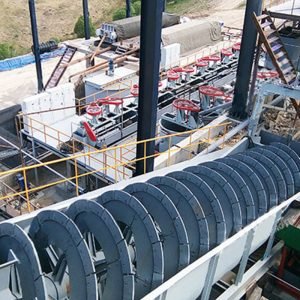
Process Introduction Mica beneficiation production line is a set of efficient and environmentally friendly process and equipment combination, which can not only extract high purity mica minerals, but a...
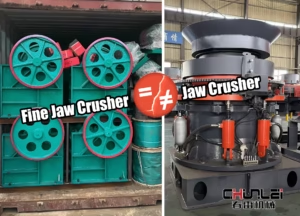
To be precise, a “fine jaw crusher” is a specific type of “Jaw Crusher.” Jaw crushers constitute a broad category, primarily divided into two main types based on their output particle size and application: Primary Jaw Crusher: This is the most ...
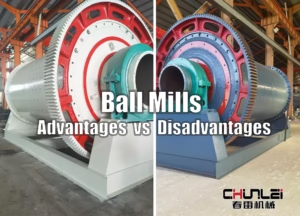
In mineral grinding operations, ball mills have long held an almost irreplaceable position. This article provides a thorough analysis of ball mills' strengths and weaknesses, comparing them with equipment such as rod mills and autogenous mills. W...
Welcome to Chunlei machinery website. We are a leading manufacturer and exporter of mining machinery in China with more than 30 years history in China.
We offer you one-stop solutions: online consultation --- customized solutions --- fast delivery --- comprehensive after-sales service
 Chunlei Mining Machinery