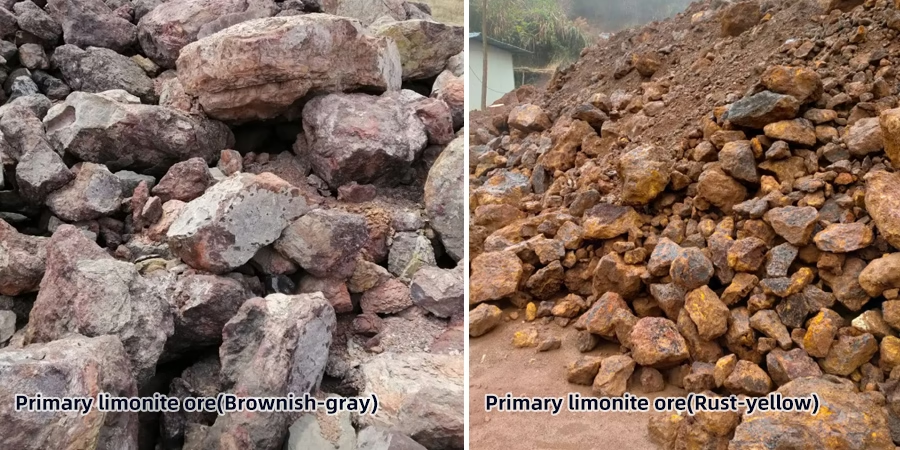
Limonite, widely recognized for its distinctive rust-yellow to brownish-gray hue, is not a true mineral but rather a collective term for mixtures of hydrated iron oxides (primarily goethite). As one of the primary iron-bearing ores, it is grouped alongside hematite, magnetite, and siderite as the four major elements of the “iron ore family.” This article delves into the nature of limonite, explores modern processing techniques, and highlights its diverse industrial applications.
What is Limonite?
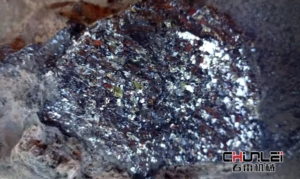
Limonite is not a primary iron ore; it typically forms through the weathering and oxidation of primary iron minerals such as magnetite and pyrite.
Property
Description
Chemical Nature
Amorphous mixture with no single chemical formula; often generalized as FeO(OH)·nH₂O.
Formation
Secondary deposit formed from the weathering and oxidation of primary iron minerals (e.g., magnetite, pyrite).
Key Distinguishing Feature
High, variable water content and amorphous structure, unlike crystalline oxides (e.g., hematite).
Color
Yellowish-brown, brown, to blackish-brown.
Streak
Yellowish-brown (a diagnostic identifying feature).
Hardness (Mohs Scale)
Relatively soft, ranging from 4 to 5.5.
Common Occurrence
Found as bog iron ore, in sedimentary deposits, and as a weathering crust (gossan) over sulfide mineral deposits.
The Modern Limonite Processing Pathway
Transforming raw limonite ore into a valuable industrial commodity involves a multi-stage process designed to increase its iron content and remove impurities.
Stage 1: Crushing and Grinding
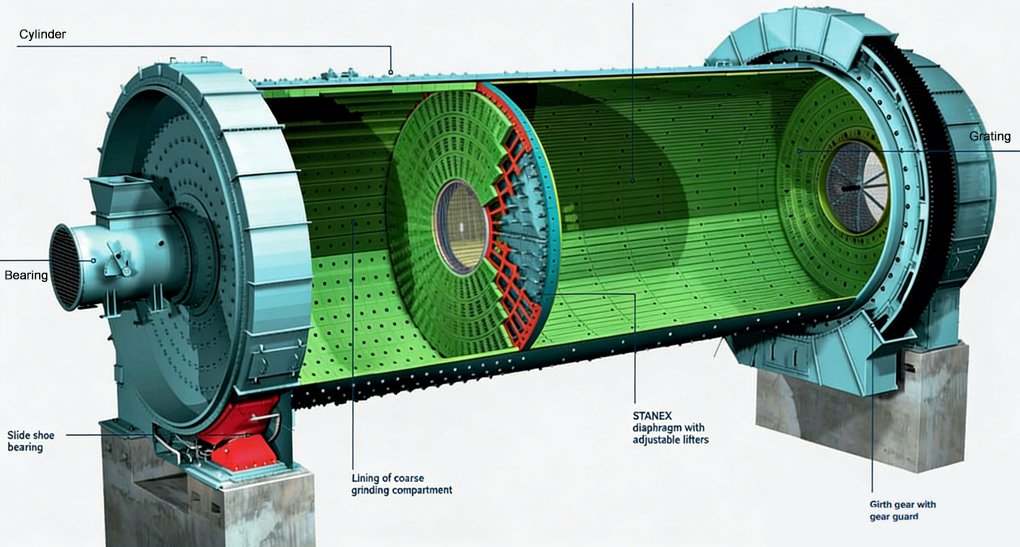
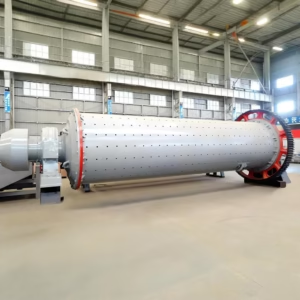
Raw limonite ore undergoes primary crushing in a jaw crusher, followed by secondary crushing in a cone crusher or impact crusher. The material is then ground in a ball mill or rod mill to separate iron oxide particles from surrounding gangue (waste rock). This stage requires strict control to prevent excessive grinding that produces too much fine powder.
Stage 2: Mineral Processing
Due to its low grade, gravity separation is most commonly used for limonite. Spiral classifiers or jigs separate heavier iron-bearing particles from lighter silica and alumina. For finer particles, High-Intensity Magnetic Separation (HIMS) proves highly effective, leveraging limonite’s weak magnetic properties. Flotation may also be employed in certain processes to remove specific silicate impurities.
Stage 3: Dewatering and Drying
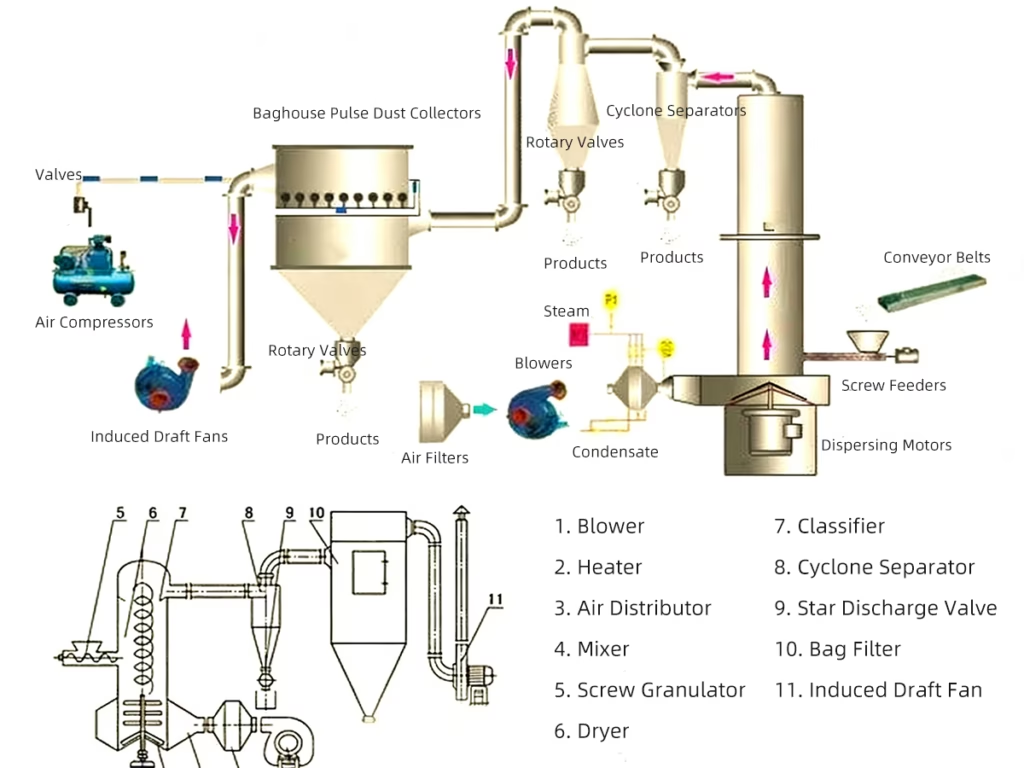
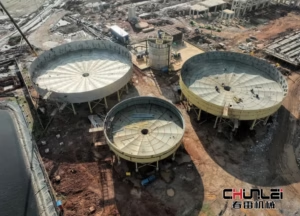
Limonite’s high moisture content presents unique challenges. After removing substantial water via thickeners and filter presses to form filter cakes, the material undergoes drying in rotary kilns. This process reduces transportation costs and prepares the ore for subsequent sintering or pelletizing. Care must be taken to avoid overheating during drying, preventing premature alteration of the ore’s properties.
Rotary Drying Process
Stage 4: Sintering and Pelletizing
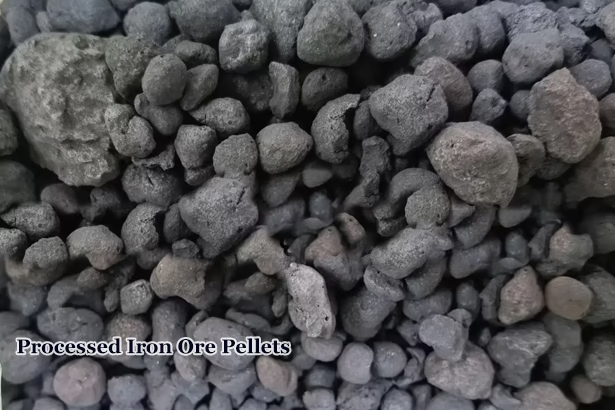
Brown iron ore powder that has undergone beneficiation and drying cannot be directly used in blast furnaces. It requires pelletizing or sintering treatment. During pelletizing, the ore powder is mixed with a binder and pressed into 10-15 mm spheres, which are then calcined to harden and form. The sintering process involves mixing the ore powder with coke powder and igniting it to form porous, lump-like ore material suitable for blast furnace use.
Major Industrial Uses and Applications of Limonite
While primarily an iron ore, limonite’s unique properties lend it to a variety of applications.
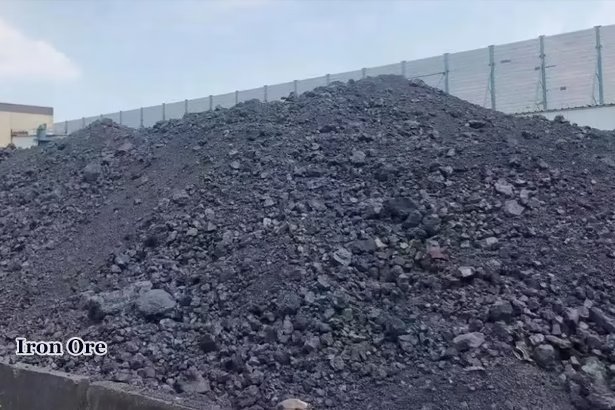
1. Iron and Steel Production Despite its lower iron content (typically 35-50% Fe) compared to hematite or magnetite, limonite remains an important source of iron, especially when beneficiated and agglomerated. It contributes to the raw material mix in steel mills globally.
2. Pigments and Colorants For millennia, limonite has been used as the natural pigment yellow ochre. When calcined (heated), it turns reddish, becoming red ochre. These natural pigments are used in paints, dyes, artist’s colors, and coatings, valued for their stability and non-toxicity.
3. Soil Conditioner and Fertilizer Agricultural-grade limonite, due to its iron content and sometimes trace minerals, is used to correct iron deficiencies in soils. It also helps in improving the phosphate availability to plants.
4. Environmental and Chemical Applications Limonite’s adsorption properties make it useful in water treatment for removing heavy metals and arsenic. It also serves as a catalyst in certain chemical processes and is investigated for use in lithium-ion batteries.
5. Historical and Niche Uses Historically, limonite was a major source of iron for early civilizations. Today, it is used in radiation shielding, as a polishing compound (“jeweler’s rouge”), and in the production of some synthetic iron oxides.
The Future of Limonite
As high-grade iron ore deposits diminish, the efficient processing of lower-grade ores like limonite becomes increasingly critical. Advances in beneficiation technology—especially in magnetic separation and energy-efficient drying—are improving the economic viability of limonite resources. Furthermore, its role in environmental remediation and emerging technologies presents new, sustainable avenues for utilization.
Conclusion
Although limonite is a rust-colored rock, its applications and demand continue to expand—from crushing, beneficiation, and pelletization to its ultimate use in steelmaking, pigment manufacturing, and environmental science. With technological advancements, the importance of efficiently utilizing this widely distributed iron ore will become increasingly prominent.
CHUNLEI’s expert team stands ready to customize tailored processes for you, offering one-stop services from design to equipment supply. Inquiries welcome!
For gold and mineral miners, choosing the right ball mill is not just a purchase decision—it’s a cornerstone of your operational efficiency, gold recovery rate, and long-term profitability. The wrong selection can lead to high energy consumptio...
Ceramic ball mills are grinding equipment that replaces traditional metal liners with ceramic liners and uses ceramic balls (such as alumina, zirconia, silicon carbide, etc.) as grinding media. Material is finely p...
A high-quality gold mine tailings dewatering system is far more than a simple assembly of machinery; it represents a strategic decision crucial to the future sustainable development of the mine. A good dewatering system is not only reflected in c...
Existing for millennia with its dazzling, alluring luster, galena has been mined and processed since ancient times. As the primary ore of lead—a metal that propelled the electronics industry while posing deadly hazards to humanity—galena has long...
Welcome to Chunlei machinery website. We are a leading manufacturer and exporter of mining machinery in China with more than 30 years history in China.
We offer you one-stop solutions: online consultation --- customized solutions --- fast delivery --- comprehensive after-sales service
 Chunlei Mining Machinery