Existing for millennia with its dazzling, alluring luster, galena has been mined and processed since ancient times. As the primary ore of lead—a metal that propelled the electronics industry while posing deadly hazards to humanity—galena has long captivated mankind.
This article explores galena’s dual nature—its profound historical significance and the dangerous reality it conceals.
What is Galena?
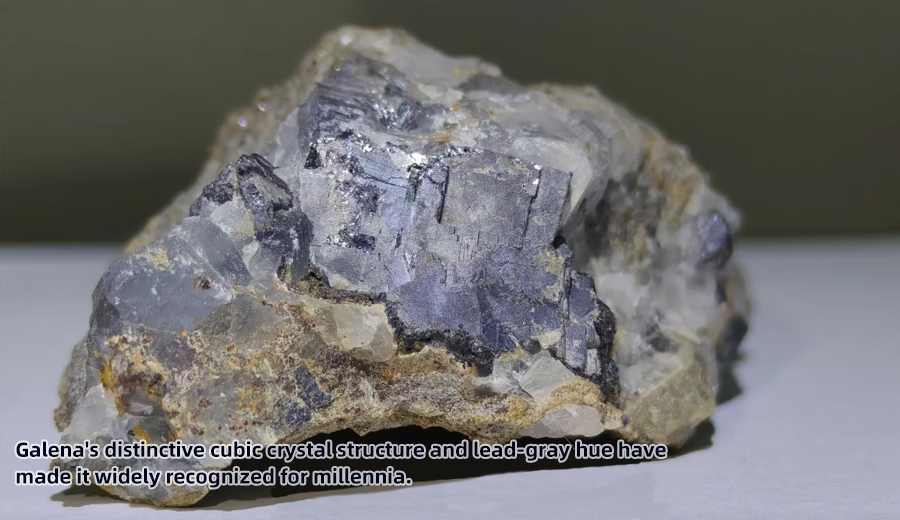
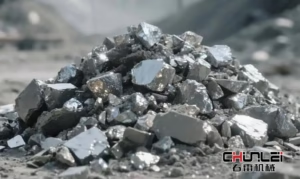
Galena, with the chemical formula PbS (lead sulfide), is a naturally occurring mineral. It is easily identified by its dense weight, bright metallic luster, and perfect cubic cleavage, often breaking into neat, right-angled pieces. Its color ranges from lead-gray to silver, and it frequently forms stunning geometric cubes or octahedrons in nature.
Chemical Composition: Lead Sulfide (PbS)
Hardness: 2.5 on the Mohs scale (very soft, can be scratched with a fingernail)
Density: Exceptionally high at 7.4–7.6 g/cm³
Streak: Lead-gray to black
Crystal System: Isometric/Cubic
How is galena formed?
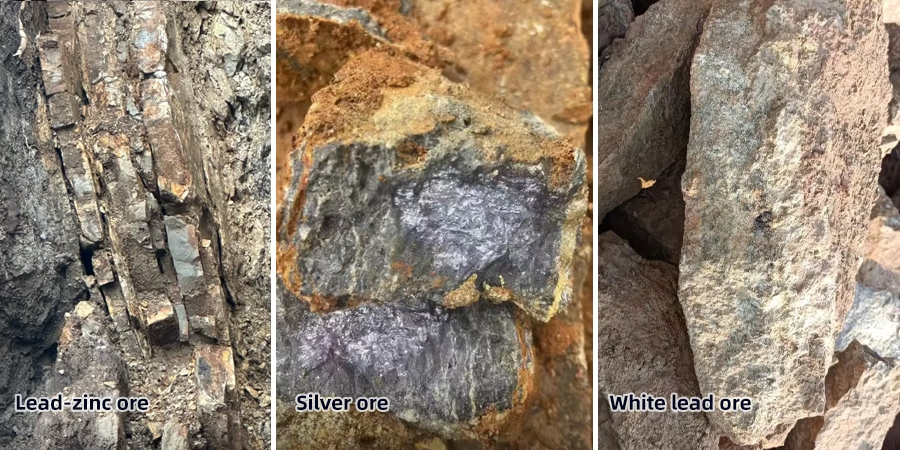
Galena is the primary sulfide mineral of lead and rarely occurs alone. Its formation is closely associated with low-to-medium-temperature hydrothermal processes, commonly appearing in contact metamorphic deposits or low-to-medium-temperature hydrothermal veins. Due to the chemical similarity between lead and zinc, galena’s most frequent “companion” is sphalerite.
In a typical “lead-zinc deposit” or “lead-zinc sulfide deposit,” galena and sphalerite are invariably found together. It also frequently occurs with minerals such as sphalerite, pyrite, calcite, and quartz. Its crystal morphology and mineral associations are key subjects of study for geologists.
Locations of Galena Deposits
The world’s largest and most renowned galena resource is found in the Mississippi Valley Type (MVT) lead-zinc deposits of Missouri, USA. This deposit not only represents the globe’s largest lead ore body, with estimated lead metal reserves exceeding 30 million metric tons, but also serves as a quintessential example of galena as the primary lead ore.
Beyond this super deposit in the United States, other significant global galena sources include:
– China: Polymetallic deposits in Yunnan, Guangdong, Qinghai, and other regions.
– Europe: Historic mining districts such as Cornwall, UK, and Freiberg, Germany.
– Australia: World-class Pb-Zn-Ag deposits like Broken Hill.
These sources collectively underpin the global lead supply chain. Currently, lead mining operations span over 40 countries, involving approximately 240 active mines. Annual refined lead production has consistently exceeded 10 million metric tons. According to the latest global lead production rankings (based on data from the U.S. Geological Survey and others), Australia has long been the world’s largest lead producer, followed by China, the United States, Mexico, Sweden, Peru, Russia, Canada, and Morocco. These nations form the core landscape of the global lead mining industry.
The Ancient History of Galena’s Applications
Galena’s history is intertwined with human civilization’s development. Ancient Egyptians used indigo containing galena as kohl and cosmetics. The Romans, masters of large-scale smelting, extracted lead for diverse applications:
- Pipeline systems: The word “plumbing” derives from the Latin “plumbum” (lead). They constructed vast networks of pipes and aqueducts.
- Coinage: Lead was often alloyed with silver, both extracted from the same galena ore.
- Sapa wine and cooking: They boiled acidic wine in lead pots to produce a sweet syrup called sapa, a beverage that was a major source of severe lead poisoning.
Uses of Galena
Galena is the primary source of lead ore, and the refined lead it yields is in high demand as an indispensable industrial metal.
Below are the five core application areas for lead metal processed from galena:
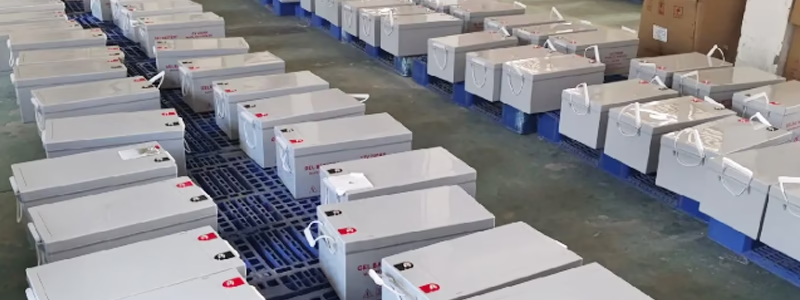
1. Energy Storage Core: Lead-Acid Batteries
Lead-acid batteries serve as the standard power source for automotive start-stop systems and provide reliable backup power for data centers, communication base stations, and renewable energy storage systems (such as solar and wind power). Their high recycling rate (exceeding 99%) makes lead the most recycled industrial metal globally, forming an efficient closed-loop supply chain.
2. Key Technologies in Radiation Protection
Lead possesses exceptional radiation absorption capabilities, making it the material of choice for shielding against ionizing radiation such as X-rays and gamma rays. This property establishes it as a “safety guardian” in medical, nuclear energy, and scientific research fields:
- Medical Protection: Lead-lined walls in CT scan rooms and radiotherapy suites, protective doors and windows, and lead aprons worn by patients.
- Nuclear Industry: A key component in nuclear waste transport containers and reactor shielding layers.
- Electronic Devices: Lead is incorporated in CRT displays and certain precision electronic components to reduce electromagnetic radiation.
3. Specialty Glass and Optical Materials
Lead crystal glass (commonly known as crystal glass) exhibits significantly increased refractive index due to lead oxide additives, enhancing its color saturation. It is widely used in high-end tableware, optical lenses, and artistic ornaments. The enduring vivid hues of classic stained glass in churches also benefit from certain lead-containing stabilizing pigments.
4. Premium Ceramics and Stable Glazes
In ancient times, lead was commonly used in ceramic production, imparting high gloss, low melting temperatures, and excellent fluidity. In modern industry, lead compounds remain critical in specific electronic ceramics (such as piezoelectric ceramics) and high-performance stable glazes, with their use strictly controlled under stringent environmental standards.
5. High-Performance Alloys and Ballast Materials
Lead forms critical alloys with numerous metals:
- Solder Alloys: Tin-lead solder long served as the standard in electronics manufacturing; today, lead-free solder dominates the industry.
- Bearing Alloys (Babbitt Alloys): Enhance the wear resistance and load-bearing capacity of mechanical bearings.
- Ballast and counterweights: From automotive wheel weights to ship ballast and racing car counterweights, lead’s high density remains irreplaceable.
- Construction and engineering: The term “plumbing” originates from the historical use of Roman lead (plumbum) pipes. In modern construction, lead sheets are still employed for roofing, soundproofing, and seismic protection.
Galena in the Modern World
The dangers of lead have drastically reduced galena’s direct applications. Its primary role remains as the dominant ore of lead. However, galena has niche modern uses:
- Semiconductor Crystals: In its pure form, galena was used in early “crystal radio” detectors.
- Collector’s Item: Prized by mineral collectors for its aesthetic and perfect crystal forms.
- Source of Minor Elements: It can be a source of silver (argentiferous galena) and other trace metals.
Critical Safety Note: Galena should only be handled by professionals with proper precautions. Amateur collectors must:
- Wear gloves and an N95 mask to avoid inhaling dust or transferring particles to the mouth.
- Wash hands thoroughly after any contact.
- Store specimens securely away from children, food, and living areas.
- Never break or sand galena without industrial-grade respiratory protection.
Conclusion
Galena plays a vital role in industry, yet poses significant risks to human health. Strict protective measures must be implemented during its mining and processing to harness nature’s gift responsibly.
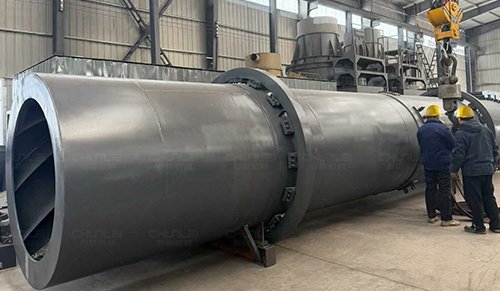
CHUNLEI’s expert team stands ready to customize tailored processes for you, offering one-stop services from design to equipment supply. Inquiries welcome!
 Chunlei Mining Machinery