For gold and mineral miners, choosing the right ball mill is not just a purchase decision—it’s a cornerstone of your operational efficiency, gold recovery rate, and long-term profitability. The wrong selection can lead to high energy consumption, frequent downtime, low output, and missed revenue opportunities. In 2026, with the rapid development of smart mining and the increasing demand for energy-saving, eco-friendly equipment, selecting a ball mill that aligns with your ore type, production scale, and budget has become more critical than ever.
This ultimate guide is tailored for gold and mineral miners of all scales—from small-scale artisanal operations to large industrial mines. We’ll break down every key factor you need to consider, debunk common myths, and provide practical tips to help you select the perfect ball mill that integrates seamlessly with your gold beneficiation line, maximizes your return on investment, and supports sustainable mining.
Understand the Core Role of a Ball Mill in Gold & Mineral Processing
Before diving into selection criteria, it’s essential to clarify why a high-quality ball mill is non-negotiable for gold and mineral mining. A ball mill is the core grinding equipment in the beneficiation process, responsible for reducing ore particles to the optimal size (usually 0.074-0.4mm) to liberate gold and other valuable minerals from gangue, ensuring efficient separation in subsequent processes (flotation, gravity separation, or cyanidation).
In gold mining, the ball mill’s performance directly affects the gold recovery rate—even a 1-2% increase in recovery can translate to significant profits. Additionally, a well-selected ball mill reduces energy consumption, minimizes maintenance costs, and ensures stable long-term operation, which is crucial for mines facing rising energy prices and labor shortages in 2026.
Key Types of Ball Mills for Gold & Mineral Mining (2026 Updated)
Not all ball mills are created equal. Different types are designed for specific ore characteristics, production scales, and processing requirements. In 2026, the most widely used ball mill types for gold and mineral mining are as follows—choose based on your unique needs:
Grid Type Ball Mill
The grid type ball mill is equipped with a grid plate at the discharge end, which filters out fine particles and ensures efficient discharge. It is ideal for coarse grinding (product particle size 0.15-0.3mm) and wet processing, making it suitable for gravity separation or flotation gold plants. Its advantages include fast discharge speed, high processing capacity, and strong adaptability to hard ores (such as gold-bearing quartz ore).
Best for: Medium to large-scale gold mines with hard ore, requiring high throughput and coarse grinding.
Overflow Type Ball Mill
The overflow type ball mill has no grid plate; instead, the ore slurry flows over the discharge trunnion. It is designed for fine grinding (product particle size 0.074-0.15mm) and continuous operation, which is widely used in CIL (Carbon-In-Leach) and CIP (Carbon-In-Pulp) gold recovery processes— the most common gold extraction methods in 2026. It offers uniform grinding particle size and high gold liberation rate.
Best for: Mines focusing on fine grinding and high gold recovery, especially those using CIL/CIP processes.
Energy-Saving Ball Mill
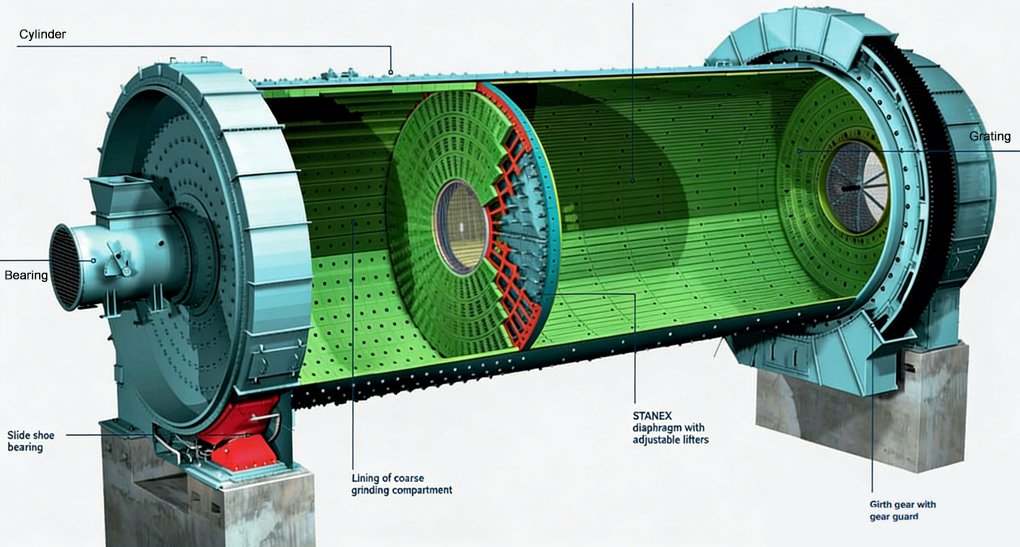
As green mining becomes a global trend in 2026, energy-saving ball mills have become the first choice for most miners. Equipped with rolling bearings instead of sliding bearings, they reduce energy consumption by 20-30% compared to traditional models. They also feature a optimized cylinder structure and wear-resistant liners, extending service life and reducing maintenance frequency.
Best for: All scales of mines aiming to reduce operating costs, meet eco-friendly standards, and achieve sustainable development.
Wet vs. Dry Ball Mill
Wet ball mills use water to assist grinding and transport ore slurry, which is suitable for gold ores containing clay or requiring flotation. They have higher processing capacity (15-30% higher than dry mills) and better grinding efficiency. Dry ball mills, on the other hand, are used for ores with low moisture content (less than 8%) or in arid regions where water is scarce. They avoid slurry leakage and are easier to maintain in dry environments.
Critical Selection Criteria for 2026 (Must-Check Before Purchase)
Selecting a ball mill requires a comprehensive analysis of your mining conditions, ore properties, and production goals. Below are the 6 most critical criteria to consider in 2026, which will directly determine the performance and profitability of your equipment:
Ore Characteristics
The hardness, density, and moisture content of your ore are the foundation of ball mill selection. Hard ores (Mohs hardness 6-8, such as gold-bearing quartz) require ball mills with high wear-resistant liners (manganese steel or high-chromium steel) and large grinding media (steel balls). Soft ores (Mohs hardness 3-5) can use ordinary steel balls and rubber liners to reduce costs. Additionally, ores with high moisture content (more than 10%) are not suitable for dry ball mills, as they can cause blockages.
Pro tip: Conduct a ore sample test to determine its hardness, density, and grindability—this will help you select the right ball mill type and parameters. CHUNLEI provides free ore sample testing services for global miners, ensuring accurate selection.
Production Capacity
Your daily or hourly ore processing capacity directly determines the size of the ball mill. The processing capacity (Q) of a ball mill can be calculated using the following empirical formula:
$$Q = 0.2 \times D^2 \times L \times n \times \varphi \times \delta$$
Where: D = effective cylinder diameter (m); L = effective cylinder length (m); n = rotation speed (r/min); φ = grinding media filling rate (20%-35%); δ = material density correction coefficient (0.8-1.0 for hard ores, 1.2-1.5 for soft ores).
For example, a ball mill with D=2.7m, L=4m, n=21.4r/min, φ=28%, and δ=0.9 (medium-hard gold ore) has a theoretical processing capacity of approximately 34.6 t/h, and the actual capacity is about 32 t/h (92% of the theoretical value).
Choose a ball mill with a capacity that matches your actual ore processing volume—avoid overcapacity (wasting energy) or undercapacity (delaying production).
Rotation Speed
The rotation speed of the ball mill directly affects grinding efficiency. The optimal speed is typically 65%-75% of the mill’s critical speed (nc), which is the speed at which grinding media begin to centrifuge against the cylinder wall (rendering the mill useless). The critical speed can be calculated by the formula:
$$nc = 42.3 / \sqrt{(D – d)}$$
Where: D = internal diameter of the mill (m); d = diameter of the grinding media (m).
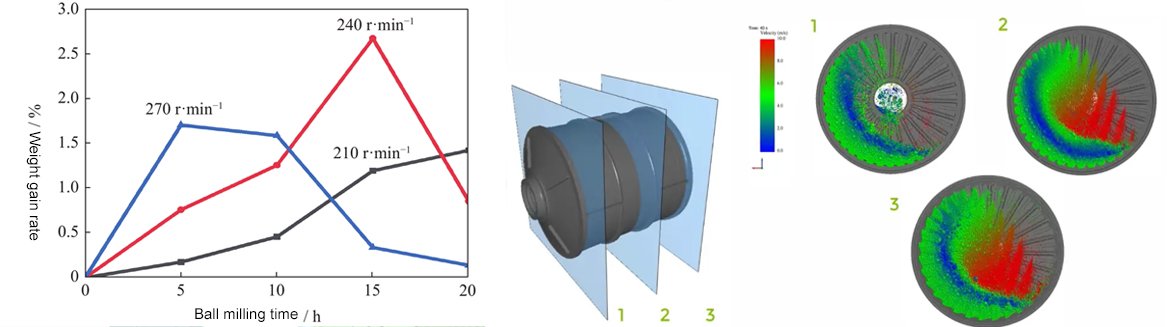
When the speed is 65%-75% of nc, the grinding media form a parabolic trajectory, combining abrasive grinding and impact fracture—achieving the highest grinding efficiency. CHUNLEI ball mills are equipped with adjustable speed systems, allowing you to optimize the speed according to ore characteristics.
Different rotation speeds on the grinding efficiency of CHUNLEI ball mill
Grinding Media & Liner Material
Grinding media (steel balls) and liners are易损 parts of the ball mill, and their quality directly affects the mill’s service life and grinding efficiency. For gold mining:
Grinding media: High-chromium steel balls are recommended for hard ores (wear resistance 3-5 times higher than ordinary steel balls); ordinary steel balls are suitable for soft ores.
Liners: Manganese steel liners are ideal for hard ores (wear-resistant and impact-resistant); rubber liners are suitable for soft ores (reducing noise and material pollution).
In 2026, CHUNLEI has upgraded its grinding media and liners—using high-quality high-chromium alloy and wear-resistant rubber, extending the service life by 30% and reducing replacement costs by 25%.
Energy Efficiency & Eco-Friendliness
With the global focus on carbon reduction and energy conservation, energy efficiency has become a key selection criterion in 2026. Look for ball mills with energy-saving motors, optimized cylinder structures, and closed-circuit grinding systems. These features can reduce energy consumption by 20-30%, lower carbon emissions, and help you meet local environmental standards.
CHUNLEI’s energy-saving ball mill is equipped with a high-efficiency motor and a closed-circuit system (matching with spiral classifier), which not only saves energy but also improves the qualified fine powder ratio by 10-15%.
After-Sales Service & Customization
For overseas miners, reliable after-sales service is crucial—equipment downtime can lead to significant losses. Choose a manufacturer with a global service network, 24/7 technical support, and local spare parts supply. Additionally, every mine has unique needs, so a manufacturer that offers customization (capacity, speed, liner material) is essential.
CHUNLEI provides one-stop customization services for gold and mineral miners, including ore sample testing, equipment design, installation, commissioning, and 24/7 after-sales support. We have established service centers in Africa, Southeast Asia, and Latin America, ensuring timely technical guidance and spare parts supply.
Common Mistakes to Avoid in 2026 Ball Mill Selection
Even experienced miners can make mistakes when selecting a ball mill. Here are 4 common pitfalls to avoid, which can save you time, money, and frustration:
Focusing Only on Price, Ignoring Quality
Low-cost ball mills may seem like a good deal, but they often have poor quality, high energy consumption, and frequent breakdowns. In the long run, they cost more in maintenance and downtime. Invest in a high-quality ball mill (like CHUNLEI) that offers stable performance and long service life—this will maximize your ROI.
Overlooking Ore Grindability
Not testing ore grindability before selection can lead to choosing a ball mill that is too small or too large, resulting in low efficiency or wasted energy. Always conduct a ore sample test to determine the grindability index and select the right parameters.
Lgnoring Compatibility with Beneficiation Line
The ball mill is part of the entire gold beneficiation line—ensure it is compatible with your crusher, classifier, flotation machine, and other equipment. A mismatched ball mill can disrupt the entire production process, reducing overall efficiency. CHUNLEI offers complete beneficiation line solutions, ensuring seamless integration between the ball mill and other equipment.
Neglecting After-Sales Service
Many miners overlook after-sales service when purchasing, but it is critical for long-term operation. Choose a manufacturer with a proven track record of after-sales support—this will ensure quick resolution of issues and minimal downtime.
Why Choose CHUNLEI Ball Mill for Your 2026 Gold & Mineral Mining Project?
In 2026, CHUNLEI Mining Machinery stands out as a leading manufacturer of ball mills and gold beneficiation lines, trusted by miners in more than 50 countries. Here’s why we are the top choice for gold and mineral miners worldwide:
Customized Solutions: We provide tailored ball mill and beneficiation line solutions based on your ore characteristics, production scale, and budget—ensuring maximum efficiency and gold recovery.
Energy-Saving & Eco-Friendly: Our energy-saving ball mills reduce energy consumption by 20-30%, meet global green mining standards, and help you reduce operating costs.
High Quality & Durability: Using high-quality materials and advanced manufacturing technology, our ball mills have a service life of 8-10 years, reducing maintenance costs and downtime.
Global After-Sales Service: 24/7 technical support, local service centers, and spare parts supply—ensuring your equipment runs smoothly at all times.
Proven Project Experience: We have completed hundreds of gold mining projects worldwide, including a 100TPD gold processing line in Africa and a 500TPD line in Southeast Asia—with a 98% customer satisfaction rate.
Final Selection Checklist for 2026
Before making your final purchase decision, use this checklist to ensure you’ve covered all key factors:
Conduct a ore sample test to determine hardness, density, and grindability.
Confirm your daily/hourly production capacity and select a ball mill with matching capacity.
Choose the right ball mill type (grid/overflow/energy-saving) based on your grinding needs (coarse/fine) and processing method (wet/dry).
Check the rotation speed range and ensure it can be adjusted to the optimal 65%-75% of critical speed.
Verify the quality of grinding media and liners (wear resistance, service life).
Evaluate energy efficiency and eco-friendly features to meet local standards.
Confirm the manufacturer’s after-sales service and customization capabilities.
Request a site visit or project case study to verify the manufacturer’s experience.
Conclusion
Selecting the right ball mill is a critical decision that impacts your gold mining operation’s efficiency, profitability, and sustainability. In 2026, with the right knowledge and guidance, you can choose a ball mill that aligns with your needs, reduces costs, and maximizes gold recovery.
CHUNLEI Mining Machinery is committed to providing high-quality ball mills and complete gold beneficiation line solutions for global miners. Whether you’re a small-scale artisanal miner or a large industrial mine, we have the expertise and experience to help you select the perfect ball mill for your project.
Contact us today to get a free ore sample test and customized ball mill quote—let’s work together to make your 2026 gold mining project more efficient and profitable!
Recently, an African client contacted us seeking to concentrate gold and sulfur from sulfur ore. Based on the client's requirements and existing equipment, and to prevent tailings loss, our engineer recommended the Model 900 spiral chute. After...
This article provides a comprehensive analysis of stone crushing plants, covering their definition, types, core equipment, and operational processes. We hope to assist you in developing efficient solutions for your current or future projects.
...
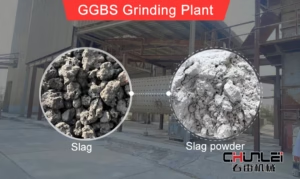
Blast furnace slag is an industrial byproduct generated during the ironmaking process in blast furnaces. When smelting pig iron, iron ore reacts at high temperatures with coke, limestone, and other flux agents within the furnace. Impurities in th...
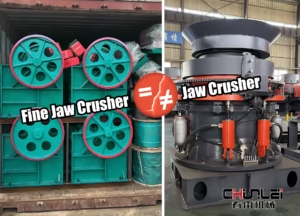
To be precise, a “fine jaw crusher” is a specific type of “Jaw Crusher.” Jaw crushers constitute a broad category, primarily divided into two main types based on their output particle size and application: Primary Jaw Crusher: This is the most ...
Welcome to Chunlei machinery website. We are a leading manufacturer and exporter of mining machinery in China with more than 30 years history in China.
We offer you one-stop solutions: online consultation --- customized solutions --- fast delivery --- comprehensive after-sales service
 Chunlei Mining Machinery