 Chunlei Mining Machinery
Bulk Density of Sand: Test Methods & Equipment Selection Guide
If you work in the sand and gravel processing industry, you’ve probably heard the term “bulk density”—but do you know how it directly impacts your equipment selection? Choosing the wrong feeder or crusher based on inaccurate density data can lead to inefficiency, increased energy consumption, and unexpected downtime.
In this guide, you will learn: what sand and gravel bulk density is, how to test it accurately, and most importantly—how to use this data to select the right equipment for your processing plant.
In this article, we will introduce:
What is bulk density of sand and gravel?
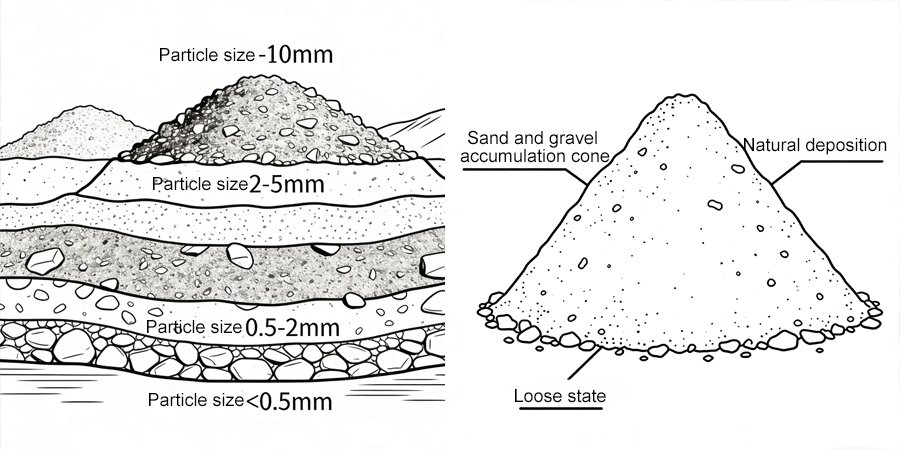
Bulk density refers to the mass of a given volume of sand and gravel, including solid particles and the voids between them. It is usually expressed in kg/m³ or t/m³ (tons per cubic meter).
Unlike particle density (which only considers the solid material itself), bulk density reflects the compactness of the sand and gravel packing—this varies significantly depending on moisture content, particle shape, and degree of compaction.
Why is bulk density of sand and gravel important?
When you purchase equipment for a mineral processing plant, feeders, crushers, and conveyors are calculated in “tons per hour” for processing capacity. However, the equipment actually transports “volume.” Converting volume to tons requires bulk density. If this parameter is chosen incorrectly, the entire production line design will be flawed.
Bulk density vs. specific gravity: What’s the difference?
Many people confuse these two terms. Let’s do a simple comparison:
| Parameter | Bulk Density | Specific Gravity |
|---|---|---|
| Definition | Mass per unit volume (including voids) | Ratio of a material’s density to the density of water |
| Unit | kg/m³ or t/m³ | Dimensionless (no unit) |
| Typical Value for Sand | 1.4 – 1.8 t/m³ | 2.6 – 2.7 |
| Why It Matters | Determines feeder and conveyor capacity | Helps with material identification and separation |
How to Test the Bulk Density of Sand and Gravel (Step-by-Step Guide)?
Accurate testing ensures you’ve selected the correct equipment. The entire testing process takes approximately 10-15 minutes and can be completed using simple tools.
Tools Required:
- A standard container (a 1 cubic foot or 0.0283 cubic meter metal drum is recommended)
- An industrial scale (accuracy at least 0.1 kg)
- A ruler (for leveling the surface)
Test Steps:
- Step 1: Weigh the empty container
Place the empty container on the scale and record the weight as W1 (unit: kg). - Step 2: Fill with sand and gravel
Pour the sand and gravel into the container from a height of approximately 5-10 cm until full. Note: Do not forcefully compact or tap the container, as this will affect the accuracy of the test results. - Step 3: Level the Surface
Use a ruler to level the surface along the edge of the container, removing excess sand and gravel. The surface should be flush with the edge of the container. - Step 4: Weigh the Container After Filling
Place the container filled with sand and gravel on a scale and record the weight as W2 (unit: kg). - Step 5: Calculate the Bulk Density
Calculation Formula:
Bulk Density (t/m³) = (W2 – W1) / Container Volume (m³) / 1000
Calculation Example:
Assume your container volume is 0.0283 m³, the empty container weight W1 = 5 kg, and after filling with sand and gravel, W2 = 50 kg.
Therefore:
Net Weight of Sand and Gravel = 50 – 5 = 45 kg
Bulk Density = 45 / 0.0283 / 1000 = 1.59 t/m³
Testing Precautions: Test the same sample three times and take the average to eliminate random errors.
Maintain consistent testing conditions: Pour the material from the same height each time and use the same leveling technique.
Record the moisture content: The bulk density of the same material can vary by more than 20% at different moisture contents.
Why is bulk density important for equipment selection?
This is a crucial aspect for plant operators and engineers. Your bulk density measurement directly impacts three key equipment categories:
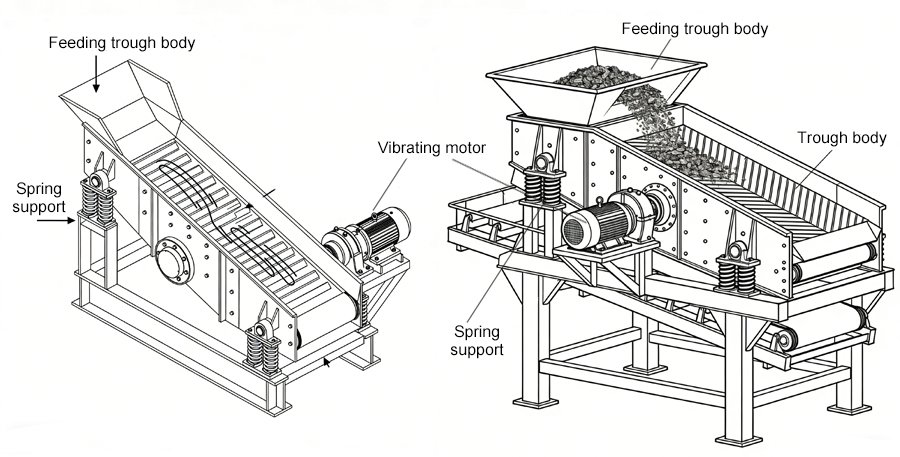
1. Vibrating Feeder Selection
Vibrating feeders typically have a capacity measured in tons per hour (t/h). To convert volumetric flow rate to mass flow rate, you need bulk density:
Formula: Mass Flow Rate (tons/h) = Volumetric Flow Rate (m³/h) × Bulk Density (t/m³)
For example:
– If you require a feeding capacity of 200 tons/h, and the material bulk density is 1.6 t/m³:
Required Volumetric Flow Rate = 200 ÷ 1.6 = 125 m³/h
– If your material bulk density is actually 1.4 t/m³ (lower than expected):
Actual Mass Flow Rate = 125 × 1.4 = 175 tons/h (25 tons/h less than required)
Underestimating bulk density can lead to selecting an undersized feeder, creating a bottleneck in the production line. Overestimating bulk density will result in unnecessary expenses for oversized equipment. For materials with a bulk density greater than 1.8 t/m³, it is recommended to select a larger feeder model.
2. Jaw Crusher vs. Cone Crusher Selection
For crushers, bulk density affects:
Feed opening utilization: Higher density materials require more energy to crush.
Capacity calculation: Most crusher capacity tables assume a standard bulk density (typically 1.6 t/m³). If your material varies significantly, a correction factor needs to be applied.
Wear component life: Higher density materials wear out faster.
| Material Bulk Density | Crusher Selection Recommendation |
|---|---|
| < 1.5 t/m³ | Standard model is sufficient |
| 1.5 – 1.8 t/m³ | Consider one size larger |
| > 1.8 t/m³ | Go one size larger and upgrade wear parts |
3. Belt Conveyor Selection
Belt conveyors are volumetric conveyors. At the same belt speed and trough angle, the conveying capacity (m³/h) is the same regardless of material density—however, the weight on the belt varies with bulk density, affecting motor power requirements and belt tension.
Power Impact: For the same volume of material, a bulk density of 1.8 t/m³ is nearly 30% heavier than 1.4 t/m³. This means:
- The motor requires a larger starting torque.
- The belt requires higher tensile strength.
- Idler rollers and supports require stronger load-bearing capacity.
Accurate bulk density values must be provided during selection; otherwise, the conveyor may fail to start under full load or overload and burn out the motor.
Common Material Bulk Density Reference Table
Use this table as a starting point. Always test your actual material whenever possible.
| Material | Bulk Density (t/m³) | Recommended Equipment |
|---|---|---|
| Dry loose sand | 1.44 – 1.60 | Standard vibrating feeder + PE/PEX jaw crusher |
| Damp sand (4-6% moisture) | 1.60 – 1.80 | Heavy-duty feeder + hydraulic cone crusher |
| Wet sand (10-15% moisture) | 1.80 – 2.00 | Scalping screen before feeding |
| Crushed stone (3/4″ – 1½”) | 1.50 – 1.70 | Impact crusher or cone crusher |
| Iron ore (coarse) | 2.10 – 2.50 | Heavy-duty apron feeder + multi-cylinder cone crusher |
| Limestone (crushed) | 1.35 – 1.50 | Hammer crusher |
| River pebble | 1.60 – 1.75 | Cone crusher |
| Granite | 1.50 – 1.70 | Multi-cylinder cone crusher |
| Gold ore | 1.60 – 2.00 | Jaw crusher + cone crusher |
Bulk Density FAQ
Q: What is the typical bulk density (kg/m³) of sand and gravel?
A: The typical bulk density of dry, loose sand ranges from 1,440 to 1,600 kg/m³ (1.44 to 1.60 t/m³). Compacted or moist sand can reach 1,800 to 2,000 kg/m³.
Q: How does moisture content affect bulk density?
A: Moisture content increases bulk density before reaching a certain level (typically 4-8%) because water fills voids without significantly increasing volume. Beyond this range, water causes agglomeration and reduces flowability, complicating equipment selection.
Q: Can materials with different bulk densities be fed using the same feeder?
A: Yes, but with limitations. Variable frequency vibrating feeders allow you to adjust the volumetric feed rate to achieve the desired mass flow rate across a range of bulk densities. However, extremely high-density materials may require heavier feeder troughs and larger drive units.
Q: Does bulk density need to be tested for every material?
A: Yes, for critical applications or when handling new material sources. Reference tables provide estimates, but actual bulk density can vary by ±15% depending on particle shape, gradation, and moisture content. This variation can significantly impact equipment selection.
Q: What is the relationship between bulk density and angle of repose?
A: Generally, materials with higher bulk density have a smaller angle of repose, meaning better flowability. However, this relationship is not linear—particle shape and moisture content play a major role. For accurate hopper and chute design, both parameters need to be tested.
Conclusion
Each material is unique. If you have specific sand or mineral samples, we can help you:
- Perform accurate bulk density tests
- Recommend suitable feeder models and specifications
- Optimal selection of your crusher
- Design a complete production line suitable for your material
Contact our engineering team—send your material parameters and get free equipment selection advice.
Latest News

2026 Zimbabwe Gold Mine Ball Mill Buyer’s Guide: Avoid Costly Mistakes & Choose the Right Model
796Decades of experience in global gold mining reveals a common, costly mistake: Zimbabwe mine owners waste tens of thousands of dollars on mismatched ball mills. A machine that works for a South African hard rock mine will fail in Zimbabwe’s dust…
-
7 Common Ball Mill Faults & Quick Fixes for Mining Sites
799If you are responsible for operating a gold or ore beneficiation production line, you undoubtedly understand just how frustrating it is when a ball mill suddenly malfunctions—whether the issue involves vibration, overheating, a drop in output, …
-
Case Study: 100TPD Gold Processing Line with Ball Mill in Africa
796If you are planning to establish a 100-ton-per-day (100 TPD) gold beneficiation production line in Africa, you are likely facing a common dilemma: Which type of ball mill is best suited for processing African gold ores? Can the equipment effect…
-
Ball Mill vs Wet Pan Mill: Which Is Better for Gold Mining?
815In gold mining operations, deciding whether to opt for a ball mill or a wet pan mill machine is one of the most challenging questions clients frequently ask me. I have spoken with dozens of mine owners who wasted money because they selected th…
loading…
已经是到最后一篇内容了!