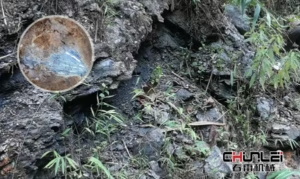
In the field of gold mining, ore type directly determines the optimal beneficiation process and equipment selection. Understanding the characteristics of different gold ore types not only enhances recovery rates but also significantly reduces operational costs. As a professional mining equipment supplier, we will provide an in-depth analysis of eight primary gold ore types and their corresponding optimal processing solutions.
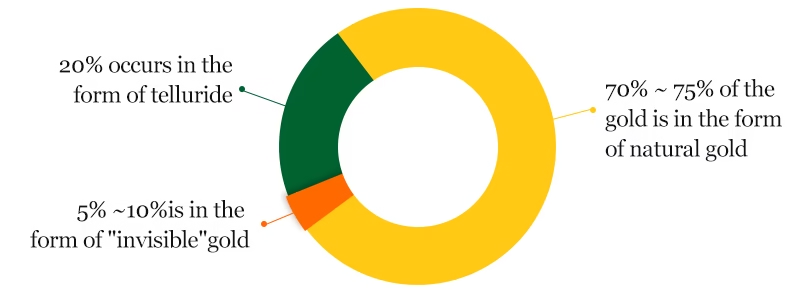
Approximately 70%–75% of gold deposits are native gold, while 20% are Au-Ag chalcopyrite. The remaining 5%–10% are “hidden” gold ores, occurring in association with quartz veins, silver ores, pyrite, chalcopyrite, sphalerite, gangue, pyrite, gangue, and other minerals.
Gold-Ore-Distribution-Ratio-Chart
Eight types of gold ores
1. Quartz Vein Gold Deposits
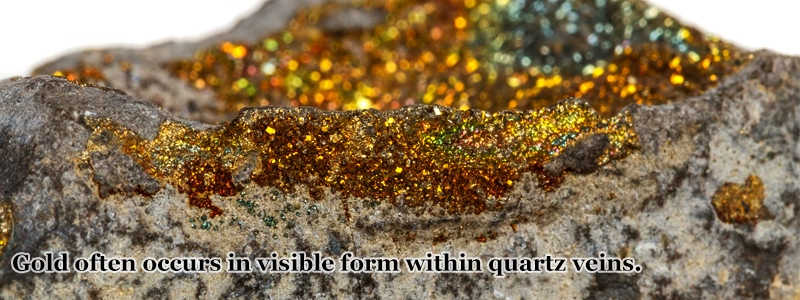
Gold, one of nature’s most precious gifts, often lies embedded in the mysterious fissures of quartz rock in free form or as inclusions, forming deposits of astonishing scale. These deposits typically exhibit high grades but exhibit uneven grain sizes.
A typical quartz vein gold ore sample.
Quartz appears as crystals in riverbed deposits or mountain fissures, displaying hues ranging from white, yellow, pink, purple, and gray to deep, mysterious black. Rose quartz gold deposits feature delicate, petal-like golden patterns, while rainbow gold refracts iridescent metallic sheen under light—true treasures of nature.
Optimal Equipment Configuration:
Jaw Crusher + Cone Crusher: Efficient primary and secondary crushing High-Pressure Roller Mill:Unique crushing advantage for quartz-rich ores Nelson Centrifugal Gold Reclaimer: Exceptional recovery of coarse free gold particles
2. Gold Associated with Sulfide Ores
Sulfide gold ore (chemical formula Au₂S) is a common type of difficult-to-process rock gold ore. Extremely fine natural gold particles (often less than 1 micron) are tightly associated with sulfides such as pyrite and arsenopyrite, frequently requiring oxidation pretreatment to liberate the gold particles.
Professional Solutions:
Flotation Equipment: Prioritizes enrichment of gold-bearing sulfides Bio-oxidation Tanks/Pressurized Oxidation Reactors: Breaks down sulfide structures CIL/CIP Tank Systems: Efficient cyanide leaching after oxidation
3. Oxidized Gold Deposits
Iron-Oxidized Copper-Gold (IOCG) deposits commonly occur along the margins of granitic intrusions. They are closely associated with magnetite and hematite, accompanied by copper sulfides and native gold, forming a distinctive ternary “iron-copper-gold” combination. Long-term weathering has partially exposed gold particles, but the high clay content poses significant processing challenges.
Targeted Equipment:
Integrated Ore Washing and Screening Machine: Effectively removes clay interference Heap Leach System: Includes spray system, leachate collection basin, and carbon adsorption columns Environmentally Friendly Leaching Tanks: Cyanide leaching apparatus compliant with environmental regulations
4. Copper-bearing gold deposits
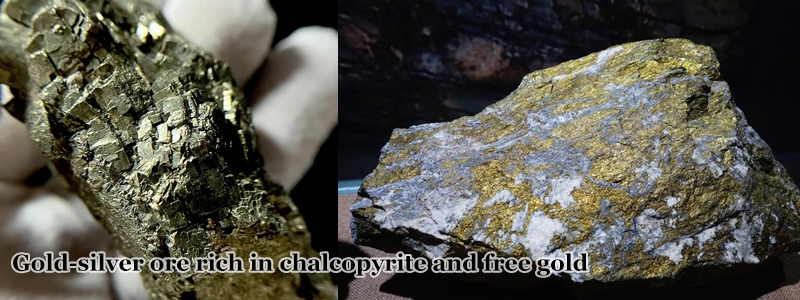
Gold-silver deposits often occur with chalcopyrite and native gold, while high-grade silver deposits typically contain extremely low base metal content. Copper minerals consume cyanide and oxygen, severely impacting gold leaching rates.
Targeted Equipment:
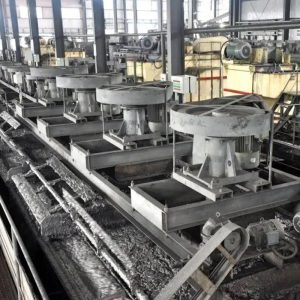
Copper-Gold Separation Flotation Machine: Enables priority flotation of copper
SART Treatment System: Recovers cyanide while separating copper
Selective Leaching Tank: Features specialized reagent formulations and control systems
5. Blue Clay Gold Ore
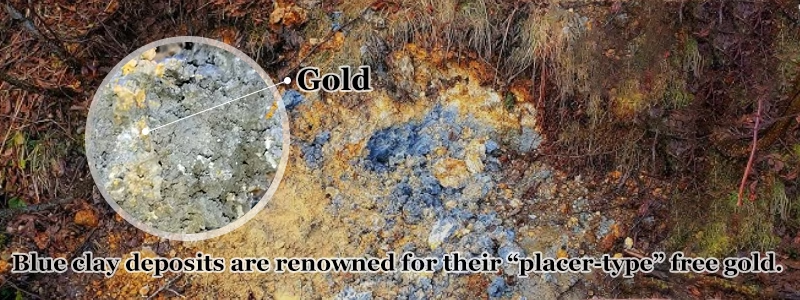
Blue clay deposits are renowned for their high concentration of “placer-type” free gold, ranking among the most gold-rich sedimentary layers in alluvial gold deposits. Blue clay possesses a fine texture and high viscosity. During water transport, its dense structure effectively traps passing gold particles. Compared to ordinary gravel layers, gold is more readily retained and concentrated within blue clay strata.
6. Granitic Gold
Granite and other plutonic rocks often contain fine-grained gold, serving as the source rock for hard-rock gold deposits. Such deposits are widely distributed globally, with world-class gold mines like Kalgoorlie and Bodington in Australia being prime examples—gold elements are not only hosted within quartz veins but also extensively disseminated throughout the granite intrusions and surrounding alteration zones. Granite harbors a high proportion of “invisible gold,” requiring ultrafine grinding to achieve effective liberation.
7. Placer Gold Deposits
Placer gold deposits are secondary ore bodies formed when primary gold deposits (such as quartz vein gold in granite) undergo long-term weathering, erosion, and fluvial transport. Due to the extremely high specific gravity of gold particles, they become concentrated in riverbeds, beaches, or ancient sedimentary layers. Gold exists in a free state within gravel, exhibiting significant density variations.
Classic Equipment Combination:
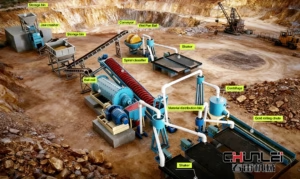
Mobile processing plant: Suitable for riverbed and terrace mining
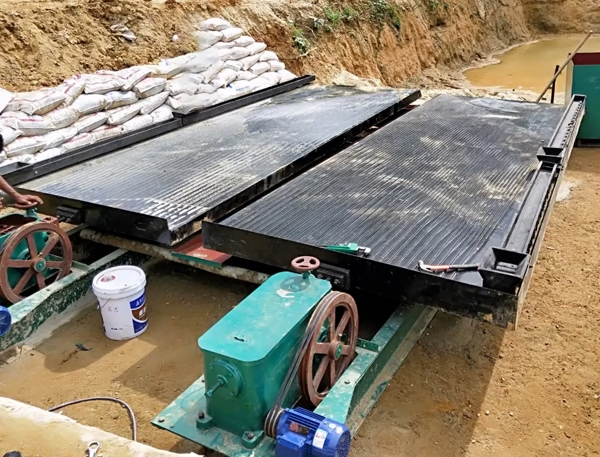
Jig + shaking table combination: Efficient gravity separation for coarse and medium-grain gold recovery
Mud-water cylinder (where permitted): Auxiliary recovery for fine-grain gold
8. Complex Polymetallic Gold Deposits
Gold deposits associated with multiple metals feature complex mineral assemblages, high processing difficulty, and significant comprehensive utilization value. They contain valuable metals such as gold, silver, lead, and zinc. The technological challenges in separating and extracting gold are substantial, and successful development enables “multiple recoveries from a single ore.”
Integrated Recovery System:
Priority Flotation-Hybrid Flotation Integrated Process Equipment
Polymetallic Separation Equipment: Including magnetic separation, electrostatic separation, etc.
Integrated Precious Metal Refining System
The Golden Four Rules for Equipment Selection: Scientific Investment for Maximizing Mineral Processing Efficiency
Rule One: Test First, Design Later — Let Scientific Data Drive Decisions
– Basic Chemical Analysis: Precisely determine key element grades including Au, Ag, As, Cu, Corg (organic carbon), and S.
– MLA/QEMSCAN Automated Mineral Analysis: Quantitatively assess grain size distribution, occurrence characteristics, liberation degree, and association patterns of gold minerals. This serves as the decisive basis for concentrator process design.
– Scanning Electron Microscopy (SEM-EDS): Observe the occurrence state of ultrafine gold particles (<10μm).
– Optional Batch Tests: Validate the feasibility of preliminary processing routes and obtain baseline recovery data through small-scale gravity separation, flotation, and leaching tests.
Rule Two: Modular Design — Adaptive Capability
Crushing and Screening Module: Independently configurable for easy adjustment of final crushed product size.
Grinding-Classification Module: Features adjustable hydrocyclone assemblies and mill speed control.
Separation Circuit Module: Flotation, gravity separation, and leaching circuits are independently adjustable.
Rule Three: High Recovery Rate
Crushing Stage: Prioritize High-Pressure Roller Grinders (HPGR). Compared to traditional cone crushers, they save over 30% energy and create more micro-fractures for subsequent grinding.
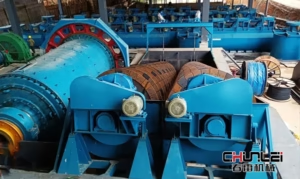
Grinding Stage: For fine grinding requirements (P80 < 75μm), select vertical agitation mills. They consume 30%-50% less energy than ball mills and produce more uniform particle size distribution, benefiting separation.
Separation Stage:
For gravity separation, prioritize centrifugal concentrators to achieve early and maximum recovery, reducing downstream processing loads.
For flotation, select high-efficiency aerated mechanical agitator flotation machines, which offer superior bubble dispersion and lower energy consumption.
Full-Process Intelligent Control: Optimize equipment operating parameters (e.g., feed rate, concentration, pressure) through AI algorithms to achieve sustained system energy efficiency.
Return on Investment Calculation: Although the initial investment in high-efficiency equipment may be 15-25% higher, this cost is fully offset within 2-3 years through energy savings and improved recovery rates. Thereafter, it becomes a sustained source of profit.
Rule Four: Environmental Compliance
Wastewater Treatment and Recycling:
Standard “Zero-Discharge” Water Recycling System: Thickener + High-Efficiency Filter + Treatment Tank.
Specialized leaching equipment using cyanide-free or low-cyanide gold leaching agents (e.g., glycine, thiosulfate).
Safe Tailings Disposal:
Provide dry tailings disposal systems (dewatering screens + high-efficiency thickeners + filter presses) to reduce tailings pond volume and ensure safe storage.
Fully enclose crushing and screening sections with baghouse dust collectors.
Install exhaust scrubbers for ores releasing arsenic or mercury.
Noise Control:Equipment incorporates low-noise design, and the plant site undergoes acoustic planning.
Conclusion
Our Core Strength: More Than Equipment, Delivering Certainty Process Mineralogy Laboratory: Free detailed MLA/QEMSCAN analysis for clients, providing precise ore “diagnosis.”
Act Now to Get Your Free Ore Optimization Plan! Submit your ore chemical analysis, mineralogical reports, or core samples via our website. Our engineers will provide a preliminary process flow recommendation and equipment configuration within 7 business days, complete with detailed case studies and ROI analysis for similar ores.
Graphite Ore Dressing Production Line
Process Introduction Crystalline graphite has natural floatability, so flotation is mainly used to separate graphite ore. For graphite ore with multiple gangues, gravity separation and flotatio...
Mineral processing equipment and systems primarily include jaw crushers and cone crushers, ball mills and hydrocyclones, agitators and flotation machines, thickeners, plate filters, dryers, and more. The processing flow mainly involves crushing, ...
Titanium ore processing is a complex and precise operation that presents challenges alongside significant opportunities. Efficient separation forms the foundation for transforming raw ore into high-value concentrates. Experience teaches us that d...
Antimony is a rare metal primarily concentrated in China, where its mining and extraction pose significant challenges. Antimony is ubiquitous in our daily lives and plays a crucial role in industrial, military, and other sectors. Antimon...
Welcome to Chunlei machinery website. We are a leading manufacturer and exporter of mining machinery in China with more than 30 years history in China.
We offer you one-stop solutions: online consultation --- customized solutions --- fast delivery --- comprehensive after-sales service
 Chunlei Mining Machinery