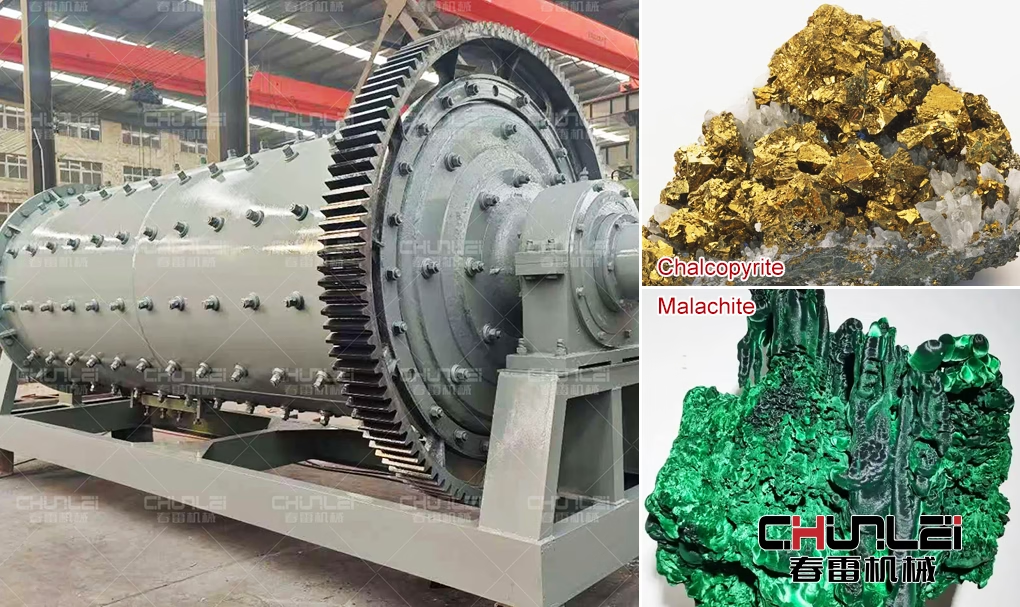
Malachite and chalcopyrite are two closely related copper minerals. Chalcopyrite is a primary copper ore, while malachite forms as a secondary mineral through the weathering and oxidation of chalcopyrite. Malachite often serves as an indicator for locating primary copper deposits, ranking among the most recognizable and valuable copper oxide minerals. It primarily exhibits a green color with distinctive concentric rings or banded patterns. Extracting copper from malachite requires precise physical processing. For most malachite flotation or leaching processes, the ideal particle size is 150 mesh. The journey from rock to 150-mesh malachite powder involves an industrial chain integrating crushing, grinding, separation, and dewatering. Among these steps, “sulfide flotation” for malachite is the core technology enabling efficient enrichment. This article focuses on the preferred equipment for grinding—ball mills, the science behind the 150 mesh specification, and how to optimize your production line for maximum profitability.
What is Chalcopyrite?
Chalcopyrite is a primary copper ore characterized by its brass-like color and metallic luster. It rarely occurs in pure form, often coexisting with chalcopyrite, limestone, galena, sphalerite, and other minerals. Therefore, recovering copper from chalcopyrite requires crushing, grinding, and classification to achieve effective separation. Pure malachite ore is uncommon, typically occurring alongside other copper minerals like chalcopyrite. Actual production employs more complex combined processes based on the ore’s overall composition.
Why is 150 mesh considered the optimal effective recovery particle size?
In mineral processing, particle size is measured in “mesh.” A 150-mesh particle can pass through a sieve with 150 holes per linear inch. 150 mesh (approximately 0.106 mm) is not an absolute “optimal recovery particle size” for malachite, but rather represents the best balance point between ensuring sufficiently high recovery rates and mineral processing efficiency—it signifies the “effective target particle size range.” Emerging technologies are now pushing beyond the traditional “150 mesh” boundary. The table below compares flotation challenges and cost considerations for different sizes of chalcopyrite under conventional flotation processes:
Particle Size Classification
Approximate mesh size
Primary Flotation Challenges
Key Cost/Efficiency Considerations
Coarse Particles (>150 mesh)
Less than 10⁶ micrometers
Particles exhibit excessive gravity, prone to detaching from bubbles; low probability of collision and adhesion with bubbles.
Without excessive grinding, recovery rates remain low, leading to resource wastage.
Optimal Particle Size Range
Approximately 150–400 mesh (10⁶–38 micrometers)
Gravity and bubble buoyancy achieve a favorable equilibrium; particles are sufficiently “dissociated,” enabling easy surface interaction with reagents.
Optimal overall efficiency: Under conditions ensuring high recovery rates and equipment capacity, grinding energy consumption remains relatively controllable.
Over-Fine Particles (<400 mesh)
Less than 38 micrometers
High surface energy facilitates non-selective agglomeration or sludging; particle-bubble collision efficiency decreases.
Requiring finer grinding results in sharply increased energy consumption; subsequent separation becomes difficult, potentially reducing recovery rates and concentrate grades.
Achieving the industry standard for high malachite pass rate at 150 mesh is primarily due to three factors:
Achieving single-particle liberation: For most malachite ores, grinding to 150 mesh is necessary to attain optimal liberation.
Avoiding over-grinding: Finer grinding isn’t always better. Over-grinding disrupts flotation processes while increasing energy consumption and costs.
Meeting flotation requirements: Particles around 150 mesh are neither too heavy to sink nor too light to effectively attach to bubbles.
How does a ball mill process chalcopyrite and malachite?
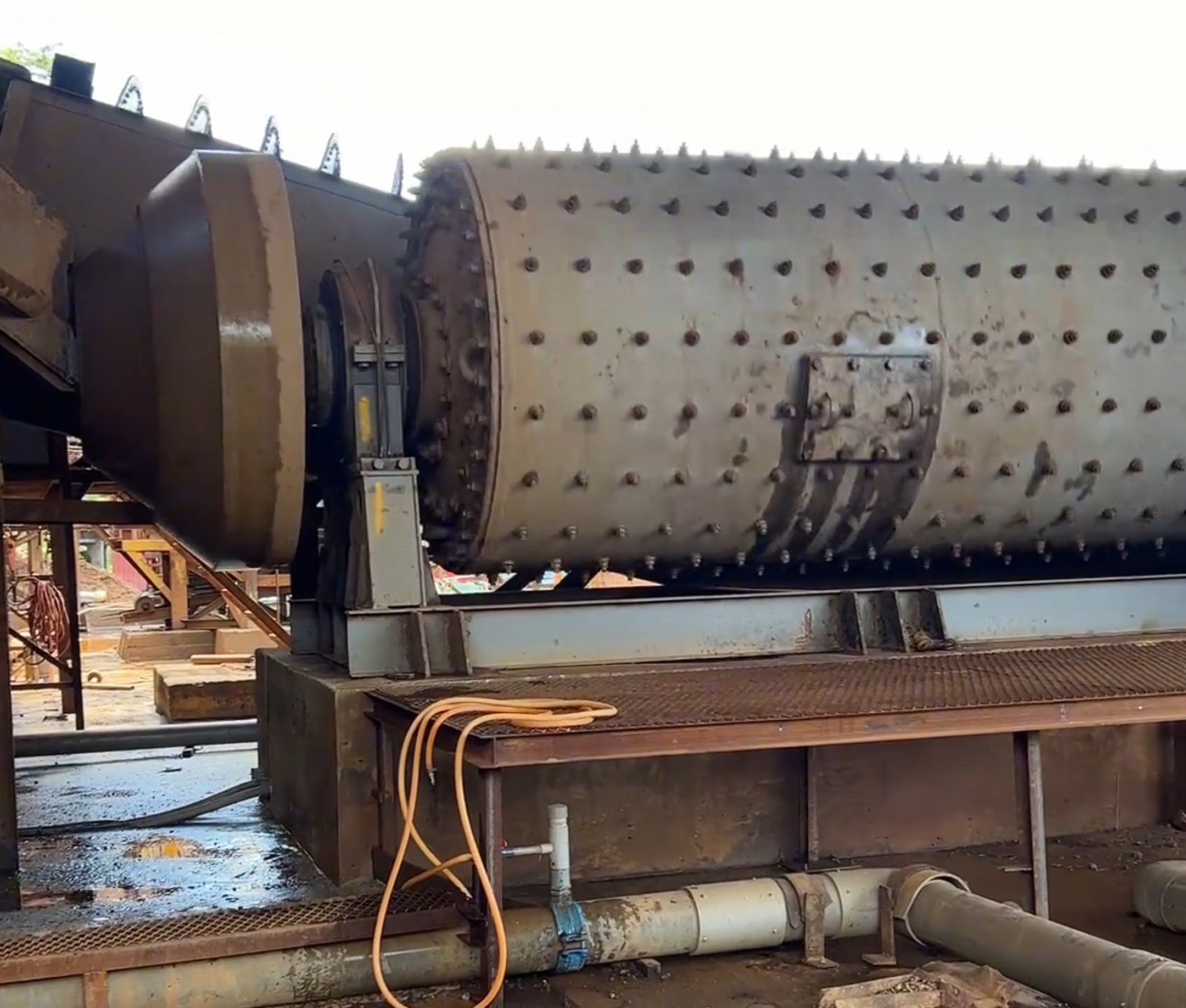
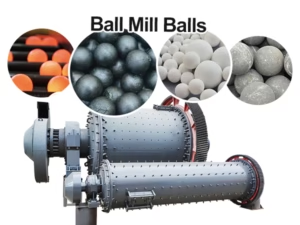
Ball mills serve as the core equipment for separating chalcopyrite and malachite, grinding the ore mixture to a uniform, suitable particle size for effective liberation. Due to their differing hardness and crushability, the following process can be adopted: Coarse grinding: First grind the ore to a coarse particle size. At this stage, a portion of already liberated chalcopyrite and malachite is preferentially floated out. Regrinding: Ore not fully liberated during coarse grinding is returned or fed into another ball mill for further grinding. The reground minerals are then returned to flotation. This process avoids excessive crushing of all minerals in a single pass, enhancing efficiency and reducing energy consumption.
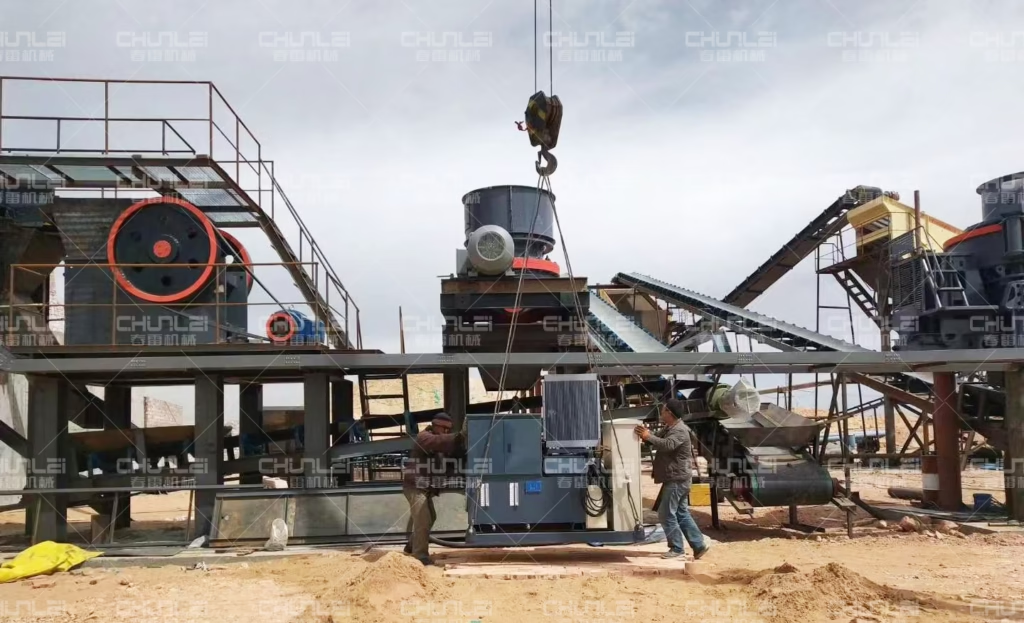
Stone-Crushing-Production-Line
Advantages of ball mills in ore processing:
Achieves efficient “individual liberation”: Through impact and grinding by steel balls, hard ores are effectively broken down, liberating useful mineral particles of chalcopyrite or malachite from their associated waste rock (gangue). This is a prerequisite for the success of any subsequent separation process.
Delivers stable, qualified particle size: Integrated with classification equipment (e.g., spiral classifiers, hydrocyclones) in a closed-circuit system, ball mills precisely and consistently grind ore to the optimal flotation range (e.g., 150-200 mesh) while preventing over-grinding.
Highly adaptable and reliable operation: As mature industrial equipment, it continuously and stably processes large volumes of ore, accommodating varying feed conditions and hardness levels.
For chalcopyrite, ball milling produces uniformly sized particles with fresh surfaces that readily interact with xanthate collectors, achieving high flotation efficiency.
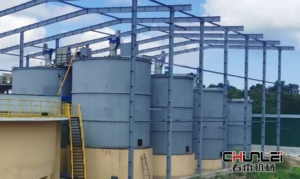
For malachite, the slurry with qualified fineness after ball milling must enter the agitation tank. There, it undergoes surface “sulfidation” modification by reacting with sodium sulfide before flotation. The thorough liberation and specific surface area provided by ball milling form the foundation for successful sulfidation.
Ore Processing Workflow
Stage 1: Crushing and Preparation (Reduced to approximately 10-20mm)
The objective of this stage is to reduce particle size in preparation for grinding.
Primary Crushing: Utilize jaw crushers to break large ore chunks down to approximately 200mm.
Screening: Implement closed-circuit screening via vibrating screens to ensure qualified particle size for grinding.
Stage 2: Grinding and Classification (Grind to -150 mesh)
This core stage achieves the target fine powder through a closed-circuit “grinding-classification” loop controlling particle size.
Grinding: Crushed ore mixed with water enters ball mills. Steel balls act as grinding media, impacting and pulverizing the ore.
Classification: The ground slurry flows into classification equipment (e.g., spiral classifiers, hydrocyclones). Fine particles (-150 mesh) overflow to the next process, while coarse particles are returned to the ball mill for regrinding.
Key Control Points: Grinding concentration (typically 65-75% solids) and classification efficiency directly impact throughput and energy consumption.
Stage Three: Enrichment and Dewatering (Obtaining Concentrate Powder)
As malachite is an oxide ore, specialized enrichment processes are required, followed by dewatering and drying.
Conclusion
Through an in-depth analysis of the beneficiation processes for chalcopyrite and malachite, we understand that the core of transforming ore into high-value products lies in a profound understanding of mineral characteristics and precise matching of process equipment.
As a specialized technical partner in mineral processing, CHUNLEI Machinery possesses not only extensive theoretical and technical expertise but also comprehensive service capabilities spanning the entire value chain—from laboratory testing and production line design to core equipment supply and production optimization. We are committed to delivering the most economical and efficient solutions to our clients, ensuring every resource is utilized to its fullest potential.
If you are facing mineral processing challenges or seeking to optimize your existing production lines, please feel free to contact us anytime.
Gold carbon, as the name suggests, refers to gold-loaded activated carbon—activated carbon that has adsorbed gold and silver. Leaching means extraction. The gold carbon leaching plant refers to the process in the carbon-in-pulp gold extraction pr...
Ball mill grinding balls are the media for grinding materials in ball mill equipment, mainly used for material crushing, mixing and refining. Its performance directly affects the grinding efficiency, energy consumption and product quality.
...
Precious metal metallurgy and mineral processing engineering remain a field deeply cultivated by mining professionals. After years of data analysis and customer feedback, CHUNLEI discovered that the root cause of low recovery rates lies not in ch...
Fluorspar is a vital mineral in nature, playing a crucial role in key sectors such as metallurgy, chemical engineering, and ceramics. Transforming raw ore into high-value concentrate requires precisely matched processing equipment and workflow.Fo...
Welcome to Chunlei machinery website. We are a leading manufacturer and exporter of mining machinery in China with more than 30 years history in China.
We offer you one-stop solutions: online consultation --- customized solutions --- fast delivery --- comprehensive after-sales service
 Chunlei Mining Machinery