 Chunlei Mining Machinery
Ball Mills vs. Rod Mills: How to Choose?
In mineral processing grinding operations, ball mills and rod mills represent one of the most critical investment decisions. Selecting the right grinding equipment not only enhances production efficiency but also impacts operational costs that may extend for decades. This article provides a detailed analysis of their differences and offers practical selection recommendations.
Choosing between a ball mill and a rod mill depends on your target product size and process requirements. Ball mills use steel balls for point-impact grinding, making them suitable for fine grinding. Rod mills employ steel rods for line-contact grinding, producing more uniform particle sizes. They are ideal for coarse grinding with minimal over-grinding.
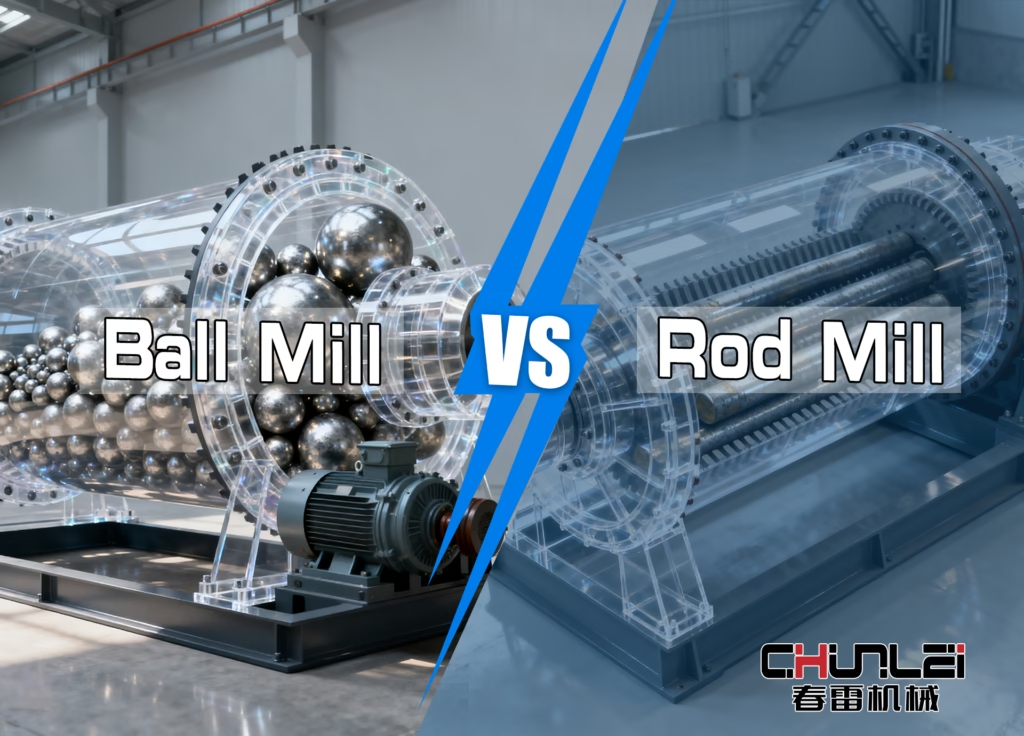
Core Differences Between Ball Mills and Rod Mills:
Although ball mills and rod mills appear similar externally, they exhibit significant differences in internal structure, operating principles, and application scenarios. The table below provides a visual overview of their core distinctions:
| Comparison Metrics | Ball Mill | Rod Mill |
| Grinding Media | Steel balls (point contact) | Steel rods (Linear contact) |
| Product Particle Size | Finer (typically 0.074-0.4mm) with uniform distribution | Coarser (typically 0.4-5mm), uniform particle size, minimal over-grinding |
| Crushing Mechanism | Primarily impact force, supplemented by grinding | Primarily crushes by compression and grinding with selective crushing action |
| Energy Consumption Level | Relatively high (typically 15-30 kWh/t) | Relatively low (typically 10-20 kWh/t) |
| Suitable Applications | Fine grinding and ultrafine grinding operations | Coarse grinding operations requiring low over-grinding rates |
Differences in Working Principles
Ball mills are typically filled with steel balls of varying sizes. As the cylinder rotates, the steel balls move in free-fall motion. When falling from top to bottom, they exert intense impact and grinding forces on the material. This “point contact” impact generates tremendous force, making it highly suitable for grinding materials requiring fine particle sizes.
Rod mills use steel rods as grinding media. Unlike the “point contact” of ball mills, the rods create “line contact” within the mill. During operation, larger particles are broken first, while smaller particles are protected. This “selective crushing” method produces a more uniform particle size distribution and, most importantly, reduces the generation of excessively fine powder (over-grinding).
Differences in Product Particle Size and Shape
As the saying goes, “Use balls for fine grinding, rods for coarse grinding.”
Most flotation processes for mineral liberation or cement production require extremely fine grinding products. If your final requirement is a product with over 90% fineness at 200 mesh (74 microns), ball mills are the unparalleled choice.
If your requirement is merely to produce uniformly sized coarse particles or prepare material for gravity separation operations, rod mills are the superior choice. Their output contains fewer coarse particles and less fines, effectively enhancing recovery rates in subsequent mineral processing stages.
Differences in Material Hardness and Properties
For high-hardness ores, the impact force of ball mills proves more effective. Rod mills, however, are better suited for coarse grinding of medium-to-low hardness materials. When material contains clay content exceeding 10%, ball mills are prone to “clogging.” Rod mills, benefiting from the rolling and screening action of steel rods, demonstrate superior handling capabilities for sticky and wet materials.
Differences in Application Scenarios
The choice between ball mills and rod mills primarily depends on requirements for final product particle size and over-grinding rates.
Ball mills dominate fine and ultrafine grinding applications. They are typically used for secondary fine grinding of metals like copper and gold where product size ≤75μm, as well as for ultrafine powder processing (-325 mesh) of cement clinker, quartz sand, and other industries requiring extremely fine grinding.
Rod mills are generally employed for coarse grinding or primary grinding operations. They are thus suitable for coarse grinding stages in tungsten-tin ore gravity/magnetic separation plants to prevent over-grinding, as well as for producing sand with a particle size of 3-5mm for use as aggregate in artificial sand concrete.
In summary: Use rod mills for coarse grinding and heavy-duty protection; use ball mills for fine grinding and achieving high fineness.
Conclusion
Ball mills and rod mills are complementary rather than substitutes. When grinding ore below 0.5mm, ball mills generally offer higher throughput capacity. Conversely, for grinding sizes between 1-3mm, rod mills often provide greater efficiency and cost advantages. In summary: Ball mills for fine grinding and achieving specific fineness requirements,Rod mills for coarse grinding and heavy-duty protection.
If you are interested in ball mills or have any inquiries, please contact us—we are available 24 hours a day to address your questions.
Latest News

Bulk Density of Sand: Test Methods & Equipment Selection Guide
800If you work in the sand and gravel processing industry, you’ve probably heard the term “bulk density”—but do you know how it directly impacts your equipment selection? Choosing the wrong feeder or crusher based on inaccurate density data can le…
-
2026 Zimbabwe Gold Mine Ball Mill Buyer’s Guide: Avoid Costly Mistakes & Choose the Right Model
805Decades of experience in global gold mining reveals a common, costly mistake: Zimbabwe mine owners waste tens of thousands of dollars on mismatched ball mills. A machine that works for a South African hard rock mine will fail in Zimbabwe’s dust…
-
7 Common Ball Mill Faults & Quick Fixes for Mining Sites
805If you are responsible for operating a gold or ore beneficiation production line, you undoubtedly understand just how frustrating it is when a ball mill suddenly malfunctions—whether the issue involves vibration, overheating, a drop in output, …
-
Case Study: 100TPD Gold Processing Line with Ball Mill in Africa
801If you are planning to establish a 100-ton-per-day (100 TPD) gold beneficiation production line in Africa, you are likely facing a common dilemma: Which type of ball mill is best suited for processing African gold ores? Can the equipment effect…
loading…
已经是到最后一篇内容了!