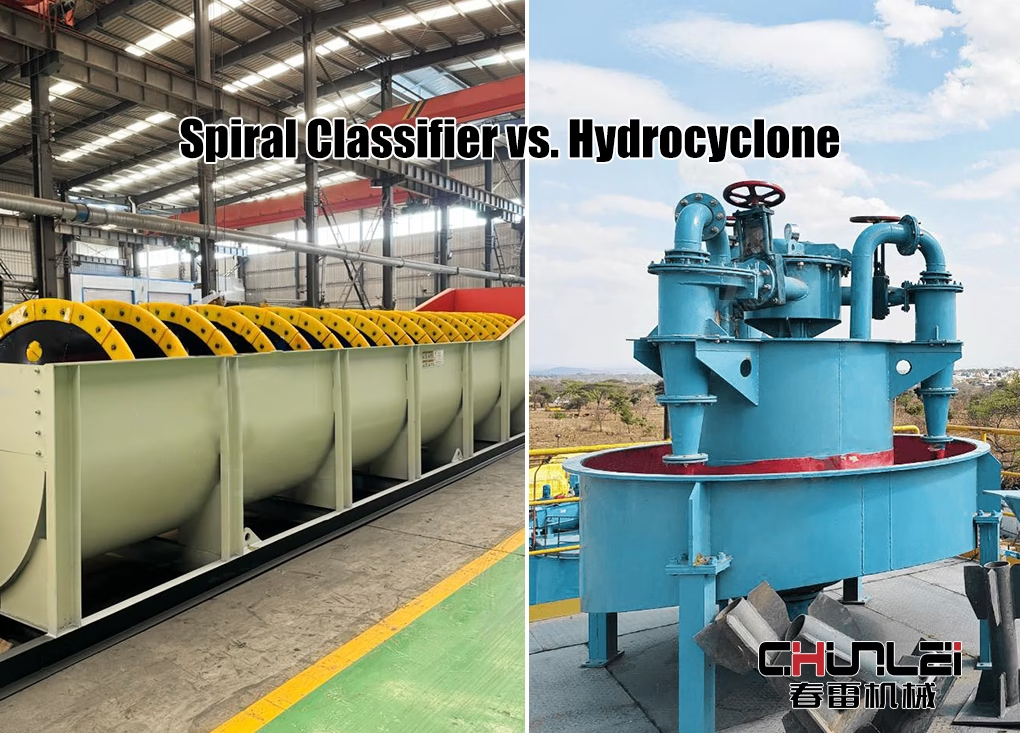
In mineral processing, the selection of classification equipment determines the technical performance and economic efficiency of the entire production line. The operational efficiency of classification equipment directly impacts energy consumption levels, separation outcomes, and product quality in the grinding and classification stage. Spiral classifiers and hydrocyclones are the two core classification devices, each possessing unique operating principles and application scenarios. Many simplistically assume spiral classifiers suit coarse particles while hydrocyclones handle fine particles—a view that leads to biased selection. To ensure seamless production flow, which should you choose? This article comprehensively analyzes both equipment’s strengths and weaknesses to help you make a smarter, more scientific decision.
The Core of Mineral Processing: Mineral Classification
Mineral classification plays a decisive role in mineral processing. It separates mixed materials into products of different particle sizes according to predetermined standards, creating optimal conditions for subsequent processing. This process is particularly crucial in closed-circuit grinding systems—classifiers promptly separate qualified products while returning undersized coarse particles to the mill for further grinding.
Precise classification not only enhances grinding efficiency by preventing energy waste from unseparated fine particles but also minimizes unnecessary loss of grinding media like steel balls. More importantly, scientifically designed classification provides ideal feed particle sizes for subsequent separation processes (such as flotation, gravity separation, or leaching), maximizing overall efficiency. Improper classification reduces recovery rates and product quality while increasing equipment load and energy consumption. Consequently, mineral classification has become an indispensable technology in mineral processing.
Comparison of Working Principles and Design Features
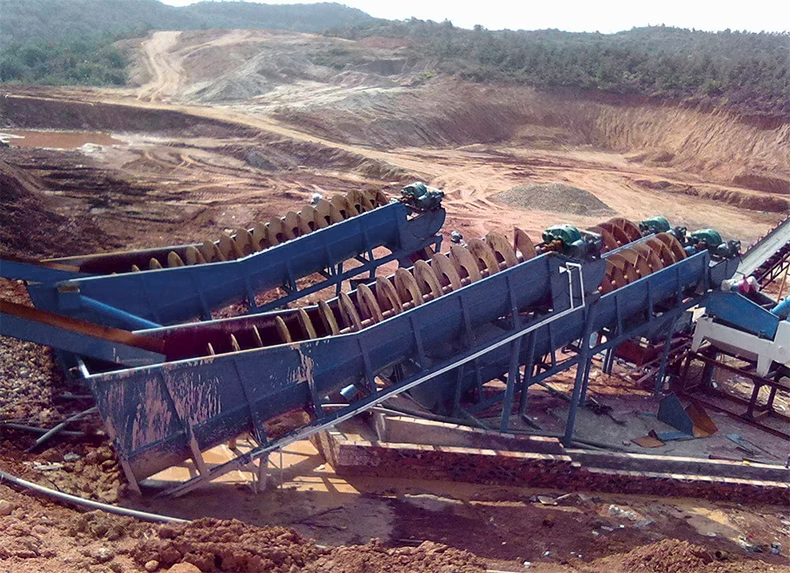
A spiral classifier is a device that classifies materials based on the principle of gravity sedimentation. Its primary design features a continuously rotating spiral shaft installed within an inclined semi-circular metal trough. Mineral slurry is fed into the trough through an inlet at the bottom. Coarse particles settle toward the trough bottom, where spiral blades propel them upward along the inclined trough and discharge them through a sand discharge port. Fine particles float in the water to form an overflow discharge.
Spiral classifiers are categorized into three types based on overflow weir height:
Low-Weir Type: The overflow weir is below the center of the discharge-end bearing, suitable for washing ore slurry and desliming operations.
High-Weir Type: The overflow weir is above the discharge-end bearing but below the edge of the spiral blades, suitable for classifying materials between 0.2 and 0.5 mm.
Submerged Type: The screw is fully submerged in the settling zone, suitable for fine classification of materials below 0.1 mm.
Hydrocyclone: Centrifugal Force Principle
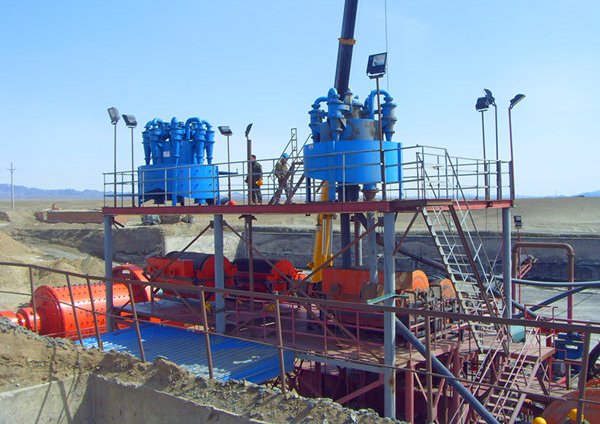
A hydrocyclone is a classification device that accelerates mineral particle settling using centrifugal force. It primarily consists of a hollow cylinder connected to a cone. Slurry is fed tangentially into the hydrocyclone under pressure, initiating rotational motion. Coarse, heavy particles, driven by greater inertial centrifugal force, are flung toward the wall and gradually discharged downward through the bottom sand outlet. Fine particles, carried by the liquid flowing toward the center, exit through the central overflow pipe as the overflow stream.
Hydraulic cyclones can generate centrifugal forces dozens or even hundreds of times greater than gravitational force, significantly increasing particle settling velocity. This not only boosts production capacity but also lowers the lower limit of the classification particle size.
Comparison Dimensions
Spiral Classifier
Hydrocyclone
Core Principles
Gravity Sedimentation: Separation based on differences in natural settling velocity of solid particles within the pulp.
Centrifugal Sedimentation: Utilizes the powerful centrifugal force generated by high-speed rotating slurry to accelerate particle settling and achieve separation.
Separation Force Field
Gravity Field
Centrifugal Force Field
Power Source
Mechanical lifting action of the spiral shaft; gravity flow of pulp (often directly connected to the mill).
Requires a sand pump to supply pressure, feeding the slurry at a specific velocity and pressure.
Key Components
1. Inclined U-shaped or semi-circular trough
1. Cylinder + Conical Body
2. Rotating shaft with spiral blades
2. Tangential Feed Pipe
3. Drive mechanism
3. Overflow Pipe (Centered at Top)
4. Elevation device (for adjusting the spiral)
4. Sand discharge port (at cone base)
Moving Parts
Features (Rotating spiral shaft)
None (static equipment)
Workflow
1. Slurry fed from the lower end of the trough.
1. High-pressure slurry is tangentially fed into the cylinder, forming a high-speed rotating flow.
2. In the settling zone, coarse heavy particles sink to the trough bottom.
2. Coarse, heavy particles are flung toward the vessel wall by centrifugal force and spiral downward through the underflow port.
3. The rotating spiral pushes settled sand upward to the discharge outlet, returning it to the mill.
3. Fine, light particles form a low-pressure zone at the center and are forced upward through the overflow pipe.
4. Slurry containing fine particles overflows from the upper weir of the trough as the product.
Suitable for two-stage or three-stage grinding (fine grinding) classification operations; can also be used for single-stage grinding.
Classification Granularity
Produces relatively coarse particles, typically greater than 0.15 mm (-200 mesh content <65%).
Produces relatively fine overflows, capable of achieving -0.074 mm (-200 mesh content >90%) or finer.
Process Flow Characteristics
Can be gravity-fed directly from ball mills without additional pumping, simplifying the process flow.
Requires pumped pressurized feed; automatic control systems are often necessary to maintain stable performance indicators.
Site and Configuration
Bulky equipment with large footprint and limited configuration flexibility.
Compact structure with minimal footprint; multiple units can be connected in parallel or series for flexible configuration.
Investment and Operations
Potentially lower capital investment and relatively modest power consumption, but substantial maintenance workload.
Requires investment in auxiliary pumps and control systems despite lower equipment cost; higher energy consumption and wear part replacement costs must be considered.
Applicability Conditions
Suitable for small-to-medium-sized processing plants with limited funding, low automation requirements, and coarse ore feed sizes.
Suitable for modern large-scale processing plants demanding high throughput and classification efficiency with robust technical support.
Technology Development Trends
Less common in new large-scale projects, yet retains value in specific applications (e.g., coarse grinding, dewatering).
Its expanding application scope, coupled with high efficiency and flexibility, has established it as the mainstream choice for modern mineral processing plants.
Conclusion
The spiral classifier excels in coarse-grain processing, stable feed handling, and operational simplicity through its gravity sedimentation principle. The hydrocyclone leverages powerful centrifugal force fields to achieve ultra-fine classification, compact footprints, and high-efficiency separation. Therefore, the choice between the two is not about superiority but depends on specific production requirements, material properties, investment budgets, and technical conditions. For projects involving complex minerals or fluctuating feed rates, a hybrid circuit can be formed. The spiral classifier performs preliminary classification and concentration, followed by the hydrocyclone for fine classification. This synergistic approach maximizes efficiency and economic benefits.
Since its inception, CHUNLEI has been dedicated to providing innovative classification solutions for the global mining industry. We specialize in developing highly efficient and reliable mineral classification equipment, offering clients comprehensive services from project evaluation to production optimization. Our equipment has earned the trust of global customers through outstanding classification efficiency and stable operational performance. Contact us today. Our professional team, backed by deep technical expertise and extensive project experience, can help you enhance classification efficiency, reduce operational costs, and maximize resource value.
Existing for millennia with its dazzling, alluring luster, galena has been mined and processed since ancient times. As the primary ore of lead—a metal that propelled the electronics industry while posing deadly hazards to humanity—galena has long...
Calcium carbonate mills, also known as calcium carbonate grinders or calcium carbonate grinding mills, primarily grind calcium carbonate minerals into various powders suitable for diverse industrial applications. Calcium carbonate is an in...
Ceramic ball mills are grinding equipment that replaces traditional metal liners with ceramic liners and uses ceramic balls (such as alumina, zirconia, silicon carbide, etc.) as grinding media. Material is finely p...
How do you transform hard ore into powder as fine as flour? How do you uniformly blend different raw materials down to the molecular level? Do you need to achieve extremely fine particle sizes for mineral extraction or industrial applications? Ar...
Welcome to Chunlei machinery website. We are a leading manufacturer and exporter of mining machinery in China with more than 30 years history in China.
We offer you one-stop solutions: online consultation --- customized solutions --- fast delivery --- comprehensive after-sales service
 Chunlei Mining Machinery