In sand and gravel aggregate production and mineral processing, cone crushers have long been the preferred choice for secondary crushing, commonly used for medium and fine crushing. However, numerous cone crusher types exist on the market, with common variants including “spring cone crushers,” “single-cylinder hydraulic cone crushers,” and “multi-cylinder hydraulic cone crushers.” For aggregate production lines, which cone crusher should be selected? What are the fundamental differences between them?
In fact, selecting the right cone crusher ensures production line efficiency while significantly reducing costs. This article provides an in-depth analysis of the differences in working principles, performance characteristics, and suitable applications of cone crushers, empowering you to make the most informed investment decision.
Crushing System
Spring Cone Crusher: Iron Protection Remains a Key Advantage
The spring cone crusher, also known as the Simmons cone crusher, represents the original generation of cone crushers. They can process highly abrasive materials like granite, basalt, and iron ore. Due to their spring-operated mechanism, when non-crushable objects (such as shovel teeth, drill bits, or other iron tools) accidentally enter the crushing chamber, the spring system provides effective release and protection, preventing catastrophic equipment damage.
Disadvantages of Spring Cone Crushers
The most obvious drawback is inconvenient discharge opening adjustment, requiring manual intervention and shutdown each time, which impacts production efficiency.
Poor product particle size distribution. Due to mechanical operation, the produced aggregate contains a high proportion of needle-shaped and flake-shaped particles, resulting in uneven grain size and an inability to produce high-quality aggregate or sand.
Lack of automation increases labor and time costs.
Although equipped with iron protection, once ferrous material enters, shutdown and cleaning are required, which is time-consuming.
When to Choose a Spring Cone Crusher?
Limited Budget: If your operation is small-scale and budget-constrained, a spring cone crusher is a viable option.
Low-Skill Environment: For remote locations where skilled technicians proficient in hydraulics or automation are unavailable.
Single-Cylinder Hydraulic Cone Crusher: Economical and Practical
The single-cylinder design replaces springs and manual adjustment with a large hydraulic cylinder. If you’re processing medium-hard or softer materials like limestone or weathered granite on a budget, the single-cylinder hydraulic cone crusher offers exceptional value for money.
Key considerations for single-cylinder hydraulic cone crushers include ensuring uniform and continuous feeding, avoiding overload, and performing regular inspections of the hydraulic system.
Multi-Cylinder Cone Crusher: The All-Rounder
The multi-cylinder crusher stands as the premium model among cone crushers. It not only features upgraded hydraulics but also thrives in harsh crushing environments, effectively combining the strengths of spring cone crushers and single-cylinder cone crushers. It excels at processing hard rocks like iron ore and granite while delivering superior final product particle size. Most importantly, the hydraulic system of the multi-cylinder cone crusher enables rapid pressure relief for overload protection. It automatically resets after discharge without requiring shutdown or manual intervention—a key reason many enterprises choose this model.
The multi-cylinder cone crusher also has notable disadvantages:
High investment costs. Advanced technology and processing capacity inevitably lead to higher equipment expenses. However, from a long-term investment perspective, the multi-cylinder cone crusher remains an irreplaceable medium-to-fine crushing solution.
Unsuitable for materials with high clay content. Such materials can easily cause blockages within the crushing chamber, necessitating pre-crushing washing or the use of a sand-clay separator.
Selecting the Right Multi-Cylinder Cone Crusher
When extreme crushing force is required, the higher pivot point and greater eccentric throw of multi-cylinder cone crushers translate into immense crushing power—essential for efficiently processing extremely hard and abrasive materials.
When high tonnage and particle shape are needed, the operating principle of multi-cylinder cone crushers enables handling large volumes of material. Additionally, the internal chamber’s abrasive action produces high-quality, highly cubic aggregates.
While excellent, multi-cylinder crushers should not be chosen indiscriminately. Using them on softer rock types results in significant waste. This not only wastes the high cost of the equipment but also increases subsequent operational expenses.
The multi-cylinder cone crusher is a specialized tool suited for large mines and quarries handling the hardest rock types.
How to Obtain Deeply Customized Solutions and Precise Quotes?
Tell us your requirements: Simply provide specific material properties, expected output, finished product specifications, and investment budget.
We conduct professional design and simulation: Our engineers will scientifically configure equipment (e.g., jaw crusher + cone crusher + sand maker combinations) based on your data, performing iterative calculations to ensure technically feasible and cost-effective solutions.
You’ll receive a clear and transparent quotation: You’ll obtain a detailed quotation including process flow design, equipment selection specifications, and investment analysis.
Every inquiry you make will be addressed with a customized production line configuration developed by CHUNLEI engineers to precisely meet your needs. Contact us now and let us transform your raw materials into tangible wealth!
As a vital non-metallic mineral resource, dolomite faces growing demand for high-purity, fine-grained powder. A dolomite grinding plant specializes in processing dolomite into fine powder for diverse industrial applications. How does such a facil...
Oxidized gold ore, often found near the surface where weathering has altered its chemical composition, presents both a challenge and an opportunity for miners and prospectors. Unlike refractory sulfide ores, oxidized ore is typically more porous ...
A variety of models are available | Get the free price list!
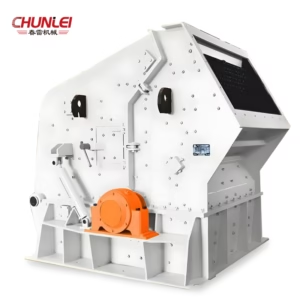
Impact crushers are categorized into PF impact crushers and CI impact crushers. PF Impact crusher, also called small diameter impact crusher. CI Impact C...
Wolfram Ore Beneficiation Process
Process Introduction Wolframite is mostly quartz large vein type or fine vein type tungsten deposits, with coarse embedded particle size, which is easier to select and separate. ChunLei's separatio...
Welcome to Chunlei machinery website. We are a leading manufacturer and exporter of mining machinery in China with more than 30 years history in China.
We offer you one-stop solutions: online consultation --- customized solutions --- fast delivery --- comprehensive after-sales service
 Chunlei Mining Machinery