 Chunlei Mining Machinery
Types of Leaching Process in Gold Mining: Simple Guide for Miners
Anyone in the mining industry knows that finding the right methods for processing low-grade ores and refining refractory ores is a key factor in determining a mine’s profitability. As metallurgists often joke, “Leaching isn’t a cure-all, but without leaching, you have nothing.”
As a mining equipment supplier, we frequently hear customers ask: “Which leaching process is best suited for my ore?” or “Why do others have higher recovery rates than me using the same process?”
In reality, the choice of leaching process directly determines your investment costs and ultimate return. Today, let’s break down the main leaching processes in a relaxed, conversational way. Whether you’re planning a new project or upgrading an existing production line, after reading this article, you’ll have a clear understanding of these processes.
In this article, we will introduce:
- Heap Leaching: The "Cost-Saving Champion" for Low-Grade Ores
- Agitation Leaching: The "Recovery Guarantee"
- Pressure Leaching: The High-End Solution for "Tough Nuts"
- Bio-oxidation Leaching: Where Environmental Compliance Meets Profitability
- Ammonia Leaching: The Optimal Choice for High-Alkaline Ores
- Alkaline Leaching (Bayer Process): Tailor-Made for Bauxite
- Conclusion
Heap Leaching: The “Cost-Saving Champion” for Low-Grade Ores
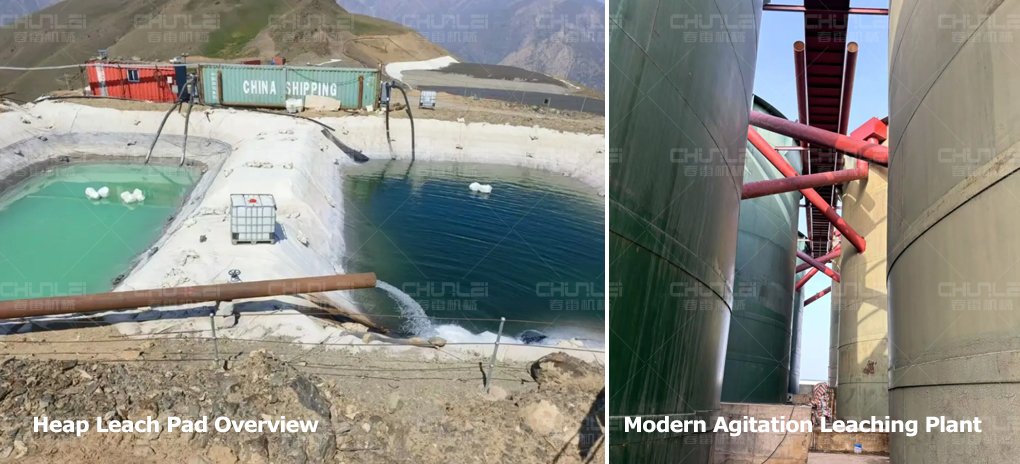
If you have large quantities of low-grade oxide ore or a limited construction budget, heap leaching is definitely your top choice. The principle is simple—pile the ore on a lined pad, use a spray or drip system to let the leach solution percolate through the heap, and “wash out” the valuable metals.
Advantages: Low capital investment, low energy consumption, large throughput.
Drawbacks: Long cycle times, weather-dependent, and if the ore is clay-rich, poor permeability can cause issues.
CHUNLEI Equipment Insight:
For heap leaching, liner integrity is critical, and spray distribution must be uniform. Our HDPE lining systems and corrosion-resistant spray pipe networks ensure no leach solution is wasted—every drop does its job. Paired with our vibrating screening equipment for ore preparation, you’ll achieve uniform particle size and better permeability.
Agitation Leaching: The “Recovery Guarantee”
For ores with decent grade where fast payback matters, agitation leaching is the more reliable choice. This involves mixing finely ground ore pulp with leach solution in agitated tanks for thorough reaction. The well-known CIL (Carbon-in-Leach) and CIP (Carbon-in-Pulp) processes fall into this category.
This approach offers high recovery rates and fast reaction kinetics, making it ideal for precious metals like gold and silver.
Featured Product: CHUNLEI High-Efficiency Double-Impeller Leaching Tank
Since we’re having a chat, let me get straight to the point. If you’re looking for agitation leaching equipment, you should check out our CHUNLEI High-Efficiency Double-Impeller Leaching Tank.
Why recommend it?
Ordinary tanks often suffer from solids settling, poor mixing, wasted reagents, and subpar recovery. Our design features a dual-impeller configuration paired with a flow-guiding draft tube, creating a “center-down, perimeter-up” circulation pattern throughout the tank.
Key Advantages:
- Recovery Rate Boost: No dead zones. Uniform pulp density and particle size distribution ensure maximum contact between reagents and mineral particles. When processing gold tailings, recovery rates consistently exceed 95%.
- Energy Efficient: Large-diameter impellers running at low speed consume less energy than single-impeller designs while also reducing mechanical wear on activated carbon (for CIL circuits).
- Superior Gas-Liquid-Solid Mixing: Hollow-shaft air injection produces fine, evenly distributed bubbles with excellent oxygen utilization—critical for cyanidation.
CHUNLEI High-Efficiency Double-Impeller Leaching Tank (Selected Models)
| Model | Tank Size D×H (mm) | Effective Volume (m³) | Impeller Speed (r/min) | Motor Power (kW) | Typical Application |
|---|---|---|---|---|---|
| XJ-10 | 2500×2500 | 6 | 65 | 2.2 | Small gold mines, labs, pilot plants |
| XJ-50 | 4000×4500 | 50 | 33.5 | 7.5 | Medium-scale concentrators, CIL/CIP |
| XJ-100 | 5000×5600 | 98 | 31 | 11 | Large-scale plants, high throughput |
| XJ-268 | 7500×8000 | 268.6 | 21 | 22 | Extra-large mines, industrial-scale production |
Pressure Leaching: The High-End Solution for “Tough Nuts”
When dealing with stubborn sulfide ores or complex deposits like laterite nickel, conventional agitation leaching often falls short. That’s where pressure leaching comes in.
Under high temperature and pressure, chemical reactions accelerate dramatically, breaking down resistant mineral structures and achieving exceptional metal recovery.
CHUNLEI Recommendation:
This process demands equipment with excellent corrosion resistance and pressure tolerance. While we don’t manufacture pressure vessels, we supply matching corrosion-resistant pumps and high-pressure piping and valves to ensure safe, stable material transfer under extreme conditions.
Bio-oxidation Leaching: Where Environmental Compliance Meets Profitability
With tightening environmental regulations, bio-oxidation is gaining traction. This approach uses acid-tolerant bacteria to oxidize sulfide minerals that encapsulate metals, freeing them for recovery. No autoclaves needed—it offers low energy consumption and minimal environmental impact, making it particularly suitable for treating refractory gold ores containing arsenic or sulfur.
A quick story:
One client switched from roasting to bio-oxidation. Although the cycle was slightly longer, operating costs dropped significantly, and environmental approvals came through smoothly.
Ammonia Leaching: The Optimal Choice for High-Alkaline Ores
If your ore is high in calcium and magnesium, using sulfuric acid leaching will consume huge amounts of acid, driving costs sky-high. Ammonia leaching offers a way out. It uses ammonium hydroxide to selectively complex metals like copper and nickel, leaving calcium and magnesium impurities largely untouched.
CHUNLEI Note:
Ammonia leaching demands excellent system sealing due to ammonia volatility. We offer integrated solutions including sealed reactors and vapor recovery systems to minimize ammonia loss and maintain a safe working environment.
Alkaline Leaching (Bayer Process): Tailor-Made for Bauxite
This process is specific to bauxite—the classic Bayer process. Concentrated caustic solution dissolves the aluminum, leaving red mud as residue. It’s a mature, large-scale industrial process.
Conclusion
After covering all this ground, the key takeaway is simple: there’s no “best” process—only the one that best fits your ore.
As mining equipment suppliers, we at CHUNLEI don’t just sell equipment. We aim to help you:
- Run Tests: Test your ore samples, determine leachability, and define the optimal process.
- Size Equipment: Tailor the equipment configuration to your flowsheet—whether it’s heap leach spray systems or double-impeller leaching tanks, we’ll provide the optimal setup.
- Support Operations: From installation and commissioning to operator training, we stay with you to ensure your line delivers profitability from day one.
If you’re grappling with low-grade ore challenges or looking to boost recovery rates at your existing plant, drop a comment or message me directly. Share your ore data, and I’ll help you figure out which “leaching combination” works best for you!