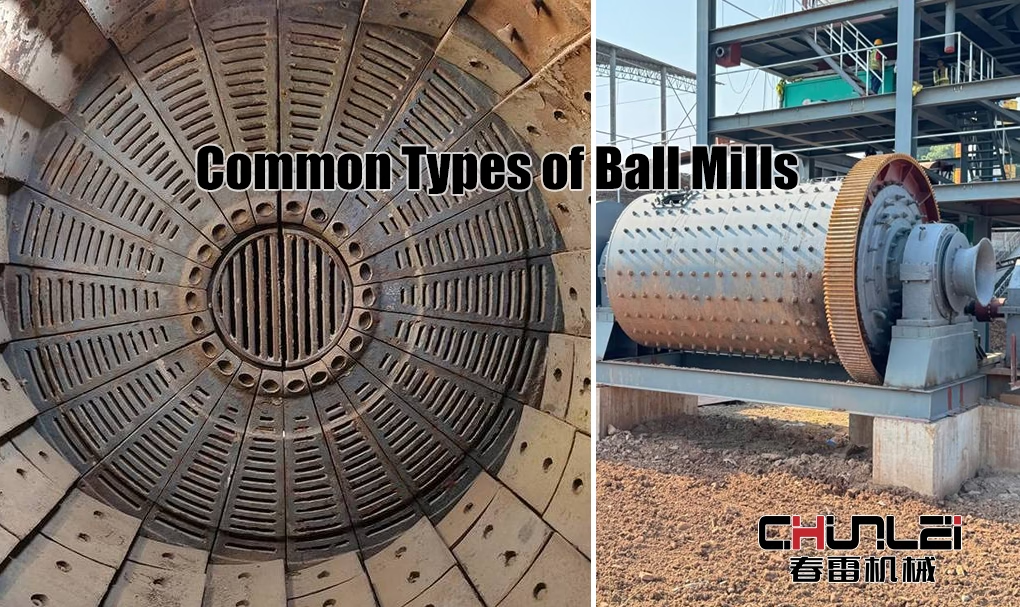
Ball mills are commonly used equipment in grinding processes, primarily relying on rotating cylinders and grinding media (steel balls, ceramic balls) to process materials. They are suitable for pulverizing various ores and materials in industrial production such as cement, mineral processing, silicate products, new building materials, and refractories. Based on different ore discharge methods, they can be classified into grate-type ball mills and overflow-type ball mills.
Similarities and Differences Between Grate-Type and Overflow-Type Ball Mills
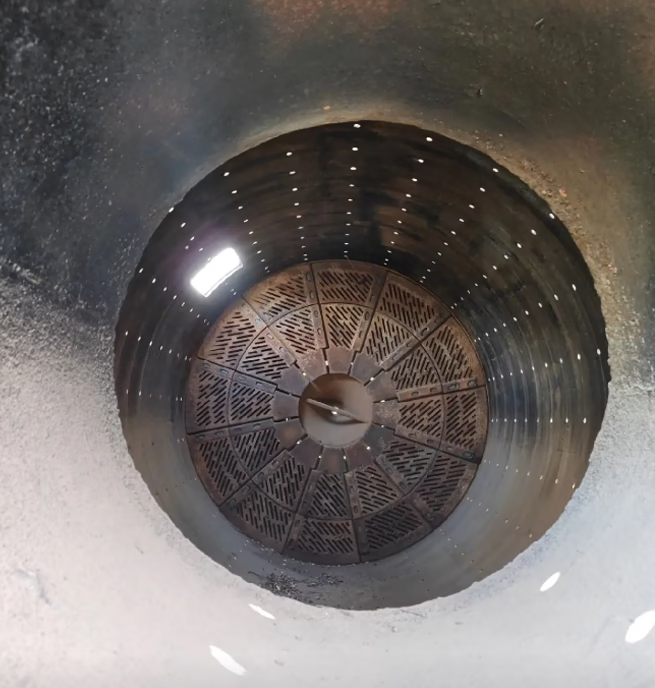
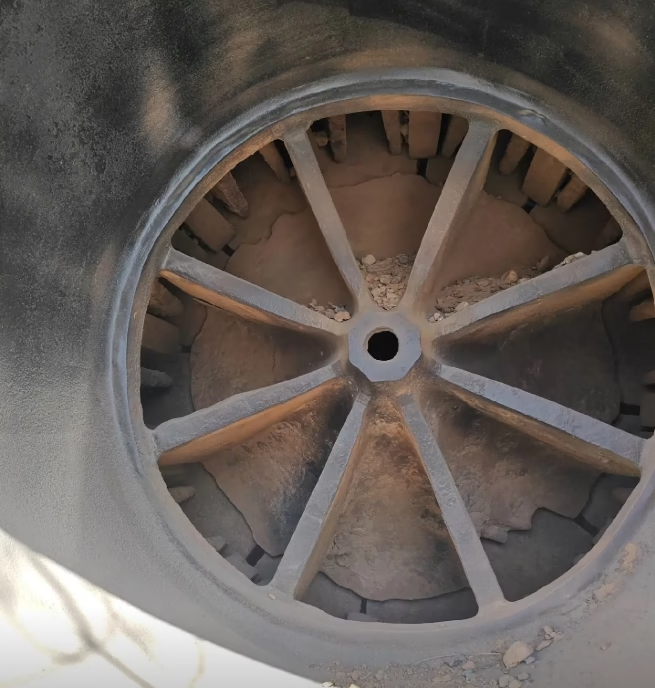
Both grate-type and overflow-type ball mills are critical for wet grinding operations. Their core distinction lies in discharge mechanisms, which directly determine their performance characteristics and applicable scenarios. The fundamental distinction between grate-type and overflow-type ball mills lies in the grate plate installed at the discharge end.
Grate-type mills are emblematic of wet grinding processes pursuing high throughput and grinding efficiency. Their design core emphasizes forced, rapid discharge to prevent over-grinding and enhance production capacity. Overflow ball mills lack a grate plate at the discharge end, relying entirely on the pulp’s own momentum for discharge. They represent a classic choice in wet grinding for their simple structure and fine grinding capabilities, characterized by discharge achieved through the natural overflow of the pulp.
Key Feature Differences
Grid-Type Ball Mill:
Forced Discharge: Only pulp meeting particle size requirements passes through, while coarse particles and grinding media are retained for further grinding.
Pulp Level Elevation: An elevation device behind the grid plate lifts the pulp to a higher discharge hollow shaft position, creating discharge momentum.
Overflow Type Ball Mill:
Natural overflow: When the continuously fed pulp level inside the cylinder exceeds the lower edge of the discharge hollow shaft neck, it automatically and continuously overflows from the shaft neck.
No forced screening: The discharged pulp may contain particles that have just met or are close to meeting the requirements, and even a small amount of extremely fine particles.
The core differences between the two are summarized in the following table format:
Comparison Dimensions
Overflow Ball Mill
Grid-type ball mill
Core Structure
No grate plate at discharge end; ore discharges via overflow
Discharge end equipped with grid plate
Discharge Method
Gravity flow, gentle
Forced, rapid
Slurry Level in the Cylinder
Higher
Lower
Grinding Time
Longer
Shorter
Product Particle Size
Finer grinding, but prone to “overgrinding” causing pulverization
Coarse and uniform, minimal overgrinding
Processing Capacity
Lower
Higher (10-25% higher than comparable models)
Energy Efficiency
Relatively higher energy consumption per unit product
Typically lower
Maintenance Complexity
Extremely low; simple and reliable structure
Higher (requires grid plate maintenance)
Are grid-type and overflow-type ball mills suitable for dry grinding or wet grinding?
Both can be used for dry grinding, but it is highly discouraged. They are fundamentally designed for wet grinding, and using them for dry grinding may result in excessive capital investment and high wear rates.
Theoretically feasible but strongly discouraged due to fundamental design conflicts.
Working Principle
Utilizes water (or liquid) as a medium to transport, cool, and convey qualified particles.
Relies on airflow or natural discharge, yet the cylinder design hinders efficient material removal and cooling.
Key Issues
None. System operates smoothly.
1. Severe Overgrinding and Temperature Rise: Extended residence time causes material to slurry and overheat.
2. Poor discharge: Without liquid entrainment, dry powder struggles to pass smoothly through grate plates or overflow ports, causing frequent blockages.
3. Dust explosion risk: Friction within the sealed cylinder generates static electricity and dust clouds, posing extreme hazards.
4. Extremely low efficiency: Violates fundamental design principles, resulting in high energy consumption and low output.
Grid Type and Overflow Type Ball Mills: Suitable Applications
Grid type and overflow type ball mills are primarily suited for wet grinding applications. However, due to their differing discharge mechanisms, their optimal applications are clearly distinguished. For scenarios prioritizing throughput and efficiency while preventing overgrinding, the grid type is recommended. For applications emphasizing product fineness and requiring simple, reliable equipment, the overflow type is preferred. Typical applications for each ball mill type are compared as follows:
Fine product size, operational reliability, simple structure
Typical Closed-Circuit Equipment
Often paired with spiral classifiers
Often paired with hydrocyclones
Product Particle Size Characteristics
Produces relatively coarse and uniform particle size with minimal over-grinding.
Produces finer particle size but prone to pulverization (overgrinding).
Ore Property Adaptability
Suitable for hard ores requiring coarse grinding particle size.
Suitable for applications requiring fine grinding or where ore is inherently prone to pulverization.
Selection Criteria for Grid Type and Overflow Type
Investment and Maintenance: Grid Type: Initial investment is slightly higher, and requires regular maintenance or replacement of grid plates, resulting in higher maintenance costs. Overflow Type: Simple structure, low maintenance costs, and more reliable operation.
Power Consumption and Efficiency: When processing the same ore to the same fineness under identical conditions, grate types typically exhibit lower energy consumption per unit because of faster discharge, reduced over-grinding, and higher overall efficiency.
Conclusion
If your primary goal is high throughput and efficiency, and you are in the front end of the grinding process, choose the grate type.
If your primary goal is to obtain ultra-fine products, and you are in the back end of the grinding process or re-grinding operations, choose the overflow type. CHUNLEI has consistently led the mineral processing industry. We provide complete crushing and mineral processing equipment and solutions. We serve clients worldwide. Our equipment is renowned for reliability, efficiency, and superior performance. We offer end-to-end support, including design, manufacturing, installation, and after-sales service. If you are planning to build or upgrade such projects, feel free to contact us anytime.
Zinc Ore Beneficiation Process
Process Introduction The core of zinc ore beneficiation technology is flotation, which realizes the effective recovery and grade improvement of zinc minerals through the steps of pretreatment, roughin...
Molybdenum (commonly referred to as “molybdenum”) is a critical industrial metal prized for its high strength, corrosion resistance, and heat tolerance. Though less well-known than metals like copper or gold, it is indispensable in modern industr...
Titanium Ore Beneficiation Process
Process Introduction The titanium ore beneficiation process is a complex and multi-step process, mainly including crushing, grinding, beneficiation and smelting.Titanium concentrate is the raw mat...
A high-quality gold mine tailings dewatering system is far more than a simple assembly of machinery; it represents a strategic decision crucial to the future sustainable development of the mine. A good dewatering system is not only reflected in c...
Welcome to Chunlei machinery website. We are a leading manufacturer and exporter of mining machinery in China with more than 30 years history in China.
We offer you one-stop solutions: online consultation --- customized solutions --- fast delivery --- comprehensive after-sales service
 Chunlei Mining Machinery