Gold carbon, as the name suggests, refers to gold-loaded activated carbon—activated carbon that has adsorbed gold and silver. Leaching means extraction. The gold carbon leaching plant refers to the process in the carbon-in-pulp gold extraction process where, after gold is fully adsorbed by the activated carbon, it is extracted from the adsorption tank. The gold carbon leaching plant primarily encompasses the following stages: impurity removal, pre-leaching concentration, leaching and adsorption, desorption electrolysis, hydrometallurgy, activated carbon regeneration, tailings filtration, and wastewater treatment.
Pre-Cyanidation Preparations
The objective of pre-cyanidation work is to process the raw ore into a slurry meeting specified requirements, which directly determines gold recovery rates and input costs.
Stage 1: Crushing and Screening
Raw ore is crushed to an appropriate particle size using jaw crushers and cone crushers. Vibrating screens separate particles of varying sizes, preventing excessively coarse material that increases grinding load and overly fine particles that may affect subsequent slurry concentration.
Stage 2: Grinding and Classification
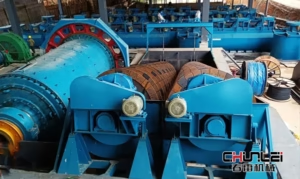
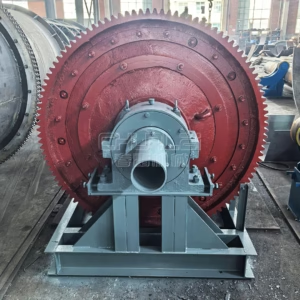
The crushed ore is further ground in ball mills to achieve single-particle liberation of gold minerals from gangue. This step is critical: insufficient fineness prevents gold exposure, while excessive fineness generates excessive tailings slurry, increasing subsequent costs.
Stage 3: Thickening and Dewatering
Thickeners are used to obtain a concentrated pulp meeting cyanide leaching requirements, with partial water recovery.
Stage 4: Impurity Removal
Eliminate or reduce gold entrapment in the ore—the core of gold processing. Common methods include roasting.
Stage 5: Slurry Conditioning
Before adding cyanide, lime or sodium hydroxide is introduced to prevent volatilization and decomposition of the pulp during cyanidation, minimizing interference with the leaching process.
Gold Carbon-in-Pulp Leaching Plant Process Flow
The “Gold Carbon-in-Pulp Leaching Plant Process Flow” refers to the complete process within the “Carbon-in-Pulp (CIP)” or “Carbon-in-Leach (CIL)” method. This encompasses the safe, efficient, and quantitative removal, separation, washing, and transportation of gold-adsorbed activated carbon from the adsorption tank system to the subsequent stage (desorption and electrolysis workshop).
Comparison Dimensions
Carbon-in-Pulp (CIP) Process
Carbon-in-Leach (CIL)
Comparison Summary and Impact
Core Process Sequence
Leaching first, adsorption second.
Leaching and adsorption occur simultaneously.
CIP employs a two-stage physical separation process, while CIL utilizes a single-stage chemical synergistic approach. This fundamental distinction dictates the plant’s process layout.
Cyanide leaching and activated carbon adsorption are performed sequentially in two independent, series-connected tank sets.
Cyanide leaching and activated carbon adsorption are performed concurrently within the same series of tanks.
Process Flow Diagram
Ore → [Leaching Cell Group] → [Adsorption Cell Group (CIP)]
Ore → [CIL Integrated Leaching/Adsorption Tank Array]
CIP features a longer process flow with clearly defined zones; CIL offers a compact process with more centralized equipment.
(After leaching, the pulp is pumped into the adsorption cells)
(Leaching and adsorption occur within the same tank column)
Activated Carbon Addition Point
Added to separate adsorption cells. No activated carbon is present in the leaching cells.
Directly added to the leaching tank. Activated carbon is present starting from the first leaching tank.
In CIL, gold is adsorbed immediately upon dissolution, whereas in CIP, adsorption begins only after complete leaching.
Protection of “Dissolved Gold”
Poorer. Gold dissolved during leaching may be lost due to “gold-scavenging” substances in the pulp (e.g., carbonaceous matter, fines) before entering the adsorption system.
Excellent. Gold is adsorbed by nearby activated carbon immediately upon dissolution, forming an “Au(CN)₂⁻ – activated carbon” protective layer that significantly minimizes gold scavenging losses.
This represents the core advantage of CIL for treating carbonaceous or complex ores.
Cyanide Consumption
Relatively low. Leaching occurs in a carbon-free environment, where cyanide primarily reacts with gold and silver, enabling more controlled consumption.
Relatively high. Activated carbon catalyzes the oxidative decomposition of cyanide (especially under high pH and oxygen conditions), leading to additional cyanide consumption.
CIP typically offers lower reagent costs.
Process Flow Control
Easier to control. Leaching and adsorption function as two independent units, allowing separate optimization of parameters (e.g., leaching time, carbon concentration, carbon regeneration rate).
Control is more complex. Leaching and adsorption interact, requiring balanced conditions for both. Carbon presence may affect pulp properties (e.g., viscosity, oxygenation).
CIP provides greater operational flexibility and is suitable for ores with stable properties.
Applicable Ore Types
Suitable for “clean” ores containing little to no gold-sequestering substances (e.g., natural carbonaceous materials, highly reactive fines).
Particularly suitable for “gold-stealing” ores, especially carbonaceous refractory gold ores. Also widely used for standard ores.
The presence of “gold-trapping carbon” is the key factor in selecting between CIP and CIL.
Investment and Operating Costs
Slightly higher equipment investment (requires two independent tank systems), but chemical costs (cyanide) may be lower.
Equipment investment is more compact (single tank array), but chemical costs and carbon losses may be higher.
Selection requires a comprehensive economic evaluation balancing ore characteristics, reagent costs, and capital investment.
Conclusion
CIL (Carbon-in-Leach) is currently the most widely applied process. Due to its strong adaptability to complex ores and high recovery rates, it has become the standard choice for most newly constructed gold processing plants.
CIP (Carbon-in-Pulp) retains advantages of low reagent costs and flexible control when treating specific “clean” ores, but is virtually ineffective against carbonaceous gold deposits.
If your ore contains carbon that “steals gold,” CIL is essential. If your ore is “clean,” both CIP and CIL are viable options—requiring specific comparison of criteria. Should you have this process, feel free to contact CHUNLEI customer service anytime.
Titanium ore processing is a complex and precise operation that presents challenges alongside significant opportunities. Efficient separation forms the foundation for transforming raw ore into high-value concentrates. Experience teaches us that d...
A variety of models are available | Get the free price list!
Wet ball mill, also called wet energy saving lattice type ball mill, adopts grooved ring liner, which increases the contact surface of ball and ore, str...
Kaolin, also known as “china clay,” is a white, fine-grained clay primarily composed of kaolinite minerals. Alongside mica, quartz, and calcium carbonate, it ranks among the four major non-metallic minerals. Possessing excellent plasticity, refra...
In the field of gold mining, ore type directly determines the optimal beneficiation process and equipment selection. Understanding the characteristics of different gold ore types not only enhances recovery rates but also significantly reduces ope...
Welcome to Chunlei machinery website. We are a leading manufacturer and exporter of mining machinery in China with more than 30 years history in China.
We offer you one-stop solutions: online consultation --- customized solutions --- fast delivery --- comprehensive after-sales service
 Chunlei Mining Machinery