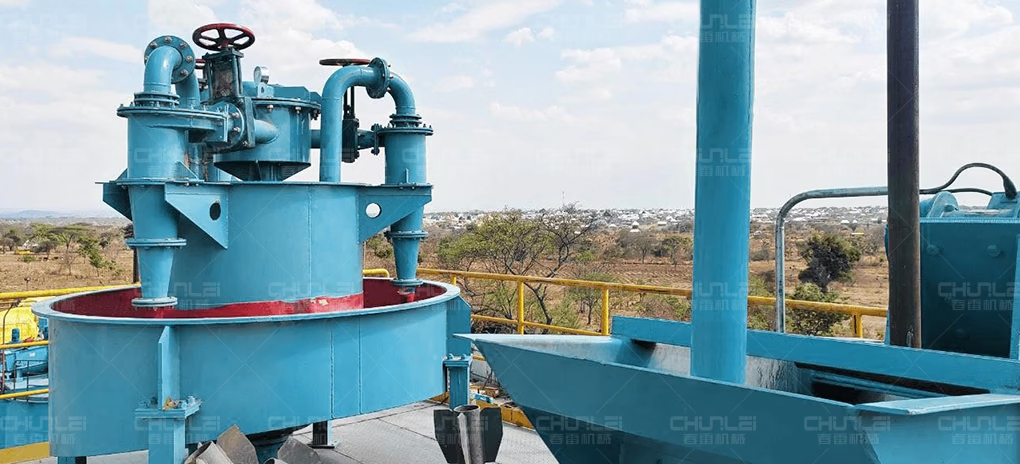
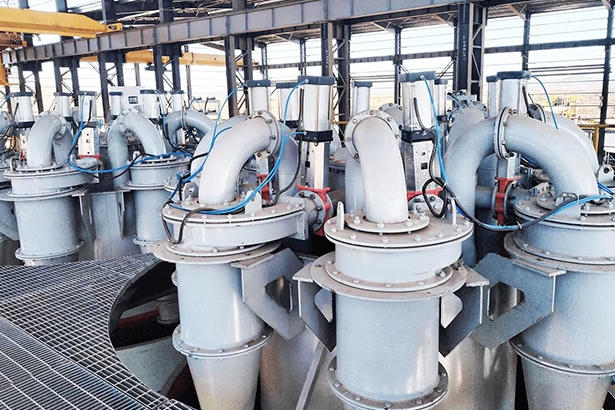
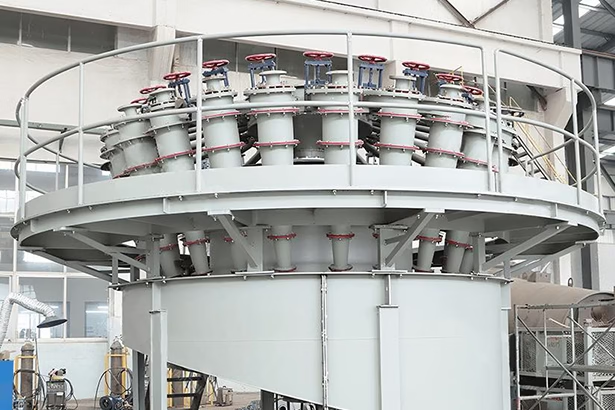
The phenomenon of “coarse particle carryover” in hydrocyclone overflow appears deceptively simple yet can disrupt the entire system’s equilibrium. It not only impacts grinding and classification efficiency but also affects the final grade of the concentrate. Over three decades, we have addressed numerous similar cases. Often, attention is focused solely on conventional parameters like hydrocyclone size, operating pressure, and feed concentration, while deeper, more subtle factors are overlooked. This issue frequently represents the most vulnerable link in the circuit’s flow balance.
To resolve this problem, one must first understand the core pulse of the entire hydrocyclone process—the coarse particles. Only by comprehending them can classification precision be stabilized at its source, thereby enhancing efficiency and reducing costs.
How do coarse particles form in hydrocyclones?
The optimal separation process in hydrocyclones achieves precise particle size classification. Under centrifugal force, the feed slurry forms distinct inner and outer swirl layers: coarse particles migrate toward the wall, descend the cone, and exit through the underflow outlet; fine particles converge in the central low-pressure zone and discharge via the overflow pipe.
However, the presence of coarse particles in the overflow indicates a problem: particles intended for the underflow have instead entered the overflow outlet. This not only reduces classification efficiency but also contaminates the fine product, potentially impacting subsequent processes like flotation and thickening. What causes this issue? This article explores the root causes.
Wear of the Vortex Detector and Top Angle Nozzle
The vortex detector, also known as the overflow pipe, and the top angle nozzle, also called the underflow nozzle, are core classification components. Their wear is the root cause of coarse particles entering the overflow product. Erosion enlarges the aperture of the vortex detector, allowing fine particles mixed with coarse particles to bypass classification and enter the overflow pipe directly. Wear on the top corner nozzle lowers the separation interface, weakening centrifugal force. Fine particles that should enter the overflow instead flow toward the bottom, while coarse particles, lacking sufficient gravitational force, mix into the overflow. This ultimately causes a steep decline in classification efficiency. CHUNLEI offers wear-resistant components to extend service life.
Improper Control of Feed Pressure, Concentration, and Flow Rate
Feed pressure, concentration, and flow rate form a delicate dynamic equilibrium—three critical operational variables that must interact within a narrow optimal window. Many mistakenly assume system stability as long as the pump runs continuously. However, pump wear or minor blockages in feed pipelines can cause fluctuations, known as pulsations. These seemingly minor pulsations act like instantaneous disturbances or seismic events, sufficient to disrupt the settling momentum of coarse particles and divert them into the overflow channel.
Model or component mismatch
There is no universal cyclone; specific processes require matching cyclones. Cyclone selection and adaptation are fundamental to determining separation performance. Incorrect selection leads to performance defects, and many issues (such as coarse particle overflow) cannot be resolved through simple operational adjustments.
Based on past experience, cyclones used for fine sand recovery and those for classification in grinding circuits differ in design and performance. Interchangeable use inevitably leads to separation failure. Cyclone selection must consider feed particle size, cut point, and processing capacity. Errors in any of these factors will result in coarse particles appearing in the overflow.
Variations in Particle Size, Density, and Viscosity
Slurry properties form the fundamental physical basis governing cyclone separation behavior, where particle size, density, and viscosity constitute an interactive, dynamically linked critical triangle. This triadic relationship collectively shapes the force and motion patterns of particle clusters within the cyclone.
Excessively high slurry viscosity severely undermines the effectiveness of centrifugal sedimentation: on one hand, it drastically reduces the terminal velocity of particle settling, making it difficult for coarse particles to achieve sufficient radial migration velocity; On the other hand, high viscosity suppresses fluid tangential velocity and inner vortex stability, causing the flow field to “dull” and reducing separation clarity. This directly manifests as coarse particles becoming “trapped” in viscous medium and entering the central overflow with the main flow, resulting in comprehensive degradation of classification accuracy.
Internal Turbulent Flow Disturbance
Within the cyclone, a highly ordered laminar flow field is crucial. Any disturbance to the internal flow directly compromises classification precision. The core issues lie in three aspects: “short-circuiting flow” allows some coarse particles to bypass adequate separation and take a “shortcut” directly from the feed inlet into the overflow pipe; “Gas-core instability” disrupts equilibrium in the central low-pressure zone, causing chaotic particle trajectories and misdirecting coarse particles into the upward flow; even minor localized “blockages” prevent particles from separating along the intended path. Therefore, maintaining flow stability and channel patency is critical to preventing coarse particle misclassification and ensuring separation precision.
How to quickly and accurately determine if coarse particles are entering the overflow outlet?
When coarse particles appear at the hydrocyclone overflow outlet, a systematic diagnostic process can be followed for rapid and precise identification. This process adheres to the principle of “from outside to inside, from easy to difficult,” prioritizing the most common and easily adjustable factors.
Step 1: Rapid On-Site Inspection
- Observe the underflow discharge pattern: An “umbrella-shaped” spray with a central air column indicates normal operation. A rope-like or columnar discharge indicates a blocked or excessively restricted underflow nozzle. This is the most direct and common cause of coarse particles entering the overflow. Immediately clean or adjust the underflow nozzle.
- Complete dispersion or absence of underflow: Excessive wear or complete detachment of the underflow outlet causes excessive underflow production, leading to strong “suction” in the overflow.
- Feed pressure: Compare with design or historical stable values. A significant pressure drop is the primary suspect.
- Feed concentration/flow rate: A sudden increase in concentration or excessive flow rate directly causes “coarse particle carryover.”
Step 2: Critical Parameter Adjustment and Verification
- If bottom discharge blockage is suspected: Under safe conditions, temporarily increase bottom discharge rate or perform flushing. Observe whether the bottom discharge pattern resumes an umbrella shape, while sampling to check if overflow particle size rapidly decreases.
- If suspecting insufficient pressure: Slowly increase feed pump frequency or open the feed valve to restore pressure to normal range. Monitor changes in overflow particle size, which typically respond quickly.
- If suspecting excessive concentration: Appropriately supplement dilution water to the feed pipe and observe the effect.
If overflow particle size improves significantly within minutes after these simple adjustments, the root cause is likely unstable operating parameters.
Step 3: Conduct an In-Depth Diagnosis
If the first two steps prove ineffective, consider more complex internal or equipment issues. Troubleshoot in the following order:
Check Feed Properties: Verify if feed particle size has suddenly increased beyond the cyclone’s processing capacity.
Inspect Key Component Wear:
Underflow Nozzle: Disassemble and check for wear-induced enlargement (measure with calipers).
- Overflow Pipe: Inspect inner wall wear.
- Lower Cone Section: Use a flashlight to inspect the inner wall for severe grooving or uneven wear, which disrupts laminar flow.
- Check “Air Nucleus” Stability: Observe the overflow discharge pattern. Violent splashing, pulsation, or discontinuous flow may indicate instability or rupture of the central air nucleus, signaling flow field disruption. This is often linked to feed pressure fluctuations, air entrainment, or severe wear.
- Check installation and blockages: Verify the cyclone is installed vertically with all flange connections properly aligned. Inspect internal components like the feed inlet and overflow pipe for localized blockages or scaling caused by foreign objects.
How to Ensure Fine Particles Remain in the Overflow of Hydraulic Cyclones?
Optimized Process Design
Clearly define the target separation particle size and feed characteristics—such as concentration and density—to precisely calculate the cyclone diameter, cone angle, and dimensions of the overflow pipe and bottom outlet pipe. These factors directly determine separation accuracy and processing capacity.
CHUNLEI offers customized solutions based on specific ore properties and process requirements, establishing the hardware foundation for long-term efficient operation.
Feed Stability
Efficient separation requires uniform, stable feeding. Maintain constant feed pressure and flow using pressure stabilizing tanks or variable-frequency pumps to eliminate centrifugal force interference from pulsed feeding.
Intelligent Control & Dynamic Operation
Monitor critical parameters like pressure, concentration, and particle size in real time. Automate data feedback and implement smart adjustments based on operator expertise for time-saving, labor-saving precision.
Regular Inspection and Maintenance
Conduct periodic checks, focusing on wear of vulnerable components like underflow nozzles, sand discharge ports, and cone liners. CHUNLEI employs high-performance wear-resistant materials to extend spare part lifespan.
Frequently Asked Questions
Question 1: Excessive fine particles in underflow (underflow runaway)
Answer: Replace worn sand discharge nozzles; increase feed pressure; reduce feed concentration; verify cyclone size compatibility.
Question 2: Excessive coarse particles in overflow (overflow coarse retention)
Answer: Clean or replace undersized sand discharge nozzles; appropriately reduce feed pressure; inspect overflow pipe wear.
Question 3: Overall classification efficiency decline
Answer: Inspect and replace all worn components; stabilize feed properties; verify correct equipment selection.
Question 4: Umbrella-shaped spray in underflow
Answer: Reduce sand discharge port size; increase feed concentration.
Question 5: High-concentration rope-like discharge in underflow
Answer: Increase sand discharge port size; decrease feed concentration.
Problem 6: Insufficient throughput or pressure fluctuations
Solution: Repair feed pump and piping; stabilize feed tank liquid level; clear blockages.
Problem 7: Severe equipment vibration or abnormal noise
Solution: Inspect foundation stability; check for loose internal components or severe wear; ensure uniform feeding.
Problem 8: Slurry leakage at joints
Solution: Tighten or replace seals; verify flange mating surfaces are flush.
Problem 9: Excessive Liner Wear
Solution: Select more wear-resistant liner material; inspect feed for abnormally hard or sharp contaminants.
Problem 10: Separation Particle Size Not Meeting Standards
Solution: Adjust combination of sand discharge nozzle and overflow pipe dimensions; modify feed pressure or concentration; evaluate need for replacing hydrocyclones with different specifications.
Problem 11: Uneven distribution across multiple cyclones
Solution: Inspect and clean the feed distributor; ensure consistent sand spout sizes for all cyclones; adjust branch valves.
Conclusion
The retention of coarse particles in hydrocyclone overflows is a systemic issue. Its complete resolution relies not only on a deep understanding of the equipment’s operating principles but also on comprehensive knowledge of the entire process flow and continuous, precise monitoring. The core problem typically stems from a combination of key component wear, improper operating parameters, mismatched equipment selection, fluctuations in raw material properties, and internal flow field turbulence.
CHUNLEI recommends adopting a systematic approach. Continuous performance monitoring is essential. Proactive measures must be implemented. This ensures hydrocyclones operate at optimal classification efficiency. It delivers superior product quality. It also reduces operational costs.
CHUNLEI Machinery is China’s leading manufacturer of mineral processing equipment, specializing in B2B solutions. Our product line covers the entire process chain: crushing, grinding, beneficiation, screening, and drying. We provide full-cycle support including design, manufacturing, installation, training, and after-sales service. We are committed to delivering high-quality, customized, and efficient solutions to help clients achieve their operational goals.
Contact CHUNLEI today to explore your Hydrocyclone needs.
 Chunlei Mining Machinery