With over 30 years in mineral processing, CHUNLEI has observed that fine gold recovery rates in many placer gold operations fall below 50%. Most of this loss stems from technical reasons. True purification requires optimizing the entire washing plant process, not just individual stages. This article comprehensively analyzes the technologies and core equipment for recovering fine gold, ensuring maximum recovery rates.
Why Do Traditional Panning Trays Cause Significant Gold Loss?
The primary reason traditional simple panning trays result in substantial fine gold loss is their inability to control turbulent water flow generated by large rocks. This forceful current easily carries fine gold particles through the tray’s gaps, preventing their settling and recovery. Additionally, the structural design of rudimentary pans is flawed. During operation, denser black sands (like magnetite) readily form a compacted, impermeable layer at the pan’s base. This prevents fine gold particles from being filtered out, forcing them to slide over the compacted surface layer with the tailings and be lost. Traditional simple gold pans primarily rely on natural water flow and gravity for separation. If the feed material is not screened beforehand, it further exacerbates gold particle suspension and overflow. Therefore, particle size classification before gold recovery is essential. Traditional gold pans lack these critical steps.
Factors Contributing to Gold Losses:
Factor Categories
Specific Causes
Consequences
Key Mechanism
Water Flow Issues
Large stones causing turbulence
Fine gold is washed out of the pan
Rocks generate unpredictable strong turbulence, producing lift greater than the settling velocity of fine gold particles. This suspends gold grains, allowing them to be carried away by the water flow.
Lack of flow control
Unable to maintain stable laminar flow
Relying on natural water flow fails to create a stable, slow “blanket flow,” which is unfavorable for fine gold settling.
Subgrade Issues
Compacted and hardened bedding layer
Forms a hard layer, preventing new gold particles from penetrating
Heavy black sands (e.g., magnetite) accumulate between filter bars. Without mechanical agitation, they compact into dense layers forming an “impermeable base plate.”
Saturated bedding layer
Loss of capture capability
Once voids are filled, subsequent gold particles cannot adhere and slide off the surface into tailings.
Operation and Design
Unscreened raw materials
Mixed sizes of material exacerbate water flow issues
Large rocks directly disrupt the flow field while occupying space, reducing the effective area for fine gold settling and capture.
Reliance on single-stage gravity separation
Poor performance for fine gold and flake gold
Without auxiliary separation forces like pulsation or vibration, it is difficult to effectively separate minute gold particles from light-weight silt and sand and direct them into the bedding layer.
Comprehensive Results
Combination of all the above factors
Significant loss of fine gold (especially sub-millimeter grade) and flake gold
Turbulence prevents settling, while the compacted layer blocks capture, ultimately causing fine gold to be carried away with the tailings.
How to separate ore with high clay content?
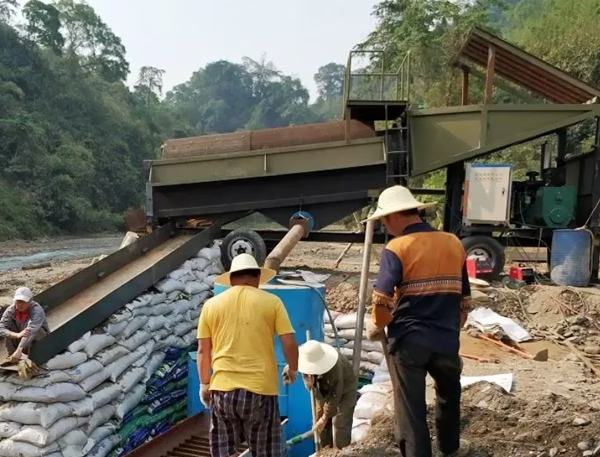
Conventional screening equipment cannot fully separate ore with high clay content. Due to its properties, clay carries gold particles away with waste rock. Standard screens only clean the rock surface and cannot break down gold particles within the clay, resulting in low gold recovery. The rotary drum screen effectively addresses this issue. Featuring a long cylindrical design lined with wear-resistant rubber or steel plates, its continuous rotation drives internal lifting plates to repeatedly lift and drop the material, creating friction between rocks. By controlling the screening duration, the drum screen ensures all clay transforms into a slurry before reaching the screening zone. Only when clay is fully liquefied do gold particles release completely in the screening zone, significantly boosting gold recovery rates.
Optimization Recommendations:
【Water Pressure Enhancement】 Install high-pressure water spray arrays on the drum’s inner wall. This increases water penetration by 40%, causing clay clumps to disintegrate upon contact, breaking down compacted material at its source. 【Residence Time Enhancement】 Dynamically adjust the drum inclination to a low-slope mode, extending material residence time by 50%. Difficult-to-process clay undergoes thorough tumbling and immersion within the drum, doubling decomposition efficiency. 【Screening Synergy】 Precise matching of outlet screen mesh size to jig feed specifications eliminates oversize accumulation and ensures uniform undersize particle size, achieving seamless integration between washing and classification.
Roughing Equipment
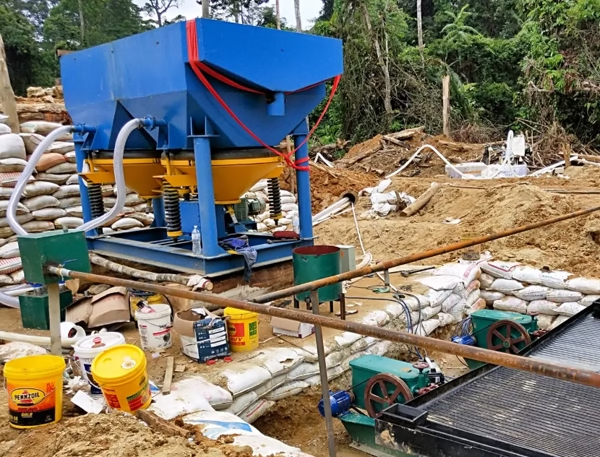
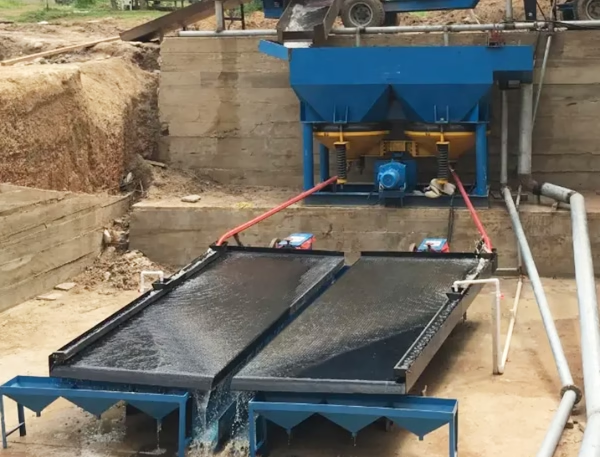
For unclassified coarse-grained gold, jigs are more suitable. They offer excellent buffering capacity against fluctuations in feed volume and particle size. Through vertical water pulsation driven by a diaphragm, the bed layer is periodically lifted. During the descent phase, density differences enable rapid sedimentation separation. Capable of processing materials across a wide particle size range of 1–20 mm, jigs exhibit high stability and are often the preferred equipment for roughing. For pre-classified fine-grained gold, pulsed sluices demonstrate superior performance, achieving higher concentration ratios with lower water consumption per unit. Evolving from fixed sluices, they employ bottom vibration or pulsed water flow to continuously fluidize the sand bed, creating dynamic conditions for heavy gold particles to penetrate downward. They excel at processing material under 6 mm, yielding modest concentrate output while significantly reducing the load on subsequent concentration stages.
Comparison Dimensions
Jig
Pulsating Flume
Core Principles
Utilizes a diaphragm to generate vertical water pulses, causing the material bed to periodically expand and contract.
Maintains sand layer fluidization (loose state) through bottom vibration or pulsating water flow.
Optimal Processing Granularity
Wide particle size range: >2 mm
Fine-grained size: <2 mm (especially post-screened material)
Feed Requirements
Highly adaptable, capable of directly processing unclassified raw ore with low sensitivity to feed rate and particle size fluctuations.
Typically requires pre-screened material, better suited for fine-grained materials with narrow particle size ranges.
Product Features
Relatively high concentrate yield, though subsequent concentration operations require greater effort.
Higher concentrate enrichment ratio with reduced concentrate volume, alleviating labor demands in final cleaning stages.
Water Consumption
Relatively high.
Relatively low.
Applicable Stages
Ideal primary roughing equipment for large-scale processing and high-recovery capture.
Better suited for selective or fine-grain recovery stages to obtain high-grade concentrates.
Key Advantages
High processing capacity, adaptable to fluctuations, and wide recoverable particle size range.
High enrichment ratio, water-efficient, high concentrate grade, and simplified subsequent processing.
Why is a centrifuge essential equipment for gold recovery?
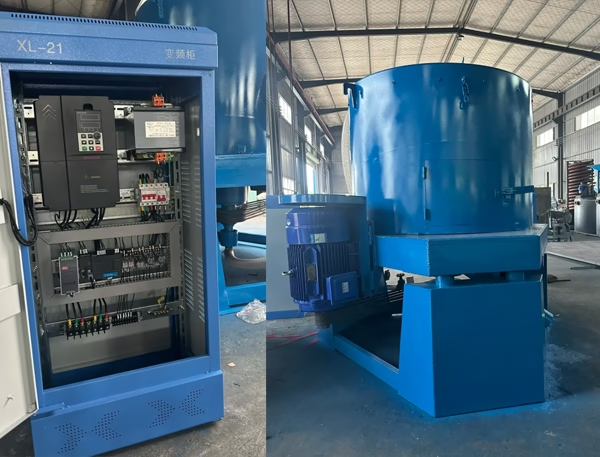
The water-jacketed centrifugal concentrator is the key apparatus for recovering fine gold, generating centrifugal forces up to 60 times that of gravity. This intense force significantly amplifies the weight difference between fine gold and sand particles, enabling the machine to efficiently capture micron-sized gold particles and effectively recover “flour gold” that traditional gravity equipment struggles to retain. Fine gold is extremely lightweight and easily washed away by water flow under normal gravity conditions. The centrifugal concentrator, however, uses high-speed rotation to force gold particles to adhere to and deposit along the inner wall of the rotating bowl.
Its core design lies in the fluidized water jacket system: water is continuously injected through micro-pores on the outer bowl wall, creating uniform back pressure. This prevents the sand layer from compacting and solidifying, maintaining a dynamically loose bed. Under the combined action of centrifugal force and water pressure, lighter sand particles are carried away by the water flow, while heavier gold particles overcome the water pressure and settle into the capture trough. To ensure long-term stable operation, the injected fluidizing water must undergo thorough filtration to prevent micro-pore clogging, maintaining separation efficiency and equipment reliability.
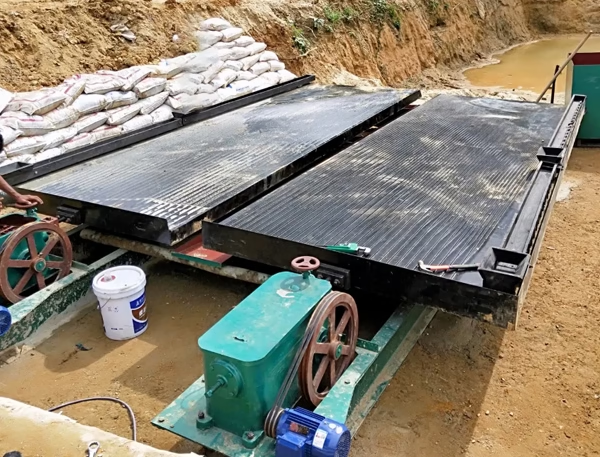
The 6-S Shaker is a powerful tool for purification and refinement.
The 6-S Shaker achieves efficient separation of high-purity gold from heavy sand through asymmetric reciprocating motion synergized with laminar water film flow. Under continuous rhythmic vibration, particles of differing densities separate: gold grains migrate longitudinally along the bed surface toward the far end driven by inertia, while lighter sand grains are carried laterally by water flow and discharged to the sides.
When the gold-black sand mixture enters the 6-S Shaker for final refining, a remarkable physical separation process unfolds. It glides forward slowly before being swiftly retracted. This alternating slow-fast motion acts like an invisible hand, continuously “rubbing” heavier particles (such as gold, with a specific gravity of 19.3) upward along fine striations on the bed surface. Simultaneously, a gentle stream of water flows over the bed like a brook, softly washing away the lighter sand and minerals (black sand like magnetite with a specific gravity of only about 5.0) from both sides.
Frequently Asked Questions
Question 1: Is there equipment that can automate the processing of large volumes of placer ore to improve efficiency? Yes. For large-scale operations, commonly used equipment includes: Vibrating Shaker: Such as the 6-S Shaker, which efficiently and continuously separates gold from heavy sands through asymmetric vibration and water flow, forming distinct gold bands for high-purity recovery. Centrifugal Gold Washer: Utilizes centrifugal force generated by high-speed rotation to significantly enhance gravity separation, capturing extremely fine flake and dust gold easily lost by traditional methods.
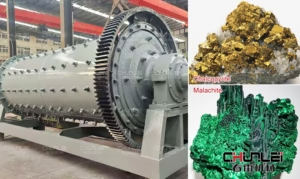
Question 2: After removing visible gold, how should I process black sand? Black sand often contains trapped gold particles. You should grind the black sand in a ball mill to release the gold, then process it again on a shaking table.
Question 3: How often should I clean the gold pan? Cleaning frequency depends primarily on black sand volume. Typically, clean every 2 hours.
Question 4: What is the processing capacity of mobile gold processing equipment? Capacity varies by model. CHUNLEI manufactures mobile units ranging from 10 tons per hour for small-scale operations to 200 tons per hour for large-scale mining.
Conclusion
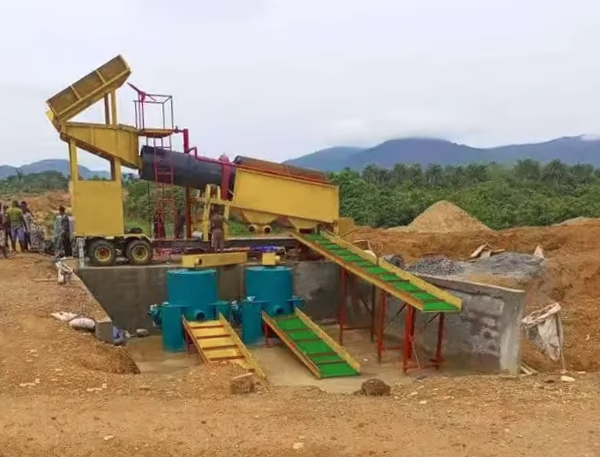
To enhance gold recovery rates, you must upgrade from simple gold pans to a system based on physical separation. First, the sand washer efficiently breaks down mud and removes adhesions, freeing trapped gold. Next, the grading screen separates particles by size for precise diversion. Coarse gold is captured by the jig, while fine gold undergoes deep enrichment in the centrifuge. Finally, the shaking table produces finished gold without chemical processing. This equipment chain maximizes output.
A high-quality gold mine tailings dewatering system is far more than a simple assembly of machinery; it represents a strategic decision crucial to the future sustainable development of the mine. A good dewatering system is not only reflected in c...
Molybdenum (commonly referred to as “molybdenum”) is a critical industrial metal prized for its high strength, corrosion resistance, and heat tolerance. Though less well-known than metals like copper or gold, it is indispensable in modern industr...
Copper-Lead-Zinc Ore Beneficiation Process
Process Introduction Copper-lead-zinc beneficiation process adopts mixed flotation-concentrate regrinding process, which can reduce the cost of milling and is easy to manage, and at the sa...
Malachite and chalcopyrite are two closely related copper minerals. Chalcopyrite is a primary copper ore, while malachite forms as a secondary mineral through the weathering and oxidation of chalcopyrite. Malachite often serves as an indicator fo...
Welcome to Chunlei machinery website. We are a leading manufacturer and exporter of mining machinery in China with more than 30 years history in China.
We offer you one-stop solutions: online consultation --- customized solutions --- fast delivery --- comprehensive after-sales service
 Chunlei Mining Machinery