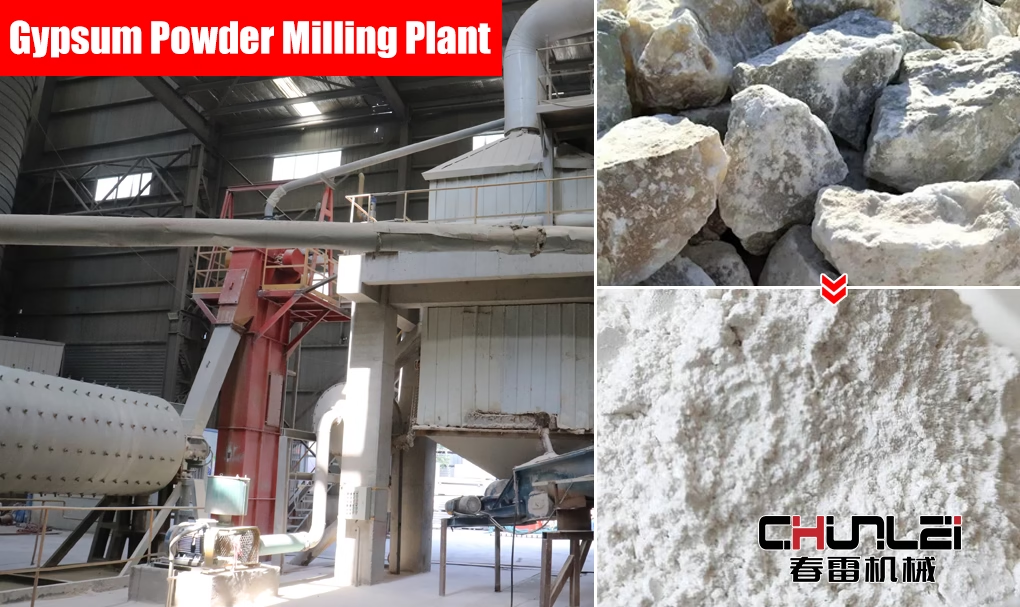
Gypsum powder is a white or grayish-white powder material produced from natural gypsum or industrial by-product gypsum through processes such as crushing, calcination, and grinding. As a vital raw material in the modern building materials industry—whether for high-end gypsum board or mold manufacturing—market demand for high-purity, ultra-fine, low-energy-consumption gypsum powder continues to grow. As a leader in the mining industry, CHUNLEI understands the market value that the right equipment can deliver to our customers.
Core Process Overview
Gypsum grinding is the critical step determining the final product’s performance and quality, closely interlinked with raw material pretreatment, calcination parameters, and classification systems.
1. Pre-processing: Crushing and Drying
Large gypsum blocks are crushed to an appropriate size using crushers. For blocks with moisture content as high as 10%-15%, drying in a kiln is essential to prevent blockages in subsequent stages. The selection of gypsum crushing equipment is primarily determined by the initial block size, hardness, production capacity requirements, and investment budget. Below is a comparison of mainstream crushing equipment:
Ideal for primary crushing: robust construction, high throughput, and relatively low cost. Suitable for the first stage of crushing in mining operations.
Particle size distribution is uneven; flaky material may be present in the product. Dust collection equipment is required.
Single-stage medium and fine crushing: utilizes hammer impact crushing with a high reduction ratio, capable of reducing large blocks to grinding mill feed size in a single pass.
Hammer heads wear rapidly; screen plates are prone to clogging when moisture content exceeds 12%. Significant noise and dust generation.
(≤600mm)
Impact Crusher
Medium-hard, brittle gypsum
≤20mm
Utilizes impact energy for crushing, producing well-shaped particles with minimal fines, making it ideal for producing well-graded aggregates. Energy consumption is higher than hammer crushers.
Impact plates and counter plates are susceptible to wear; sensitive to materials containing moisture or clay.
(≤800mm)
Double Roll Crusher
Medium and small blocks, sticky wet materials
2-10mm
Employs compression crushing, resulting in minimal over-crushing and low dust generation, suitable for sticky and wet materials. Commonly used for fine crushing of industrial by-product gypsum.
The construction of the grinding system represents the most critical technology, determining key factors such as output, fineness, and energy consumption.
Ball Mill—Specialized Ultra-Fine Powder Production Equipment
Advantages: Ball mills pulverize materials through the impact and grinding action between grinding media and raw materials within the cylinder. Prolonged grinding produces ultra-fine powders exceeding 800 mesh, suitable for high-value-added applications like ultra-fine gypsum powder and specialty gypsum powders. It also serves as a secondary fine grinding device.
Disadvantages: Low grinding efficiency and relatively high power consumption.
Advantages: Rollers crush material against grinding rings under combined centrifugal and gravitational forces, with classification via a top-mounted classifier. Its simple structure produces 80-400 mesh building gypsum powder, meeting most construction needs. Lower purchase cost makes it suitable for smaller investment projects.
Disadvantages: Requires a separate drying system for wet materials. Direct contact between grinding rollers and rings may cause wear that affects product whiteness. Only processes relatively dry gypsum blocks.
Vertical Roller Mill — The Choice for Large-Scale Production
Advantages: Also known as a vertical mill, it employs the fluidized bed grinding principle. Material is crushed by the grinding action between rollers and a rotating grinding disc, achieving fine powder of 80-600 mesh. It integrates grinding, drying, and classification into one unit. They consume less electricity than Raymond mills or ball mills and can process raw materials with up to 15% moisture content without requiring separate dryers. Suitable for large-scale projects with annual production exceeding 150,000 tons.
Disadvantages: Significant initial investment, stringent requirements for feed stability, complex maintenance requiring specialized teams. Not suitable for producing ultra-fine powder above 600 mesh or gypsum with spherical particle shape.
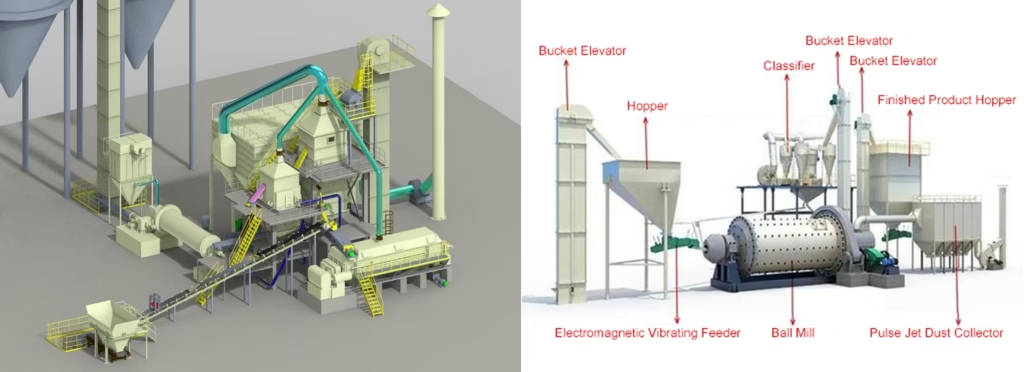
Gypsum-Grinding-Process-Flowchart
3. Drying and Collection
The gypsum grinding process requires installation of a hot air system and a collection system. The hot air system primarily provides heat to the mill for drying the material. The collection system, mainly comprised of high-efficiency pulse baghouse dust collectors, ensures compliant dust emissions while recovering all product.
Process Selection and Product Correlation
Grinding Before Calcination: The mainstream process. Raw materials are first ground into raw powder, then enter calcination furnaces (such as fluidized bed furnaces or rotary kilns) to dehydrate and mature into gypsum powder. The uniform fineness of raw powder facilitates stable subsequent calcination, resulting in superior product performance.
Calcination followed by grinding: Calcined gypsum (β-hemihydrate gypsum) exhibits increased toughness, though grinding energy consumption rises. This approach benefits specific products requiring high specific surface area, such as plastering gypsum.
Integrated grinding and calcination: High-temperature hot air is introduced into equipment like vertical mills to simultaneously complete grinding and calcination. This offers the shortest process flow and high thermal efficiency, but demands extremely high standards for equipment and control systems.
Outstanding Advantages of CHUNLEI Machinery Equipment
Lower Operating Costs: Efficient grinding principles and system design reduce power consumption.
Longer Wear Part Lifespan: Special wear-resistant materials or designs applied to critical contact areas like grinding rollers and liners extend service life, lowering maintenance frequency and costs.
Extensive Project Experience: We have delivered successful solutions for numerous large-scale gypsum board production lines and specialty gypsum powder manufacturers worldwide, backed by rich experience and after-sales technical support.
Turnkey Projects: We provide full-process services from process design, equipment manufacturing, installation and commissioning to personnel training. Experienced engineering teams are deployed to ensure first-time startup success and rapid attainment of design capacity.
Conclusion
Modern gypsum grinding technology is evolving toward “large-scale, intelligent, low-energy consumption, and zero-emission” operations. The core lies in selecting high-efficiency mills that integrate drying, grinding, and classification, and building stable, clean, automated production systems around them.
If you require detailed comparative data on specific mill types, need specialized grinding solutions for particular raw materials, or seek a reliable gypsum powder equipment supplier, please feel free to contact us anytime. We can provide you with in-depth analysis.
Before the National Day, a customer from Indonesia country visited Spring Thunder Mining Machinery Manufacturing Factory, toured our production workshop and had an in-depth communication with our engineer team. The customer ordered several mi...
It is widely known that in aggregate production lines, the jaw crusher unquestionably handles primary crushing. However, for secondary and tertiary crushing, should one choose an impact crusher or a cone crusher? Selecting the appropriate equipme...
The ball mill serves as the core of the production line, with its processing capacity directly determining the overall efficiency of the entire line. True capacity enhancement is not achieved through simple speed increases or pressure boosts, but...
Gravity separation, also known as gravity sorting, operates on the core principle of separating minerals based on differences in their relative density (specific gravity). Mineral particles of varying densities experience distinct gravitational a...
Welcome to Chunlei machinery website. We are a leading manufacturer and exporter of mining machinery in China with more than 30 years history in China.
We offer you one-stop solutions: online consultation --- customized solutions --- fast delivery --- comprehensive after-sales service
 Chunlei Mining Machinery