In mineral processing and ore beneficiation industries, the core factor determining corporate profitability lies in enriching valuable minerals from raw ore at lower costs and higher efficiency. As a classic and highly effective physical beneficiation method, jig gravity separation utilizes pulsating water flow to separate minerals based on density differences. Its high throughput, low operating costs, and broad applicability set it apart among numerous separation technologies. While many perceive it as solely density-based separation, it actually creates a dynamic fluidized bed—functioning as a dynamic system to achieve efficient mineral separation. This article delves into the working principles of jig separation and explores methods to enhance final product recovery rates and separation efficiency, providing practical guidance for process optimization in mineral processing plants.
Jigging Gravity Separation: The Cornerstone of Efficient Mineral Processing
Amidst the constant emergence of new mineral processing technologies, jigging gravity separation remains the unshakable cornerstone process for mineral separation. This technology leverages density differences between minerals, achieving precise separation and enrichment through pulsating water flow. However, the ingenuity of this technology lies not merely in the simple principle of “heavy sinks, light floats.” Its true essence resides in constructing and controlling a highly dynamic “fluidized bed layer.” This bed layer functions far beyond a simple sieve; it operates like an efficient automated sorter, continuously loosening, reorganizing, and intelligently sorting minerals under the influence of alternating water currents. This profound separation capability enables jigging machines to efficiently process diverse minerals—from coarse to fine grains—achieving high recovery rates at relatively low operational costs. This powerful yet economical processing capability finds application across numerous sectors, including tungsten, tin, gold, and coal mining, serving as the cornerstone for many successful mineral processing plants.
Core Principle of Gravity Separation in Jigging
The core of gravity separation in jigging utilizes density differences between mineral particles. Through periodic expansion and contraction of the bed layer induced by pulsed water flow, high-density minerals (heavy products) settle while low-density minerals (light products) rise, thereby achieving separation of mineral particles.
The jigging operation unfolds in two distinct phases:
Loosening and Stratification: Rising water lifts and loosens the bed layer, allowing particles to begin settling according to their density. This phase creates space for particle rearrangement.
Conveying and Separation: Descending water compresses the bed layer. Heavy particles pass through bed layer gaps into the concentrate chute at the bottom, while light particles are carried by the water flow toward the tailings end.
The essence of jig separation lies in the precise pulsation of the water flow. The rhythm of the pulsed water flow is critical to the entire process. A uniform rhythm ensures consistent expansion and contraction of the pulp tank bottom plate, synchronizing internal particle movement and orderly settling. Any disruption in rhythm leads to entanglement between concentrate and tailings, reducing recovery rates. Therefore, precise control is key to maximizing mineral recovery and enhancing concentrate grade.
Forces Acting on Particles and Stratification Dynamics
Under the alternating water flow of the jig, mineral particles experience the combined effects of several key forces:
Gravity: Drives particles downward, with magnitude directly dependent on particle density.
Water Flow Force: Resistance generated by piston or diaphragm-driven water flow provides the primary kinetic energy and directional force for particle movement.
Inertia Force: The tendency of particles to maintain their original state of motion within accelerating/decelerating water flow influences the response speed for jumping and settling.
Bed Resistance: Friction and collisions with surrounding particles as the particle traverses the bed form the critical separation environment.
These forces interact, causing particles of different densities to experience varying forces and separate. This highly efficient and economical sorting characteristic establishes the jig as a key player in gravity separation.
How to Properly Select Jigging Equipment?
How do different jig models match various ore characteristics? Many mineral processing plants prioritize processing capacity while often overlooking the precise alignment between equipment and ore properties. Such mismatches can lead to insufficient separation accuracy, unstable recovery rates, and increased operational costs.
Common Types of Jigs
Piston-Type Jig:
Description: The oldest jig design, utilizing a crank-connecting rod mechanism to drive a piston’s reciprocating motion within a sealed chamber, directly generating water pulses. Features & Applications: Produces relatively simple water pulse waveforms, suitable for coarse and medium-grained ores. Commonly used in small-scale mines or simple mineral processing operations. Features simple structure and easy maintenance.
Diaphragm-Type Jig: Description: Replaces the piston with a rubber diaphragm, using an eccentric drive mechanism to indirectly generate more uniform water pulses. Features and Applications: Produces gentler, more consistent pulses than piston-type machines, offering greater control over bed disturbance. Suitable for both coarse and fine particles, it is one of the most widely used jig types today, though its mechanical transmission structure is relatively complex.
Pistonless Jig (Under-Screen Air Chamber Type): Description: The mainstream of modern jigging technology. Water flow pulsation is driven by air valves. Representative models include BATAC, AM-25, etc. Features and Applications: Pulse parameters (frequency, amplitude, waveform) can be independently and precisely adjusted. Offers high processing capacity, excellent separation efficiency, and relatively low energy consumption. Particularly adept at handling fine-grained materials and large-scale industrial coal preparation and mineral processing operations.
Characteristic Dimensions
Piston-Type Jig
Diaphragm-type Jig
Pistonless Jig (Air Pulse)
Pulse Generation Method
Mechanical piston directly drives water flow
Mechanically driven flexible diaphragm creates pulsating water flow
Compressed air drives water flow within the air chamber
Pulse Waveform Control
Single, non-adjustable or difficult to adjust
Relatively uniform, but limited adjustment range
Enables precise, independent control with diverse waveforms
Processing Particle Size Range
Coarse and medium-sized materials
Coarse, medium, and fine-grained materials across wide particle size ranges
Particularly adept at handling fine-grained materials
Processing Capacity
Lower
Moderate
Extremely high, suitable for large-scale operations
Structural Complexity
Simple
Moderate
Relatively complex (pneumatic and control systems)
Maintenance Costs
Low (simple structure, easy maintenance)
Moderate (requires monitoring diaphragm wear)
Requires professional maintenance (involving pneumatic and automation components)
Energy Consumption Level
Higher (low mechanical transmission efficiency)
Moderate
Low (high air-driven efficiency)
Technology Maturity
Traditional, becoming obsolete
Mature technology with widespread application
Modern mainstream technology
Typical Application Scenarios
Small mines, simple mineral processing, roughing operations
Suitable for medium to large-scale mines, highly adaptable to particle size variations
Large coal preparation plants, modern mineral processing plants, precision sorting
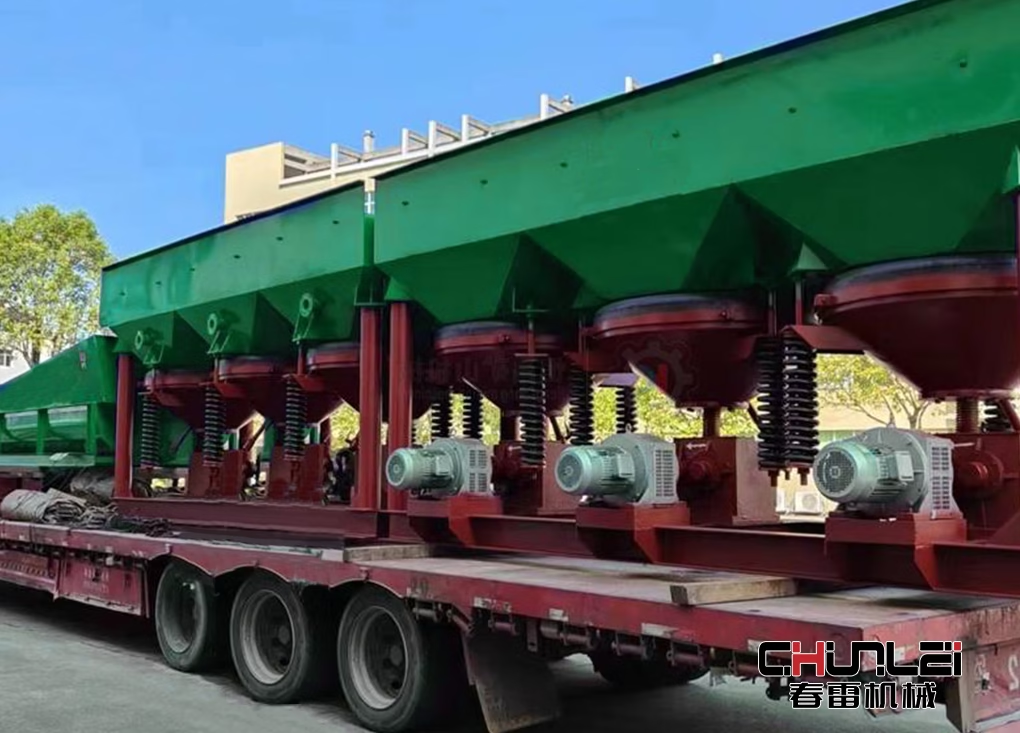
Jigging-Gravity-Sorting-Operation-Site
Jigging-Gravity-Sorting-Operation-Site
Jigging-Gravity-Sorting-Operation-Site
Key Factor 1: Mineral Properties Determine Jig Separation Efficiency
In the jig gravity separation process, mineral properties refer to the inherent physical attributes of the feed material. These characteristics establish the limiting values for separation efficiency even before the material enters the jig. Neglecting these factors leads to poor separation results and mismatched jig selection, preventing the jig from achieving maximum performance. Attempting to separate materials with extremely small density differences or high intergrowths using a jig inevitably results in low efficiency, as this violates its fundamental physical principles. Optimizing the jigging process requires a thorough understanding and pre-treatment of mineral properties.
Density: The Core Driving Force of Separation The fundamental basis of jig separation lies in the differing settling velocities of mineral particles with varying densities under gravitational force. The greater the density difference, the easier and more thorough the separation. When target minerals and gangue minerals have similar densities, their trajectories in the water flow become highly similar. This results in significant gangue contamination in the concentrate or substantial loss of target minerals.
Particle Size: The Bridge of Separation The primary interference factor in jigging is the “equivalent settling phenomenon,” where a low-density large particle and a high-density small particle may exhibit identical settling speeds. If feed material is pre-screened into grades with similar particle sizes, separation relies primarily on density differences to exploit settling speed variations. If feed material is not pre-screened, severe equal descent occurs, causing cross-contamination and resulting in particularly low recovery rates and poor quality.
Particle Shape: The Shackles of Separation Mineral particles exhibit various shapes. Spherical particles settle fastest, while flaky, acicular, and irregularly shaped particles encounter greater resistance, impairing density-based stratification. This necessitates individual particle liberation. Fully liberated mineral particles can be sorted purely by density, whereas incompletely liberated particles cause valuable minerals to be carried away with the tailings, reducing recovery rates. The jig itself cannot effectively liberate these intergrown particles.
Key Factor 2: Stroke and Frequency of Pulsed Water Flow Determine Jig Separation Efficiency
Stroke: Also known as amplitude, it determines the loose space within the bed layer. An insufficient stroke results in an unloose bed layer, preventing thorough stratification; an excessive stroke causes excessive turbulence, disrupting stratification.
Frequency: Also known as pulse rate, it determines the velocity and rhythm of the water flow. Excessively high frequency prevents particles from settling; excessively low frequency leads to inefficient production.
Optimization Approach: Based on variations in feed particle size and density, adopt a combination of “large particles with large stroke and low frequency, fine particles with small stroke and high frequency.
Key Factor 3: Impact of Bed Thickness on Ore Separation
Regulating bed thickness essentially involves finding the optimal balance between recovery rate and concentrate grade. When the target material is a heavy product (such as iron, tungsten, or cassiterite), the bed can be appropriately thickened to allow for longer separation time and higher concentrate grade. When the target mineral is a light product (e.g., coal concentrate), a thinner bed layer is preferable to facilitate rapid flotation and recovery. Bed layer thickness must be coordinated with stroke length, stroke frequency, and discharge rate. Altering any single parameter may disrupt the effectiveness of the others.
Parameter Status
Impact on Concentrate Grade (Quality)
Impact on Recovery Rate
Sorting Phenomena and Consequences
Primary Cause Analysis
Bed layer too thick
Significantly Improved
Significantly Reduced
High stratification resistance prevents heavy mineral particles from penetrating to the bottom layer, causing substantial middlings and intergrown minerals to accumulate in the concentrate zone and reducing concentrate grade. Simultaneously, some fine-grained heavy minerals cannot be effectively recovered and are lost with the tailings.
1. Insufficient Suction Force: The suction force during the water flow descent phase is inadequate to effectively settle heavy particles.
2. Obstructed Conveyance Path: Excessively dense bed layers impede the movement of heavy products toward the discharge outlet.
3. Reduced Processing Capacity: To maintain thick bed layers, discharge volume must be reduced, diminishing the equipment’s processing capacity.
Bed layer moderate
Maintains Optimal Balance
Maintaining Optimal Balance
Good bed looseness with clear stratification: High-density minerals settle smoothly to the bottom, while low-density minerals are pushed toward the tailings end by horizontal flow. Both concentrate grade and metal recovery rates reach optimal levels, achieving highly efficient separation.
1. Looseness and Stratification Coordination: Water flow provides sufficient space for bed loosening while maintaining adequate suction force.
2. Adequate Separation Space: Creates distinct, stable stratification zones for particles of varying densities.
3. Stable and Continuous Discharge: Maintains consistent bed thickness, ensuring continuous and uniform operation of discharge mechanisms.
Bed layer too thin
Dramatically Reduced
May be temporarily elevated but highly unstable
Excessively loose bed structure loses its “filter layer” function, causing uneven water distribution and even short-circuiting. Large quantities of light minerals are washed into the concentrate, severely contaminating it; heavy minerals settle too rapidly, easily causing discharge device blockages or excessive concentrate accumulation.
1. Loss of Protective Layer: The bed fails to effectively trap fine heavy minerals, leading to their loss.
2. Water flow short-circuiting: Pulsed water flow directly impacts the screen plate, preventing uniform upward flow and disrupting stratification.
3. “Coal leakage” phenomenon (in coal beneficiation): Concentrate products become severely contaminated, failing quality standards.
4. Accelerated equipment wear: Direct water erosion of the screen plate hastens its deterioration.
Key Factor 4: Impact of Water Velocity in the Hopper (Underflow Water Addition) on Jig Sorting
Regulating the underflow water addition rate essentially controls the bed layer’s looseness and the intensity of the downward water flow. It primarily influences sorting efficiency by altering the state and force of the water flow within the bed layer.
Parameter Status
Impact on Stratification
Impact on Concentrate Grade
Impact on Recovery Rate
Description of Phenomena and Consequences
Water velocity too low
Insufficient bed looseness
Concentrate grade may increase, but overall separation efficiency is poor
Recovery rate of heavy minerals significantly reduced
1. Phenomenon: The bed layer becomes rigid, rising and falling as a single “piston-like” unit with unclear stratification.
(Insufficient makeup water)
2. Consequences: Fine-grained heavy minerals are extensively lost in tailings due to inability to penetrate the dense bed layer; light products are also severely contaminated due to the bed layer’s bulk transport.
Water velocity moderate
Good bed looseness with clear and stable stratification
Achieving optimal balance between concentrate grade and recovery rate
Recovery rate of heavy minerals remains high
1. Phenomenon: During upward flow, the bed remains moderately loose, providing ample space for density-based stratification; downward flow generates moderate “suction force.”
(Optimal range)
2. Consequences: High-density minerals settle effectively, while low-density minerals are smoothly displaced, achieving efficient separation. Suction force effectively recovers fine heavy minerals mixed into the upper layer while discharging light fine gangue.
Water velocity too high
Excessive bed looseness or even disorder
Concentrate grade drops sharply
Recovery rate may be temporarily elevated but with poor quality
1. Phenomenon: The bed layer is completely disrupted, particles enter free-falling state, and density stratification conditions are destroyed.
(Excessive makeup water)
2. Consequences: Strong upward flow carries large quantities of light, fine particles into the concentrate, severely contaminating the product; excessive suction force may draw fine heavy minerals into the lower layer, but more often causes bed instability and ineffective separation.
Key Factor 5: Impact of Water Velocity in the Hopper (Underflow Water Addition) on Jig Sorting
Feeding is the first step in the jigging process. Though not directly involved in separation, it fundamentally determines whether subsequent separation occurs under optimal conditions. Fluctuations in feed rate, concentration, and particle size prevent stable jig operation, causing separation efficiency and performance metrics to plummet. Stable feed rates ensure consistent bed thickness and looseness; excessively fine or coarse feed concentrations disrupt stratification. To ensure uniform and stable feeding, necessary crushing, screening, and desliming of the raw ore should be performed.
Conclusion
In summary, gravity separation using jigging machines is an art of separation that appears simple yet is highly precise. The key to enhancing recovery rates and efficiency lies in deeply understanding the interaction between pulsed water flow and mineral particles at the fundamental level, while systematically controlling the five critical elements—“water flow, bed layer, feed, discharge, and equipment”—in practical application. Each parameter adjustment represents an intervention in the sedimentation dynamics of minerals. If you are seeking to optimize your jigging separation process or have questions regarding separation solutions for specific minerals, please contact our expert team for tailored technical advice and solutions.
Antimony is a rare metal primarily concentrated in China, where its mining and extraction pose significant challenges. Antimony is ubiquitous in our daily lives and plays a crucial role in industrial, military, and other sectors. Antimon...
A variety of models are available | Get the free price list!
The autogenous mill, also called ultrafine laminar autogenous mill/semi-autogenous mill, is a new type of autogenous mill, which is a kind of grinding e...
A variety of models are available | Get the free price list!
Impact crushers are categorized into PF impact crushers and CI impact crushers. PF Impact crusher, also called small diameter impact crusher. CI Impact C...
The gold ore CIL carbon-in-leach process primarily involves simultaneous leaching and adsorption, achieving gold recovery rates exceeding 90% while simplifying the workflow. Within the field of gold mineral processing technology, it stands as the...
Welcome to Chunlei machinery website. We are a leading manufacturer and exporter of mining machinery in China with more than 30 years history in China.
We offer you one-stop solutions: online consultation --- customized solutions --- fast delivery --- comprehensive after-sales service
 Chunlei Mining Machinery