Molybdenum (commonly referred to as “molybdenum”) is a critical industrial metal prized for its high strength, corrosion resistance, and heat tolerance. Though less well-known than metals like copper or gold, it is indispensable in modern industry. This guide comprehensively explores how molybdenum is extracted from the earth and transformed into usable materials that reinforce structures ranging from skyscrapers to aerospace alloys.
What is molybdenum? Where is it found?
Molybdenum is a silvery-white metallic element that does not occur in its free state. It is primarily extracted from molybdenite ore (MoS₂), though it can also be a valuable byproduct of copper mining. The world’s major molybdenum deposits are located in the United States (Colorado), China, Chile, and Peru. The actual molybdenum content in the rock mined from these deposits is typically low, ranging from 0.01% to 0.25%. Therefore, efficient processing is crucial.
Stage 1: Molybdenum Mining Methods
There are two primary methods for mining molybdenum, chosen based on deposit geology and depth.
1. Open-Pit Mining (Surface Mining)
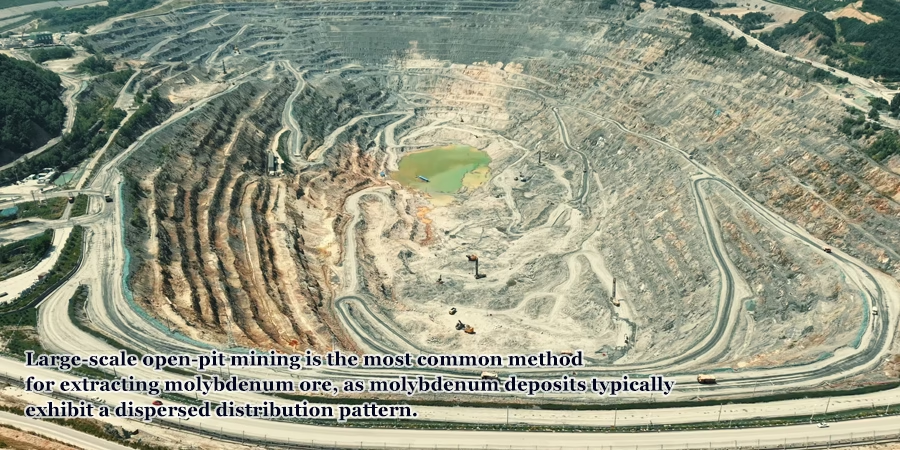
This is the most prevalent method for molybdenum extraction. When ore bodies are located relatively close to the surface, open-pit mining is the most cost-effective approach.
Process: Overburden (topsoil and rock covering the ore) is removed using large excavators and haul trucks.
Drilling and Blasting: Precise drill patterns are made, filled with explosives, and detonated to fragment the hard rock.
Hauling: The broken ore is loaded and transported to the primary crusher.
Advantages: Higher production rates, lower cost per ton, and safer working conditions compared to underground mining.
2. Underground Mining
When the molybdenite ore body is deep or the geological conditions are unsuitable for an open pit, underground methods are employed.
Process: Access shafts, ramps, or declines are constructed to reach the ore.
Methods: Techniques like block caving, cut-and-fill, or room-and-pillar mining are used to extract the ore, which is then brought to the surface via skips or conveyors.
Application: Used for higher-grade, deeper veins.
Stage 2: The Milling and Beneficiation Process
The goal of this stage is to separate the valuable molybdenite mineral from the worthless waste rock (gangue) and produce a concentrate. This process is known as froth flotation.
Step 1: Crushing and Grinding
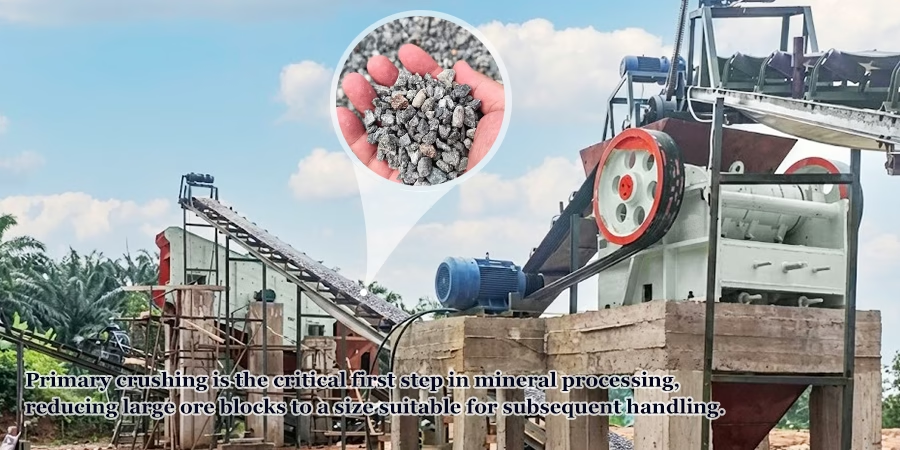
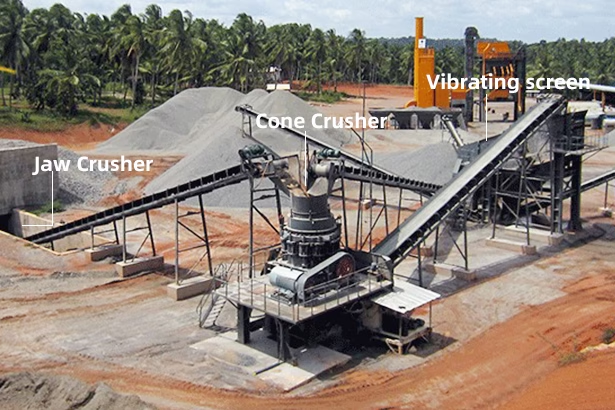
Primary Crushing: Run-of-mine ore is crushed in jaw or cone crushers to reduce it to pieces about 10-20 cm in diameter.
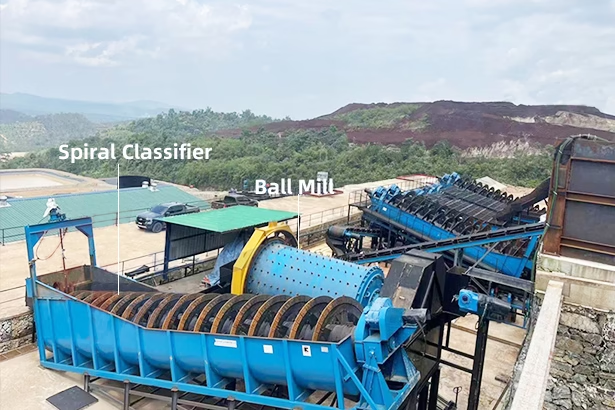
SAG/Ball Mill Grinding: The crushed ore is then ground in Semi-Autogenous Grinding (SAG) mills and ball mills with water to create a slurry. The grinding reduces the particles to a fine sand or silt consistency, liberating the molybdenite flakes from the gangue.
Step 2: Froth Flotation(the heart of molybdenum recovery)
1. Conditioning: Chemical reagents are added to the slurry. These include:
Collectors (hydrocarbon oils): Coat the molybdenite particles, making them hydrophobic (water-repelling).
Frothers: Create stable bubbles in the flotation cells.
Depressants (often sodium silicate or lime): Used to suppress other minerals like copper if present.
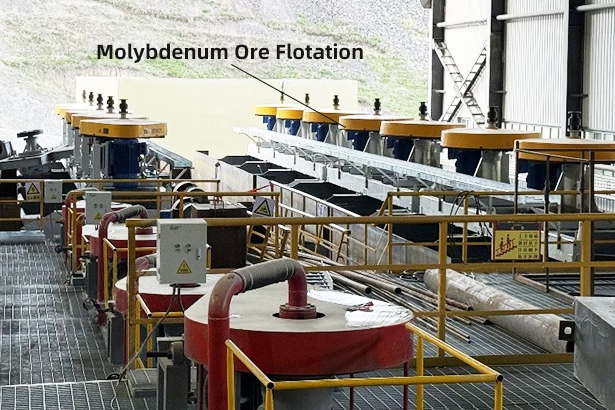
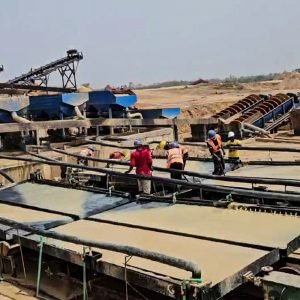
2.Flotation Cells: The slurry is agitated and aerated. Hydrophobic molybdenite particles attach to air bubbles and rise to the top, forming a mineral-rich froth.
3. Skimming: The froth is skimmed off the surface. This molybdenite concentrate typically grades between 40-55% Mo.
4. Multiple Stages: The slurry passes through several cleaning and scavenging stages to maximize recovery, often exceeding 90%.
Step 3: Dewatering
The final concentrate slurry is thickened and then filtered using drum filters or press filters to create a moist filter cake (approx. 8-10% moisture) suitable for transport or roasting.
Crushing-and-Screening
Grinding-and-Classification
Molybdenum-Ore-Flotation
Stage 3: Roasting: Converting Concentrate to Molybdic Oxide (MoO₃)
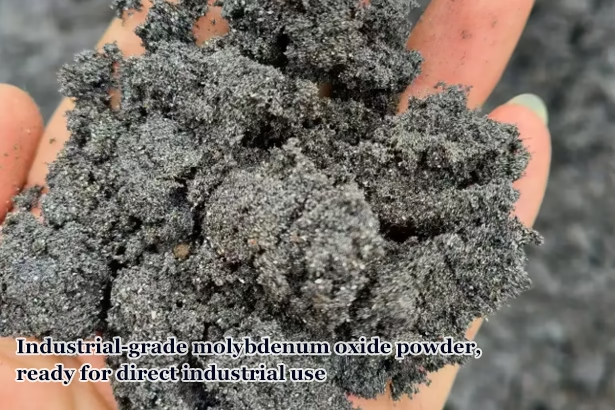
Concentrate into Molybdenum Oxide (MoO₃) Molybdenum sulfide concentrate (MoS₂) cannot be directly used in steel alloys. The roasting process converts it into industrial-grade molybdenum oxide, known as “technical oxide.” Industrial-grade molybdenum oxide typically contains at least 57% molybdenum and less than 0.1% sulfur.
Process Flow: The concentrate is heated in a multi-chamber roaster under an oxygen-enriched atmosphere, maintaining temperatures between 600-700°C.
Output: This process releases sulfur as sulfur dioxide (SO₂), which is captured and converted into sulfuric acid in modern environmental facilities. The final product is a fine, gray MoO₃ powder.
Stage 4:Purification and Metal Production
For industries requiring ultra-high purity (e.g., chemicals or superalloys), technical oxides undergo further processing:
Chemical Purification: Oxides dissolve in ammonia solution to form ammonium molybdate. Impurities are removed through filtration and precipitation. Subsequent crystallization or heat treatment yields pure molybdenum trioxide or ammonium molybdate (ADM).
Thermal Reduction Method: To produce ferromolybdenum (FeMo), a common steel additive, pure MoO₃, iron oxide, and aluminum powder are mixed and ignited in a furnace (aluminum thermite reaction).
Hydrogen Reduction Method: To produce pure molybdenum metal powder, refined MoO₃ undergoes two-stage hydrogen reduction in a furnace (first forming MoO₂, then converting to pure Mo metal powder).
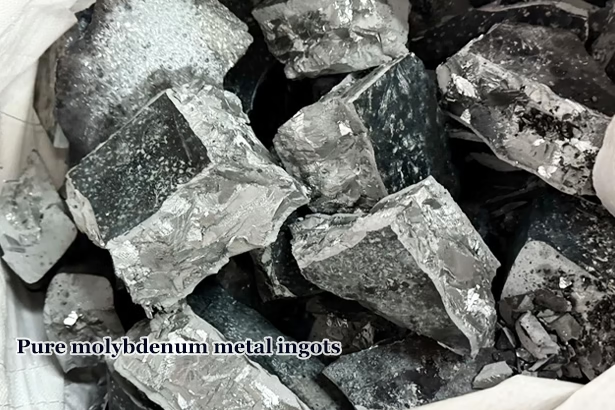
Consumable Arc Melting Method: Metal powder is isostatically pressed into compacts, then melted in a vacuum arc furnace to form solid molybdenum ingots for subsequent processing.
Applications: Where Does Molybdenum Go?
The processed molybdenum finds its way into countless essential products:
Application Category
Key Properties Molybdenum Imparts
Common Products & Uses
Structural & Stainless Steel (~75% of total demand)
Essential Plant Nutrient, Specialty Material Properties
Agricultural Fertilizers (for trace element deficiency), Nickel-Moly Alloys for Chemical Handling, Aerospace Coatings
Environmental and Sustainability Considerations
Modern molybdenum operations prioritize environmental responsibility. Key practices include:
Tailings Management: Secure, engineered impoundments store waste rock and processed tailings.
Water Recycling: Over 90% of process water is typically recycled within the concentrator plant.
SO₂ Capture: Roaster off-gases are treated to produce marketable sulfuric acid, drastically reducing emissions.
Land Reclamation: Progressive reclamation of mined land to a stable, productive post-mining landscape is a standard part of mine planning.
Conclusion
From trace minerals sealed within granite to the core component of the world’s strongest alloys, molybdenum’s transformation is nothing short of a feat. The process encompasses three key stages—precise mining, meticulous flotation, and high-temperature treatment—ensuring efficient utilization of molybdenum.
Specific techniques and processing flows for molybdenum mining and processing may vary based on ore characteristics and environmental regulations. CHUNLEI’s expert team stands ready to customize tailored processes for you, offering one-stop services from design to equipment supply. Inquiries welcome!
In the production of cement clinker at cement grinding plants, the ball mill is undoubtedly the most central and widely used equipment. It serves as the core link between clinker calcination and the final cement product, grinding the hardened cli...
Africa is rich in mineral resources and has great potential for mining development. However, general grinding mill equipment is costly and requires high usage conditions, which cannot be widely used in the development of African mining industry. ...
Calcium carbonate mills, also known as calcium carbonate grinders or calcium carbonate grinding mills, primarily grind calcium carbonate minerals into various powders suitable for diverse industrial applications. Calcium carbonate is an in...
Tin Ore Beneficiation Production Line
Process Introduction Flotation is a commonly used method in tin ore beneficiation, mainly used for the separation of concentrates. The process flow is generally divided into three parts: raw or...
 Chunlei Mining Machinery