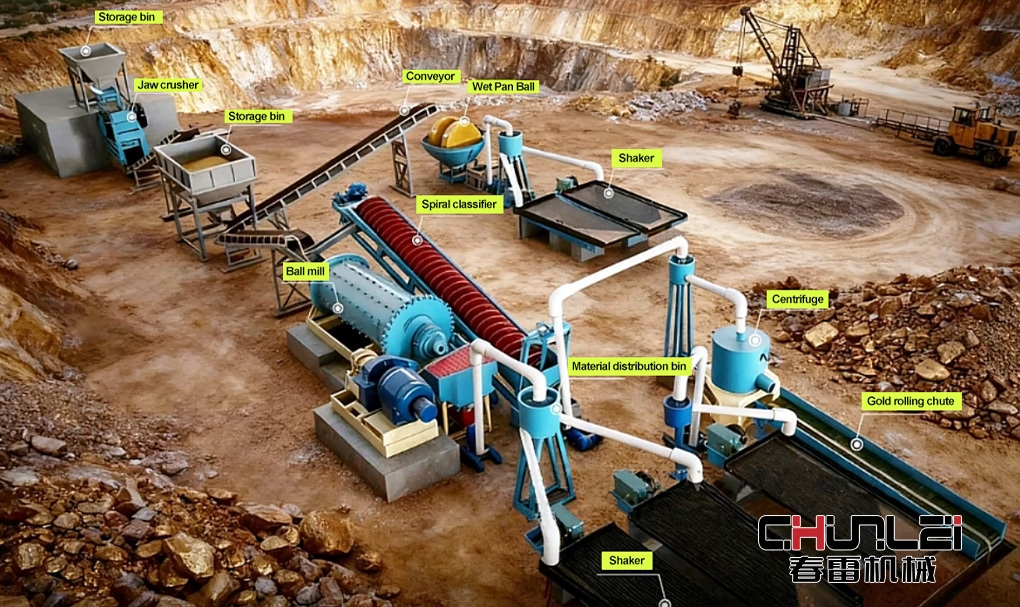
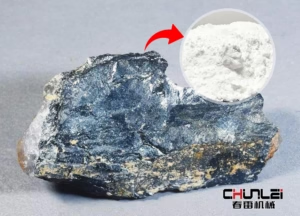
Mineral processing equipment and systems primarily include jaw crushers and cone crushers, ball mills and hydrocyclones, agitators and flotation machines, thickeners, plate filters, dryers, and more. The processing flow mainly involves crushing, grinding, separation, and drying.
What is mineral processing?
Mineral processing, also known as ore dressing, is an extremely broad industrial process. Through a series of physical, chemical, or combined methods, it separates and concentrates useful minerals from gangue minerals based on their distinct properties. Since naturally occurring ores are rarely usable in their raw state, mineral processing transforms these materials into usable substances.
What is the mineral processing workflow?
The primary production process is as follows:
Crushing and Grinding
After crushing raw ore into 10-30mm fragments via crushers, the material enters ball mills to grind into fine powder smaller than 0.2mm, achieving mineral liberation. Ground particles proceed to hydrocyclones or spiral classifiers for classification. Qualified ore particles advance to subsequent processes, while coarse particles are returned to ball mills for regrinding.
Separation and Enrichment
Methods such as gravity separation, magnetic separation, flotation, electrostatic separation, and chemical separation are selected based on mineral properties.
- Gravity separation utilizes mineral density differences through jigs, shaking tables, or spiral chutes. Jigs stratify minerals by weight using water flow; shaking tables segregate minerals by agitation and water flow; spiral chutes separate minerals via centrifugal force generated by water flow.
- Magnetic separation primarily employs magnetic separators, sorting minerals based on magnetic property variations.
- Flotation utilizes differences in the physicochemical properties of mineral surfaces for separation, representing the most widely applied method. Its primary principle involves agitation by impellers, causing hydrophobic minerals to float while hydrophilic minerals sink, thereby achieving separation.
- Electrostatic separation primarily exploits differences in mineral electrical conductivity. Conductive and non-conductive minerals separate along distinct trajectories due to differing electrical charges.
- Chemical beneficiation utilizes differences in mineral chemical properties to achieve separation through dissolution in solutions or under high temperature and pressure conditions.
Solid-Liquid Separation and Drying
A thickener employs the principle of gravitational settling to concentrate dilute mineral slurry. This thickened slurry is then dewatered in a filter press to form a low-moisture filter cake. If further drying is required, thermal drying can be performed using a dryer or rotary kiln, ultimately yielding a dry powder concentrate.
Primary Equipment for Mineral Processing
Jaw Crusher
As is well known, all raw ore must first pass through the “jaw crusher”—this “tiger’s mouth”—before being processed in subsequent stages. Its primary function is coarse crushing, breaking large rocks into smaller pieces.
Cone Crusher/Impact Crusher
Due to the structure and function of the jaw crusher, the smaller stones produced by it require further crushing by a cone crusher or impact crusher. This step refines the stones into finer particles, facilitating and protecting subsequent equipment.
Ball Mill
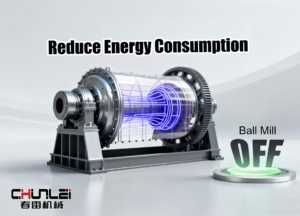
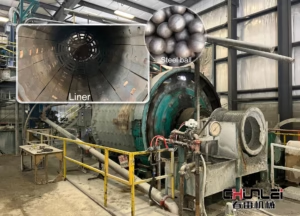
The quintessential grinding equipment, its rotating cylinder filled with steel balls impacts and grinds ore into fine powder. It refines crushed material until mineral particles are fully liberated (typically below 0.2 mm) and classifies them by particle size.
Hydrocyclone
A critical classification device, it rapidly separates slurry by particle size using centrifugal force, often forming a closed-circuit loop with the mill.
Flotation Machine
Generates countless microscopic bubbles. Hydrophobic (gas-loving) target mineral particles in the finely ground, chemically treated pulp selectively attach to these bubbles. The bubbles are then skimmed off for collection, achieving separation from hydrophilic gangue minerals.
Thickener
Also known as a thickening machine or settling tank. Continuously concentrates low-concentration dilute slurry (typically from flotation, gravity separation, etc.) into high-concentration underflow slurry while simultaneously producing clarified overflow water. Enables continuous feeding, continuous sludge discharge, and continuous drainage. Serves as a critical buffer and preparatory stage connecting wet separation operations to subsequent filtration/drying processes.
Conclusion
In summary, mineral processing equipment and systems form an interlinked precision industrial chain. Through processes such as crushing, grinding, separation, and dewatering, and supported by modern detection and control technologies, they efficiently transform low-grade ores into high-value economic products, serving as the backbone of modern mining and raw materials industries.
 Chunlei Mining Machinery