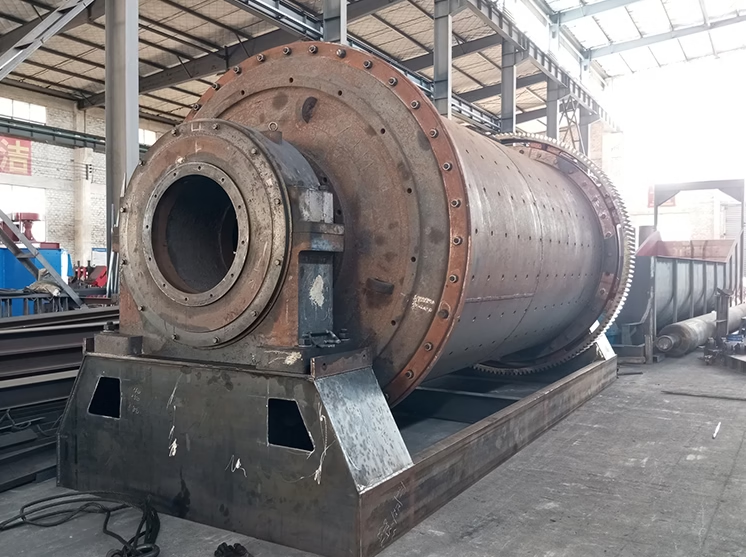
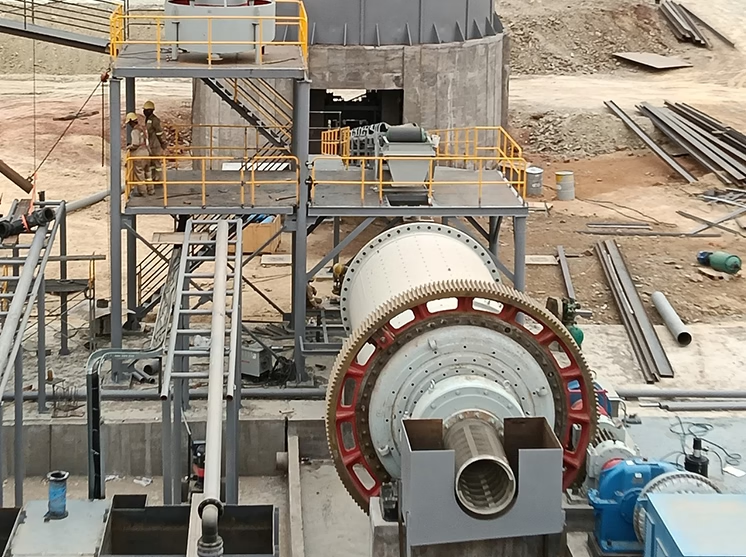
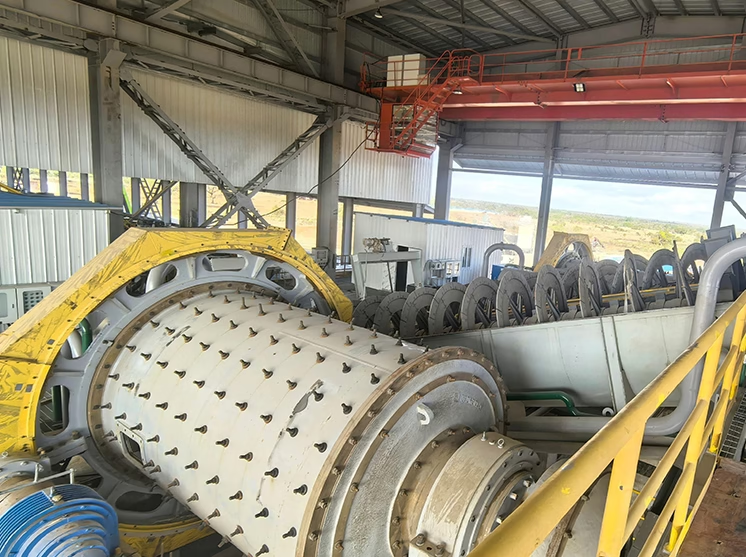
The ball mill serves as the core of the production line, with its processing capacity directly determining the overall efficiency of the entire line. True capacity enhancement is not achieved through simple speed increases or pressure boosts, but rather requires systematic optimization of the entire closed-loop process: “crushing-grinding-classification.
CHUNLEI Machinery delivers not just individual equipment, but comprehensive solutions that elevate the entire process from feed intake to finished powder output. This article provides a detailed guide starting with the fundamentals—ball grading, liner selection, and system optimization—empowering your ball mill to achieve new heights of production efficiency.
Your profits may be stuck inside your ball mill
At the heart of mineral processing plants, ball mills are not only critical components but also major energy consumers, often acting as bottlenecks. Their capacity ceiling directly determines the entire production line’s throughput. A minor optimization of the ball mill can yield significant leverage effects. For instance, a 1% increase in output translates to reduced unit processing costs, directly boosting actual profits. Conversely, an inefficient ball mill not only incurs high electricity costs but also silently accelerates component wear, increasing maintenance expenses. This slows the entire production line and erodes the company’s profitability. Therefore, optimizing ball mills is no longer merely a technical issue—it is a core financial concern. Shifting strategic focus to ball mill optimization upgrades plant competitiveness and is crucial for ensuring maximum corporate returns.
一、 the biggest production trap: neglecting feed optimization
When optimizing ball mills, we often focus on the mill itself while overlooking the root cause—the quality of feed material entering the mill. This directly impacts production efficiency and determines both output and costs. Many treat crushing and grinding as separate processes. To minimize crushing costs, they feed inadequately crushed material into ball mills, leading to excessive energy consumption and accelerated internal wear. It’s crucial to understand that the energy required to grind 1-inch material to the desired fineness in a ball mill far exceeds that needed by a crusher to achieve the same result. Moreover, when the mill is burdened with this “crushing work,” it consumes energy and volume, significantly reducing effective grinding capacity. Crushing is not merely a prelude to grinding; it is an integral part of the grinding process. Crushing equipment like jaw crushers and cone crushers, along with screening systems, must be regarded as the ball mill’s “first stage.” Providing the ball mill with feedstock that is as small and uniform as possible is the most fundamental method to reduce mill wear and enhance production capacity.
二、the Main Force in Pulverization and Grinding: Steel Ball Media
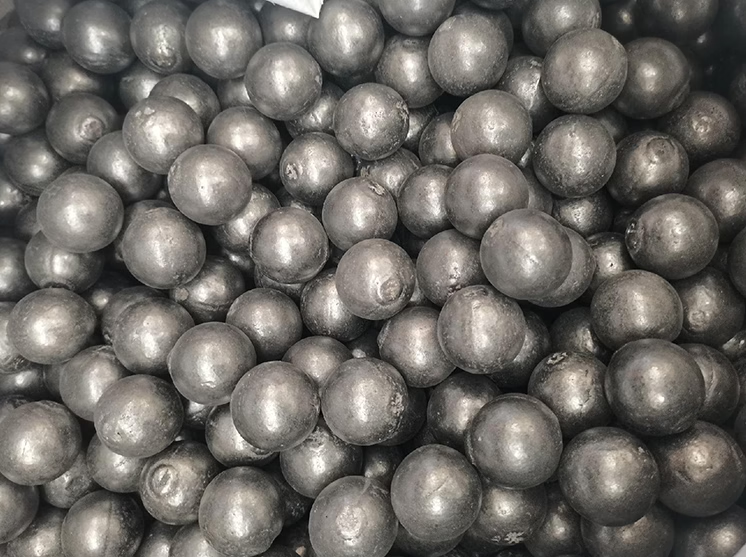
Many mistakenly believe that simply filling the mill with the largest steel balls will yield fine particles—a common misconception. The grinding media inside the ball mill perform the actual work, and selecting the appropriate steel ball size and filling volume is a precise science and art of balancing. Steel balls of different sizes (coarse, medium, fine) undertake distinct grinding tasks, working synergistically as an indispensable trio. Large balls generate immense impact force to break down the material. Medium balls serve as the bridge between sizes, performing secondary crushing on material already broken by the large balls. Small balls primarily handle the fine grinding of this secondary crushed material, ultimately achieving the target fineness. Regular inspection of steel ball loading is crucial. Monitoring ball consumption allows for timely detection of issues, preventing unnecessary wear and tear on the ball mill.
Ball-Mill-Steel-Balls
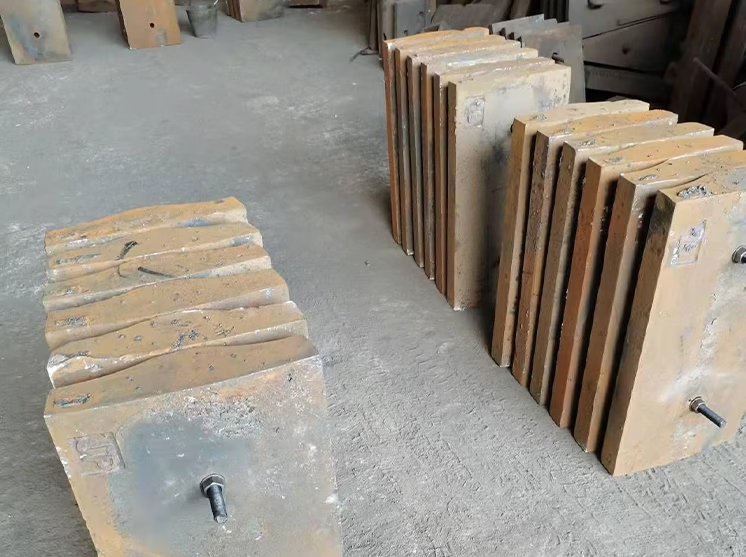
Ball-Mill-Lining-Plates
三、the Drive Mechanism of Ball Mills: Lining Plates
Lining plates serve not only as the protective layer within ball mills but also as the core grinding components. Their structure and design actively lift steel balls and materials to the highest point, generating maximum impact force to achieve efficient pulverization. Wear on the liner significantly reduces grinding efficiency and output. The generated impact force fails to reach its maximum, causing steel balls to transition from efficient throwing to inefficient sliding. This not only results in substantial energy waste but also leads to a significant drop in production. Therefore, regular inspection of liners is essential. Liner designs (e.g., wave, double-wave, ladder, graded) are not universal; each profile is optimized for specific ore hardness and grinding mechanisms (impact crushing vs. abrasive grinding). Selecting the appropriate liner maximizes energy transfer, boosting throughput and production efficiency.
四、Core Parameters for Efficient Production: Rotational Speed and Slurry Concentration
Rotational speed and slurry concentration are two critical parameters for ball mill optimization. Their coordinated operation determines the mill’s grinding efficiency and ultimate processing capacity. Rotational speed is the “heartbeat” of the ball mill, influencing the movement trajectory of steel balls and energy release. The mill must operate between 65% and 85% of its critical rotational speed. Too low a speed results in weak impact force and low efficiency; too high a speed causes idle rotation, eliminating the impact function of ball drop. This not only reduces grinding effectiveness but also accelerates liner wear.
Slurry concentration serves as the key medium influencing energy transfer efficiency between steel balls and ore particles. The optimal slurry density typically ranges between 65% and 75% solids content, maximizing contact opportunities between steel balls and ore particles to achieve efficient grinding.
Rotational speed determines impact force, while concentration dictates transfer efficiency. Only when both factors achieve perfect coordination can the ball mill unleash maximum energy, achieving dual leaps in both production capacity and energy efficiency.
Conclusion
Boosting ball mill capacity is a competitive path to lower operating costs and higher profitability. From the preparatory phase of “more crushing, less grinding” to scientifically precise steel ball grading, and on to the optimized integration of closed-circuit systems—each step is key to unlocking latent production potential. Remember: continuous attention, scientific diagnostics, and professional support form the inexhaustible driving force behind sustained improvements in mill efficiency. If you’re striving to overcome production bottlenecks, we stand ready to be your most reliable partner. Contact us today to receive a customized capacity optimization plan. Let us transform our expertise into tangible profit growth on your bottom line.
The global graphite market is undergoing a dramatic transformation, driven primarily by the exponential growth of the electric vehicle (EV) battery sector. A graphite mine's profitability in 2026 is no longer determined by carbon grade alone, but...
The gold ore CIL carbon-in-leach process primarily involves simultaneous leaching and adsorption, achieving gold recovery rates exceeding 90% while simplifying the workflow. Within the field of gold mineral processing technology, it stands as the...
The current sand and gravel market faces high demand but limited natural sand resources and rising prices. Conventional sand-making production lines suffer from low output and inconsistent quality. When searching for “clinker sand-making plants,”...
Phosphate Ore Dressing Production Line
Process Introduction Phosphate beneficiation is a complex, multi-step process designed to separate useful minerals (such as apatite) from waste rock in phosphate ore.
Flotatio...
Welcome to Chunlei machinery website. We are a leading manufacturer and exporter of mining machinery in China with more than 30 years history in China.
We offer you one-stop solutions: online consultation --- customized solutions --- fast delivery --- comprehensive after-sales service
 Chunlei Mining Machinery