 Chunlei Mining Machinery
Impact Crusher
527A variety of models are available | Get the free price list! Impact crushers are categorized into PF impact crushers and CI impact crushers. PF Impact crusher, also called small diameter impact crusher. CI Impact C...
View detailsSearch the whole station Hot Product Catalog
As a core grinding equipment in mining, cement, ceramics, and other industries, ball mills convert the majority of electrical energy into heat energy. This results in energy consumption accounting for approximately 30%-40% of the total energy consumption in the entire production process, while the actual utilization rate is only 10%-20%. Such enormous energy consumption leads to profit loss. So, how can we reduce ball mill energy consumption? This article will analyze four key aspects.
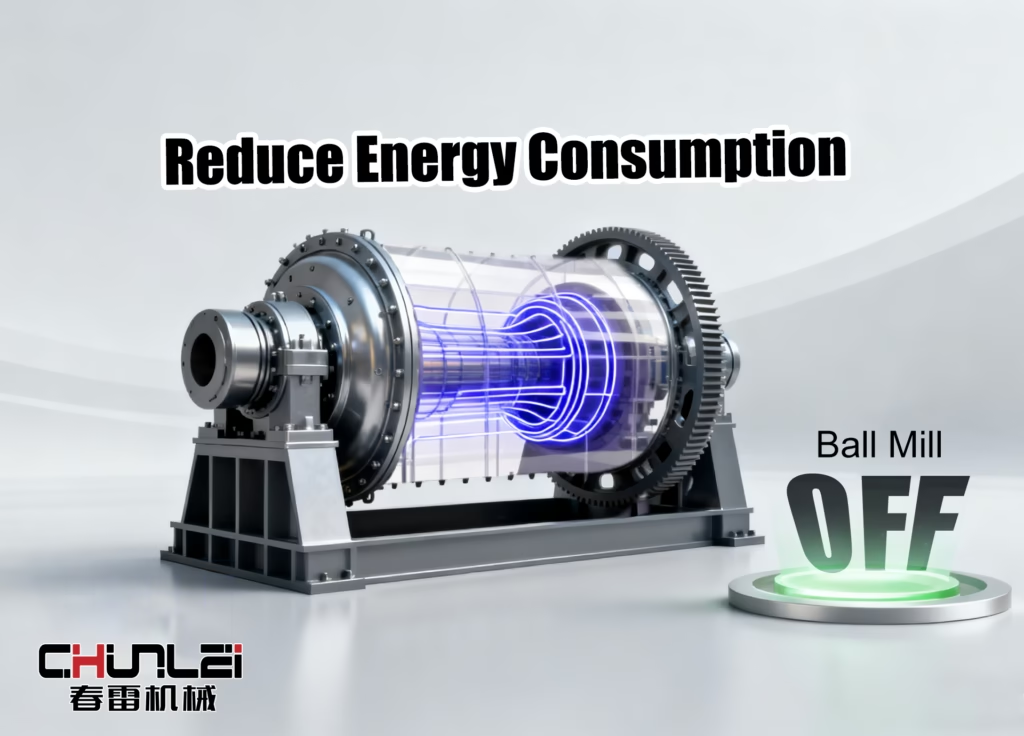
Scientific proportioning of grinding media is crucial for reducing energy consumption. Adopting the principle of “large balls for crushing, medium balls for transition, small balls for grinding” allows combining three sizes of steel balls proportionally (e.g., Φ30mm at 20%, Φ20mm at 30%, 30% Φ15mm, 20% Φ10mm) to achieve tighter packing during operation. This reduces ineffective impacts and void space, thereby enhancing grinding efficiency.
Another approach involves mixing ceramic and steel balls. In semi-autogenous mills, using a 70% ceramic ball and 30% steel ball mixture reduces energy consumption by 57% and wear by 47.3%. Ceramic balls provide fine grinding while steel balls deliver strong impact; their interaction yields more uniform product particle size.
By breaking ore into smaller, finer particles during the crushing stage, the ball mill’s crushing burden is reduced, allowing it to focus solely on grinding. This embodies the “more crushing, less grinding” principle. Practice demonstrates that for every 1mm reduction in feed particle size, the ball mill’s specific power consumption decreases by approximately 6%-8%, while processing capacity increases by over 10%, achieving dual benefits of energy savings and production enhancement.
Replacing traditional heavy liners with lightweight composite liners (e.g., high-alumina ceramics, rubber composites, or carbon fiber-reinforced materials) effectively reduces energy consumption and power usage during ball mill operation. This indirectly boosts production efficiency while lowering operational costs.
Grinding operations involve numerous variable parameters. Accurately identifying underload, normal load, and overload conditions to prevent empty grinding and balling issues is paramount. Manual control inevitably leads to unstable production, whereas an intelligent control system resolves this flawlessly. However, the operational parameters of intelligent control must be configured according to the particle size formula required by the project.
If you are interested in ball mills or have any inquiries, please contact us—we are available 24 hours a day to address your questions.
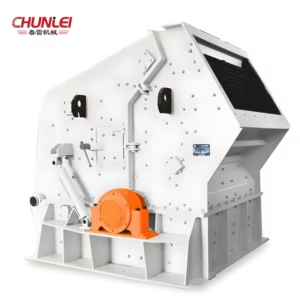
A variety of models are available | Get the free price list! Impact crushers are categorized into PF impact crushers and CI impact crushers. PF Impact crusher, also called small diameter impact crusher. CI Impact C...
View details
Dolomite Dressing Production Line Process Introduction Dolomite beneficiation process is a beneficiation solution to separate dolomite concentrate from dolomite ore. Based on the mosaic structure of dolomite ore and years of benefi...
View details
Cement ball mills and Cement mixing ball mills are two distinct types of equipment with fundamentally different operating principles and application scenarios. Below are the differences between them, ranging from working principles to application...
View details
The ball mill serves as the core of the production line, with its processing capacity directly determining the overall efficiency of the entire line. True capacity enhancement is not achieved through simple speed increases or pressure boosts, but...
View details