 Chunlei Mining Machinery
How to Reduce Ball Mill Energy Consumption?
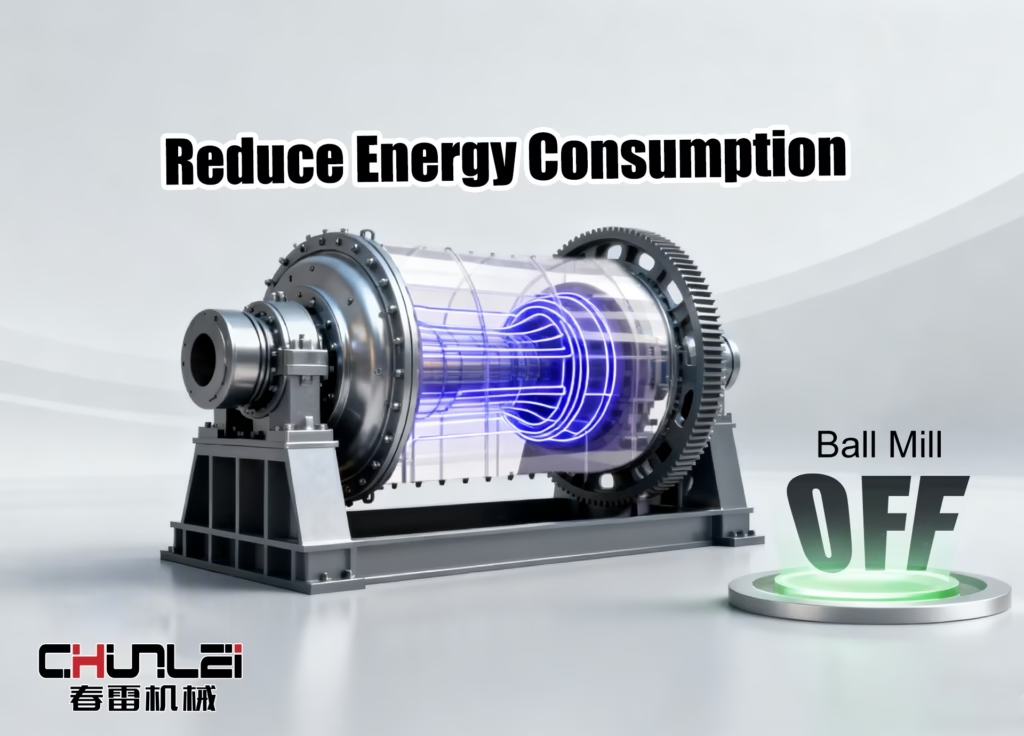
As a core grinding equipment in mining, cement, ceramics, and other industries, ball mills convert the majority of electrical energy into heat energy. This results in energy consumption accounting for approximately 30%-40% of the total energy consumption in the entire production process, while the actual utilization rate is only 10%-20%. Such enormous energy consumption leads to profit loss. So, how can we reduce ball mill energy consumption? This article will analyze four key aspects.
1. Optimizing Grinding Media Proportioning
Scientific proportioning of grinding media is crucial for reducing energy consumption. Adopting the principle of “large balls for crushing, medium balls for transition, small balls for grinding” allows combining three sizes of steel balls proportionally (e.g., Φ30mm at 20%, Φ20mm at 30%, 30% Φ15mm, 20% Φ10mm) to achieve tighter packing during operation. This reduces ineffective impacts and void space, thereby enhancing grinding efficiency.
Another approach involves mixing ceramic and steel balls. In semi-autogenous mills, using a 70% ceramic ball and 30% steel ball mixture reduces energy consumption by 57% and wear by 47.3%. Ceramic balls provide fine grinding while steel balls deliver strong impact; their interaction yields more uniform product particle size.
2. Increasing the Crushing Stage
By breaking ore into smaller, finer particles during the crushing stage, the ball mill’s crushing burden is reduced, allowing it to focus solely on grinding. This embodies the “more crushing, less grinding” principle. Practice demonstrates that for every 1mm reduction in feed particle size, the ball mill’s specific power consumption decreases by approximately 6%-8%, while processing capacity increases by over 10%, achieving dual benefits of energy savings and production enhancement.
3. Optimizing Ball Mill Liners
Replacing traditional heavy liners with lightweight composite liners (e.g., high-alumina ceramics, rubber composites, or carbon fiber-reinforced materials) effectively reduces energy consumption and power usage during ball mill operation. This indirectly boosts production efficiency while lowering operational costs.
4. Intelligent Control System
Grinding operations involve numerous variable parameters. Accurately identifying underload, normal load, and overload conditions to prevent empty grinding and balling issues is paramount. Manual control inevitably leads to unstable production, whereas an intelligent control system resolves this flawlessly. However, the operational parameters of intelligent control must be configured according to the particle size formula required by the project.
If you are interested in ball mills or have any inquiries, please contact us—we are available 24 hours a day to address your questions.
Latest News

7 Common Ball Mill Faults & Quick Fixes for Mining Sites
786If you are responsible for operating a gold or ore beneficiation production line, you undoubtedly understand just how frustrating it is when a ball mill suddenly malfunctions—whether the issue involves vibration, overheating, a drop in output, …
-
Case Study: 100TPD Gold Processing Line with Ball Mill in Africa
786If you are planning to establish a 100-ton-per-day (100 TPD) gold beneficiation production line in Africa, you are likely facing a common dilemma: Which type of ball mill is best suited for processing African gold ores? Can the equipment effect…
-
Ball Mill vs Wet Pan Mill: Which Is Better for Gold Mining?
807In gold mining operations, deciding whether to opt for a ball mill or a wet pan mill machine is one of the most challenging questions clients frequently ask me. I have spoken with dozens of mine owners who wasted money because they selected th…
-
Types of Leaching Process in Gold Mining: Simple Guide for Miners
781Anyone in the mining industry knows that finding the right methods for processing low-grade ores and refining refractory ores is a key factor in determining a mine’s profitability. As metallurgists often joke, “Leaching isn’t a cure-all, but wi…
loading…
已经是到最后一篇内容了!