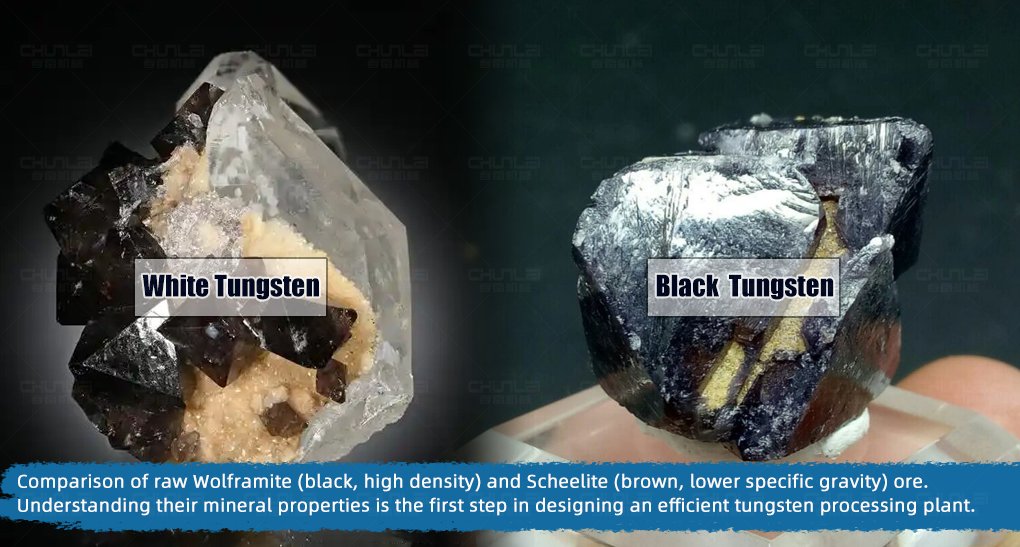
In the mining industry, tungsten ore is known as the “teeth of industry” due to its high density and hardness. However, many mine owners face a common challenge during processing: The physical properties of Wolframite and Scheelite are completely different. If you use a “one-size-fits-all” approach, you often end up with low recovery rates and off-grade concentrates.
As a professional supplier of mining machinery and equipment, we understand the importance of tailoring the process to the specific ore. Today, let’s dive into how to achieve high-efficiency tungsten recovery through a combined gravity separation process.
Understanding the “Personality Differences” Between Wolframite and Scheelite
In mineral processing, Wolframite and Scheelite are like two brothers with very different personalities and must be treated differently:
Scheelite: Specific Gravity is the Weakness. Scheelite has a lower specific gravity compared to Wolframite. During gravity separation, it settles more slowly and is more likely to be lost in the tailings.
Wolframite: Liberation Size is the Challenge. The liberation size of Wolframite is usually much finer than that of Scheelite. This means that to liberate Wolframite from the gangue, you need to grind the ore much finer.
Now that we understand the core logic—Scheelite depends on specific gravity, Wolframite depends on fineness—our process design must maximize strengths and minimize weaknesses.
Core Process: Grinding Based on Scheelite, Recovery Targeting Wolframite
Based on our years of experience in equipment configuration, an efficient combined gravity separation process for mixed Wolframite-Scheelite ores should be designed as follows:
Step 1: Precision Grinding
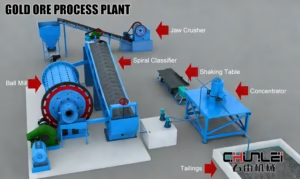
In the grinding stage, the liberation size of Scheelite should be the benchmark. Grind the ore to the optimal particle size to avoid over-grinding (which loses Scheelite in fines) while creating conditions for Wolframite liberation. Grinding equipment like a Ball Mill can be used in a closed circuit with a classifier to ensure a stable grinding fineness.
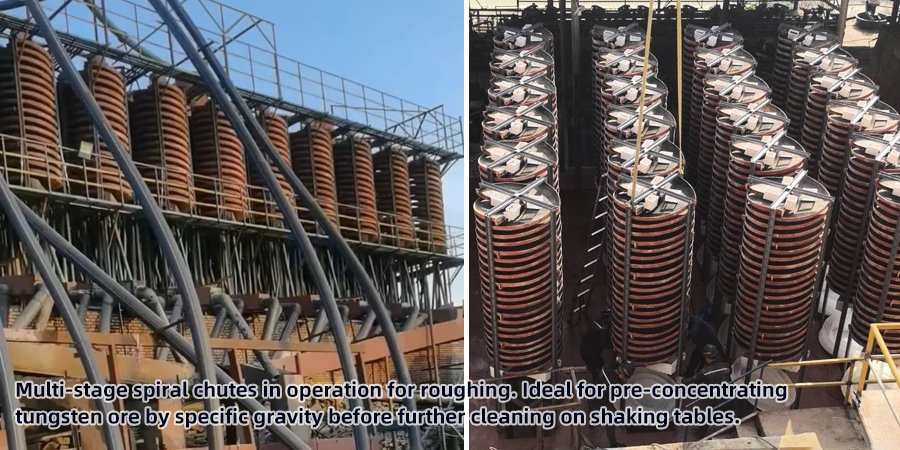
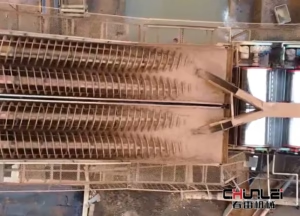
Roughing Stage: The spiral chute handles the relatively coarser particles, discarding a large amount of tailings for initial concentration.
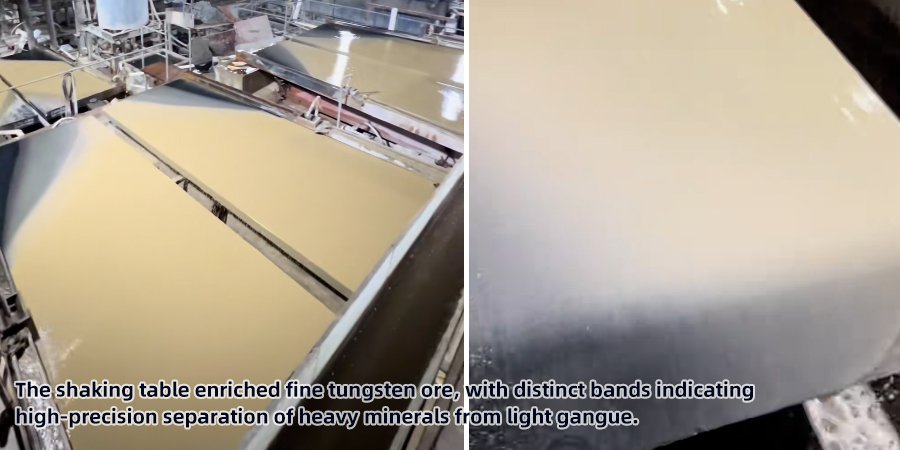
Cleaning Stage: The rough concentrate from the spiral chute goes to a Shaking Table for cleaning. Shaking tables can accurately separate minerals by specific gravity, producing a high-grade final concentrate.
Midlings Treatment: The midlings and tailings from the shaking table often contain unliberated or intergrown particles. These need to be processed with Hydraulic Classification equipment. We highly recommend using a stable performance Hydrocyclone for this classification.
The coarse underflow from classification needs to be sent back for regrinding. This step is crucial because Wolframite has a finer liberation size and must be reground to achieve complete liberation.
For the fine fractions from regrinding and the original ore, the processing equipment must be adjusted.
This is where a Low-Velocity, Flat-Type Spiral Chute with a smaller pitch should be used. This prevents the fine valuable minerals from being washed away by high-velocity water.
The fine slime concentrate from this spiral chute also goes to a shaking table for cleaning. However, this stage typically uses a shaking table with more rifles and finer grooves to enhance the capture of fine particles.
By following this combined gravity separation process, comprehensive recovery rates can reach over 70%. This effectively solves the problem of Wolframite loss through over-grinding and the difficulty of recovering fine Scheelite.
Mobile Crushing Stations
In-Depth Recovery: Flotation and Tailing Scavenging
If the ore is complex or you require an extremely high-grade concentrate, consider a Gravity-Flotation Combined Process.
Flotation Process: For ultra-fine Scheelite that cannot be effectively recovered by gravity, Flotation Machines or Flotation Columns can be used for secondary recovery. By adding efficient collectors and modifiers, precise separation of tungsten minerals from gangue is achieved.
Tailing Scavenging: If you don’t have the conditions for flotation, or want to maximize recovery, an Auto-Flushing Carpet Machine can be used to scavenge the gravity tailings. This simple process is highly effective and can typically increase the overall recovery rate by 5-10%. It’s a powerful tool for smaller plants to boost profitability.
Why Choose Our Equipment?
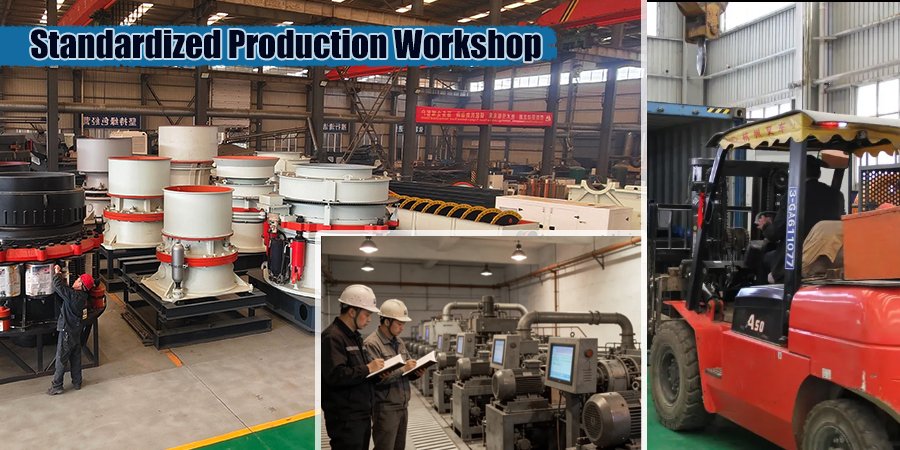
In tungsten processing, the stability and suitability of your equipment directly determine your economic returns. Our complete line of mineral processing equipment offers the following advantages:
Efficient Separation: Our Jig Machines, Spiral Chutes, and Shaking Tables are highly effective at recovering fine particles, ensuring high gravity recovery rates.
Strong Adaptability: The modular design allows for quick adjustments to the process flow to handle fluctuations in ore characteristics.
Long-Lasting Durability: Key components are made from wear-resistant alloys, leading to longer equipment life and lower maintenance costs.
Conclusion
No two tungsten mines are exactly the same. Due to variations in mineral dissemination size and associated elements, the exact liberation size and the boundary between gravity and flotation must be determined through professional mineral processing tests.
We don’t just provide you with a full range of equipment, including Jaw Crushers, Ball Mills, Classifiers, Spiral Chutes, Shaking Tables, and Flotation Machines. We are also committed to providing you with preliminary mineral processing tests and process flow design services. Only by analyzing your ore sample and conducting liberation analysis and beneficiation experiments can we match you with the most suitable equipment and process to maximize your economic benefits.
Hard rock crushing has long posed a significant challenge in mining operations. Ensuring effective crushing while controlling costs has become an urgent industry priority. Traditional crushing methods often involve high energy consumption and exc...
Gravity separation, also known as gravity sorting, operates on the core principle of separating minerals based on differences in their relative density (specific gravity). Mineral particles of varying densities experience distinct gravitational a...
The iron ore crushing process typically involves feeding into primary and secondary crushers, screening, fine crushing, and dry separation. For economic efficiency, finer ore fed into the dry separator generally yields a higher proportion of iron...
Africa is rich in mineral resources and has great potential for mining development. However, general grinding mill equipment is costly and requires high usage conditions, which cannot be widely used in the development of African mining industry. ...
Welcome to Chunlei machinery website. We are a leading manufacturer and exporter of mining machinery in China with more than 30 years history in China.
We offer you one-stop solutions: online consultation --- customized solutions --- fast delivery --- comprehensive after-sales service
 Chunlei Mining Machinery