 Chunlei Mining Machinery
Comprehensive Analysis of Ball Mills: Advantages and Disadvantages Compared to Other Grinding Equipment
In mineral grinding operations, ball mills have long held an almost irreplaceable position. This article provides a thorough analysis of ball mills’ strengths and weaknesses, comparing them with equipment such as rod mills and autogenous mills. We aim to help you minimize unnecessary losses when making your selection.
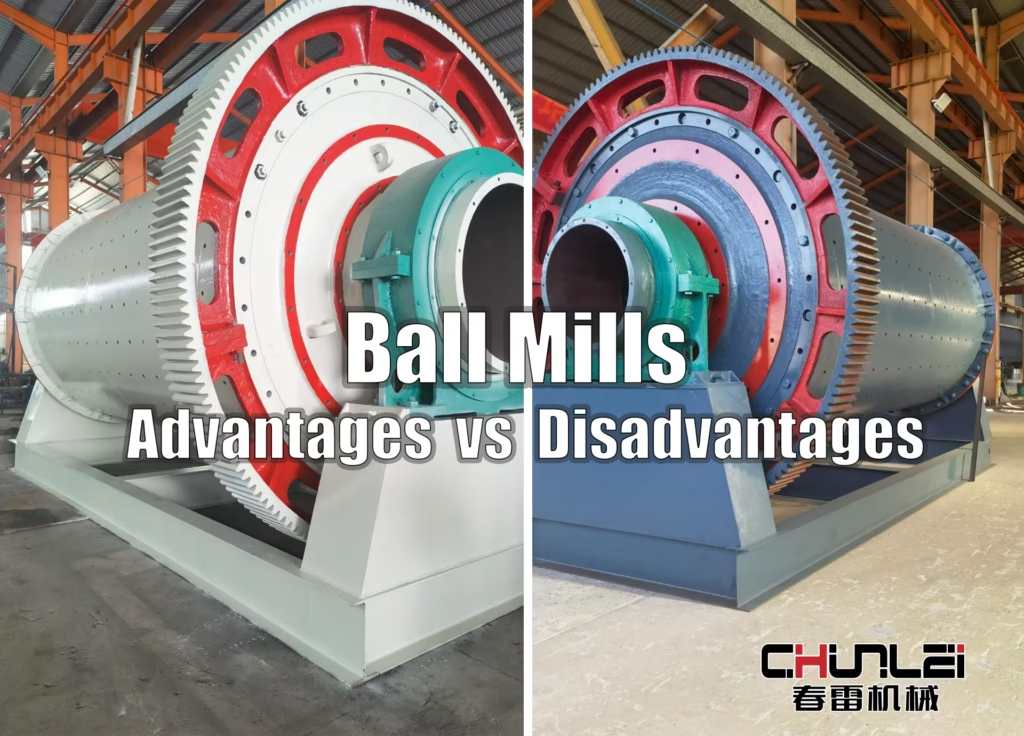
Compared to other grinding mills, the core advantages of ball mills
- Versatile grinding methods and continuous production capacity
Ball mills can process various types of materials, including both high-hardness and low-hardness metal ores, non-metallic ores, and more. They can perform dry grinding or wet grinding of minerals, and can even combine drying and grinding processes simultaneously, offering flexible and diverse operation. This powerful versatility enables continuous, long-term production with stable output and high capacity. They are particularly well-suited for large-scale production industries like cement manufacturing, providing a continuous supply of fine powder without frequent interruptions for maintenance or material loading/unloading. - Exceptional Crushing Ratio and Fineness Control
Ball mills achieve crushing ratios exceeding 300 with uniform particle size distribution and easy adjustment of product fineness—critical for applications requiring precise particle size ranges. This characteristic makes them indispensable in pharmaceutical manufacturing, where near-perfect particle size control is essential and other grinding equipment struggles to match the precision of ball mills. - Simple and Reliable Structure, Easy Maintenance
Ball mills consist of a cylindrical shell, rotating shaft, and grinding media. Their straightforward design ensures stable operation and enables long-term continuous running. Compared to more complex grinding equipment, this simplicity makes maintenance and repairs more convenient. This reliability makes ball mills the preferred grinding equipment in many heavy industrial sectors. Additionally, ball mills are highly user-friendly for new operators, requiring only basic training to operate. - Wide Range of Applications
Ball mills can process diverse materials, including hard solids like ores, minerals, and ceramics, as well as softer substances such as chemicals and pigments. Consequently, they find extensive use across numerous sectors:
Ore Crushing: Second-stage fine grinding (P80 ≤ 75μm) for metals like gold and copper
Cement production: Grinding of cement clinker
Ceramic industry: Grinding of ceramic raw materials
Chemical industry: Raw material pulverization and catalyst preparation
New energy sector: Grinding of battery materials
Compared to other types of mills, ball mills have the following disadvantages:
- Higher energy consumption
During operation, ball mills rely on mechanical energy for grinding, involving the rotational motion of the cylinder and the impact of grinding media on materials. This process is time-consuming and results in higher energy costs. When used for sand production, ball mills may yield lower output and efficiency than rod mills. - Inability to achieve ultrafine grinding
While ball mills can grind fine powders, they are significantly less effective than Raymond mills for producing ultrafine particles. Therefore, for applications requiring extremely fine particles—such as manufacturing high-grade ceramics or certain nanomaterials—other grinding equipment may be more suitable.
- High Consumption of Grinding Media and Lining Plates
During ball milling, grinding media and lining plates wear out rapidly and require regular replacement, increasing operational costs. Routine maintenance necessitates continuous replenishment of steel balls to achieve the desired particle size. - Over-grinding Phenomenon
Improper operation can easily lead to over-grinding in ball mills. Excessive grinding may result in finer particle sizes than required, causing waste and reducing overall production efficiency. In contrast, rod mills utilize line-contact grinding, yielding a relatively lower over-grinding rate.
Comparison Chart of Ball Mills and Other Grinding Machines
To provide a clearer understanding of the differences between ball mills and other grinding machines, the following table compares the key characteristics of various grinding equipment:
| Characteristics | Ball Mill | Rod Mill | Autogenous Mill |
| Grinding Media | Steel balls (diameter 20-150mm) | Steel rods (diameter 50-100mm) | Ore itself |
| Crushing Method | Point contact, primarily impact-driven | Line contact, selective grinding | Ore particles collide and crush each other |
| Product Particle Size | 0.074-0.4mm, fineness up to -200 mesh ≥90% | 1-3mm, final product size typically 0.833-0.147mm | Wide particle size range (0.1-5mm) |
| Energy Consumption Level | 15-30kWh/t | 10-20kWh/t | 25-40 kWh/ton |
| Maintenance Costs | Medium (frequent ball replenishment) | Low (rod consumption 0.3kg/t) | High (rapid liner wear) |
| Suitable Applications | Fine grinding of metal ores, ultrafine powder processing | Coarse grinding, sand making operations | Processing of raw ore in large mines |
New Developments in CHUNLEI Ball Mill Technology
Drawing on years of experience and technological advancements, CHUNLEI ball mills continue to undergo innovative improvements. For instance, CHUNLEI Machinery has introduced a synergistic effect between high-energy electrons and mechanical impact forces, significantly accelerating material refinement and reducing production costs for enterprises. Additionally, compact and lightweight ball milling equipment has been progressively developed, greatly enhancing operational flexibility.
When should a ball mill be selected?
- When extremely high product fineness is required, the ball mill is the only choice.
- When processing highly abrasive or extremely hard materials
- For composite processes requiring simultaneous drying or mixing
- For large-scale production demanding continuous, stable operation
- When high uniformity in product particle size is required: Although ball mills may exhibit over-grinding, proper steel ball grading (proportional mixing of large and small balls) effectively controls particle size distribution, yielding relatively uniform products.
Considerations for other grinding mills:
- When product fineness requirements are not stringent and cost is a priority, rod mills may be selected.
- For processing extremely coarse raw ore (particle size ≤350mm), self-grinding mills may be considered.
- When strict prevention of “over-grinding” is required, the rod mill’s method of grinding coarse particles first to protect fine particles is more suitable.
- When processing materials with high clay content or high viscosity, ball mills are prone to “clogging.” Autogenous mills can be considered.
- In scenarios with limited space or noise sensitivity, ball mills are relatively large and thus generate significant noise. They are unsuitable for locations too close to residential areas.
Conclusion
In simple terms, the “activity” of activated carbon in adsorbing gold manifests as follows:
When selecting grinding equipment, it is essential to conduct a comprehensive assessment based on raw material characteristics (particle size, hardness), product specifications, and operational costs. As a manufacturer with over 30 years of specialization in mining machinery production, CHUNLEI Machinery enjoys a strong reputation within the industry. If you are interested in ball mills or have any inquiries, please contact us—we are available 24 hours a day to address your questions.
Latest News

What are the gravity separation process flows for tin ore?
800Having worked in the tin mining industry for many years, I’ve observed a recurring issue among clients: even when the raw ore has a high tin content and a substantial amount of processing equipment is employed, the final tin recovery rates rema…
-
Gravity Concentration vs. Flotation for Gold: Which Process Should You Choose?
800In gold beneficiation projects, many mining engineers face a critical question: Why does the final gold recovery rate consistently fall short of expectations, even when grinding fineness and reagent regimes are strictly maintained according t…
-
Gravity Separation for Gold: When Is It Suitable for Gold Ore?
800Many people immediately associate “gold ore” with gravity separation, yet not all gold deposits are suitable for recovery using gravity methods alone. Gravity separation is appropriate for liberated native gold or other heavy minerals that ex…
-
How Classification Affects Gold Grinding Efficiency
800In gold ore grinding circuits, attention is often focused primarily on ball mill capacity, power consumption, and grinding media; however, in actual operation, classification plays an equally critical role in determining grinding efficiency. …
loading…
已经是到最后一篇内容了!