 Chunlei Mining Machinery


Spiral Sand Washing Machine
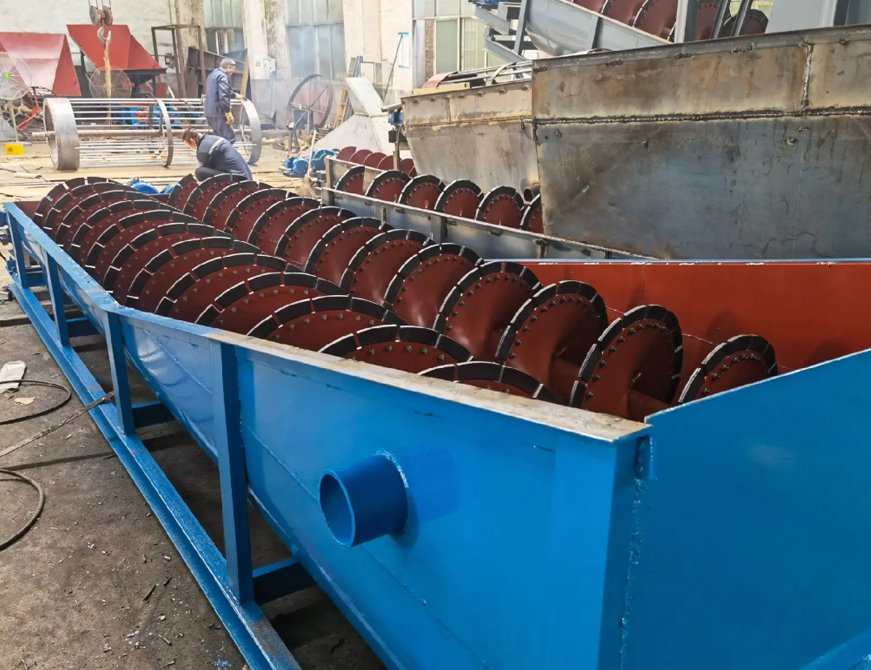
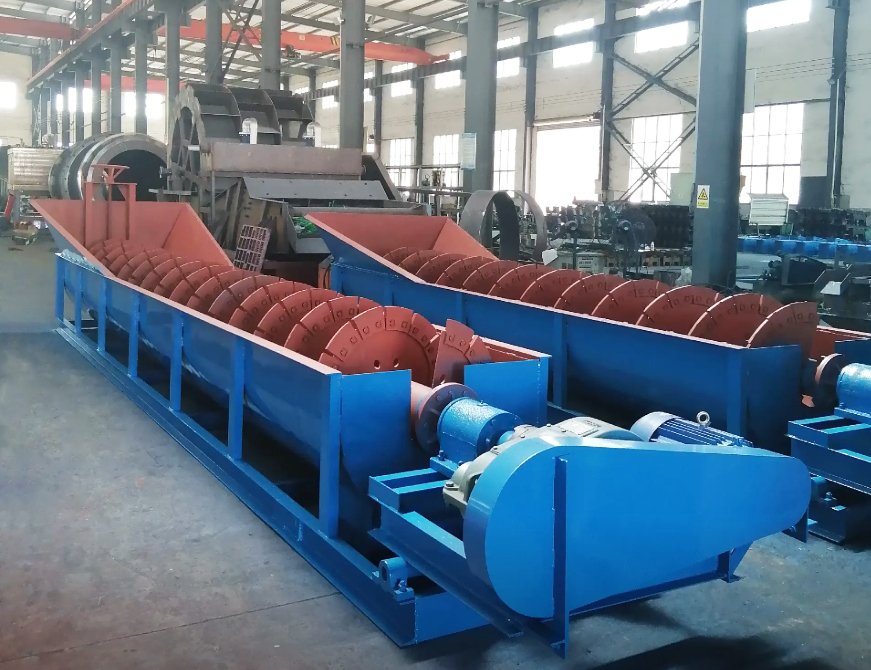
Spiral Sand Washing Machine, also known as gravel washing machine or Spiral sand washer, can be divided into single screw sand washing machine and double screw sand washing machine due to the different number of screws inside the screw sand washing machine, there is only one screw inside the single screw sand washing equipment, and there are two screws inside the double screw sand washing equipment.
- Feed size:≤10mm
- Capacity:20-450m³/h
- Applicable materials: Sand and gravel washing machine is widely used in highway, hydropower, construction and other industries for washing, grading, removing impurities, as well as fine-grained and coarse-grained material washing and other operations, especially suitable for construction and road building sand and gravel.
What is Spiral Sand Washer?
A spiral sand washer (commonly known as an auger sand washer), also called a spiral sand washing equipment, is a mechanical device used to clean and classify sand, gravel, or ore. Specifically designed for manufactured sand, river sand, weathered sand, and tailings sand, it is mainly used in construction sand and gravel plants, mineral processing plants, sand quarries, etc., to remove mud and impurities from sand and gravel, improving sand quality.
This equipment completes the integrated operation of washing, desliming, grading, and dewatering through low-speed agitation by spiral blades, counter-current clean water rinsing, and gravity classification. It features a simple structure, stable operation, and low maintenance costs, making it the mainstream choice for small to large sand and gravel production lines.
CHUNLEI Spiral Sand Washing Machine Advantages
Leveraging over 20 years of experience in mining sand washing, CHUNLEI provides efficient, environmentally friendly, and durable sand and gravel washing solutions for river sand, manufactured sand, and mineral sand. It quickly removes impurities, improves sand and gravel quality, reduces operating costs, and ensures a smoother and more reliable production process.
- High Washing Efficiency: Optimized deep-trough spiral + adjustable weir plate achieves a washing efficiency of 95%+, ensuring clean and uniform sand and gravel.
- Low Fine Sand Loss: Optimized speed and gap design result in a loss rate of ≤5%, high recovery rate, and stable output.
- Energy Saving and Environmental Protection: Fully enclosed tank prevents overflow, low energy consumption, and water recycling reduce operating costs.
- Simple Operation and Maintenance: Integrated design with a small footprint, automatic sludge discharge, few vulnerable parts, and easy maintenance.
- Durable: Durable key components minimize maintenance.
- Flexible Customization: Supports single/double spiral, diesel/electric power, and extended tanks to adapt to various production capacities and site conditions.
Working Principle
The spiral sand washer uses water flow and spiral agitation to clean mud and impurities from sand and ore. The cleaned sand and ore are then discharged via a spiral conveyor.
- Feeding and Mixing: Muddy sand and ore enter the water tank and form a slurry with water.
- Spiral Agitation and Cleaning: The motor drives the spiral shaft to rotate at low speed. The rotating blades push the sand and ore to tumble and rub, thus achieving cement separation.
- Countercurrent Washing and Desliming: Clean water flows in countercurrently from the discharge end to enhance desliming; light impurities are carried by the water flow to the overflow end.
- Grading and Dewatering: Coarse sand is pushed to the discharge port for natural dewatering (moisture content 12%–15%); fine sand and muddy water enter the sedimentation tank or fine sand recovery machine.
- Finished Product Discharge: Clean sand and ore are conveyed to the finished product silo, completing the cleaning process.


Why does my spiral sand washer always fail to clean the sand properly?
Incomplete sand cleaning is mostly caused by operating conditions, parameters, wear, water supply, and material characteristics:
| Problem | Possible Causes | Solutions |
| Incomplete sand washing | Wear or incorrect angle of spiral blades | Check blade wear, replace or adjust angle if necessary |
| Mud cannot be discharged from the tank | Insufficient tank depth or improper overflow design | Increase water depth or adjust overflow height |
| Poor sand-mud separation | High mud content/high fine sand content in sand | Wash multiple times, or screen out large impurities first, wash in batches if necessary |
| Low sand washing efficiency | Excessive feed rate | Control feed rate to within 80% of rated capacity |
| Incomplete washing | Inappropriate rotation speed | Adjust rotation speed to ensure sand is fully agitated but not lost with water flow |
| Incomplete washing | Insufficient water | Increase flushing water volume to ensure mud discharge |
| Mixed mud and water | Poor water quality or excessive mud thickness | Install mud-water separation equipment or use clean water for rinsing |
Spiral sand washing machine vs. wheel sand washing machine
| Comparison Dimensions | Spiral Sand Washer | Wheel Sand Washer |
| Washing Efficiency | High (95%+), thorough desliming | Medium (85%–90%), more residue |
| Fine Sand Loss | Low (≤5%) | High (10%–20%) |
| Processing Capacity | Large (10–500t/h) | Medium (5–100t/h) |
| Energy Consumption | Low (20% energy saving) | Relatively High |
| Maintenance Cost | Low, fewer vulnerable parts | Relatively High, easily damaged wheel buckets |
| Applicable Materials | High mud content, high fine sand | Low mud content, mainly coarse sand |
What types of sand, gravel, or ore are suitable for spiral sand washing machines?
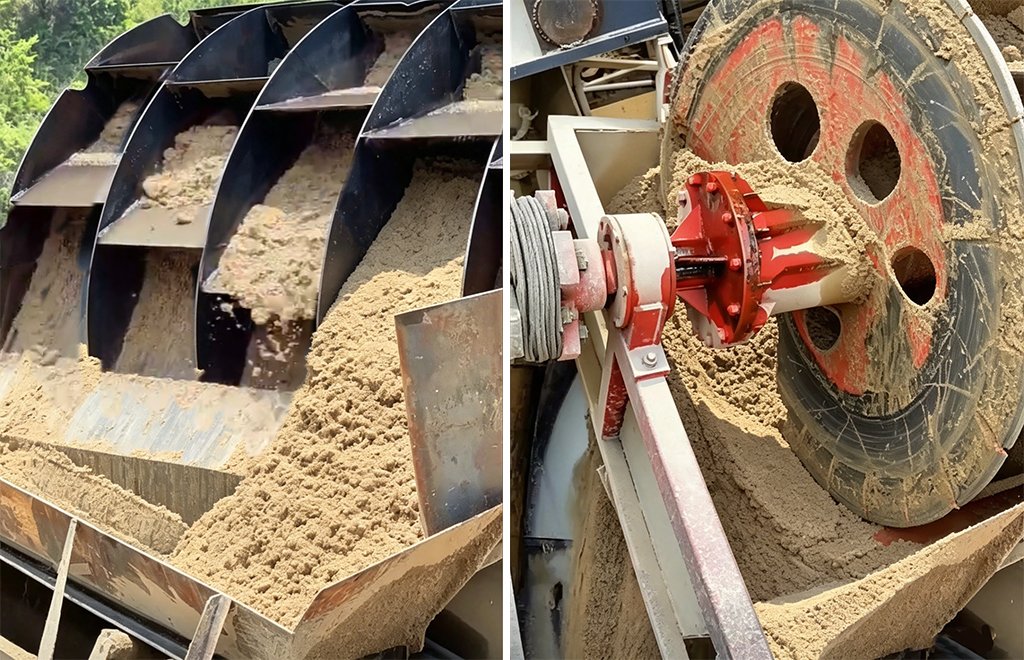
Spiral sand washing machines are suitable for cleaning, grading, and removing impurities from a variety of natural sand, gravel, and ore materials, especially those with high mud content and numerous impurities. Commonly used materials include river sand, manufactured sand (such as granite, basalt, limestone, etc.), mountain sand, weathered sand, quartz sand, building aggregates, and some ores such as iron ore and manganese ore.
Due to the equipment’s strong tumbling and cleaning capabilities, it can effectively improve the cleanliness of the finished product when processing high-mud, high-dust materials. It is widely used in sand and gravel plants, mines, building materials, highways, hydropower, and other industries.
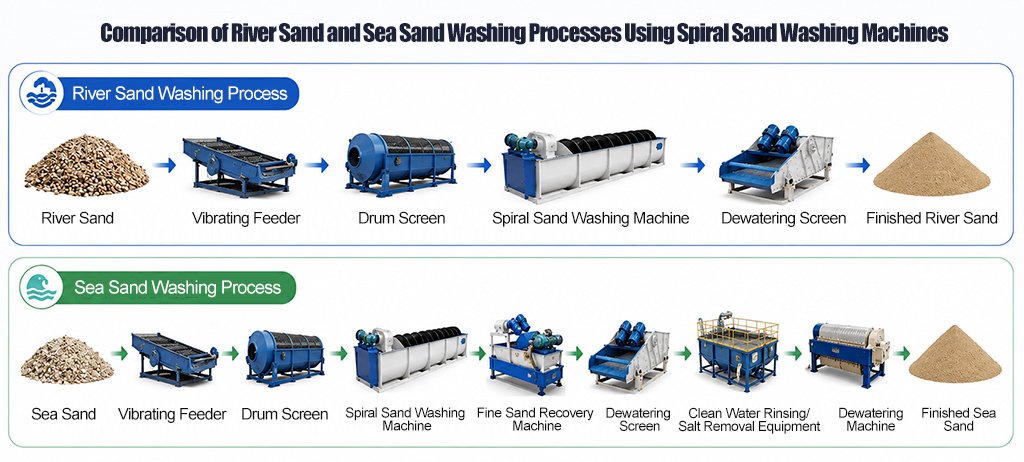
What are the differences between using a spiral sand washer to clean sea sand and river sand?
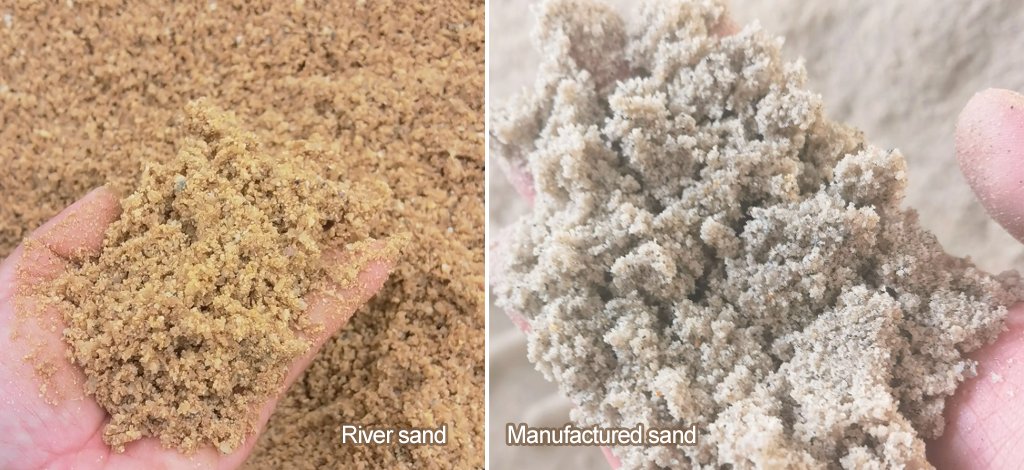
Sea sand and river sand differ in salt content, impurity composition, and cleaning methods, therefore the processing methods used when using a spiral sand washer will also differ.
River sand, with impurities such as mud and stone powder, can meet most construction sand requirements with conventional washing. Sea sand, however, contains impurities such as salt and shells. In addition to removing mud and sand, it is crucial to reduce the salt and chloride ion content; otherwise, it may affect concrete quality and steel reinforcement durability.
Cleaning sea sand typically requires increasing the number of washes and water usage. Some production lines also use dewatering and fine sand recovery equipment to improve desalination efficiency. In contrast, the river sand washing process is relatively simple and has lower requirements for equipment corrosion and water treatment.
Because spiral sand washers have strong tumbling and agitation capabilities, they are well-suited for cleaning various sand and gravel, including sea sand and river sand.
What to do about severe fine sand loss during sand washing?
Severe fine sand loss during sand washing leads to decreased output and economic losses. Fine sand loss can be effectively reduced and output and economic benefits ensured by adjusting the rotation speed, weir plate, water flow, and blades, combined with a recovery device and a suitable machine model. Specifically:
- Reduce Rotation Speed: Standard 12–16 rpm, reduce to 8–10 rpm for high fine sand output to minimize disturbance.
- Adjust Weir Plate: Raise it by 50–100 mm to reduce overflow velocity and prolong settling time.
- Replace Blades: Repair worn blades, controlling the gap to 5–8 mm to reduce sand leakage.
- Control Water Flow: Sand-to-water ratio 1:1.2–1.5 to avoid direct flow to the overflow outlet.
- Install Recovery Machine: Add a fine sand recovery machine to the overflow outlet to reduce the loss rate to ≤5%.
- Clean Overflow Outlet/Tank: Regularly clean the overflow outlet to maintain stable water flow.
- Select the Right Machine Model: For high fine sand output and large production capacity, consider using an extended tank or a twin-spiral machine.
What precautions should be taken when handling materials with high viscosity and mud content?
In actual sand production, many users encounter materials with high mud content, such as mountain sand, weathered sand, and river silt. These raw materials are prone to clumping and have strong adhesion. If the handling method is not appropriate, it can easily affect the sand washing effect and the stability of equipment operation.
When using a spiral sand washer to process materials with high mud content, it is recommended to maintain uniform feeding and appropriately increase the washing water volume to ensure thorough separation of mud and sand. For raw materials with a large amount of mud lumps, a simple screening or pre-washing process can be added at the front end, which can significantly improve the subsequent washing efficiency.
In addition, highly viscous materials are more likely to adhere to the spiral blades and the inside of the tank during operation. Therefore, it is necessary to clean the accumulated mud regularly and check the condition of easily worn parts. Appropriately controlling the processing volume also helps to improve the cleanliness of the finished sand and the overall operational stability.
With proper configuration, the spiral sand washer is also suitable for continuous washing operations of sand and gravel materials with high mud content and high impurities.
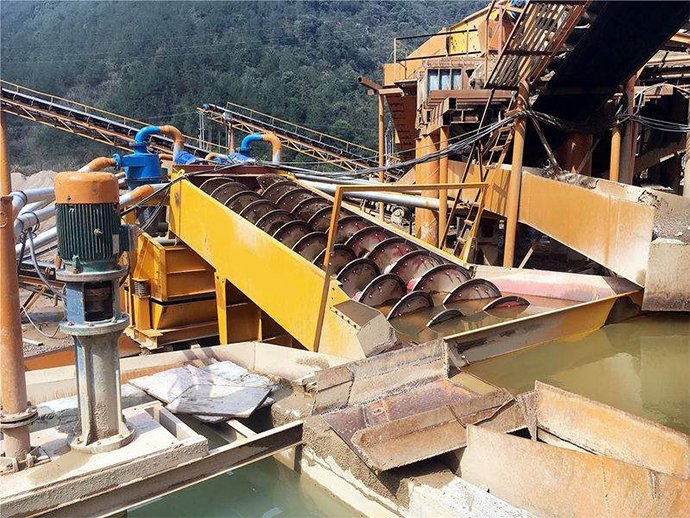
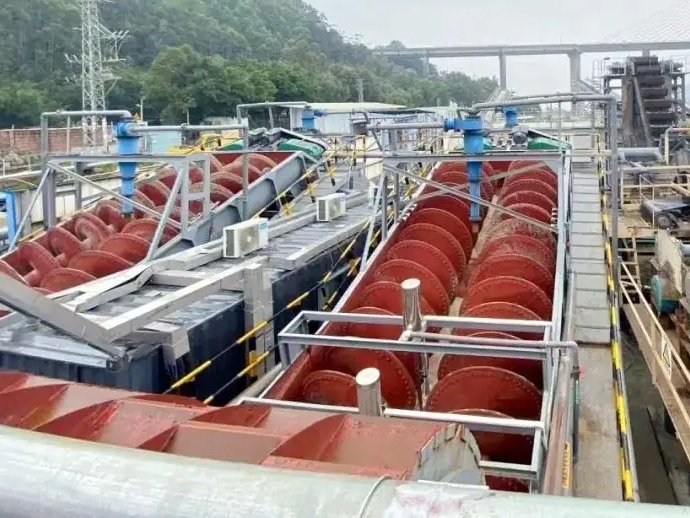
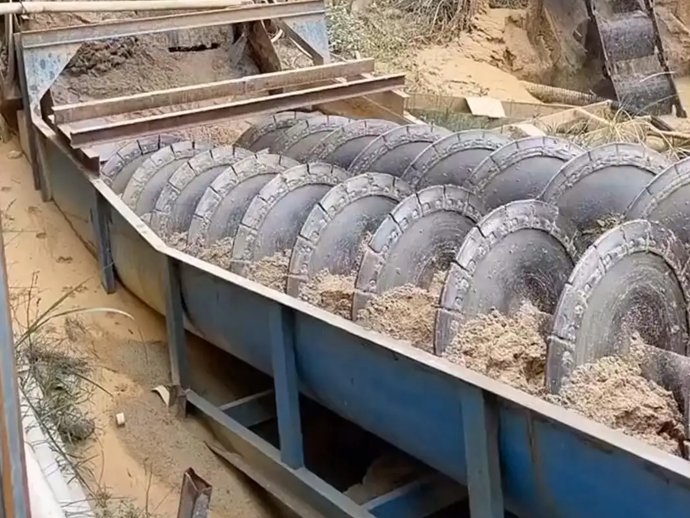
Spiral Sand Washer Customer Site Demonstration
Different regions and different materials have different requirements for sand washing equipment. Our spiral sand washers have been widely used in river sand, sea sand, manufactured sand, mountain sand, and high-mud-content sand and gravel cleaning projects, operating stably on-site and achieving excellent washing results.
Common Faults and Solutions
During long-term operation, spiral sand washing machines may experience some common problems due to improper operation or inadequate maintenance. Understanding the causes and addressing them promptly can effectively reduce downtime and ensure sand washing efficiency.
Decreased Washing Cleanliness
Possible Causes: Excessive feed rate, insufficient water volume, or excessive mud content.
Solutions: Control the feed rate, increase the washing water volume, and add a pre-washing process if necessary.
Equipment Blockage or Strain
Possible Causes: High material viscosity, excessive mud lumps, or continuous overload operation.
Solutions: Maintain uniform feed, promptly clean mud from the tank, and avoid prolonged full-load operation.
Severe Fine Sand Loss
Possible Causes: Excessive water flow or improper discharge control.
Solutions: Adjust the water flow rate; consider using a fine sand recovery device.
Bearing Overheating or Abnormal Noise
Possible Causes: Insufficient lubrication, bearing wear, or impurities entering the bearing.
Solutions: Regularly add lubricating oil and check bearing wear.
Rapid wear of the spiral blades.
Possible causes: Long-term handling of high-hardness sand and gravel or failure to promptly clean accumulated material.
Solution: Regularly inspect vulnerable parts and maintain or replace them promptly.
Technical Parameters of Spiral Sand Washing Machine
| Model | Spiral Diameter(mm) | Length of flume(mm) | Screw speed(r/min) | Capacity(t/d) | Motor power(kw) | Overall Dimension(mm≤) | ||||
| According to sand return | By overflow | Transmission | For lifting | Length | Width | Height | ||||
| LX-3 | 300 | 3000 | 12-30 | 80-150 | 20 | 1.1 | —- | 3850 | 490 | 1140 |
| LX-5 | 500 | 4500 | 8-12.5 | 135-210 | 32 | 1.1 | —- | 5430 | 680 | 1480 |
| LX-7 | 750 | 5500 | 6-10 | 340-570 | 65 | 3 | —- | 6720 | 980 | 1820 |
| LX-10 | 1000 | 6500 | 5-8 | 675-1080 | 110 | 5.5 | —- | 7590 | 1240 | 2380 |
| LX-10 | 8400 | 675-1080 | 85 | 7.5 | —- | 9600 | 1240 | 2680 | ||
| LX-12 | 1200 | 6500 | 4-6 | 1170-1870 | 155 | 7.5 | 2.2 | 8180 | 1570 | 3110 |
| LX-12 | 8400 | 1170-1870 | 120 | 7.5 | 2.2 | 10370 | 1540 | 3920 | ||
| 2LX-12 | 6500 | 2340-3740 | 310 | 15 | 4.4 | 8230 | 2790 | 3110 | ||
| 2LX-12 | 8400 | 2340-3740 | 240 | 15 | 4.4 | 10370 | 2790 | 3920 | ||
| LX-15 | 1500 | 8300 | 4-6 | 1830-2740 | 235 | 7.5 | 2.2 | 10410 | 1880 | 4080 |
| LX-15 | 10500 | 1830-2740 | 185 | 7.5 | 2.2 | 12670 | 1820 | 4890 | ||
| 2LX-15 | 8300 | 2280-5480 | 470 | 15 | 4.4 | 10410 | 3390 | 4080 | ||
| 2LX-15 | 10500 | 2280-5480 | 370 | 15 | 4.4 | 12670 | 3370 | 4890 | ||
| LX-20 | 2000 | 8400 | 3.6-5.5 | 3290-5940 | 400 | 11-15 | 3 | 10790 | 2530 | 4490 |
| LX-20 | 12900 | 3210-5940 | 320 | 11-15 | 3 | 15610 | 2530 | 5340 | ||
| 2LX-20 | 8400 | 7780-11880 | 800 | 22-30 | 6 | 11000 | 4600 | 4490 | ||
| 2LX-20 | 12900 | 7780-11880 | 640 | 22-30 | 6 | 15760 | 4600 | 5640 | ||
| LX-24 | 2400 | 9130 | 3.67 | 6800 | 580 | 15 | 3 | 11650 | 2910 | 4970 |
| LX-24 | 14130 | 6800 | 490 | 18.5 | 4 | 16580 | 2930 | 7190 | ||
| 2LX-24 | 9130 | 13600 | 1160 | 30 | 6 | 12710 | 5430 | 5690 | ||
| 2LX-24 | 14130 | 13700 | 910 | 37 | 8 | 17710 | 5430 | 8000 | ||
| 2LX-30 | 3000 | 12500 | 3.2 | 23300 | 1785 | 40 | 8 | 16020 | 6640 | 6350 |
| 2LX-30 | 14300 | 23300 | 1410 | —- | —- | 17091 | —- | 8680 | ||
FAQ
Q: What materials is a spiral sand washer suitable for cleaning?
A: It can be used for cleaning various sand and gravel materials such as river sand, manufactured sand, mountain sand, weathered sand, and stone powder sand, especially suitable for raw materials with high mud content.
Q: How effective is the spiral sand washer?
A: The equipment combines spiral propulsion with water flushing to effectively remove mud, dust, and impurities from sand and gravel, improving the cleanliness of the finished sand.
Q: Can it handle materials with high mud content?
A: Yes. For materials with high mud content, the water volume can be appropriately increased and the feed rate controlled to maintain a stable cleaning effect.
Q: Will the spiral sand washer result in significant fine sand loss?
A: Compared to some traditional sand washing equipment, the spiral sand washer results in less fine sand loss. To further improve the recovery rate, it can be used in conjunction with a fine sand recovery machine.
Q: What is the hourly processing capacity?
A: The output varies depending on the model. Small equipment can process tens of tons per hour, while large equipment can reach hundreds of tons per hour. Choose the appropriate model based on your production needs.
Q: Is the equipment prone to clogging during operation?
A: Under normal circumstances, material blockage is not common. Maintaining a uniform feed rate and promptly cleaning accumulated mud can effectively prevent blockages.
Q: Is daily maintenance complicated?
A: Maintenance is relatively simple. Regularly check the bearings, reducer, and auger blades, and perform lubrication and cleaning as needed.
Q: What is the difference between a spiral sand washer and a wheel sand washer?
A: Spiral sand washers are more suitable for materials with high mud content and have stronger cleaning capabilities; wheel sand washers are more suitable for production lines with higher requirements for fine sand recovery.
Related Products —
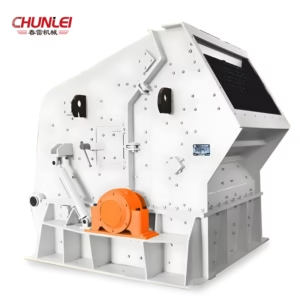
Impact Crusher
An impact crusher is a core piece of equipment in sand and gravel aggregate production for medium and fine crushing and shaping. It uses a high-speed rotor to drive hammer plates to impact the material, and the repeated…
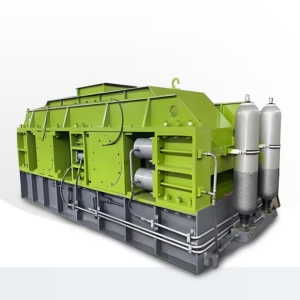
Hydraulic Roll Crusher
Hydraulic roller crushers (also known as hydraulic double roller crushers) are energy-saving medium and fine crushing core equipment in the fields of mining, sand and gravel plants, building materials and solid waste treatment. They are m…
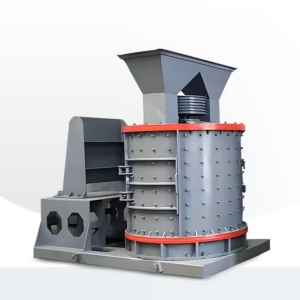
Combination Crusher
Combination Crusher is a new product optimized and designed based on our company’s PEL vertical compound crusher and combined with domestic and foreign fine crushing technology. The vertical compound crusher, also kno…
Electromagnetic vibrating feeder
A variety of models are available | Get the free price list! Electromagnetic vibrating feeder is a kind of automated equipment that utilizes electromagnetic vibration principle to drive the continuous, uniform or q…
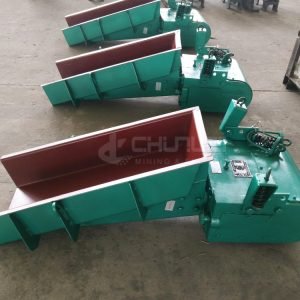
Vibrating feeder
Vibrating feeder, also known as vibrating feeder, can provide continuous and uniform feeding for crushing machinery and screening of materials, which is widely used in crushing and screening combined equipment in mineral processing, buil…

loading…
已经是到最后一篇内容了!