 Chunlei Mining Machinery
What’s The Difference Between Charcoal and Activated Carbon?
Customers often ask us about the distinction between charcoal and activated carbon. From a mining machinery manufacturer’s perspective, charcoal is a basic carbon material primarily used as fuel, while activated carbon is an advanced, porous material serving as a powerful adsorbent. The transformation between them is akin to evolving from a “skeleton” to a “super sponge.” Using a house as a simple analogy, charcoal is the “semi-finished product” or “rough-built house” of activated carbon, while activated carbon represents the “high-end finishing touches” applied to that rough structure. This article will focus on manufacturing processes to thoroughly analyze the fundamental differences between charcoal and activated carbon.
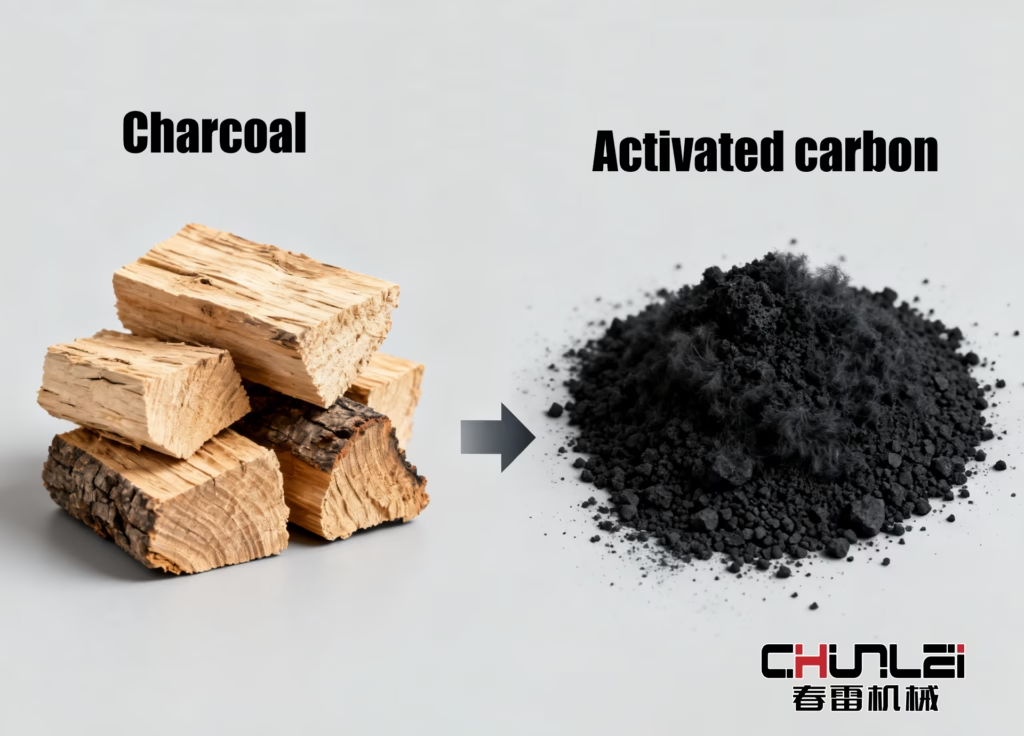
What is charcoal?
Charcoal, also known as the “traditional energy star,” is produced through a relatively simple manufacturing process involving high-temperature carbonization in kilns—a process called “carbonization.” Charcoal has fewer pores but larger pore sizes, enabling it to burn and generate heat. It is commonly used as a reducing agent and fuel in metallurgy and other fields.
What is activated carbon?
Activated carbon is known as the “purification expert.” It is formed by subjecting charcoal to a secondary “activation” process, creating an extremely developed and dense network of micropores with an enormous surface area. Data indicates that one gram of activated carbon can possess a specific surface area of 500–2000 square meters—equivalent to a football field! This immense surface area endows it with powerful adsorption capabilities. In gold carbon-in-leach (CIL) plants, activated carbon captures dissolved gold ions from cyanide solutions. It is also an indispensable material for air and water purification.
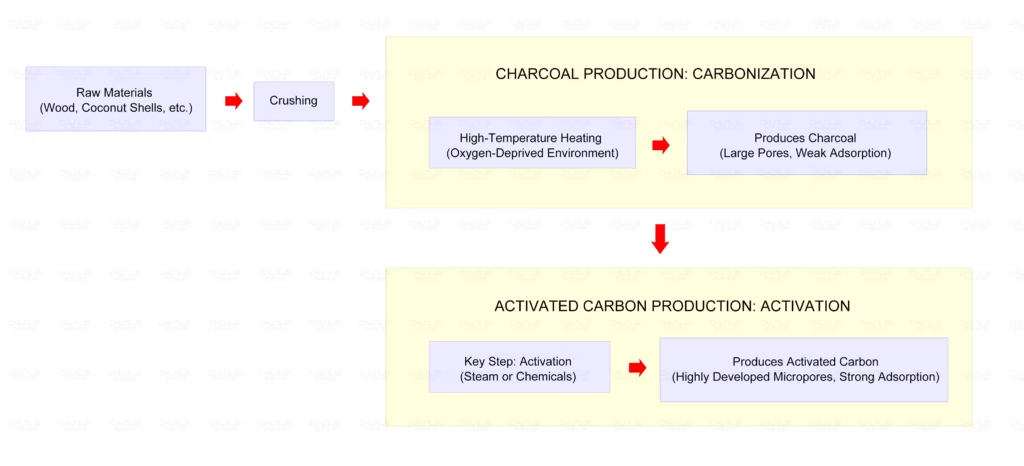
Charcoal vs. Activated Carbon: What’s the Fundamental Difference?
In manufacturing, the fundamental difference between charcoal and activated carbon lies in their intended purposes: Charcoal is produced as an “energy source/raw material,” commonly used for barbecuing, heating, and similar applications. Activated carbon, however, is manufactured as a “functional material” capable of adsorbing harmful substances in the air, such as formaldehyde and benzene. Consequently, it finds extensive use in water treatment, air purification, and related fields.
| Manufacturing Stage | Charcoal | Activated Carbon |
| Core Process | Requires only carbonization | Carbonization + Activation |
| Process Focus | Focuses on efficiency and output. Key concerns include carbonization rate, energy consumption, and production capacity. | Pursuing performance and purity. Key concerns include specific surface area, pore size distribution, strength, impurity content, and other metrics. |
| Equipment and Cost | Equipment is relatively simple (e.g., earth kilns, continuous carbonization furnaces), with low initial investment and operating costs. | Requires specialized activation furnaces (e.g., Slev furnace, rotary kiln), strict environmental compliance, and substantial equipment investment, resulting in high production costs. |
| Final Result | A fuel whose primary value lies in the heat released during combustion. | An adsorbent whose primary value lies in physically adsorbing impurities. |
How does activated carbon’s “activity” adsorb gold?
The process by which activated carbon adsorbs gold from gold-bearing solutions is not a simple “adhesion,” but rather a precise electrochemical process commonly known as the “carbon-in-pulp (CIP) method.” This technique stands as one of the core technologies in modern gold extraction industries.
Industrial cyanidation involves chemically reacting crushed gold ore to oxidize solid elemental gold (Au⁰) and combine it with cyanide ions (CN⁻), forming soluble gold-cyanide complexes (Au(CN)₂⁻). The core of activated carbon’s gold adsorption lies in its ability to reduce trace gold ions (Au(CN)₂⁻, known as the gold cyanide complex) in the solution into minute gold atoms (Au⁰), which then firmly adhere to the carbon’s vast internal surface area.
Activated carbon’s high efficiency also stems from its “selective” adsorption. Although other metal complexes like copper or zinc may be present in the solution, activated carbon exhibits preferential adsorption for the gold cyanide complex (Au(CN)₂⁻). The adsorbed activated carbon, termed “gold-loaded carbon,” can contain several kilograms of gold per ton of carbon—significantly higher than the ore’s original grade (typically a few grams per ton).
Common Gold Adsorption Methods in Industry: Carbon-in-Pulp (CIP) and Carbon-in-Leach (CIL)
Carbon-in-Pulp (CIP): First, the ore undergoes cyanide leaching. Then, activated carbon is mixed with the leached pulp to adsorb gold.
Carbon-in-Leach (CIL): Cyanide leaching and activated carbon adsorption occur simultaneously within a single series of tanks. This concurrent leaching and adsorption process achieves higher efficiency and is currently the mainstream technology.
金矿选矿生产线工艺示意图-1024x605.avif)
Conclusion
In simple terms, the “activity” of activated carbon in adsorbing gold manifests as follows:
Physically: Its enormous specific surface area and pore structure provide a vast “battlefield” for trapping gold.
Chemically: Its surface reductive properties supply crucial electrons, reducing gold ions (Au⁺) in solution to gold atoms (Au⁰) and immobilizing them.
This represents a highly efficient, economical, and recyclable industrial marvel that integrates physical adsorption, chemical reduction, and electrochemical deposition. If you’re interested in this,Contact us now for a free customized solution quote!
Latest News

What are the gravity separation process flows for tin ore?
800Having worked in the tin mining industry for many years, I’ve observed a recurring issue among clients: even when the raw ore has a high tin content and a substantial amount of processing equipment is employed, the final tin recovery rates rema…
-
Gravity Concentration vs. Flotation for Gold: Which Process Should You Choose?
800In gold beneficiation projects, many mining engineers face a critical question: Why does the final gold recovery rate consistently fall short of expectations, even when grinding fineness and reagent regimes are strictly maintained according t…
-
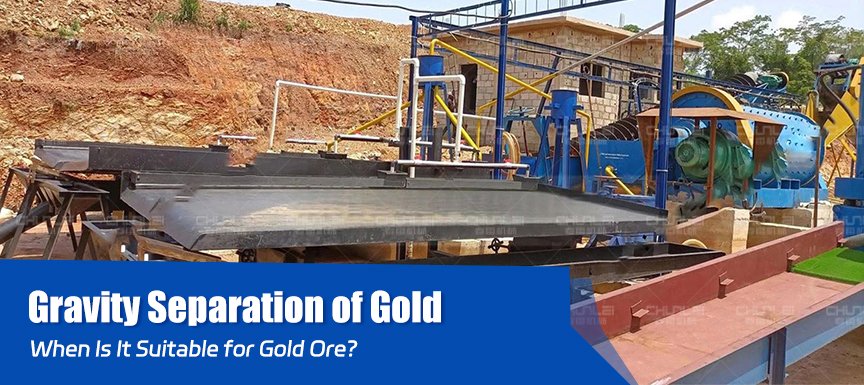
Gravity Separation for Gold: When Is It Suitable for Gold Ore?
800Many people immediately associate “gold ore” with gravity separation, yet not all gold deposits are suitable for recovery using gravity methods alone. Gravity separation is appropriate for liberated native gold or other heavy minerals that ex…
-
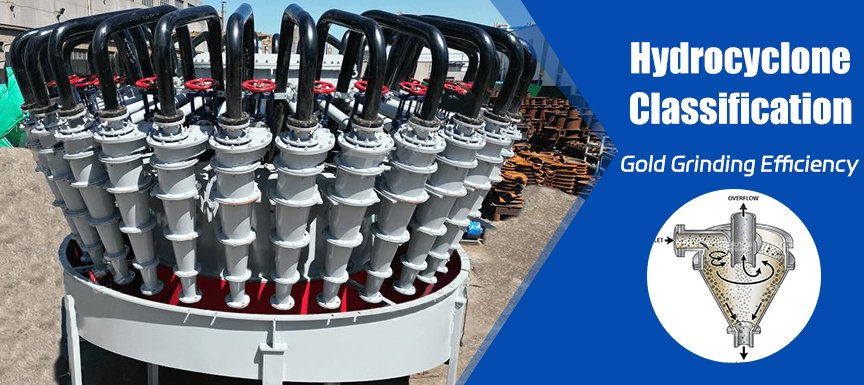
How Classification Affects Gold Grinding Efficiency
800In gold ore grinding circuits, attention is often focused primarily on ball mill capacity, power consumption, and grinding media; however, in actual operation, classification plays an equally critical role in determining grinding efficiency. …
loading…
已经是到最后一篇内容了!