 Chunlei Mining Machinery
Gravity Separation for Gold: When Is It Suitable for Gold Ore?
Many people immediately associate “gold ore” with gravity separation, yet not all gold deposits are suitable for recovery using gravity methods alone.
Gravity separation is appropriate for liberated native gold or other heavy minerals that exhibit a significant density difference from the gangue. If the gold exists as coarse, free-milling particles, gravity separation can recover a portion of the gold with minimal or no chemical reagents; however, if the gold is primarily encapsulated within sulfides, or consists of very fine particles intimately intergrown with gangue, relying solely on gravity separation may prove ineffective.
Therefore, determining whether a gold deposit is suitable for gravity separation requires looking beyond mere “gold grade” and instead considering the following factors:
In what form does the gold exist? What is the particle size? Is the gold liberated? What is the Gravity Recoverable Gold (GRG) content? And what recovery process is planned for the post-gravity separation stage?
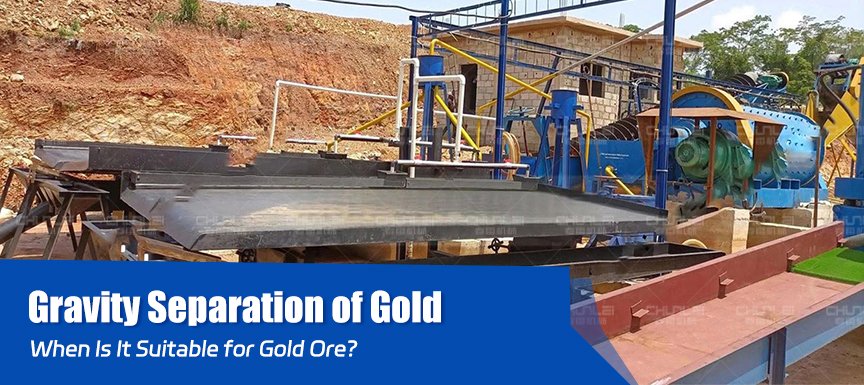
What is gold gravity separation?
Gold gravity separation is a mineral processing method that utilizes the density difference between gold and gangue minerals to achieve separation through the action of water flow, gravity, and centrifugal force.
Gravity separation is particularly suitable for liberated, coarse-grained free gold.
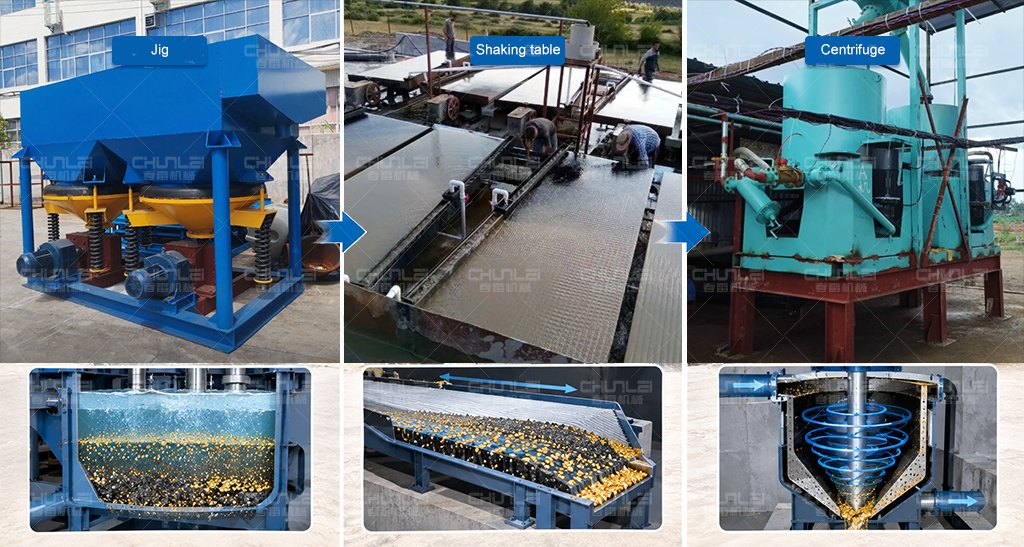
Common equipment includes:
Different types of equipment vary in terms of suitable particle size ranges, processing capacities, and feed conditions. Centrifugal gravity technology may be considered for finer free gold.
High gold grade is not the decisive factor for gravity separation.
It is a common misconception that high-grade gold ore is automatically suitable for gravity separation.
If an ore has a high gold content but the gold exists as fine particles encapsulated within sulfides, gravity separation may not yield good results.
Conversely, for some ores with only moderate grades, gravity separation can be highly effective if they contain significant amounts of coarse, free-milling gold that is amenable to gravity recovery.
Therefore, determining suitability for gravity separation requires evaluating:
Gold occurrence state + particle size + degree of liberation + GRG characteristics.
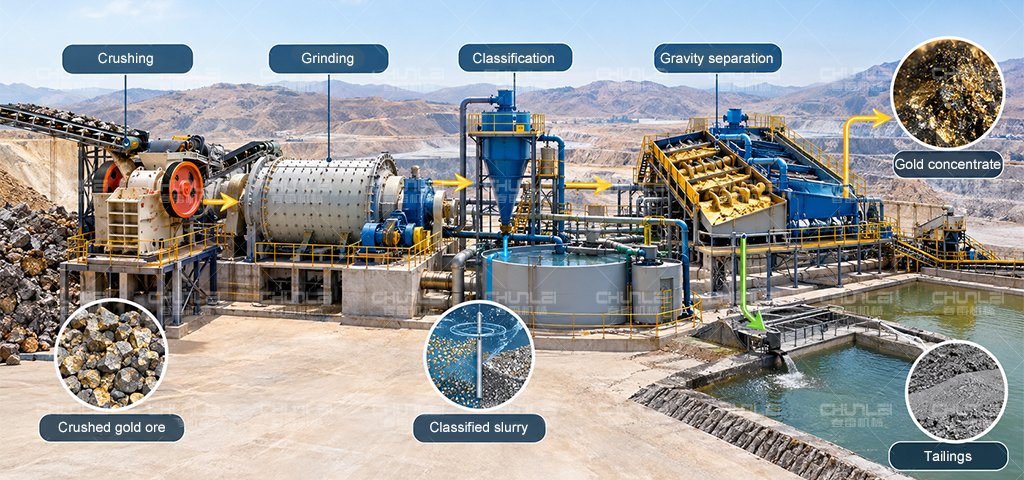
Which gold ores are suitable for gravity separation?
1. Gold ores containing coarse, free-milling gold
This is the most typical application scenario for gravity separation.
If relatively coarse native gold particles are liberated during crushing or grinding, gravity equipment can utilize gold’s high density to pre-concentrate it. This prevents liberated free gold from repeatedly re-entering the grinding circuit along with the slurry.
Consequently, gravity recovery stages are often incorporated into gold grinding circuits to capture free gold as early as possible. Centrifugal gravity concentrators are widely used for this purpose within grinding circuits.
2. Ores with a significant density difference between native gold and gangue
Gravity separation is generally more effective when native gold has been liberated from gangue minerals such as quartz or feldspar.
The typical process flow can be summarized as follows:
Crushing → Grinding/Liberation → Gravity Separation → Gold Concentrate
However, the specific flowsheet must still be determined based on ore characteristics and gold particle size.
3. Gold ores containing a certain amount of GRG
Gravity Recoverable Gold (GRG) is a crucial concept for determining whether a gold ore is a suitable candidate for gravity recovery.
It is not simply a measure of “total gold grade”; rather, it focuses on the specific portion of gold that can be recovered via gravity separation under defined equipment and testing conditions.
GRG testing typically involves progressive grinding and gravity recovery stages to observe gold liberation and recovery at various particle sizes, thereby characterizing the gravity-recoverable gold content of the ore.
Therefore, when designing a large-scale gravity separation circuit for a gold mine, GRG test results provide more valuable guidance than relying solely on assay-based gold grades.
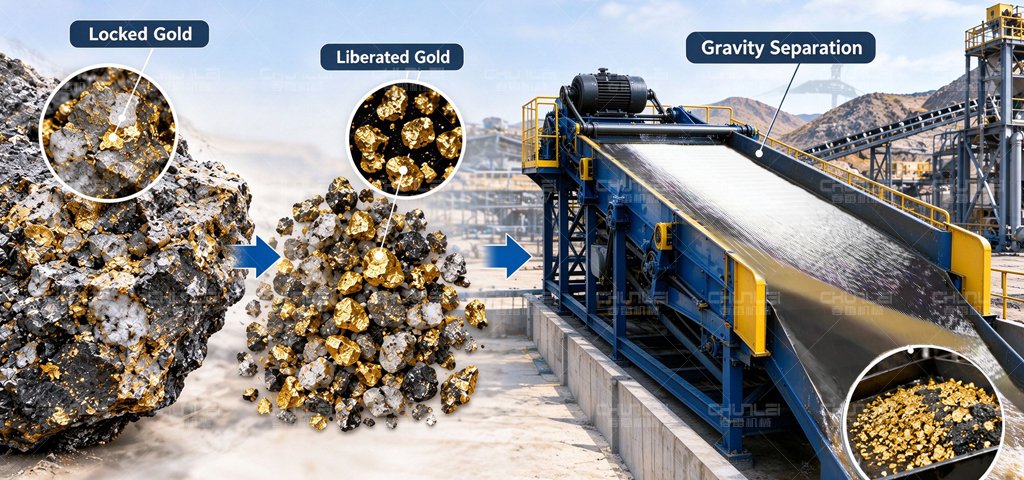
Five Key Indicators for Determining the Suitability of a Gold Deposit for Gravity Separation
Determining whether a gold deposit is suitable for gravity separation requires looking beyond mere gold grade. The critical factors to consider are the form in which the gold occurs, its particle size, its degree of liberation, and the proportion of gold amenable to gravity recovery. In short, the first step is to assess whether the gold can be separated via gravity before deciding whether to install gravity separation equipment.
| Key Indicators | What to Focus On | Significance for Gravity Separation |
| 1. Gold Occurrence | Native gold, encapsulated gold, sulfide-associated gold | Higher free gold content generally indicates greater potential for gravity separation |
| 2. Gold Particle Size | Coarse, medium, fine, and ultra-fine | Coarse free gold is typically easier to recover via gravity; ultra-fine gold requires careful assessment |
| 3. Gold Liberation Degree | Whether gold is released from gangue minerals like quartz or sulfides | Greater liberation facilitates more effective gravity separation |
| 4. GRG (Gravity Recoverable Gold) | Determines the recoverable gold proportion and particle size distribution via gravity testing | A better indicator of gravity separation potential than total gold grade alone |
| 5. Post-Gravity Recovery Strategy | How gravity concentrates are processed (e.g., subsequent flotation or leaching) | Determines whether gravity separation can effectively improve overall recovery rates and economic viability |
Coarse free gold + high liberation + favorable GRG characteristics → prioritize gravity separation.
If the gold primarily occurs as fine-grained encapsulated gold or is associated with sulfides, gravity separation cannot be assumed suitable—even with high gold grades—and processes such as flotation, leaching, or combined methods often need to be considered.
Commonly Used Equipment for Gold Gravity Separation
| Equipment | Applicability/Characteristics | Key Advantages | Considerations |
| Jig | Coarser particles; materials with significant density differences | Simple structure; high processing capacity | Limited suitability for extremely fine gold |
| Shaking Table | Gold minerals that are already well-liberated | High separation precision; suitable for cleaning stages | Relatively limited single-unit processing capacity |
| Spiral Chute | High throughput; medium-sized particle slurries | Simple structure; relatively low operating costs | Limited recovery of ultra-fine free gold |
| Centrifugal Concentrator | Fine free gold; grinding circuits | Uses enhanced gravity to improve fine gold recovery | Sensitive to feed concentration, slurry conditions, etc. |
| Spiral Chute | Coarse free gold; placer gold | Simple; relatively low investment | Sensitive to slurry conditions and gold particle size |
For placer and alluvial gold deposits, gravity separation is typically more straightforward; for hard-rock gold deposits, however, the design of gravity recovery stages often requires integrating crushing, grinding, and liberation considerations.
Where should gravity separation be positioned within the gold processing flowsheet?
The placement of gravity separation in the gold processing flowsheet is not fixed; it depends primarily on the gold’s particle size, degree of liberation, and mode of occurrence. In practical design, there are two common positions for gravity separation: recovering coarse, free gold as early as possible after grinding, or serving as a pre-concentration step following crushing and screening.
| Gravity Separation Stage | Applicable Conditions | Primary Objective |
| After crushing, before grinding | Contains significant coarse free gold that easily liberates from the gangue | Recover coarse gold early to minimize losses during subsequent grinding |
| After grinding and classification | Gold is fully liberated after grinding; contains medium-to-coarse free gold recoverable by gravity | Recover gravity-recoverable gold from the grinding product as early as possible |
| Within the grinding circuit | Closed-circuit grinding (ball mill + hydrocyclone) with significant gravity-recoverable gold present | Continuously or intermittently recover coarse free gold; reduce over-grinding |
| Before flotation/leaching | Ore contains both free gold and gold encapsulated in sulfides | Recover easily gravity-recoverable gold first, then process the remaining gold |
Most Common Gold Processing Flowsheets
For many primary gold ores containing coarse free gold, the following sequence may be considered:
Crushing → Grinding → Classification → Gravity Separation → Flotation/Leaching → Gold Recovery
If there is a significant amount of coarse free gold, an alternative early-stage approach is:
Crushing → Screening/Washing → Gravity Separation → Grinding → Flotation/Leaching
Gravity separation should generally be positioned at the stage where gold has been liberated but has not yet entered more complex recovery circuits; it is particularly suitable for the early recovery of coarse free gold, rather than being rigidly fixed to a specific processing stage.
How do you choose between gravity separation, flotation, and leaching?
The choice is not a simple matter of picking one of the three; the actual decision depends on the mode of gold occurrence, particle size, degree of liberation, and ore characteristics.
| Beneficiation Method | Best Suited For | Key Criteria | Typical Process Stage |
| Gravity Separation | Coarse-grained, free-milling, and well-liberated gold ores | Significant density difference between gold and gangue | After crushing or after grinding and classification |
| Flotation | Gold associated with sulfides, fine-grained gold, or ores requiring enrichment | Gold and associated minerals (e.g., sulfides) exhibit good floatability | After grinding and classification |
| Leaching | Fine-grained gold or ores amenable to leaching | Gold is effectively soluble in the leaching agent | After grinding or concentrate treatment |
| Gravity Separation + Flotation | Coarse free gold + sulfide-associated gold | Gold exists in different particle sizes and modes of occurrence requiring separate recovery | Gravity separation recovers gold early; flotation treats the remaining gold |
| Gravity Separation + Leaching | Free gold + fine-grained gold amenable to leaching | Recover easily gravity-recoverable gold first, then leach the remainder | Gravity separation followed by leaching |
| Flotation + Leaching | Gold primarily associated with sulfides, or flotation concentrate requires further processing | Enrichment followed by improved final recovery | Flotation concentrate → Leaching |
Gravity separation is prioritized for coarse-grained free gold, flotation for sulfide-associated gold, and leaching for fine-grained gold amenable to dissolution; a combined process is employed if the mode of gold occurrence is complex.
How do you design a rational gravity separation flowsheet for gold ore?
When designing a gravity separation flowsheet, do not focus on the equipment first; instead, prioritize the mode of gold occurrence and the liberation size. You can evaluate the process using the following steps:
1. Determine suitability for gravity separation
Assess whether the gold is predominantly coarse-grained and free-milling; focus on gold particle size, the degree of liberation, and GRG (Gravity Recoverable Gold).
2. Determine crushing size
Configure crushing and screening operations based on raw ore properties and downstream grinding requirements.
3. Determine grinding size
Grind only until the gold is sufficiently liberated; finer is not necessarily better, as over-grinding should be avoided.
4. Determine the gravity separation stage
If there is significant coarse free gold, consider early recovery after crushing; if liberation via grinding is required, place the gravity separation step after the grinding and classification circuit.
5. Select gravity separation equipment
For coarse gold, consider jigs or sluices; for medium-to-fine gold, consider shaking tables or centrifugal concentrators.
6. Plan downstream recovery
If the gravity separation tailings still contain sulfide-associated gold or fine-grained gold, follow up with flotation or leaching.
Typical flowsheet:
Crushing → Grinding → Classification → Gravity Separation → Gravity Concentrate Recovery → Tailings to Flotation/Leaching
The core principle is: recover gravity-recoverable gold as early as possible, and route the gold that cannot be recovered by gravity separation to subsequent processing stages.
Common Misconceptions About Gravity Gold Beneficiation
Misconception 1: All gold ores are suitable for gravity separation.
Incorrect.
The true determinants of gravity separation performance are the gold’s mode of occurrence, particle size, degree of liberation, and gravity-recoverable characteristics.
Misconception 2: Higher gold grade means more effective gravity separation.
Not necessarily.
High-grade ores containing fine, encapsulated gold may still require flotation or leaching.
Misconception 3: Gravity separation can completely replace leaching.
While it can handle the primary recovery task for some ores containing free gold, gravity separation is often just one part of the overall process for complex ores.
Misconception 4: Larger equipment yields higher recovery rates.
Not necessarily.
Increased throughput does not automatically translate to improved separation performance. Factors such as feed particle size, slurry conditions, equipment parameters, and gold particle size are all critical.
Misconception 5: Focusing solely on gravity concentrate grade.
A high-grade concentrate does not equate to a high overall recovery rate.
One must also consider:
Recovery + Concentrate Mass + Concentrate Grade + Downstream Treatment Cost
FAQ
Q: What type of gold ore is best for gravity separation?
A: Typically, ores containing coarse, free-milling, and easily liberated native gold. Placer gold and certain free-milling hard-rock gold ores often show good potential for gravity recovery, though final confirmation requires testing.
Q: Can gravity separation recover fine gold?
A: Yes, but the effectiveness depends on gold particle size, slurry conditions, and equipment type. For finer free gold, enhanced gravity separation equipment is often a better choice than traditional sluices or jigs. Data indicates that centrifugal gravity technology is already being used to recover finer free gold.
Q: Should gravity separation be used before or after grinding?
A: There is no single answer.
If coarse free gold is present, early recovery during the crushing or grinding stages can be considered; if the gold requires grinding for liberation, gravity recovery can be integrated into an appropriate grinding circuit.
Q: Is gravity separation sufficient for gold recovery?
A: Not necessarily.
If the ore contains both free gold and gold encapsulated in sulfides, the following approaches might be used:
Gravity + Flotation
or:
Gravity + Leaching
Combined flowsheets are usually more rational than relying solely on a single method.
Q: How do I know whether my gold ore needs a gravity circuit?
A: The most reliable method is not to rely on fixed parameters found online, but to start by analyzing ore properties, gold particle size, and liberation characteristics—including GRG (Gravity Recoverable Gold) testing—and then conduct an economic evaluation based on gravity separation tests and downstream recovery processes.
Conclusion
Gravity separation is ideally suited not merely for high-grade gold ores, but specifically for ores containing significant amounts of liberated, coarse-grained free gold.
Determining suitability for gravity separation involves evaluating several key factors:
Ore characteristics → Gold occurrence/mode of existence → Gold particle size → Degree of liberation → Gravity separation testing → Economic viability
If the ore contains a substantial amount of coarse free gold, gravity separation allows for early gold recovery, minimizes over-grinding, and reduces the processing load for subsequent flotation or leaching stages. Conversely, if the gold exists primarily as fine particles, locked grains, or inclusions within sulfides, a combination with other recovery processes is usually required.
If you are unsure whether your gold ore is suitable for gravity separation, please provide details regarding ore characteristics, gold occurrence, processing capacity, and target particle size. We can then analyze the appropriate gravity separation flow and equipment configuration based on your specific operational conditions. Contact us today!
Latest News

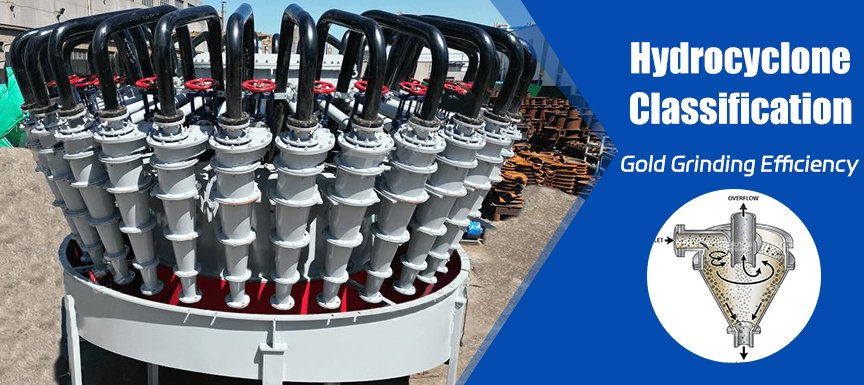
How Classification Affects Gold Grinding Efficiency
800In gold ore grinding circuits, attention is often focused primarily on ball mill capacity, power consumption, and grinding media; however, in actual operation, classification plays an equally critical role in determining grinding efficiency. …
-
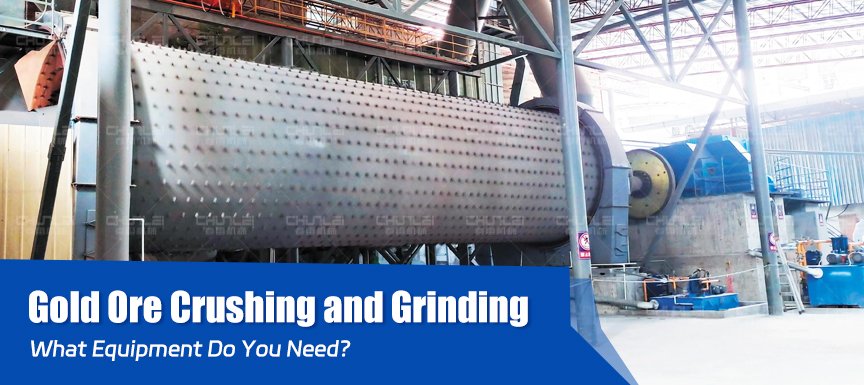
Gold Ore Crushing and Grinding: What Equipment Do You Need?
800When designing a gold ore processing line, my clients often ask which crushers and mills to purchase. However, the equipment selection should actually be based on a thorough understanding of the ore characteristics. Issues in many projects do…
-
How to Select the Right Gold Processing Plant for Your Ore
800When selecting a gold processing plant, simply assuming that a full suite of equipment is all that is needed can lead to issues such as low recovery rates, high energy consumption, and failure to meet production targets.Different ores require d…
-
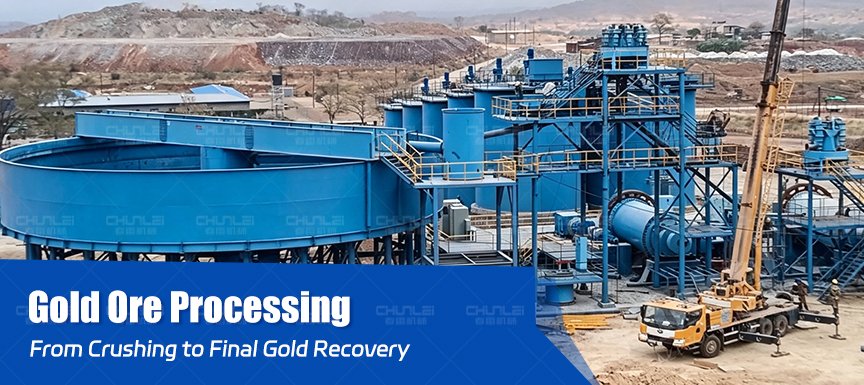
Gold Ore Processing: From Crushing to Final Gold Recovery
800A gold processing plant is not merely a simple assembly of crushers, ball mills, and gold recovery equipment; rather, the goal is to determine the optimal process flow based on factors such as mineral composition, gold particle size,…
loading…
已经是到最后一篇内容了!