 Chunlei Mining Machinery
Gravity Concentration vs. Flotation for Gold: Which Process Should You Choose?
In gold beneficiation projects, many mining engineers face a critical question:
Why does the final gold recovery rate consistently fall short of expectations, even when grinding fineness and reagent regimes are strictly maintained according to standards?
Relying on gravity separation often results in high loss rates for fine-grained and small, liberated gold particles; conversely, a full-flotation process not only drives up reagent costs but also struggles to effectively separate coarse gold from gangue minerals. Selecting the wrong process can lead to higher grinding costs, lower recovery rates, and even significant gold losses in the tailings.
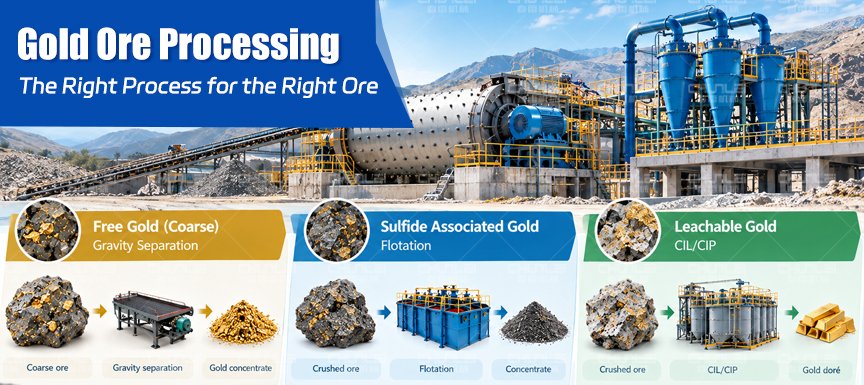
How, then, should one choose between gravity separation and flotation? Gold does not exist in a single form within the ore. Some ores contain coarse native gold that can be rapidly recovered through simple gravity separation, whereas in other ores, the gold is encapsulated within sulfide minerals—such as pyrite or arsenopyrite—requiring flotation to concentrate the gold-bearing minerals.
Ultimately, the key to successful gold extraction lies in selecting a process that is well-suited to the specific characteristics of the ore.
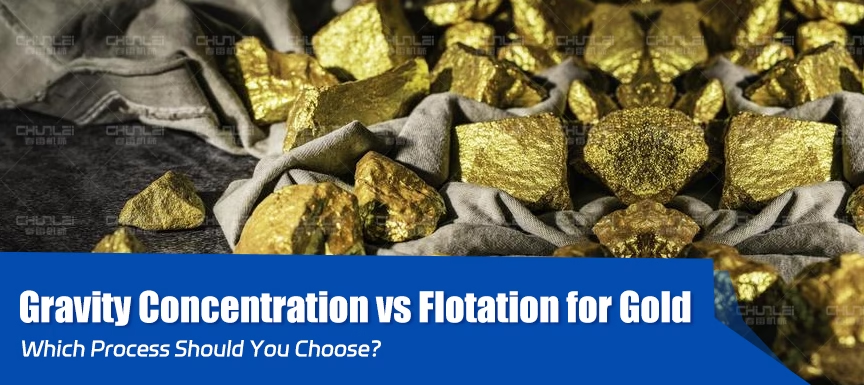
Fundamental Differences Between Gravity Separation and Flotation for Gold
Gravity separation is the preferred method when gold exists in a free state (free gold), possesses high density, and exhibits a significant density difference from gangue minerals. It is particularly effective for ores containing coarse-grained free gold, enabling early and high recovery while avoiding losses due to slime formation caused by over-grinding.
Gravity separation is ineffective when gold is intimately associated with sulfides (such as pyrite or arsenopyrite) or exists in an extremely fine state (microscopic or sub-microscopic particles encapsulated within sulfides); in such cases, flotation is required. Flotation relies on differences in surface hydrophobicity to concentrate gold and gold-bearing sulfides into the froth product.
The primary distinction between gravity separation and flotation lies in the specific mineral properties utilized for separation:
| Process | Gold Gravity Separation | Gold Flotation |
| Separation Principle | Difference in density | Difference in surface hydrophobicity |
| Primary Target | Coarse-grained free gold | Fine-grained and sulfide-associated gold |
| Reagents Required? | No | Yes |
| Grinding Requirements | Lower | Higher |
| Operational Complexity | Simple | Relatively complex |
| Typical Equipment | Shaking tables, jigs, centrifugal concentrators | Flotation machines, agitation tanks |
Gold Gravity Separation: What Types of Ore Is It Suitable For?
1. Suitable for Coarse-Grained Native Gold Ore
The core advantage of gold gravity separation is its ability to rapidly recover liberated free gold.
Typical applicable ores:
- Alluvial gold deposits
- Weathered oxidized gold ore
- Lode gold ore containing coarse native gold
- Low-sulfide gold ore
If gold particles are relatively large—for example,
100 μm
—they generally respond well to gravity separation.
Because there is a significant density difference between coarse gold particles and gangue minerals, gravity separation equipment can effectively capture the gold particles.
2. Common Gold Gravity Separation Equipment
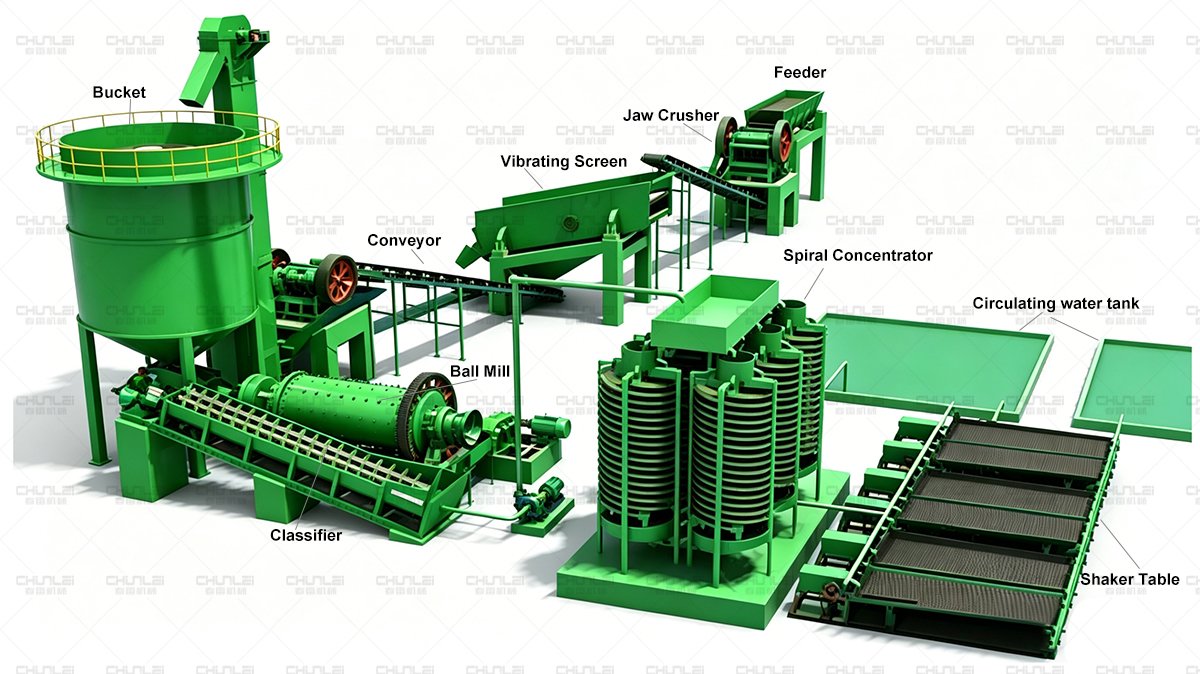
Gold gravity separation equipment primarily includes:
- Centrifugal Concentrator
- Strong capability to recover fine free gold
- Suitable for rapid recovery within the grinding circuit
- Jig Separator
- Coarse gold
- High-throughput processing
- Shaking Table
- High concentrate grade
- High separation precision
3. Advantages and Limitations of Gold Gravity Separation
Gold gravity separation utilizes the density difference between gold and other minerals to achieve separation. It is characterized by a simple process flow, low costs, and rapid recovery, making it particularly suitable for processing ores containing free gold.
Key advantages:
- Rapid recovery: Allows for the early recovery of free gold, achieving “early and increased recovery.”
- Low cost: Simple equipment, low investment, and low operating costs.
- Environmentally friendly: Uses few or no chemical reagents, reducing environmental pollution.
- Effective enrichment: Increases gold grade and reduces the volume of material requiring downstream processing.
- Simple operation: Stable process and easy maintenance.
- Strong adaptability: Suitable for various gold-bearing ores, including alluvial and lode gold.
Gold gravity separation—achieving rapid gold recovery with low cost and high efficiency—is a vital process in gold beneficiation.
Gold Flotation Process: Why Is It Suitable for Sulfide Gold Ore?
1. Relationship Between Gold and Sulfide Minerals
In many lode gold deposits, gold does not exist independently; instead, it is:
- Disseminated within pyrite
- Associated with arsenopyrite
- Encapsulated by sulfide minerals
In such cases, even grinding may not be sufficient to directly liberate the gold.
The function of flotation is not to directly “select gold,” but rather to first concentrate the gold-bearing sulfide minerals, followed by subsequent gold recovery.
2. Gold Flotation Process Steps
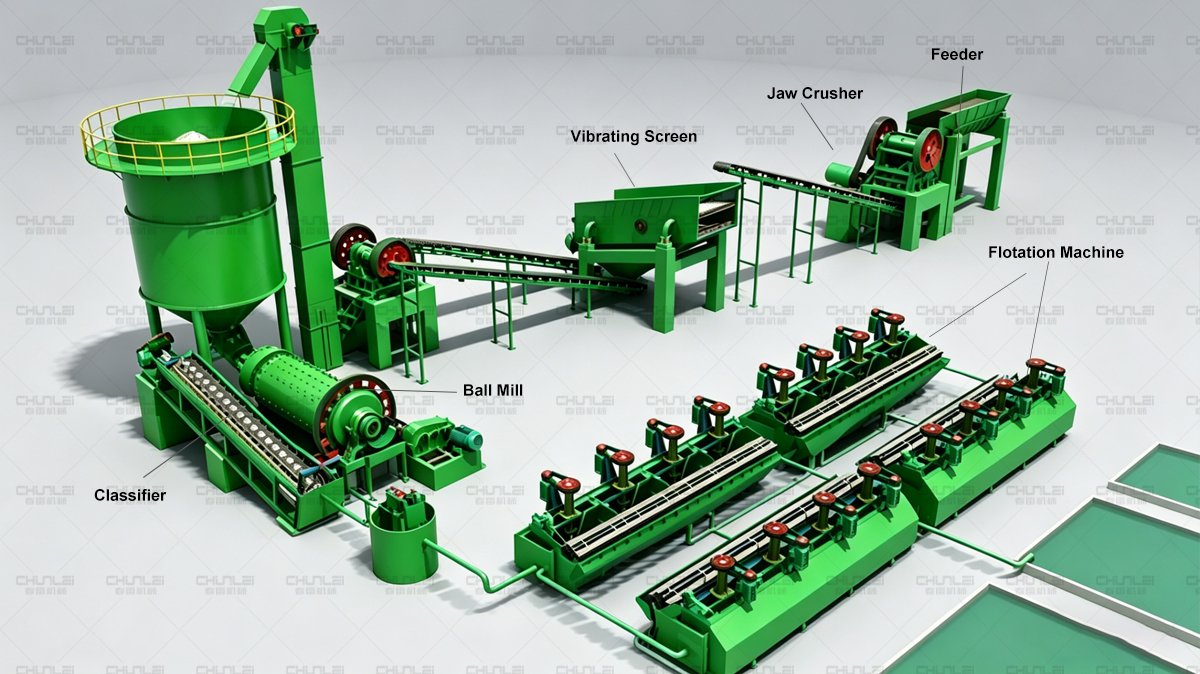
Gold flotation is a method of concentration and recovery that exploits differences in surface properties between gold minerals and other minerals; chemical reagents are used to cause gold minerals to adhere to air bubbles.
Main steps of the gold flotation process:
- Ore Crushing
Crushing run-of-mine ore to a suitable particle size in preparation for subsequent grinding. - Grinding and Classification
Grinding to fully liberate gold minerals, while using classification equipment to control slurry particle size. - Slurry Conditioning and Reagent Addition
Adding reagents—such as collectors and frothers—to the slurry to optimize the flotation characteristics of the gold minerals. - Flotation Separation
The slurry enters the flotation machine; gold minerals float upward with air bubbles to form a froth concentrate, while gangue minerals remain in the tailings. - Concentrate Thickening and Dewatering
Thickening and filtering the gold concentrate obtained from flotation to reduce moisture content. - Downstream Concentrate Processing
Depending on ore characteristics, methods such as roasting, leaching, or smelting may be employed to further extract the gold.
3. Key Indicators Affecting Gold Flotation Recovery
Key factors influencing gold flotation recovery rates include ore properties, grinding fineness, reagent regimes, slurry conditions, and flotation equipment performance. Properly controlling these parameters can enhance the degree of gold mineral liberation and flotation selectivity, thereby improving gold recovery performance.
Specifically:
- Grinding fineness determines the extent to which gold minerals are exposed.
- Reagent dosage affects the interaction between gold minerals and air bubbles.
- Pulp pH influences the flotation environment.
- Flotation time and equipment parameters impact concentrate recovery rates.
Optimizing these process parameters effectively minimizes gold loss while increasing concentrate grade and overall economic benefits.
Gravity Separation vs. Flotation: A Comprehensive Performance Comparison
In gold beneficiation, there is no absolute superiority of one method over the other; the choice depends primarily on the mode of occurrence of the gold within the ore. Modern large-scale gold mines typically employ a combined “gravity separation plus flotation” flowsheet to achieve early recovery of coarse gold and efficient recovery of fine gold, thereby maximizing overall economic returns.
| Comparison Criteria | Gravity Separation | Flotation |
| Separation Principle | Physical separation based on the density difference between gold and gangue minerals | Physicochemical separation using reagents to attach gold-bearing minerals to air bubbles, causing them to float |
| Primary Gold Types | Coarse-grained free gold, native gold, liberated gold | Fine-grained gold, sulfide-hosted gold, encapsulated gold |
| Best Suited Ores | Placer gold deposits, oxidized ores, simple vein ores | Sulfide-hosted gold ores (e.g., pyrite, arsenopyrite), complex polymetallic ores |
| Particle Size Suitability | Most effective for coarse gold; centrifugal equipment can process some fine gold | Better suited for fine gold; capable of recovering finely disseminated gold |
| Gold Recovery Rate | Generally high recovery for coarse gold, but significant loss of ultra-fine gold | Strong recovery capability for fine and refractory gold; overall recovery rate is usually higher |
| Concentrate Grade | High concentrate grade, facilitating downstream processing | Concentrate volume is relatively large; requires further concentration or smelting |
| Process complexity | Simple; minimal equipment; easy to operate | Complex; requires grinding, reagent schemes, and froth control |
| Investment cost | Lower; low equipment investment and short construction period | Higher; requires flotation machines, reagent systems, and automation controls |
| Operating cost | Low; no large quantities of chemical reagents needed | Higher; requires collectors, frothers, modifiers, etc. |
| Environmental impact | Excellent; relies primarily on physical separation | Moderate; requires control of reagent usage and wastewater treatment |
| Energy consumption | Lower | Higher (especially during grinding and aeration stages) |
| Operational requirements | Low technical requirements; easy maintenance | High demands on operators, pulp conditions, and reagent control |
| Recovery speed | Fast; enables “early gold recovery” | Slower; requires pulp conditioning, aeration, and cleaning stages |
| Typical equipment | Jigs, shaking tables, spiral chutes, centrifugal concentrators | Flotation machines, agitation tanks, cleaner cells |
| Summary of advantages | Low cost, high grade, eco-friendly, suitable for coarse gold recovery | Broad recovery range; suitable for complex ores and fine-grained gold |
| Main limitations | Limited effectiveness for ultrafine or encapsulated gold | High reagent consumption; complex process control |
How to Choose the Right Gold Recovery Process?
Selecting the appropriate gold recovery process depends primarily on ore characteristics, the mode of gold occurrence, and economic factors. The selection process can be broken down into the following steps:
- 1. Analyze the mode of gold occurrence
- Free, coarse-grained gold: Prioritize gravity separation; it offers rapid recovery and low costs.
- Fine-grained gold or gold associated with sulfides: Suitable for flotation.
- Refractory gold encapsulated in minerals: Requires roasting, oxidative pretreatment, or leaching processes.
- 2. Determine ore characteristics
- Test for ore hardness, clay content, sulfur content, and harmful elements.
- Select crushing, grinding, and beneficiation circuits based on ore properties.
- 3. Select the recovery method
- Gravity separation: Suitable for coarse, free gold.
- Flotation: Suitable for fine-grained gold and gold-bearing sulfides.
- Cyanide leaching: Suitable for ores with good gold leachability.
- Combined processes: Complex ores often require combinations such as “gravity separation + flotation” or “flotation + leaching.”
- 4. Conduct an economic assessment
- Compare gold recovery rates, equipment investment, operating costs, and environmental requirements.
- Select the process scheme that offers the highest overall return.
- 5. Verify through testing
- Conduct beneficiation tests to optimize reagents, grinding fineness, and process parameters, ensuring effective industrial-scale production.
FAQ
Q: What is the difference between gold gravity selection and flotation?
A: Gravity separation mainly uses the density difference between gold and gangue minerals to separate, and is suitable for processing coarse-grained free gold; flotation uses the hydrophobicity difference on the mineral surface to separate, and is suitable for processing fine-grained gold and sulfide-coated gold.
Q: Under what circumstances is reselection preferred?
A: When the ore contains a lot of coarse-grained free gold, and the density difference between gold and waste rock is obvious, gravity separation is preferred, which can recover part of the gold in advance and increase the recovery rate.
Q: What are the reselection devices?
A: Common equipment includes jigs, shakers, spiral chutes, centrifugal concentrators, etc. Among them, the centrifuge is suitable for recovering fine particles of free gold.
Q: Why is the reselection recovery rate not high?
A: The main reasons include too fine gold particles, gold being wrapped by sulfide or other minerals, high slime content, insufficient grinding and dissociation, etc.
Q: What ores are suitable for gold flotation?
A: Flotation is suitable for processing fine-grained gold, sulfide gold-containing ores, gold and pyrite/arsenic pyrite symbiotic ores, and is especially suitable for gold ores that are difficult to recover by gravity separation.
Q: What is the principle of gold recovery through flotation?
A: By adding collectors, foaming agents and regulators, the surface of gold-containing minerals is made hydrophobic and adheres to the bubbles to form foam products to achieve gold enrichment.
Q: Why does gold flotation require grinding?
A: The purpose of grinding is to fully dissociate gold minerals from gangue and improve the effect of pharmaceuticals. If there is insufficient grinding, the gold will be wrapped and the flotation effect will decrease.
Q: Is the finer the gold ore ground, the better?
A: No. Too fine grinding will increase energy consumption and produce a large amount of slime, which will affect the flotation and gravity separation effects. The reasonable grinding fineness should be determined based on the properties of the ore.
Q: Can gold gravity selection and flotation be used together?
A: Yes. A common process is “gravity separation + flotation”. Gravity separation is used first to recover coarse-grained free gold, and then flotation is used to recover fine-grained gold and gold in sulfides to improve the overall recovery rate.
Q: Do flotation reagents have a big impact on gold recovery?
A: Very big. The type and dosage of collector, the performance of frother and the pH value of slurry will all affect the gold flotation index.
Q: Why is the gold flotation bubble unstable?
A: Possible reasons include insufficient dosage of chemicals, inappropriate slurry properties, changes in ore surface properties, or unreasonable selection of foaming agents.
Q: Why does the flotation concentrate have high gold content but low recovery rate?
A: It means that although the gold enrichment effect is good, part of the gold does not enter the concentrate. The possible reasons are that the gold particles are too fine, severely wrapped or the flotation conditions are insufficient.
Q: Why do gravity separation tailings still contain gold?
A: It may be that fine-grained gold, flake gold, and coated gold cannot settle effectively and require further treatment by flotation, cyanidation, or other methods.
Q: How to judge whether a gold mine is suitable for gravity separation or flotation?
A: It is necessary to conduct ore test analysis, including gold particle size distribution, occurrence state, mineral composition, dissociation degree, etc., and determine the process based on the test results.
Q: What are the methods to improve the recovery rate of gold flotation?
A: Optimize the grinding fineness, adjust the chemical system, improve the slurry conditions, strengthen the selection process, and use gravity separation to recover coarse gold in advance.
Q: What is the biggest advantage of gold reselection?
A: The equipment is simple, low-cost and environmentally friendly. It does not require a large amount of chemicals and is suitable for early recovery of high-value coarse gold.
Q: What is the biggest advantage of gold flotation?
A: It has strong adaptability to fine-grained gold and complex gold-bearing ores, and can effectively recover gold symbiotic with sulfide ores.
Q: Does gold reselection require no potions at all?
A: Generally, mineral processing agents are not required, but some processes may require the addition of a small amount of auxiliary agents to improve slurry dispersion or improve recovery effects.
Q: What are the main factors affecting the recovery rate of gold mineral processing?
A: Mainly including ore properties, gold particle size, gold occurrence state, grinding fineness, equipment selection, chemical system and operating conditions.
Q: Should I choose gravity separation or flotation for gold mineral processing?
A: There is no fixed answer. Coarse-grained free gold is given priority by gravity separation; fine-grained gold and sulfide gold-bearing ores are given priority by flotation; complex ores usually adopt a combined process.
Conclusion
Gravity separation and flotation are not competing methods; rather, they are technical choices determined by the specific characteristics of the ore.
When it comes to gold processing, equipment is not necessarily better simply because it is more expensive or advanced; the most important factor is matching the process to your ore’s properties. Selecting the right flow sheet helps you avoid costly detours, maximize recovery rates, and minimize production costs.
Is your ore better suited for gravity separation or flotation? Contact us today—our engineers can analyze your ore samples and specific operational conditions to recommend the most suitable gold processing solution, free of charge.
Latest News

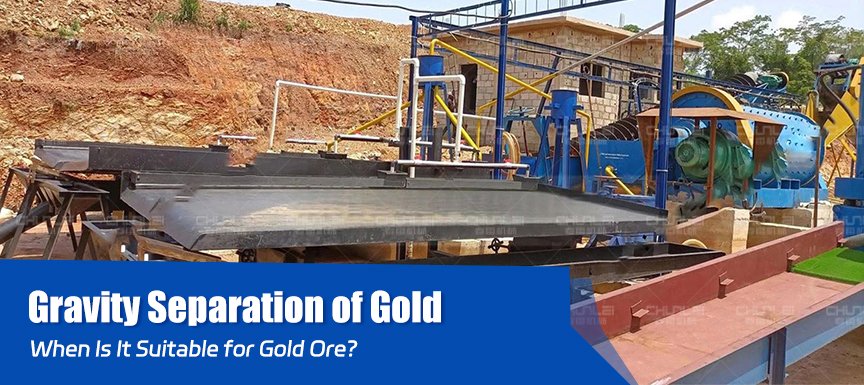
Gravity Separation for Gold: When Is It Suitable for Gold Ore?
800Many people immediately associate “gold ore” with gravity separation, yet not all gold deposits are suitable for recovery using gravity methods alone. Gravity separation is appropriate for liberated native gold or other heavy minerals that ex…
-
How Classification Affects Gold Grinding Efficiency
800In gold ore grinding circuits, attention is often focused primarily on ball mill capacity, power consumption, and grinding media; however, in actual operation, classification plays an equally critical role in determining grinding efficiency. …
-
Gold Ore Crushing and Grinding: What Equipment Do You Need?
800When designing a gold ore processing line, my clients often ask which crushers and mills to purchase. However, the equipment selection should actually be based on a thorough understanding of the ore characteristics. Issues in many projects do…
-
How to Select the Right Gold Processing Plant for Your Ore
800When selecting a gold processing plant, simply assuming that a full suite of equipment is all that is needed can lead to issues such as low recovery rates, high energy consumption, and failure to meet production targets.Different ores require d…
loading…
已经是到最后一篇内容了!