 Chunlei Mining Machinery
How to Select the Right Gold Processing Plant for Your Ore
When selecting a gold processing plant, simply assuming that a full suite of equipment is all that is needed can lead to issues such as low recovery rates, high energy consumption, and failure to meet production targets.
Different ores require different processing methods; equipment selection should begin with an analysis of the ore’s properties to determine the process flow, followed by matching the equipment and capacity to those requirements.
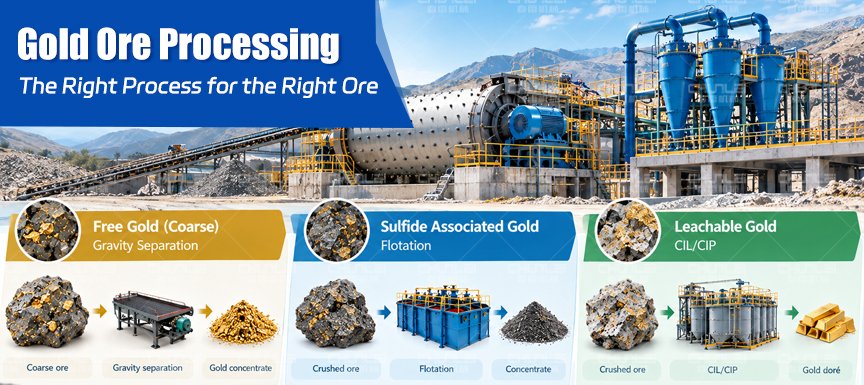
Determine Your Ore Type
The first step in selecting a gold processing plant is understanding the ore; this determines the processing method and, ultimately, the appropriate equipment models. Begin by clarifying the following factors:
- Run-of-mine (ROM) grade
- Mode of gold occurrence
- Gold mineral grain size
- Ore hardness
- Feed particle size
- Ore clay content
- Gangue mineral composition
- Beneficiability and leaching characteristics
1. Mode of Gold Occurrence
This is one of the most critical factors when selecting a recovery process.
If gold exists primarily as coarse-grained free gold, gravity separation is typically incorporated after grinding to minimize gold loss.
If gold is primarily associated with sulfide minerals, flotation is considered to first produce a gold-bearing sulfide concentrate for subsequent processing.
If gold is finely encapsulated within minerals, simply adding gravity separation equipment often fails to solve the problem; instead, the focus must be on grinding for liberation and optimizing subsequent leaching or flotation conditions.
2. Ore Hardness and Grindability
Hardness directly influences the choice of crushing and grinding equipment.
Harder ores generally require more robust crushing equipment and consume more energy during grinding.
If a ball mill is selected based solely on tonnage without considering ore hardness and grindability, the operation may suffer from low capacity, failure to meet particle size specifications, and high energy consumption. Therefore, when designing a gold processing plant, equipment selection must be based on an assessment of grinding difficulty derived from ore test data.
3. Gold Mineral Dissemination Size
The required fineness of grinding depends on the liberation characteristics between the gold minerals and the gangue.
If the gold is already sufficiently liberated, extending grinding time is unnecessary; however, if the gold is encapsulated within fine-grained minerals, finer grinding may be required. Therefore, the key factor to consider is the optimal liberation size, rather than the finest grinding size.
Determining the Processing Flow Based on Ore Characteristics
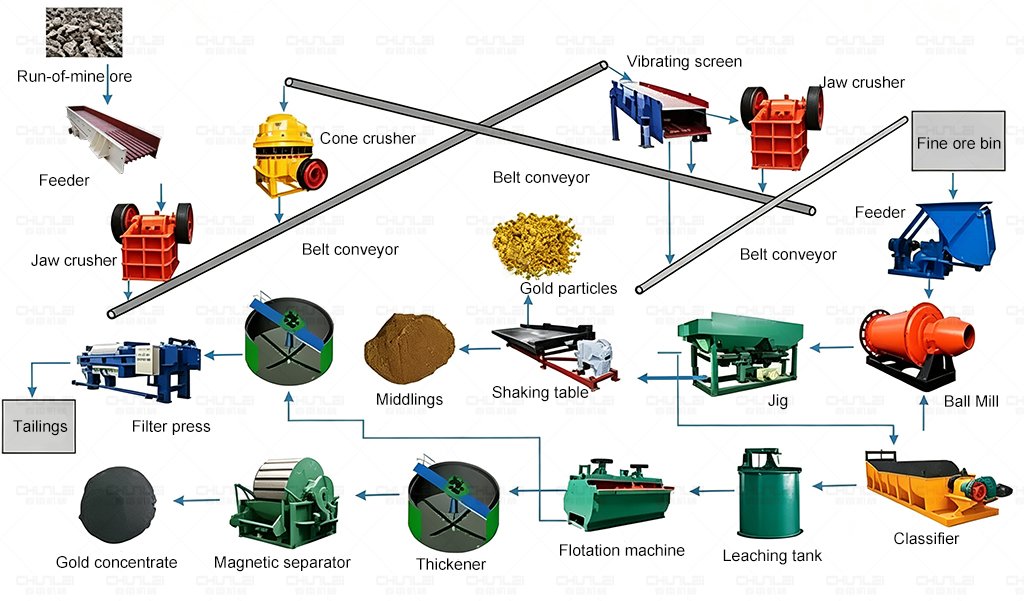
The general processing flow for gold ore can be summarized as follows:
Run-of-mine ore → Crushing → Screening → Grinding → Classification → Gravity separation/Flotation/Leaching → Gold recovery → Tailings treatment
However, the actual flow is adjusted based on the specific characteristics of the ore.
1. Crushing
Crushing does not recover gold directly; instead, it prepares the ore by achieving a suitable feed particle size for the subsequent grinding stage. Common configurations include:
Jaw crusher → Cone crusher → Vibrating screen
For mobile or small-scale projects, integrated mobile crushing and screening units may also be used.
Factors to consider during the crushing stage include:
- Maximum feed size
- Design processing capacity
- Product particle size
- Ore hardness
- Clay content
Poor control of product particle size during crushing directly increases the load on the downstream ball mill.
2. Grinding and Classification
Grinding is typically one of the most energy-intensive stages in a gold processing plant. A typical configuration is:
The cyclone performs classification, sending appropriately sized fine particles to the next process stage while returning coarse particles to the ball mill for further grinding.
Key aspects to focus on during grinding include:
- Feed particle size
- Product particle size
- Slurry density
- Ball mill processing capacity
- Circulating load
- Cyclone classification efficiency
If classification efficiency is poor, issues such as over-grinding or the carry-over of coarse particles into the recovery stage can occur, even if the ball mill itself is functioning correctly.
3. Gravity separation, flotation, and leaching
This stage is the key factor that truly determines how the gold is recovered.
| Comparison Criteria | Gravity Separation | Flotation | Leaching |
| Suitable Gold Ores | Coarse-grained, abundant free gold | Gold associated with sulfides or other minerals | Fine-grained gold suitable for leaching |
| Main Principle | Separation based on density differences | Separation based on differences in mineral surface properties | Dissolution of gold using chemical reagents |
| Gold Particle Size Requirements | Better suited for coarse gold | Suitable for fine-grained and disseminated gold | Can process finer gold particles |
| Grinding Requirements | Usually does not require excessive grinding | Requires appropriate liberation size | Usually requires thorough liberation |
| Common Equipment | Centrifugal concentrators, shaking tables, sluices | Flotation machines | Leaching tanks, adsorption equipment |
| Advantages | Simple process, minimal reagent use | Advantageous for sulfide-associated gold | Potentially more effective for fine-grained or refractory gold |
| Key Considerations | Recovery of fine gold may be limited | Sensitive to pulp conditions and reagents | Higher demands regarding reagent consumption, environmental protection, and tailings treatment |
In short:
- Coarse free gold → prioritize gravity separation
- Gold associated with sulfides → consider flotation
- Fine-grained gold suitable for leaching → consider leaching
- Complex ore characteristics → consider combined processes such as gravity separation plus flotation, or gravity separation plus leaching
How is the processing capacity of a gold processing plant determined?
The production capacity of a gold processing plant cannot be determined solely by the nameplate ratings of the ball mills or crushers; instead, it should be calculated by working backward from the mine’s ore supply rate and the entire process flow.
Generally, the following factors are considered:
| Key Factors | Primary Considerations |
| Mine Ore Supply | Stable daily tonnage of run-of-mine (ROM) ore |
| Ore Characteristics | Hardness, clay content, and grindability affect actual production capacity |
| Feed Particle Size | Larger ROM ore requires higher primary crushing capacity |
| Target Particle Size | Finer grinding typically demands higher grinding capacity |
| Equipment Utilization | Calculations cannot assume 24-hour full-load operation |
| Process Bottlenecks | Insufficient capacity in any stage—crushing, grinding, classification, or recovery—limits the plant’s total output |
For instance, when planning to process 1,000 tons of raw ore per day, one cannot simply select equipment rated for “1,000 tons/day”; instead, it is necessary to verify that the crushers, ball mills, cyclones, and downstream recovery equipment are mutually compatible.
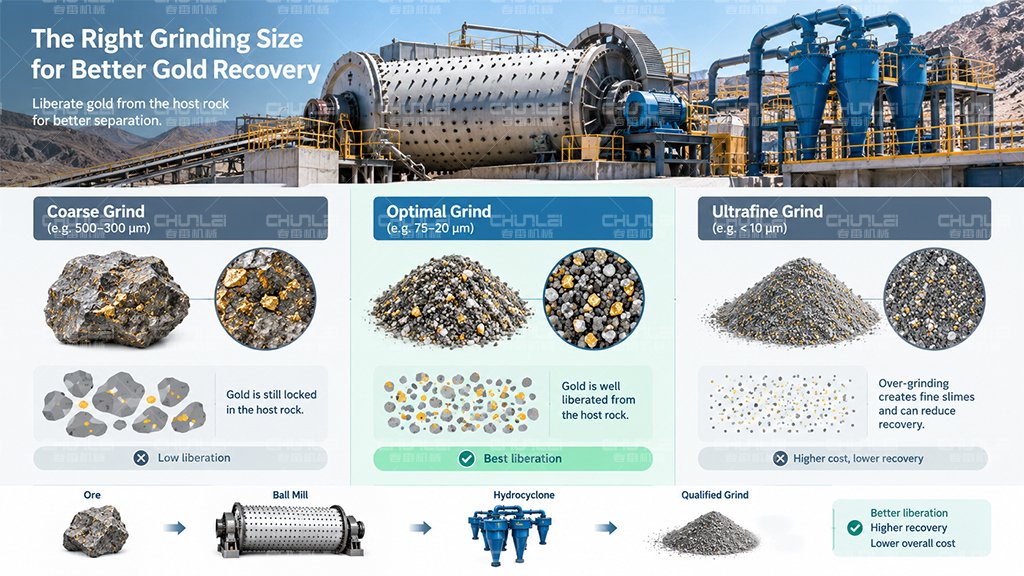
Why shouldn’t one simply aim for the finest possible grinding size?
When starting a gold mining project, many clients often wonder: “Doesn’t grinding the ore finer make it easier to recover the gold?”
In reality, that is not entirely the case. You shouldn’t immediately aim for an extremely fine grind size at the start of a project. Grinding ore finer increases energy consumption in the ball mill as well as the wear on steel balls and liners, thereby raising processing costs. Furthermore, grinding certain ores too finely can lead to “sliming” (the formation of excessive fines/sludge), which negatively impacts downstream gravity separation, flotation, or leaching processes.
The key factor is determining exactly how fine the ore needs to be ground to achieve sufficient liberation of the gold minerals. If the gold is already largely liberated, further grinding may not yield a significant increase in recovery rates, yet electricity consumption and grinding costs will continue to rise.
Therefore, the goal at the processing plant is not to grind as finely as possible, but to grind to the optimal level required for the process.
The approach should be to first determine the appropriate grind size based on ore characteristics, gold dissemination size, and the subsequent recovery method, and then select the matching ball mill and classification equipment. This ensures effective liberation while avoiding unnecessary over-grinding and excessive costs.rding to the requirements of the grinding circuit, so that the ball mill can obtain stable and appropriate feed materials.
Comparison of Common Processing Methods for Different Gold Ores
A single, standardized process cannot simply be applied to all types of gold ore. The choice of processing method is primarily determined by factors such as gold particle size, mode of occurrence, degree of oxidation, association with sulfides, and ore leachability. In practice, methods such as gravity separation, flotation, and leaching are often combined rather than used in isolation.
| Gold Ore Type | Key Characteristics | Common Processes | Process Focus |
| Placer/Alluvial Gold Ore | Coarse gold particles; high proportion of native gold | Washing + Gravity separation | Early recovery of coarse native gold |
| Oxidized Gold Ore | High degree of oxidation; gold is easily exposed | Crushing + Heap leaching/Leaching; sometimes combined with gravity separation | Focus on leaching performance and ore permeability |
| Quartz Vein Gold Ore | Gold often associated with quartz; significant variation in particle size | Crushing + Grinding + Gravity separation/Leaching | Decide whether to add gravity separation based on gold particle size |
| Free-milling Gold Ore | Gold easily dissociates from gangue minerals | Gravity separation + Leaching | Gravity separation recovers coarse gold early; leaching treats fine gold |
| Sulfide Gold Ore | Gold associated with sulfides like pyrite and arsenopyrite | Grinding + Flotation; leaching if necessary | Pre-concentrate gold-bearing sulfides before further processing |
| Gold-Copper Polymetallic Ore | Gold associated with copper, lead, zinc, etc. | Grinding + Flotation + Downstream metallurgical processing | Consider associated metals alongside gold recovery |
| Refractory Gold Ore | Gold encapsulated by sulfides or other minerals; difficult to leach directly | Flotation + Pre-treatment + Leaching | Focus on “liberating” the gold |
| Carbonaceous Gold Ore | Carbonaceous matter may adsorb gold from the solution | Flotation/Pre-treatment + Leaching | Prevent “preg-robbing” from affecting leaching recovery |
It is important to note that heap leaching is not mandatory for oxidized gold ores, nor is flotation strictly required for sulfide gold ores. The final processing flowsheet should ideally be determined through ore characterization and beneficiation testing, as processing methods can vary significantly even for the same type of gold ore depending on gold particle size and mode of occurrence.
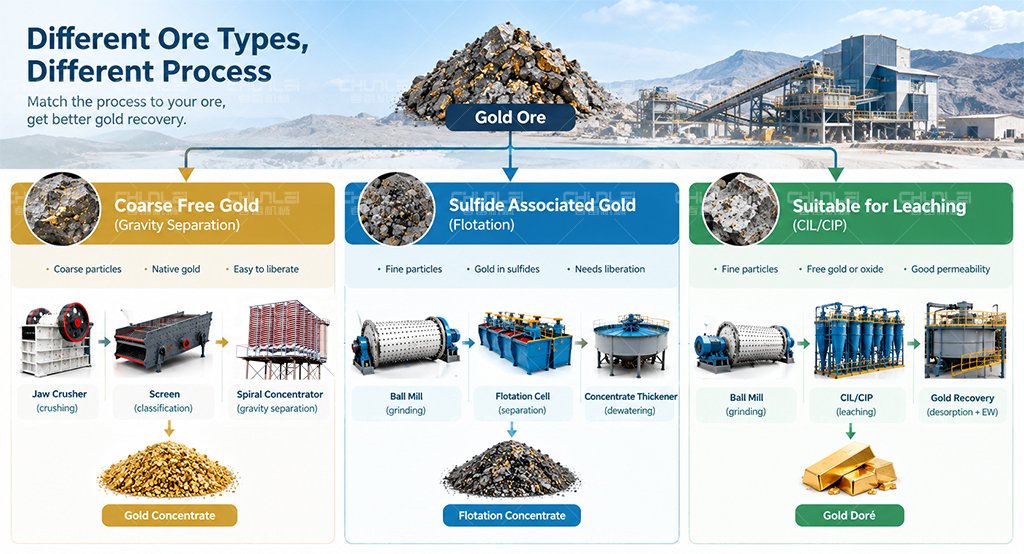
How should the processing method be selected based on gold particle size and mode of occurrence?
In actual plant operations, the most common pitfall is focusing solely on grinding fineness.
Grinding finer does not necessarily result in higher gold recovery. The goal of grinding should be to achieve sufficient liberation of gold from host minerals while avoiding over-grinding, slime formation, and unnecessary energy consumption.
| Gold Particle Size and Mode of Occurrence | Common Scenario | Preferred Process |
| Coarse-grained, native gold | Gold is largely liberated | Gravity separation; recover coarse gold as early as possible |
| Medium-to-coarse grained, partially liberated | Grinding releases a portion of the gold | Grinding + Gravity separation |
| Fine-grained, associated with sulfides | Gold primarily hosted in minerals such as pyrite and arsenopyrite | Grinding + Flotation |
| Fine-grained, fully liberated and easily leachable | High degree of gold exposure | Grinding + Leaching |
| Gold encapsulated by sulfides | Direct leaching yields poor results | Flotation concentration + Pre-treatment/Leaching |
| Coarse and fine gold coexist | Significant variation in gold particle size within the same ore | Gravity separation + Flotation/Leaching |
Common Mistakes When Selecting a Gold Processing Plant
Mistake 1: Selecting equipment based solely on price
Cheap equipment does not necessarily mean lower project costs.
If the equipment has insufficient capacity, high energy consumption, or requires frequent maintenance, long-term operating costs may actually be higher.
Mistake 2: Directly copying the process flow of another gold mine
Even if two projects are both “gold mines,” the ore characteristics may differ completely.
A process suitable for gravity separation in one project may not be suitable for another.
Mistake 3: Focusing only on the ball mill while ignoring the entire grinding circuit
The ball mill, cyclones, pumps, and piping form an integrated system.
Simply scaling up the ball mill without considering classification capacity can lead to system imbalance.
Mistake 4: Relying solely on theoretical recovery rates
Laboratory results cannot be simply equated to industrial production results.
Actual performance depends on factors such as:
- Feed fluctuations
- Slurry conditions
- Equipment stability
- Operational proficiency
- Process control
Mistake 5: Finalizing the process flow without conducting ore sample tests
This is a mistake best avoided.
If ore characteristics are not clearly understood, finalizing equipment models and process flows too early can result in high modification costs later on.
FAQ
Q: Should a gold processing plant select equipment first or determine the process flow first?
A: You should first study the ore properties and determine the basic process flow before selecting equipment. Equipment serves merely as the execution units within the process flow.
Q: Do all gold mines require a ball mill?
A: Not necessarily. Whether a ball mill is used depends on ore hardness, target particle size, gold liberation requirements, and the downstream recovery process.
Q: Does finer grinding of gold ore always result in a higher recovery rate?
A: Not necessarily. Over-grinding can increase slime generation and energy consumption. The goal is to find an optimal particle size that achieves sufficient liberation.
Q: How is the processing capacity of a gold plant determined?
A: It requires a comprehensive assessment of factors such as mine ore supply, ore properties, target product size, and the capacities for crushing, grinding, and downstream recovery; one cannot rely solely on the theoretical output of a single piece of equipment.
Q: When should ore sample testing be conducted?
A: If the ore properties, mode of gold occurrence, or amenability to processing are unclear, it is advisable to conduct ore sample testing before finalizing the industrial process flow and equipment models in order to mitigate risks associated with process selection.
Conclusion
When undertaking a gold mining project, understand your ore characteristics before discussing equipment. Is the gold coarse-grained or fine-grained? Does it occur as native gold or is it encapsulated in sulfides? These factors influence the choice of crushing, grinding, and classification methods, as well as the selection of gravity separation, flotation, or leaching processes. In short: Ore Properties → Process Flow → Liberation Size → Equipment Matching → Recovery Rate → Operating Costs. Only with the right process flow can the equipment deliver optimal performance.
Unsure which process suits your gold ore? Consult CHUNLEI engineers to obtain a tailored gold processing solution.
Latest News

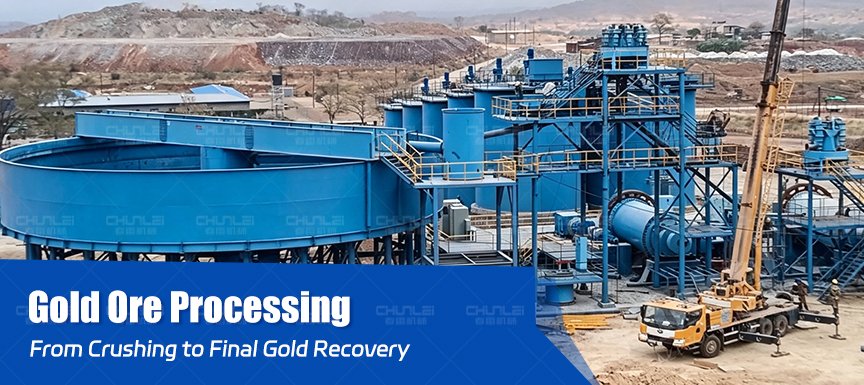
Gold Ore Processing: From Crushing to Final Gold Recovery
800A gold processing plant is not merely a simple assembly of crushers, ball mills, and gold recovery equipment; rather, the goal is to determine the optimal process flow based on factors such as mineral composition, gold particle size,…
-
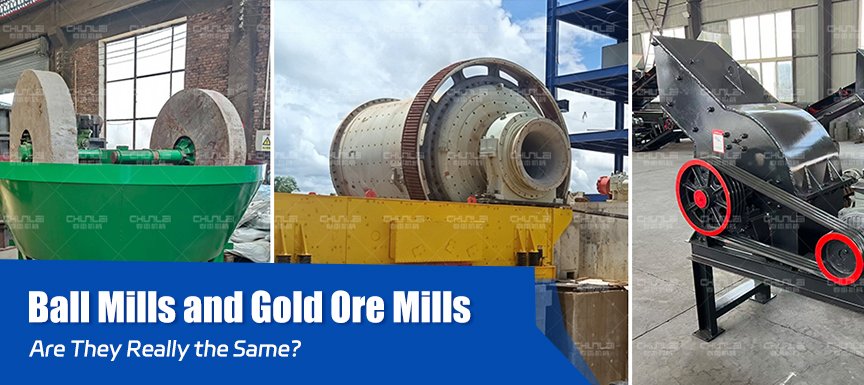
Ball Mills and Gold Ore Mills: Are They Really the Same?
800When searching for gold ore grinding equipment, customers often encounter various terms such as “Ball Mill,” “Gold Mill,” “Gold Milling Machine,” and “Gold Ore Grinding Machine.” Many buyers assume that a “Gold Mill” is a specialized mill de…
-
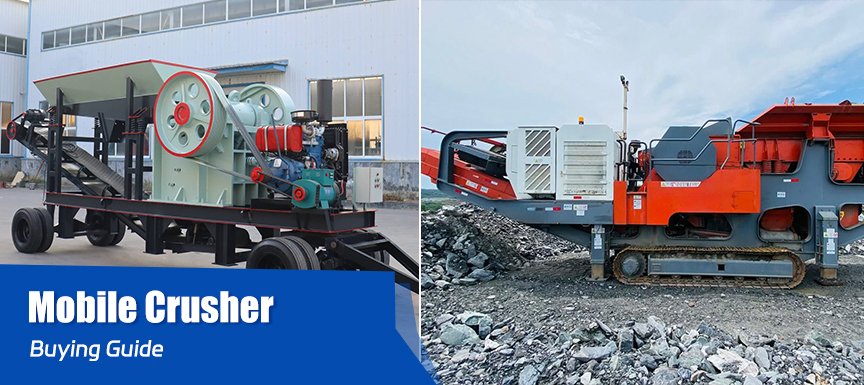
Mobile Crusher Buying Guide: Wheeled or Tracked?
800Many customers focus solely on portability when purchasing a mobile crusher, viewing it merely as the acquisition of a single piece of equipment. In reality, selecting the wrong model can lead to either insufficient output or excessive wear and…
-
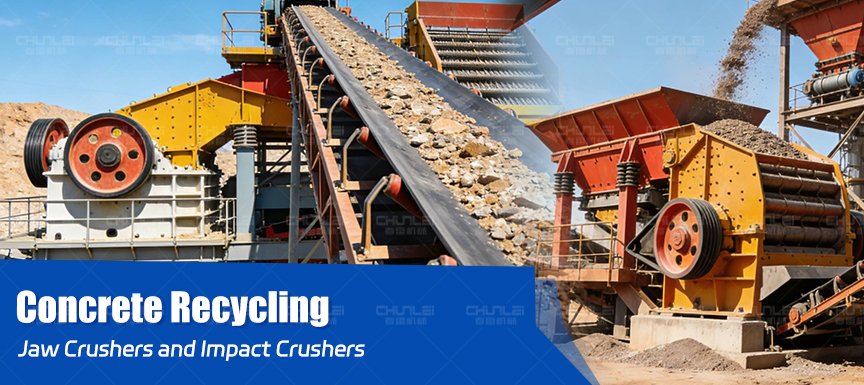
Jaw Crushers and Impact Crushers: Turnkey Solutions for Concrete Recycling
800Demolishing old buildings and roads generates vast amounts of waste concrete; direct landfilling not only consumes valuable space but also incurs high transportation costs. The real challenge lies in transforming this waste concrete into reusab…
loading…
已经是到最后一篇内容了!