 Chunlei Mining Machinery

Which types of tin ore are the most difficult to process?
Not all tin ores are easy to process. For some alluvial (placer) tin deposits, a simple combination of washing, screening, and gravity separation is often sufficient to produce a high-quality tin concentrate. Primary (lode) tin deposits, however, are far more complex; gravity separation alone is rarely enough, requiring a multi-stage process that includes crushing, grinding, desliming, and flotation.
In general, primary tin ores characterized by fine cassiterite (tin oxide) grains, complex mineral associations, and high clay content are the most challenging to process.
So, which types of tin ore are the most difficult to treat? And what specific processes and equipment should be used for different types of tin ore? Let’s explore this by examining ore characteristics, beneficiation processes, equipment configurations, and recovery rates.
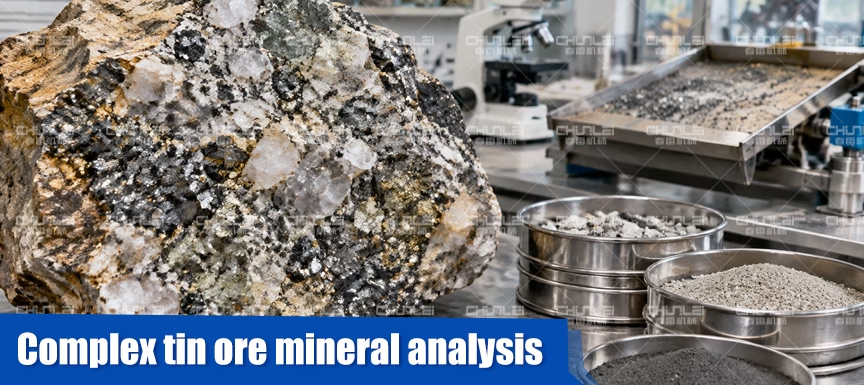
Which types of tin ore are the most difficult to process?
In the actual beneficiation of tin ore, not all deposits are easy to process for recovery. Generally speaking, fine-grained cassiterite ores, polymetallic sulfide-cassiterite ores, complex associated tin ores, alluvial tin ores with high clay content, and low-grade, refractory tin ores are among the most difficult types to process.
The reasons for these difficulties vary: in some cases, cassiterite particles are so fine that they are easily lost during gravity separation; in others, the cassiterite is intimately associated with sulfide minerals, making it difficult to separate; and in some instances, high clay content or complex mineral composition leads to reduced separation efficiency and lower tin recovery rates. Therefore, the selection of processing equipment cannot be based solely on the general type of tin ore; rather, the process must be determined by considering factors such as ore particle size, mineral dissemination characteristics, mineralogical composition, and the results of beneficiation tests.
Which types of tin ore are the most difficult to process?
| Tin ore type | Main mineral processing difficulties | Common processing techniques | Difficulty of beneficiation |
| Fine grained cassiterite ore | Cassiterite has fine particle size and is easily lost with tailings, making it difficult to effectively recover it with ordinary jigs. | Classification, fine particle gravity separation, shaking table, centrifugal beneficiation, flotation if necessary | very high |
| Cassiterite polymetallic sulfide ore | Cassiterite coexists with pyrite, chalcopyrite, galena, etc., and it is difficult to separate the minerals. | Sulfide ore flotation, desulfurization, gravity separation and combined processes | very high |
| Complex symbiotic tin deposit | The relationship between cassiterite and other gangue or valuable minerals is complex, and it is difficult to separate it with a single process. | Combined process of stage grinding, gravity separation, flotation and magnetic separation | very high |
| High mud content tin ore | Clay and slime tend to coat cassiterite, affecting the sorting effect, and the loss of fine-grained tin is greater. | Ore washing, scrubbing, desliming, grading, and gravity separation higher | Relatively High |
| Low-Grade, Refractory Tin Ore | Low content of valuable tin minerals and a high proportion of gangue; difficult to achieve both a high enrichment ratio and high recovery. | Pre-concentration (waste rejection), multi-stage gravity separation, fine-particle recovery, and other necessary combined separation techniques. | Relatively High |
Which types of tin ore are the most difficult to process?
In terms of practical mineral processing, fine-grained cassiterite ores and complex associated (polymetallic) tin ores are generally the most challenging.
- Fine-grained cassiterite ores: The primary issue is that the cassiterite particles are extremely fine, making them difficult to capture effectively with standard gravity separation equipment, which often leads to the loss of tin.
- Complex associated tin ores: The main challenge lies in the intricate intergrowth of minerals. Achieving effective separation requires precise control over the grinding fineness and the application of a combination of different mineral processing methods.
It is also worth noting that tin-bearing ores with high clay or silt content are not necessarily easier to process than primary tin ores. If the clay content is high and the cassiterite particles are fine, significant tin losses can occur during the ore washing and desliming stages.
When dealing with difficult-to-process tin ores, do not rush to select specific models of jigs, shaking tables, or flotation machines. It is advisable to first conduct an analysis of the ore’s properties and particle size distribution, along with mineral processing tests. This will help determine the degree of cassiterite liberation, the particle size distribution, and the distribution of tin across various size fractions—information essential for designing a targeted beneficiation flowsheet. This approach helps avoid suboptimal equipment configuration and improves both the grade of the tin concentrate and the overall tin recovery rate.
Why is it particularly difficult to recover fine-grained tin ore?
In the process of tin ore beneficiation, many processing plants face a persistent challenge: even when the tin grade in the raw ore is relatively high, the final concentrate recovery rate remains low. This is especially true for fine-grained tin ore; despite crushing, grinding, and gravity separation, a significant amount of cassiterite is still lost to the tailings.
The difficulty in recovering fine-grained tin ore is not merely a matter of inadequate equipment; rather, it is the result of a complex interplay between mineral particle size, the degree of mineral liberation, the phenomenon of “sliming” (the formation of ultra-fine, clay-like particles), and the specific beneficiation process employed.
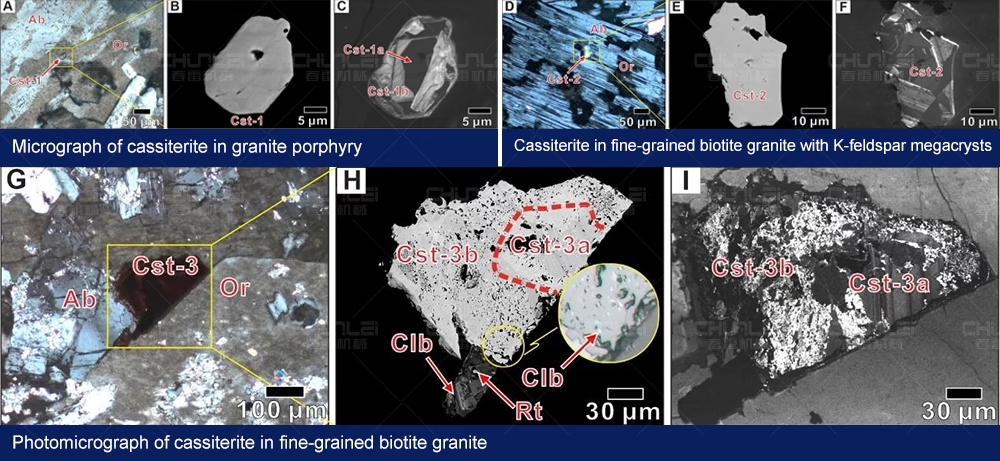
1. Cassiterite is relatively brittle and prone to over-grinding.
Cassiterite has a high specific gravity, which is the primary reason it is well-suited for gravity separation.
However, a notable characteristic of cassiterite is its tendency to break down into fine particles during crushing and grinding processes.
As particles become increasingly fine, several issues arise:
- The efficiency of gravity separation decreases.
- Fine cassiterite particles are more likely to be lost in the tailings.
- Surface effects of the particles become more pronounced.
- Flotation processes become more sensitive to operating conditions.
Therefore, the goal of grinding is not simply to reduce the ore to the finest possible size, but rather to strike a balance between achieving sufficient mineral liberation and avoiding over-grinding.
2. Fine cassiterite is difficult to recover via conventional gravity separation.
Traditional gravity separation equipment—such as jigs and shaking tables—each has an optimal particle size range for effective processing.
When cassiterite particles become too fine, the differences in settling behavior between minerals of varying densities are overshadowed by the influence of particle size and hydrodynamic conditions, leading to a significant drop in the separation efficiency of conventional gravity methods.
This often results in fine cassiterite reporting to the tailings.
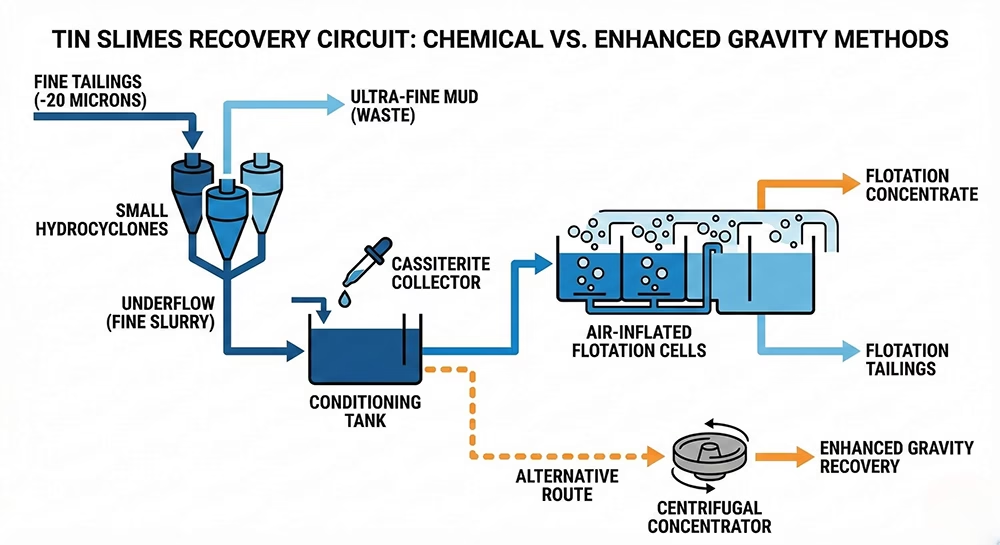
For fine cassiterite, alternative recovery methods—such as centrifugal gravity separation or flotation—should be considered as supplementary processes.
3. Slime coating hinders cassiterite flotation
Fine slimes and clay particles tend to adhere to the surface of cassiterite, effectively encasing it in a layer of mud—a phenomenon commonly known as “slime coating.”
This coating prevents flotation reagents from properly attaching to the cassiterite surface, which inevitably compromises flotation efficiency. Furthermore, an excess of slimes increases reagent consumption and negatively impacts the quality of the final concentrate.
Consequently, during mineral processing, it is essential to carefully control desliming, pulp density, pH levels, and reagent dosage to ensure that slimes do not interfere with the separation process.
4. Complex mineral associations increase separation difficulty
When cassiterite is intimately associated with minerals such as quartz, tourmaline, or various sulfides, it must be sufficiently liberated through grinding.
If the grinding is insufficient, the cassiterite remains encapsulated within the gangue minerals.
Conversely, over-grinding results in the excessive production of fine particles and slimes.
Therefore, mineralogical analysis and grinding tests are necessary to determine the optimal particle size for achieving effective mineral liberation.
How to improve the recovery rate of refractory tin ore?
In the face of difficult-to-select tin ore, no equipment can solve all problems.
A reasonable mineral processing process should match equipment according to the properties of the ore and the characteristics of different particle sizes.
Step 1: Do mineralogy analysis first
Before determining the equipment, you must first understand the following data:
- Raw ore tin grade and mineral composition.
- The embedded particle size of cassiterite.
- The symbiotic relationship and dissociation characteristics of cassiterite and other minerals.
- Clay and slime content in ores.
- Sulfide mineral content.
- Distribution of tin in different particle sizes.
Common detection methods include XRD, XRF, optical microscopy and SEM-EDS. If necessary, automatic mineral dissociation analysis can also be performed.
The goal is simple: figure out where tin is and how difficult it is to separate from other minerals.
Step 2: Reasonably control crushing and grinding
Different tin ores have different dissociation requirements. Do not use the same grinding fineness for all tin ores.
For example:
- Coarse-grained cassiterite: May require relatively little grinding to achieve dissociation requirements.
- Fine-grained disseminated tin ore: may require further fine grinding.
- High mud content tin ore: may need to be scrubbed and graded before subsequent processing.
- Complex sulfide associated tin ore: stage grinding and stage sorting may be required.
Through the grinding test, the appropriate grinding fineness can be determined and unnecessary over-grinding can be reduced.
Step 3: Process separately according to different granularities
This step is especially important for fine-grained tin ores.
You can consider the following processing ideas:
- Coarse grade: Use jig machine for re-selection.
- Medium grade: Use spiral chute or shaker.
- Fine particle size: using centrifugal gravity separation equipment or flotation.
- Slime part: tested separately, and whether to be recycled is determined based on the tin grade and particle size.
It should be noted that these are only preliminary device matching ideas and are not fixed granularity standards. The specific classification particle size needs to be determined through experiments.
Step 4: Configure mineral processing equipment appropriately.
Different pieces of equipment are responsible for different stages of the process.
| Equipment Name | Primary Function | Suitable Ore Conditions |
| Jaw Crusher | Primary (coarse) crushing | Hard primary tin ore |
| Ball Mill | Grinding; facilitating mineral liberation | Primary tin ore |
| Vibrating Screen | Size classification (screening) | Ores with a wide particle size distribution |
| Trommel Washer (Drum Washer) | Washing; breaking up clay | Tin ore with high clay content |
| Jig | Gravity separation of coarse particles | Liberated coarse-grained cassiterite |
| Spiral Chute | Gravity separation | Fine- to medium-grained placer (alluvial) deposits |
| Shaking Table | Cleaning (upgrading); increasing concentrate grade | Liberated minerals of appropriate particle size |
| Centrifugal Concentrator | Gravity separation of fine particles | Fine-grained heavy minerals |
| Flotation Machine | Separation of fine-grained minerals | Fine-grained cassiterite and sulfide-bearing ores suitable for flotation |
| Magnetic Separator | Removal of magnetic impurities | Tin ore containing magnetic minerals |
When selecting equipment, the most important consideration is not the number of machines installed, but rather whether each piece of equipment is processing the specific particle-size fraction for which it is best suited.
Step 5: Regularly analyze tailings to identify the actual source of tin loss.
Do not rely solely on the final concentrate grade; pay close attention to the tin content in the tailings as well.
Regular analysis is recommended for:
- Tin grade of the run-of-mine (ROM) ore.
- Tin grade of the concentrate.
- Tin grade of the tailings.
- Distribution of tin across different particle size fractions.
- Recovery rates for individual pieces of equipment at each stage.
If the tin in the tailings is found to be concentrated primarily in the -20 μm size fraction, the focus should be on recovering these ultra-fine particles, rather than simply increasing the number of jigs or shaking tables.
Existing research indicates that fine-grained cassiterite can be recovered from conventional gravity-separation tailings through combined processes, such as centrifugal gravity separation and flotation.
5 Common Mistakes in the Beneficiation of Refractory Tin Ores
Even with the right equipment, an ill-conceived process design can still lead to low recovery rates.
The following five mistakes are particularly critical to avoid during the beneficiation of tin ores.
Mistake 1: Relying solely on jigs for all particle size ranges.
While jigs are effective for processing coarse-grained minerals within a specific size range, they cannot efficiently recover all fine-grained cassiterite.
Mistake 2: Assuming that finer grinding is always better.
Excessive grinding tends to generate large amounts of slime (fine sludge), which increases the loss of cassiterite.
Mistake 3: Overlooking tin resources present in the slime.
Some fine-grained cassiterite may end up in the slime; failing to test this material before disposal can result in a waste of resources.
Mistake 4: Selecting equipment based exclusively on the grade of the run-of-mine ore.
Even if two tin ores have the same head grade, they may differ significantly in terms of grain size distribution, mineral associations, and liberation characteristics.
Mistake 5: Focusing only on concentrate grade while ignoring recovery rates.
A high concentrate grade does not necessarily indicate an effective overall beneficiation process; one must also consider the tin recovery rate and losses to the tailings.
Refractory tin ore beneficiation FAQ
Q1: Which types of tin ore are the most difficult to process?
A: Tin ores characterized by fine-grained dissemination and complex mineral associations are generally the most challenging to process. Because cassiterite (tin oxide) particles are extremely fine and difficult to liberate, traditional gravity separation often leads to the loss of fine tin particles; therefore, a combination of fine grinding, classification, gravity separation, and flotation may be required.
Q2: Why is it difficult to recover fine-grained cassiterite?
A: Gravity separation is generally less effective for fine-grained cassiterite than for coarser particles of an optimal size. Furthermore, fine cassiterite particles can become coated with mineral slime (sludge), which complicates both gravity separation and flotation processes.
Q3: Can gravity separation be used for tin ores associated with sulfides?
A: Yes. If the cassiterite has been sufficiently liberated, it can be recovered via gravity separation. However, if the sulfide content is high or the mineral associations are complex, additional processes—such as sulfide flotation, desulfurization, or other separation techniques—may be necessary.
Q4: What equipment is suitable for processing fine-grained tin ores?
A: There is no single piece of equipment suitable for all fine-grained tin ores. Centrifugal gravity concentrators and flotation machines are potential options, often used in conjunction with desliming and classification equipment. The final selection should be based on the ore’s particle size distribution and the results of mineral processing tests.
Q5: How can the recovery rate of refractory (difficult-to-process) tin ores be improved?
A: Begin with mineralogical analysis and particle size distribution testing, then optimize the grinding, classification, gravity separation, and flotation processes based on the specific characteristics of the ore. Additionally, regularly monitor the tin content in the tailings from each stage to identify where the primary losses are occurring.
Conclusion
Determining the ease of processing tin ore requires looking beyond just the ore type. Generally, primary tin ores characterized by fine-grained dissemination, high clay content, or complex mineral associations present greater processing challenges. When selecting equipment for tin ore beneficiation, one should not focus solely on model specifications, nor should equipment be added indiscriminately.
The correct approach is to first understand the ore’s properties, then determine the appropriate process and equipment. This helps avoid unnecessary setbacks while enabling better control over both investment and production costs.
If you are considering a tin ore beneficiation project, please feel free to send us ore samples, along with information regarding ore grade or particle size distribution. We can assist you in analyzing the most suitable beneficiation process and equipment configuration.
[Inquire About Tin Ore Beneficiation Solutions]
Latest News

How can the recovery rate of tin from high-sludge oxidized alluvial tin ores be effectively improved?
800When dealing with oxidized alluvial tin ores containing high levels of sludge (fine clay/silt), many processing plants initially consider adding more jigs or shaking tables, or increasing the processing capacity of their existing equipment. I…
-
What is the difference between sulfide tin ores and oxide tin ores?
800Those involved in tin ore processing have likely encountered this scenario: the raw ore has a decent tin content, yet after crushing, grinding, and beneficiation, the concentrate grade remains low, while a significant amount of tin is lost to t…
-
What equipment is required for the beneficiation of alluvial tin ore?
800Having worked in alluvial tin ore processing for many years, I have found that such deposits are indeed often easier to process than primary (lode) tin deposits. Through long-term natural weathering and the action of flowing water, much of the …
-
Why are alluvial tin deposits the easiest type of tin deposit to process?
800For grinding operators or gravity separation technicians, the greatest concern is not low ore grade, but rather fine mineral dissemination. In the case of primary (hard-rock) tin deposits, if the chosen beneficiation process is unsuitable, reco…
loading…
已经是到最后一篇内容了!