 Chunlei Mining Machinery

What equipment is required for the beneficiation of alluvial tin ore?
Having worked in alluvial tin ore processing for many years, I have found that such deposits are indeed often easier to process than primary (lode) tin deposits. Through long-term natural weathering and the action of flowing water, much of the cassiterite has already become detached from the waste rock. By employing processes like washing and screening—combined with gravity separation equipment such as jigs and shaking tables—it is possible to effectively recover the tin.
However, one should not assume that a single jig can handle every type of alluvial tin deposit. Factors such as a high content of fine clay (slimes), excessively fine cassiterite particles, or complex mineral composition can all negatively impact recovery rates. Ultimately, success depends on a thorough assessment of the specific ore; selecting the right equipment and designing an appropriate processing flow are essential to minimizing tin loss.
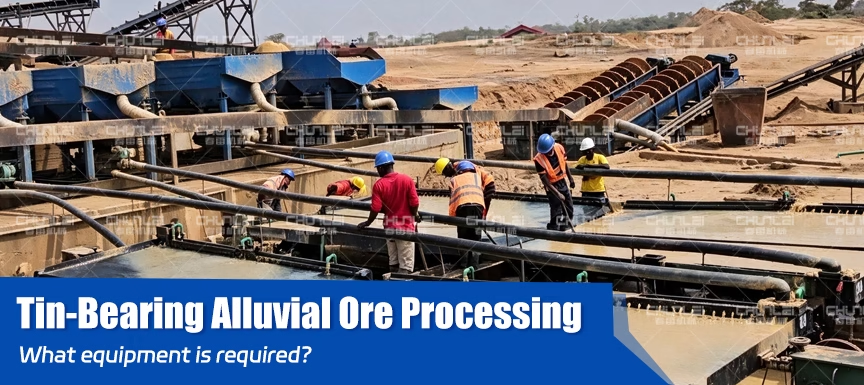
What equipment is required for processing alluvial tin ore?
The processing of alluvial tin ore typically involves stages such as ore washing, screening, classification, gravity separation, concentrate purification, and dewatering. Common equipment includes trommel scrubbers (rotary washers), vibrating screens, jigs, spiral chutes, shaking tables, centrifugal concentrators, magnetic separators, and dewatering equipment.
Not every processing plant requires all of these machines. The specific equipment needed depends on the characteristics of the raw ore and the separation requirements at each stage of the process.
1. Ore Washing Machine (Trommel Scrubber)
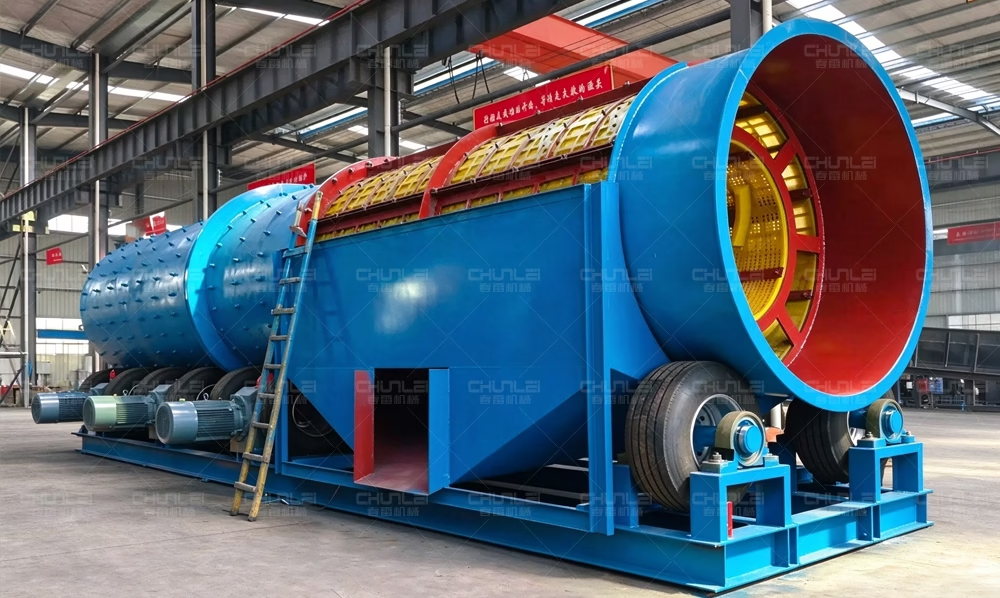
Primary Function: To remove clay, mud clods, and surface impurities from the alluvial tin ore, ensuring that mineral particles are fully dispersed. This creates a stable feed condition for subsequent screening and gravity separation stages.
Applicable Scenarios:
- The raw ore contains a significant amount of clay or mud clods.
- Gravel and particles are cemented together, which would cause clogging during direct screening.
- The raw ore has a wide range of particle sizes, necessitating continuous washing and pre-treatment.
Common equipment includes trommel scrubbers, rotary scrubbers, and other washing units tailored to the degree of cementation of the ore.
Selection Criteria: Consider factors such as the clay content of the raw ore, ore hardness, processing capacity, required washing intensity, and water availability. If the clay content is low and the mineral particles disperse easily, heavy-duty scrubbing equipment may not be necessary.
2. Vibrating Screens and Trommel Screens
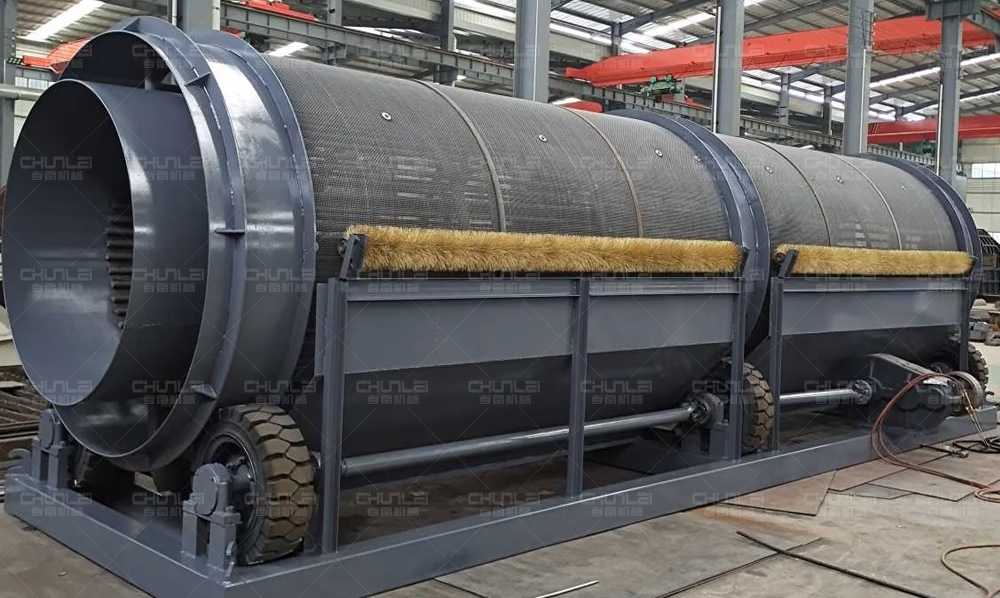
The purpose of screening is not merely to remove large waste rock; more importantly, it serves to classify ore by particle size, preventing coarse particles from interfering with the recovery of fine-grained cassiterite.
- Trommel Screens: Suitable for the continuous processing of wet gravel; they often perform both ore washing and preliminary screening.
- Vibrating Screens: Ideal for more precise size classification of the feed, allowing for the separation of material into different size fractions.
- High-Frequency Fine Screens: Can be selected based on the properties of the ore slurry and specific screening objectives when fine control over particle size is required.
For instance, coarse-grained minerals may be directed to a jigging process, while finer ore particles are sent to spiral concentrators, shaking tables, or other gravity-separation equipment designed for fine materials.
Selection Criteria: Screen aperture sizes should be determined based on the particle size distribution of the cassiterite, its degree of liberation, and the effective operating range of downstream equipment—rather than simply adopting specifications used at other mining operations.
3. Jig Separators
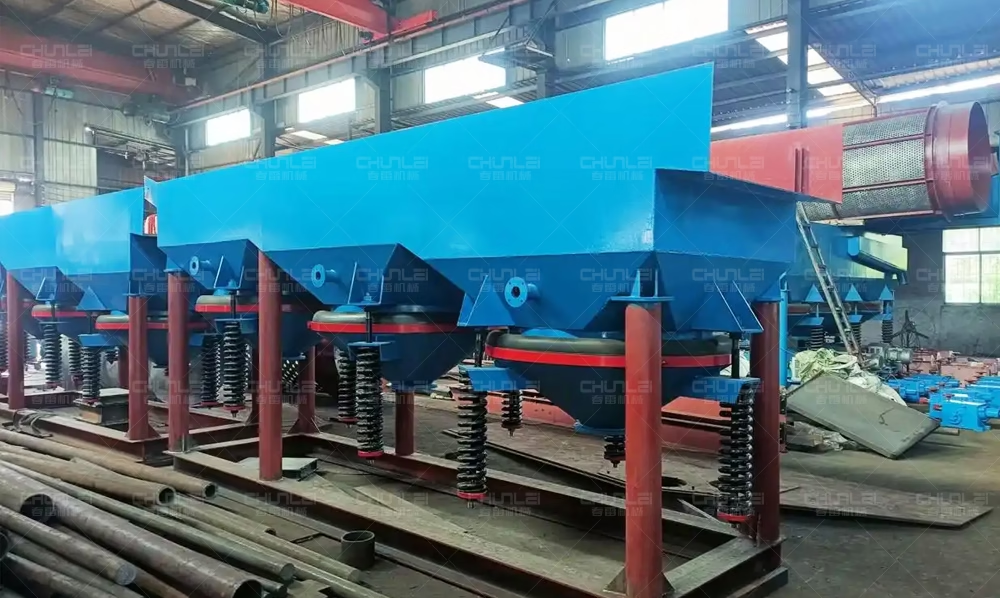
The jig separator is a core piece of equipment frequently used in the gravity beneficiation of placer tin ore. It utilizes differences in particle density and settling behavior—under the influence of a pulsating water flow—to separate heavy minerals from lighter ones.
Due to its high density, cassiterite can be concentrated into the “heavy” product fraction, provided that the particle size and operating conditions are appropriately managed.
Primary Functions:
- Pre-concentration of coarse-grained cassiterite.
- Reducing the processing load on downstream refining/cleaning equipment.
- Early recovery of coarser tin-bearing minerals from a large volume of light-weight gravel and sand.
Jig separators are particularly well-suited for coarse-grained materials that exhibit good liberation; however, their performance remains dependent on factors such as particle size, particle shape, density differentials, and the stability of the feed.
Selection Criteria: Particle size analysis and gravity separation testing should be conducted before determining the target size range for jigging, the number of separation stages, and the optimal feed conditions. For ores containing significant amounts of ultrafine cassiterite, a jig alone is typically insufficient to achieve full recovery.
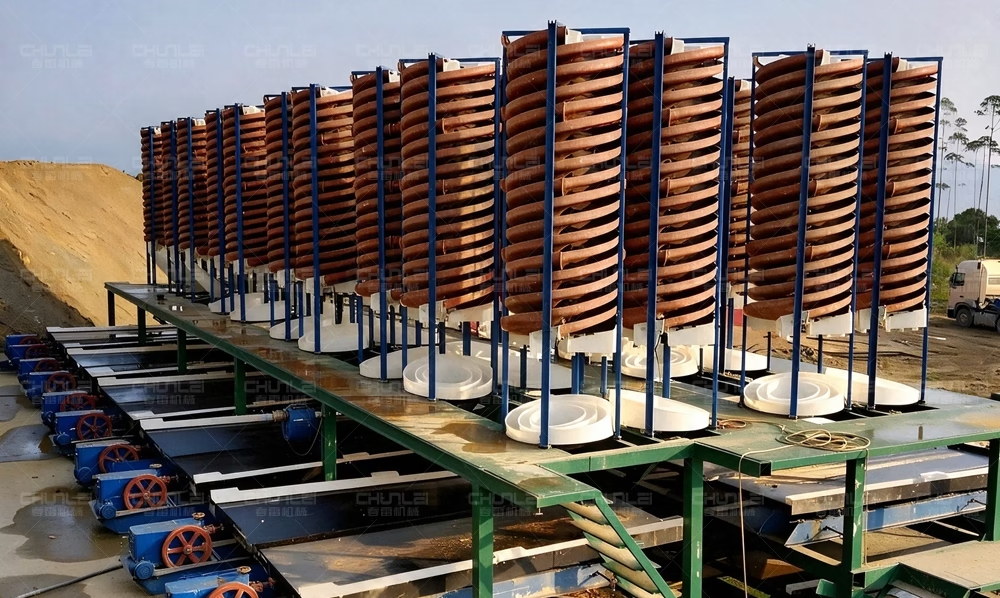
4. Spiral Concentrator
Spiral concentrators utilize gravity, fluid dynamics, and differences in the motion of mineral particles to separate heavy minerals from light ones. They are typically suited for fine-grained placer deposits that have been appropriately classified by size.
Key Advantages:
- Capable of continuous slurry processing.
- Well-suited for parallel, multi-unit configurations.
- Effective for roughing or pre-concentration, thereby reducing the load on downstream cleaning stages.
It should be noted that spiral concentrators are not equally effective for all fine-grained materials. Separation efficiency can be significantly compromised if the particles are excessively fine, the content of slimes (fine clay/silt) is too high, or the feed pulp density fluctuates substantially.
Selection Criteria: First, determine the effective particle size range for separation; then, select the appropriate equipment specifications and the number of units to be operated in parallel based on the slurry flow rate, feed pulp density, and target recovery rate.
5. Shaking Table
Shaking tables utilize the reciprocating motion of the deck, the flow of water, and differences in the density, particle size, and shape of mineral grains to achieve further separation.
In the processing of alluvial tin ores, shaking tables are commonly used for:
- Cleaning of rough concentrates obtained from jigs or spiral concentrators.
- Retreatment of middlings.
- Enrichment of fine-grained cassiterite within an appropriate size range.
- Increasing concentrate grade and reducing the inclusion of gangue minerals.
The advantage of a shaking table lies in the ease with which separation results can be observed and adjusted. However, the processing capacity per unit is generally limited, and the operation requires a stable feed—consistent in terms of particle size, pulp density, and water flow rate.
Selection Considerations: Shaking tables can be highly valuable if the objective is to improve concentrate grade. If the volume of raw ore is large, it is essential to first evaluate the number of units required, the necessary floor space, water consumption, and the volume of middlings to be recirculated.
6. Centrifugal Concentrator
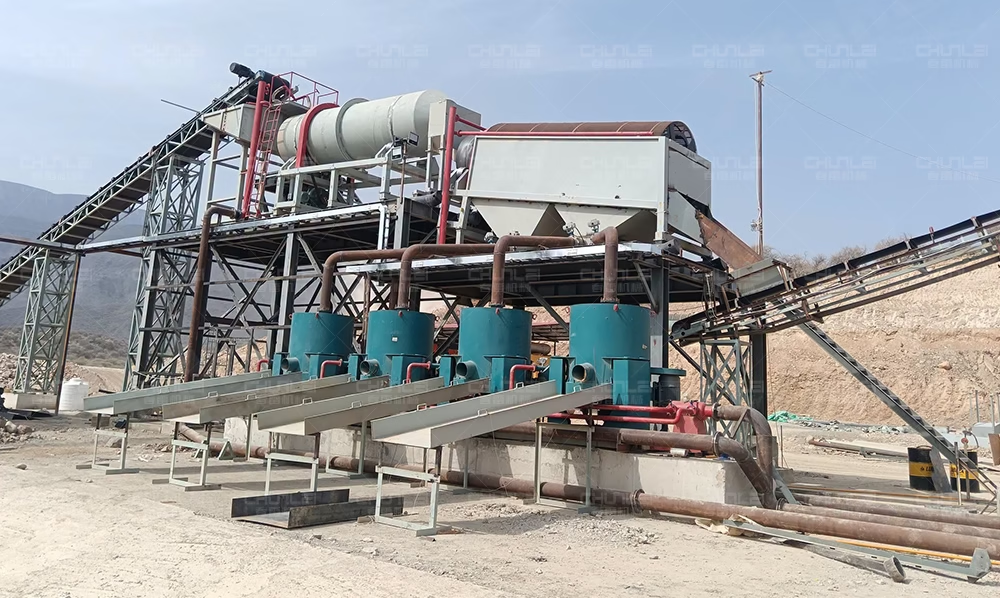
When the cassiterite in alluvial tin ore is too fine for effective recovery via conventional gravity separation equipment, centrifugal concentrators may be evaluated through testing.
Centrifugal concentrators utilize an enhanced centrifugal field to amplify density-based separation, making them suitable for recovering certain fine-grained heavy minerals. Their performance depends on the equipment type, particle size distribution, slurry characteristics, and specific operating conditions.
It should be noted that centrifugal concentrators are not a universal solution for all fine-particle or “slimy” (high-sludge-content) ore issues. In cases involving ultra-fine particles or highly sludged slurries, further investigation into particle liberation, the impact of slimes, and alternative recovery methods is required.
7. Magnetic Separator
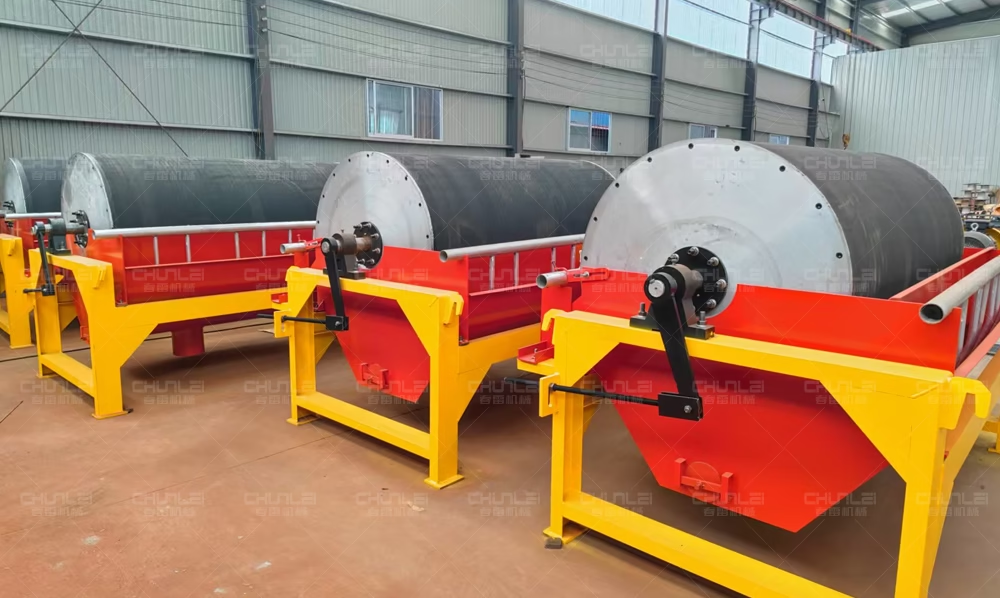
Alluvial tin concentrates may contain ilmenite, magnetite, monazite, or other associated heavy minerals. If these minerals compromise the quality of the concentrate, magnetic separation can be employed for their removal.
Common options include:
- Low-intensity magnetic separators: Designed for strongly magnetic minerals.
- High-intensity magnetic separators: Designed for mineral assemblages with specific magnetic susceptibility differences.
- Dry or wet magnetic separators: Selected based on the material’s moisture content, particle size, and process requirements.
Magnetic separation is typically used for concentrate purification or the removal of associated minerals; it should not be viewed as a direct replacement for primary separation equipment such as jigs, spiral concentrators, or shaking tables.
Selection Guidelines: Conduct an analysis of the mineral composition and magnetic properties first, then determine the appropriate magnetic field strength, separation method, and placement within the process flow.
8. Dewatering Equipment (Dewatering Screens, Thickeners, and Filtration Units)
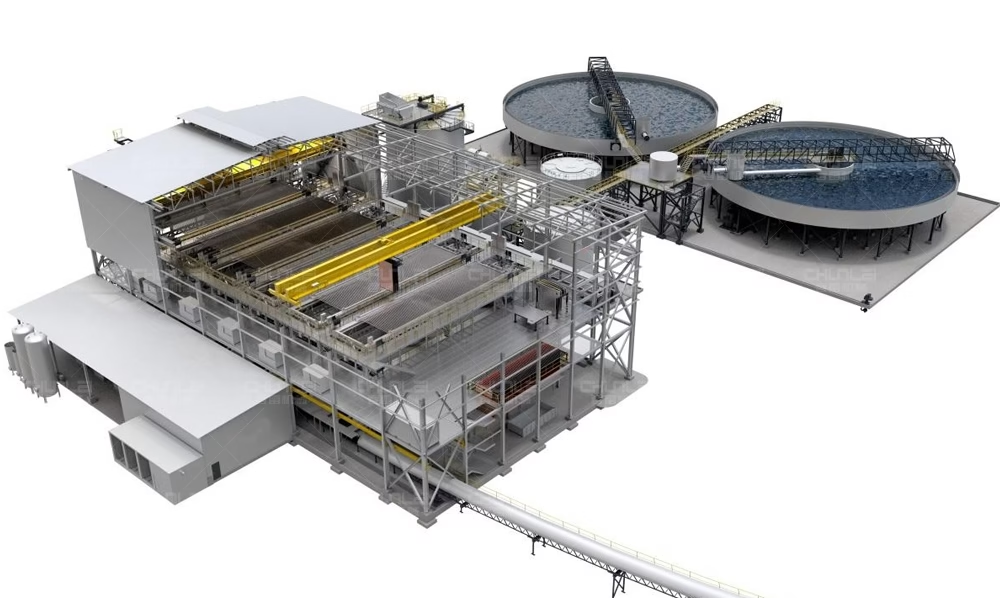
Dewatering equipment determines the downstream processing methods for concentrates and tailings, and also influences the water circulation system of the mineral processing plant.
Common configurations include:
- Dewatering screens: Used for granular materials of appropriate particle size.
- Thickeners: Used to reduce the water content of mineral slurries.
- Filters or filter presses: Used to further reduce the moisture content of concentrates or tailings.
- Pumps, piping, and water recovery infrastructure: Used for transporting slurries and recovering process water.
Dewatering systems should be designed in conjunction with upstream processing capacity, product moisture requirements, and tailings disposal strategies; equipment selection should not be based solely on the nominal capacity of individual units.
What is the complete processing workflow for alluvial tin ore?
The typical processing workflow for alluvial tin ore can be summarized as follows:
Raw ore feed → Ore washing → Screening and classification → Size-fractionated gravity separation → Concentrate refining → Magnetic separation (if necessary) → Concentrate dewatering.
For ores with high clay content, a significant proportion of fine-grained cassiterite, or insufficient mineral liberation, additional processes—such as desliming, recovery of fine particles, regrinding of middlings, or other supplementary treatments—may be required. Research into cassiterite beneficiation also emphasizes that particle size distribution, the degree of mineral liberation, and the strategic combination of various gravity separation devices are critical factors influencing overall separation performance.
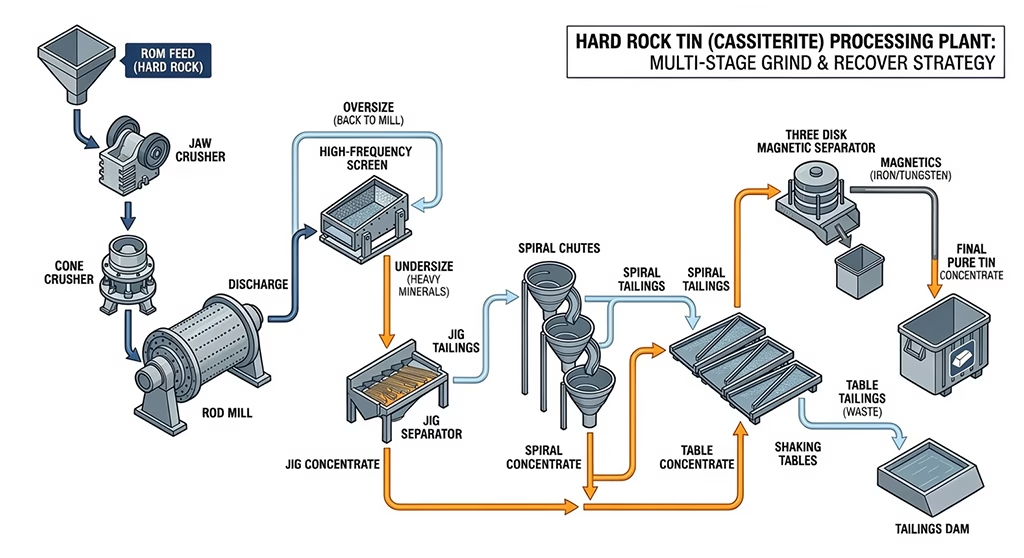
Step 1: Raw Ore Feeding and Washing
The raw ore is fed into the washing system. The washer breaks up mud clumps and removes a portion of the clay, thereby reducing the risk of clogging during subsequent screening.
If the ore consists primarily of loose sand and gravel, the washing system can be relatively simple; however, if sticky clay or weathered, cemented material is present, the required scrubbing intensity and processing duration should be determined through testing.
Step 2: Screening and Size-Based Classification
Screening divides the raw ore into different size fractions, allowing for the selection of appropriate downstream equipment based on the characteristics of each fraction.
For example:
- Coarse fraction: Evaluate jigging (gravity separation).
- Fine sand fraction: Evaluate spiral concentrators or shaking tables.
- Ultrafine tin-bearing fraction: Evaluate centrifugal concentrators or other fine-particle recovery technologies, depending on the cassiterite grain size and slime content.
This classification approach serves as a conceptual framework for process design rather than a set of rigid size boundaries. Actual screen aperture sizes should be determined based on particle size analysis, tin grade per size fraction, and mineral processing test results.
Step 3: Gravity Roughing and Cleaning
The goal of roughing is to recover easily liberated cassiterite as early as possible and to reduce the volume of material proceeding to subsequent stages.
Common equipment combinations include:
- Jigs: Used for the pre-enrichment of suitable coarse fractions.
- Spiral concentrators: Used for processing appropriate fine sand fractions.
- Shaking tables: Used for the further cleaning of rough concentrates and middlings.
- Centrifugal concentrators: Employed to recover fine-grained cassiterite, provided their effectiveness has been confirmed through testing.
Depending on the ore characteristics, the process may also incorporate scavenging, cleaning, and the recirculation of middlings. Generally, staged processing is easier to control than feeding a mixture of all particle sizes into a single piece of equipment.
Step 4: Middlings Processing and Potential Regrinding
If gravity separation products contain composite particles (intergrowths) of cassiterite and gangue, the middlings should undergo mineralogical analysis to determine whether regrinding is necessary.
Do not simply add regrinding equipment solely because the concentrate grade is low. If the issues stem from the entrainment of slimes, improper classification, or the presence of associated heavy minerals, indiscriminate grinding may generate an excess of fine-grained cassiterite that is difficult to recover.
For materials requiring regrinding, the grinding fineness must be strictly controlled, and liberated cassiterite should be promptly separated via screening or classification. Industry guidelines for tin ore processing also emphasize the need to avoid over-grinding and advocate for the separate recovery of different particle-size fractions.
Step 5: Concentrate Purification and Dewatering
If the gravity-separated concentrate contains magnetic minerals that compromise product quality, magnetic separation can be employed, leveraging the differences in magnetic susceptibility among the minerals.
Subsequently, the concentrate is processed using dewatering screens, thickeners, or filtration equipment. Tailings should be thickened, dewatered, and disposed of in a regulated manner—taking into account particle size, moisture content, and environmental requirements—while also evaluating the feasibility of recycling process water.
How should equipment be selected for alluvial tin ores of varying particle sizes?
Particle size is a key criterion for equipment selection, though it should not be the sole factor considered. For a given particle size, other variables—such as the degree of cassiterite liberation, particle shape, density variations, and the content of fine slimes—also significantly influence separation outcomes.
In general, for coarse-grained alluvial tin ores, the preferred approach involves screening followed by gravity separation using jigs. For medium-to-fine-grained ores, gravity separation equipment such as shaking tables and spiral chutes is typically prioritized. For fine and ultra-fine-grained ores, the primary focus must be on addressing slime classification, the recovery of fine particles, and the mitigation of losses in the tailings.
Selection guide for equipment based on alluvial tin ore particle size:
| Tin-Bearing Alluvial/Placer Deposit Particle Size (Reference) | Key Mineral Processing Challenges | Recommended Equipment | Primary Function |
| Coarse Fraction: >2 mm | Large particle size; requires high separation efficiency to prevent the loss of valuable minerals | Vibrating screens, jigs | Screening/classification, pre-enrichment of coarse cassiterite |
| Medium Fraction: 0.5–2 mm | Requires a balance between throughput and separation precision | Jigs, spiral concentrators | Gravity separation and preliminary enrichment of the medium fraction |
| Fine Fraction: 0.1–0.5 mm | Reduced differences in particle settling rates; higher demand for separation precision | Shaking tables, spiral concentrators | Separation of fine cassiterite, improvement of concentrate grade |
| Very Fine Fraction: <0.1 mm | Highly susceptible to interference from slimes, slurry flow dynamics, and particle agglomeration | Hydrocyclones, fine-particle shaking tables, etc. | Classification and desliming, recovery of fine cassiterite |
| Ultrafine Fraction: <0.037 mm (37 μm) | Difficult to recover via gravity separation; prone to loss in the tailings | Specialized fine-particle gravity separation equipment; evaluation of alternative separation methods may be necessary | Maximize recovery of very fine cassiterite to minimize metal loss |
The equipment listed in the table represents the initial selection; it does not imply that a separate unit is required for every individual particle-size fraction. Hydrocyclones are primarily used for classification or desliming rather than as a primary piece of equipment for the direct recovery of cassiterite. Whether ultra-fine cassiterite can be effectively recovered must be verified through mineral processing tests.
How should equipment be configured for different types of tin ore?
Equipment configuration should be based on the specific properties of the ore, rather than selecting equipment models first and then attempting to adapt the ore to them.
Scenario 1: Alluvial tin ore with low clay content and good cassiterite liberation.
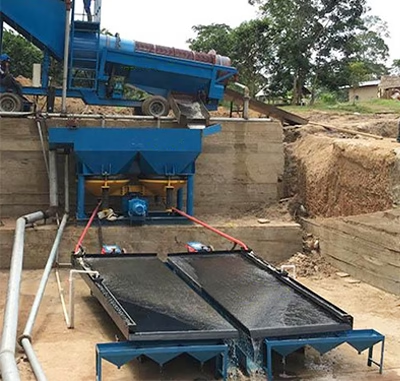
Recommended Process Flow:
Raw ore feed → Trommel washing and screening → Sizing/Classification → Jigging (roughing) → Shaking table (cleaning/finishing) → Concentrate dewatering.
This approach is suitable for alluvial tin ore where minerals are well-liberated, clay content is minimal, and the particle size distribution is relatively easy to process. The potential need for spiral chutes, scavenging stages, or other equipment should be determined through testing.
Scenario 2: Alluvial tin ore with high clay content and complex particle size distribution.
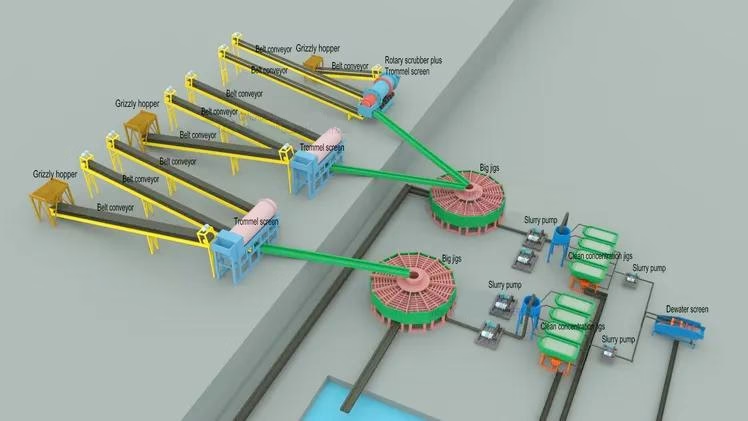
Recommended process flow:
Raw ore feed → Intensive washing → Multi-stage screening → Desliming → Gravity separation tailored to specific size fractions → Separate recovery of fine-grained tin-bearing material → Concentrate cleaning and dewatering.
While this type of ore may require a larger number of equipment units, the key is ensuring that materials of different particle sizes and mineral compositions are directed to the most appropriate separation stages.
Scenario 3: Alluvial tin ore with significant losses of fine-grained cassiterite
Recommended process flow:
Raw ore pretreatment → Sizing/Classification → Gravity separation (coarse fraction) → Gravity separation (fine fraction) → Middlings analysis and recirculation → Concentrate purification.
If the content of fine-grained cassiterite is high, consider comparing centrifugal gravity separation, fine-particle shaking tables, and other applicable technologies. For ultra-fine particles, the potential need for methods such as flotation should be determined based on mineralogical analysis and beneficiation testing; the process should not be selected based on particle size alone.
Scenario 4: Alluvial tin ore containing a high proportion of associated heavy minerals
Recommended process flow:
Washing → Screening → Gravity pre-concentration → Shaking table (cleaning) → Magnetic separation (or other targeted separation methods) → Concentrate dewatering.
If significant amounts of ilmenite, magnetite, or other associated minerals are present, it is essential to first determine the differences in magnetic properties and particle size between these minerals and cassiterite. Where necessary, the various products should be assayed separately to avoid excessive loss of tin metal while attempting to increase the grade of the concentrate.
5 Common Mistakes When Selecting Processing Equipment for Alluvial Tin Deposits
Mistake 1: Focusing solely on equipment capacity while ignoring ore characteristics
Nominal equipment capacity is not a direct indicator of actual processing performance. Factors such as ore particle size, clay content, pulp density, and the degree of mineral liberation all significantly impact equipment operation.
Correct approach: Before finalizing equipment selection, conduct a sieve analysis of the raw ore, determine the tin grade, and perform necessary beneficiation tests.
Mistake 2: Feeding particles of all sizes into the same gravity separation unit
Coarse and fine particles exhibit different movement behaviors. If the particle size range is too broad, it can lead to inadequate separation of coarse particles and poor recovery of fine particles.
Correct approach: Implement appropriate screening, classification, and size-fractionated processing stages based on the particle size distribution and separation test results.
Mistake 3: Excessive desliming, leading to tin loss
While desliming can improve conditions for certain gravity separation processes, the removed fine slimes may also contain valuable cassiterite (tin ore).
Correct approach: Sample and analyze the desliming overflow to quantify tin loss, then determine whether it is necessary to recover the fine-grained cassiterite.
Mistake 4: Indiscriminately adding grinding equipment
In some alluvial tin deposits, the cassiterite is already sufficiently liberated, rendering additional grinding unnecessary. Over-grinding can increase the proportion of ultra-fine particles, making subsequent gravity separation more difficult.
Correct approach: First, assess the content of composite particles (middlings) and the degree of liberation; apply controlled regrinding only to the specific middlings or composite particles that require it.
Mistake 5: Prioritizing concentrate grade at the expense of overall recovery
While further cleaning can increase the concentrate grade, if excessive tin is lost to the middlings and tailings, the overall economic performance of the processing plant may remain suboptimal.
Correct approach: Monitor the raw ore grade, concentrate grade, concentrate yield, total recovery, and tailings tin grade simultaneously. Use a material balance analysis to evaluate the effectiveness of any process improvements.
FAQ
Q: What are the primary pieces of equipment required for processing alluvial tin ore?
A: Common equipment includes feeders, ore washers, trommel or vibrating screens, jigs, spiral chutes, and shaking tables. Depending on the specific characteristics of the ore, centrifugal concentrators, magnetic separators, and dewatering equipment may also be incorporated. The exact configuration depends on the ore properties, processing capacity, and the target quality of the final product.
Q: Is a ball mill always necessary for processing alluvial tin ore?
A: Not necessarily. For alluvial tin ore that is already sufficiently liberated, the focus is typically on washing, screening, and gravity separation. Grinding or regrinding operations are only considered if test results indicate that the cassiterite remains intergrown with gangue minerals and requires further liberation.
Q: What is the difference between a jig and a shaking table?
A: Jigs are generally used for the gravity pre-enrichment of coarser particles, serving a different purpose and capacity range than shaking tables. Shaking tables are typically employed for further cleaning and the processing of middlings, helping to increase the grade of the final concentrate. While both can be used in combination, one cannot simply declare one superior to the other without considering particle size and the degree of mineral liberation.
Q: How can the recovery rate of tin be improved during processing?
A: The first step is to identify the specific particle size fractions and process stages where tin losses are occurring. Recovery can be improved through targeted measures such as enhancing ore washing, optimizing screening, implementing proper classification, minimizing over-grinding, adjusting gravity separation parameters, and recovering valuable middlings. Any proposed modifications should be validated through testing and material balance calculations.
Q: How is the number of equipment units for an alluvial tin processing line determined?
A: This should be determined by holistically considering factors such as the dry ore throughput, the particle size distribution of the raw ore, the mass proportion of each size fraction, the effective processing capacity of individual units, equipment availability (uptime), redundancy requirements, and the overall process configuration. Simply dividing the total throughput by the nominal capacity of a single unit is insufficient, as feed rates, slurry flow rates, and effective processing capacities vary across different stages of the process.
Conclusion
Having worked in alluvial tin processing for many years, I’ve learned one key principle: It’s not about how much equipment you buy, but about choosing the right equipment to maximize tin recovery.
- High clay content? Prioritize ore washing and desliming.
- Abundant coarse cassiterite? Consider using a jig.
- Lots of fine sand? Try a combination of spiral chutes and shaking tables.
- Risk of losing fine-grained tin? Evaluate recovery methods like centrifugal concentration.
- Presence of magnetic minerals? Conduct tests first before deciding whether to incorporate magnetic separators.
- High moisture content in tailings? Don’t overlook dewatering and water-recycling systems.
Ultimately, the path to avoiding costly mistakes and achieving higher recovery rates lies in first understanding the nature of your ore, then designing the process, and finally selecting the appropriate equipment.
What equipment is best for your alluvial tin deposit? Don’t rush into purchases—get a clear picture of your ore first. Share details like clay content, particle size distribution, and processing capacity with us, and we’ll help you determine the ideal processing solution!
Latest News

Why are alluvial tin deposits the easiest type of tin deposit to process?
800For grinding operators or gravity separation technicians, the greatest concern is not low ore grade, but rather fine mineral dissemination. In the case of primary (hard-rock) tin deposits, if the chosen beneficiation process is unsuitable, reco…
-
A Comprehensive Guide to Types of Tin Ore and Mineral Processing Techniques
800Tin ore beneficiation is not merely a matter of crushing and grinding the ore before feeding it into a jig or a shaking table. Even within a single tin mining project, the optimal beneficiation process can vary significantly depending on factor…
-
How is a 0.2% tin ore processed into a 60% concentrate?
800Many clients attempt to process ore containing 0.2% tin, only to find that—after a series of operations—the ore grade has failed to improve, while significant amounts of cassiterite remain in the tailings. Some clients try to compensate by inte…
-
What are the gravity separation process flows for tin ore?
800Having worked in the tin mining industry for many years, I’ve observed a recurring issue among clients: even when the raw ore has a high tin content and a substantial amount of processing equipment is employed, the final tin recovery rates rema…
loading…
已经是到最后一篇内容了!