 Chunlei Mining Machinery

A Comprehensive Guide to Types of Tin Ore and Mineral Processing Techniques
Tin ore beneficiation is not merely a matter of crushing and grinding the ore before feeding it into a jig or a shaking table. Even within a single tin mining project, the optimal beneficiation process can vary significantly depending on factors such as the type of raw ore, the grain size of the cassiterite, the mineralogical texture (how minerals are disseminated), and the composition of the gangue minerals.
For some alluvial tin deposits, effective separation can be achieved through screening, desliming, and gravity concentration. In contrast, primary (lode) tin deposits often require a more complex approach—involving multi-stage crushing, staged grinding, classification, and gravity concentration—sometimes even supplemented by flotation or magnetic separation. An ill-conceived process design can lead to issues such as substandard concentrate grades, the loss of fine-grained cassiterite into the tailings, or excessively high energy consumption during grinding.
This article explores the primary types of tin ore, ore characteristics, beneficiation workflows, equipment selection, recovery optimization, and common pitfalls in the process, providing guidance on how to determine the most appropriate treatment strategy for different types of tin ore.
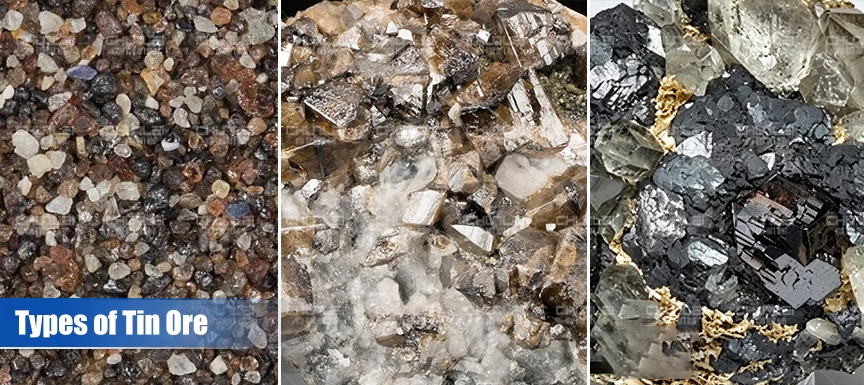
What are tin ores, and what are their primary types?
Tin ores refer to ores or mineral resources that contain the element tin and possess value for development and utilization. In nature, tin can be found in oxide minerals, sulfide minerals, and complex polymetallic deposits; however, the mineral processing characteristics vary significantly depending on the specific mineralogy.
Cassiterite (SnO₂) is the primary industrial source of tin. Due to its high density, cassiterite is generally well-suited for gravity separation. However, it is also brittle, meaning that crushing and grinding processes can easily produce fine particles, which may complicate subsequent recovery. For fine-grained cassiterite or complex polymetallic ores, a combination of flotation and other separation techniques is often required.
1. Classification by Deposit Type
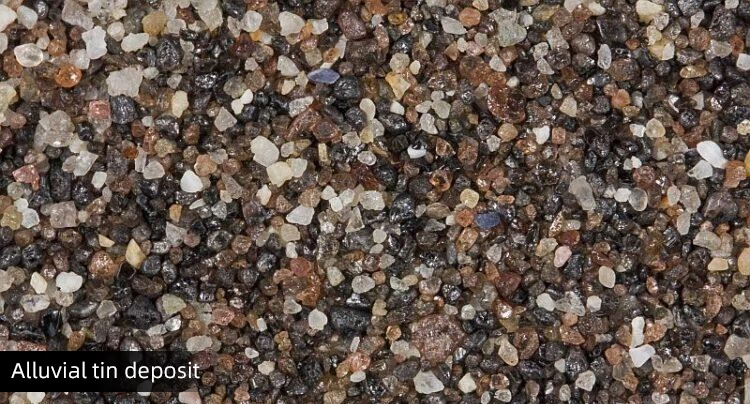
Placer (Alluvial) Tin Ore
Placer tin deposits are typically formed when tin-bearing rocks undergo weathering and fragmentation, followed by transport and natural sorting by water currents. In these deposits, cassiterite may exist as relatively coarse, liberated particles within gravel, riverbed sediments, or weathered regolith.
- Key characteristics: A mixture of gravel, clay, and heavy minerals.
- Primary challenges: Clay content, particle size distribution, and the potential loss of fine-grained cassiterite.
- Common processing methods: Screening, washing, desliming, jigging, and gravity separation using shaking tables.
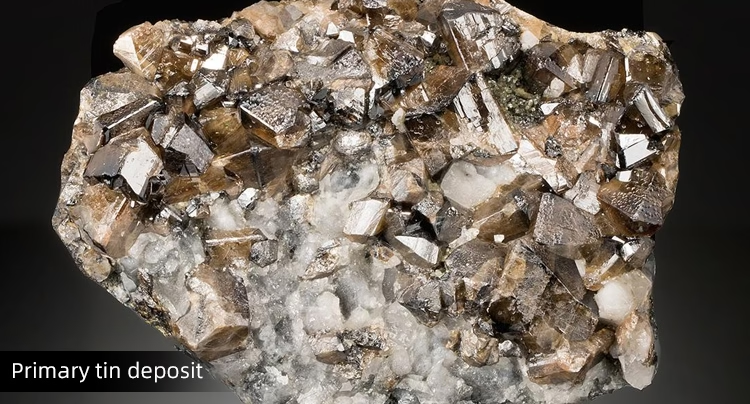
Primary (Hard-Rock) Tin Ore
Primary tin deposits are typically associated with geological environments such as granite-related mineralization systems, greisens, pegmatites, or hydrothermal veins. In these deposits, cassiterite is often disseminated within a matrix of quartz, feldspar, and other minerals.
- Key characteristics: The ore requires crushing and, typically, grinding.
- Primary challenges: Fine dissemination of cassiterite and complex mineral intergrowths.
- Common processing methods: Crushing, staged grinding, classification, gravity separation, and necessary final cleaning/refining stages.
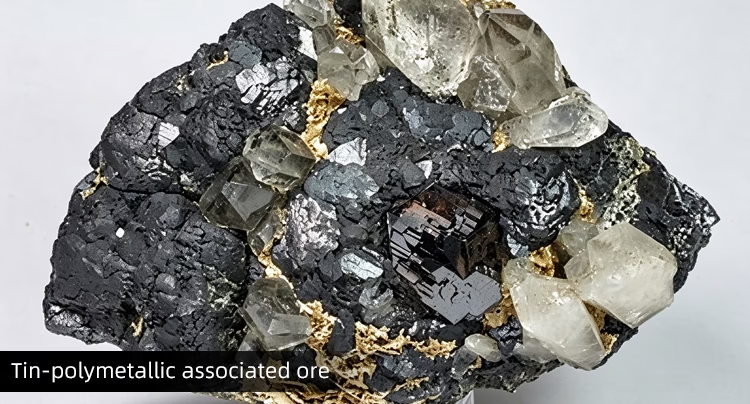
Complex Tin-Polymetallic Ore
In addition to cassiterite, this type of ore may contain other valuable minerals—such as copper, lead, zinc, and iron—as well as various sulfides, with the specific composition depending on the individual ore deposit.
- Key Characteristics: Complex mineral composition; minerals may be finely intergrown or encapsulated within one another.
- Primary Challenges: Separating tin from other valuable minerals, ensuring concentrate quality, and achieving comprehensive resource recovery.
- Typical Processing Methods: A combination of gravity separation and flotation, supplemented—where necessary—by magnetic separation or other separation techniques.
2. Classification by type of tin-bearing mineral
In addition to classifying by deposit type, it is also necessary to identify the specific minerals in which the tin actually resides.
| Types of Tin-Bearing Minerals | Key Characteristics | Focus Areas for Mineral Processing Design |
| Cassiterite (SnO₂) | Primary industrial tin mineral; high density | Focus on liberation size, size-fraction classification, and recovery of fine particles |
| Stannite | A sulfide of copper, iron, and tin | Requires investigation into sulfide flotation and the specific mode of occurrence of the tin |
| Other Tin-Bearing Sulfides | May contain associated elements such as copper, lead, and zinc | Select an appropriate approach—such as selective flotation or a combined processing flowsheet—based on the mineral composition |
Not all tin-bearing minerals are suitable for the same gravity separation process. If tin occurs primarily within sulfides or complex intergrown minerals, relying solely on gravity separation techniques—typically used for cassiterite—may fail to yield satisfactory results. Therefore, the mode of occurrence of the tin must first be determined through mineralogical analysis before a processing strategy is developed.
Ore Characteristics and Beneficiation Challenges for Different Types of Tin Deposits
The beneficiation process for tin ore is not determined solely by the grade of the run-of-mine ore; rather, it depends on the mineral composition, the degree of cassiterite liberation, particle size distribution, and the mode of occurrence of valuable minerals.
1. Density and Liberation Characteristics of Cassiterite
Cassiterite has a high density, creating a significant density contrast with common gangue minerals such as quartz. Consequently, gravity separation is typically a key method for processing tin ore.
However, a density difference does not guarantee easy separation across all particle sizes. As particles become finer, factors such as fluid resistance, particle shape, and pulp conditions exert a greater influence, often making it difficult to effectively recover fine and ultra-fine cassiterite using conventional gravity separation equipment.ugh mineral liberation and particle size analysis; it cannot be assessed based solely on the grade of the run-of-mine ore.
2. Why Is Grinding Fineness So Critical?
Grinding tin ore requires balancing two competing concerns:
- Insufficient grinding: Cassiterite remains intergrown with gangue minerals, making effective enrichment via gravity separation difficult.
- Over-grinding: Liberated cassiterite is subjected to further breakage, increasing the proportion of fine slimes, which can lead to a decline in recovery rates.
Therefore, the target for grinding should be based on achieving proper mineral liberation and meeting the optimal feed size requirements for downstream separation equipment, rather than simply striving for the finest possible product size.
3. Which parameters must be tested prior to mineral processing?
| Test Item | Primary Objective | Impact on Process Design |
| Tin Grade of Run-of-Mine (ROM) Ore | Determine the initial tin content | Assess requirements for pre-concentration and downstream processing |
| Mineral Composition and Tin Occurrence | Identify the specific minerals containing tin | Evaluate the suitability of gravity separation, flotation, or combined process schemes |
| Particle Size Distribution | Determine the proportions of coarse particles, fine particles, and slimes | Establish strategies for screening, classification, and size-fraction-specific processing |
| Degree of Mineral Liberation | Assess the extent of intergrowth between cassiterite and gangue minerals | Define the required grind size and potential needs for regrinding |
| Tin Grade by Size Fraction | Identify the size fractions where the majority of tin is concentrated | Detect potential losses of fine tin and incomplete liberation of coarse particles |
| Harmful Impurities and Associated Minerals | Identify factors affecting product quality and separation challenges | Determine requirements for cleaning, flotation, or other purification stages |
Before deciding to purchase equipment, prioritize conducting chemical analysis, mineralogical analysis, particle size analysis, and beneficiation tests on representative ore samples. This helps minimize wasted investment resulting from equipment mismatch.
What are the mineral processing methods for tin ore?
Tin ore processing is rarely accomplished with a single piece of equipment; rather, it involves a combination of various processes tailored to the specific characteristics of the ore. Key methods include gravity separation, flotation, magnetic separation, screening and classification, as well as necessary pre-treatment and final refining (cleaning) stages.
Gravity Separation: A Core Method for Cassiterite Processing
Gravity separation relies on differences in the density, particle size, and movement behavior of minerals within a fluid medium to achieve separation.
Common gravity separation equipment includes:
- Jigs: Suitable for coarser materials, provided the particle size and degree of mineral liberation meet the equipment’s requirements.
- Shaking Tables: Used for the fine-tuning (cleaning) of fine-grained sands and heavy minerals within an appropriate size range.
- Spiral Concentrators: Employed for the pre-enrichment or gravity separation of specific particle size fractions.
- Centrifugal Gravity Concentrators: Used in testing and for processing fine-grained materials that are difficult to recover effectively via conventional gravity separation.
The effective particle size range for any specific piece of equipment depends on its design, the nature of the ore, the feed concentration, and operational conditions; it cannot be determined solely by the name of the equipment.
Flotation: An Important Complement for Fine-Grained Cassiterite and Complex Ores
Flotation utilizes differences in the surface properties of minerals, achieving separation through the action of chemical reagents, pulp chemistry, and air bubbles.
For certain fine-grained cassiterite or complex associated ores, flotation serves as a supplement to gravity separation. However, the flotation of cassiterite is highly sensitive to factors such as mineral surface conditions, particle size, reagent regimes, pulp pH, and the presence of associated minerals; therefore, targeted testing is essential.
Common applications include:
- Recovering fine-grained cassiterite from the tailings of conventional gravity separation circuits.
- Achieving the selective separation of tin minerals from other minerals, given an appropriate mineralogical composition.
- Developing comprehensive recovery processes for tin-bearing polymetallic ores.
- It should be noted that flotation is not a direct substitute for gravity separation. For materials with high cassiterite content, suitable particle size, and significant density differences, gravity separation often remains the simpler and more economical primary processing route.
Magnetic Separation: Used for the Auxiliary Removal or Separation of Magnetic Minerals
Magnetic separation exploits differences in the magnetic properties of minerals and is commonly used to remove or separate magnetic iron minerals and other magnetic components. In tin processing, magnetic separation may be employed to remove impurities from gravity-concentrated products or to treat specific intermediate streams; however, its necessity depends on the specific mineral assemblage and the required product specifications.
Magnetic separation should not be viewed as a universal solution for cassiterite recovery. The magnetic properties and particle size characteristics of both the cassiterite and its associated minerals must be carefully analyzed and tested to determine whether magnetic separation is a viable or beneficial option.
Screening, Classification, and Desliming: Creating Conditions for Efficient Separation
While screening and classification are not, in themselves, final methods for tin enrichment, they directly influence the separation efficiency of downstream equipment.
Their primary functions include:
- Separating materials by particle size to facilitate proper equipment selection and matching.
- Reducing interference in the separation process caused by a mixture of coarse and fine particles.
- Removing fine slimes—under appropriate conditions—that might otherwise hinder subsequent gravity separation.
- Providing effective particle size control for grinding circuits.
Desliming must be approached with caution. Fine slimes may contain valuable, fine-grained cassiterite; discharging these materials without first analyzing the tin grade and distribution within the slime fraction can lead to significant resource loss.
Typical Beneficiation Processes for Various Types of Tin Ore
Beneficiation processes cannot be applied uniformly across different types of tin ore. For alluvial (placer) tin deposits, the focus is on the efficient recovery of liberated cassiterite; for primary (lode) tin deposits, the emphasis lies on crushing, grinding, and the control of mineral liberation; for fine-grained tin ores, the priority is to minimize losses in the fine-slimes fraction; and for complex polymetallic tin ores, the process must balance the recovery of cassiterite with the separation of associated minerals. Typical beneficiation flowsheets for tin ores are illustrated below:
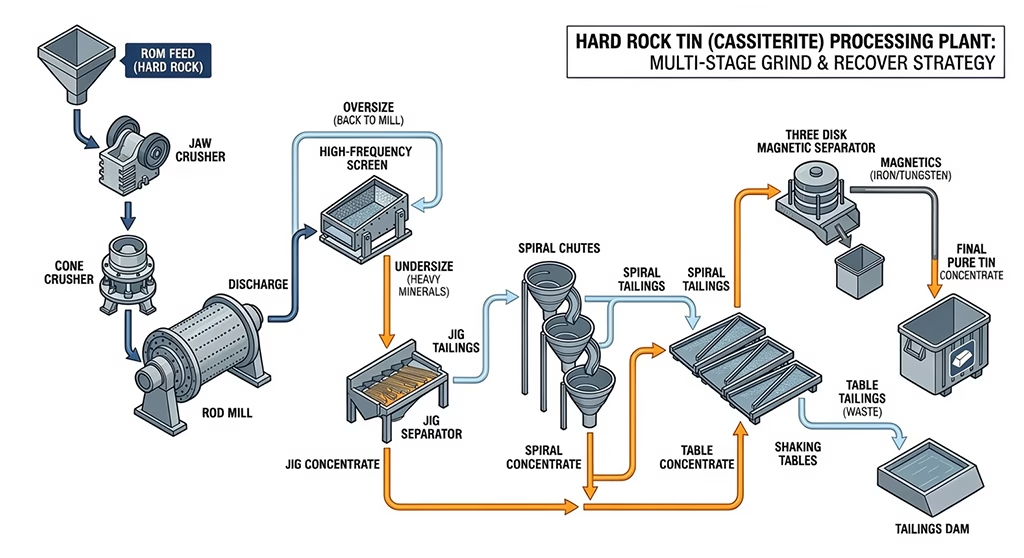
Comparison of Typical Processes for Different Tin Ores
| Tin Ore Type | Key Beneficiation Challenges | Typical Process Flow | Common Equipment |
| Alluvial/Placer Tin Ore | Varying degrees of particle dispersion; fine-grained cassiterite is prone to loss | Washing → Screening → Classification → Coarse-grain gravity separation → Fine-grain gravity separation → Final cleaning | Washing machines, vibrating screens, jigs, shaking tables, spiral chutes |
| Primary (Lode) Tin Ore / Hard-Rock Tin Ore | Cassiterite is intergrown with gangue minerals, requiring thorough liberation | Crushing → Screening → Stage grinding → Classification → Gravity separation → Regrinding of middlings → Final cleaning | Jaw crushers, cone crushers, ball mills, classification equipment, jigs, shaking tables |
| Fine-Grained Tin Ore | Fine cassiterite is difficult to recover and tends to end up in tailings or fine slimes | Classification → Fine-grain gravity separation → Enhanced gravity separation or flotation (if necessary) → Final cleaning | Hydrocyclones, fine-grain shaking tables, centrifugal gravity separators, flotation machines |
| Tin-Polymetallic Sulfide Ore | Cassiterite coexists with sulfides and other valuable minerals | Crushing → Grinding → Flotation of sulfides → Gravity separation of tailings or specific middlings to recover cassiterite → Final cleaning | Ball mills, flotation machines, thickeners, jigs, shaking tables |
| Complex Tin-Bearing Ores | Complex mineral composition; significant variations in cassiterite grain size and mode of occurrence (dissemination) | Crushing → Stage grinding → Classification → Combination of gravity separation and flotation → Processing of middlings → Final cleaning | Grinding and classification equipment, gravity separation equipment, flotation machines, and dewatering equipment |
The above represents common approaches to process design rather than a fixed, standard procedure. The specific process should be determined based on the analysis of ore samples and mineral processing tests.
How should tin ore processing equipment be selected and matched?
Equipment selection should be determined by the characteristics of the ore and the target particle size range; one should not select equipment first and then attempt to derive the process flow from it.
| Equipment Name | Primary Function | Materials Best Suited for Detailed Evaluation | Key Selection Criteria |
| Jaw Crusher | Primary crushing | Hard-rock tin ore (run-of-mine) | Feed particle size, reduction ratio, throughput capacity |
| Cone Crusher (or other fine-crushing equipment) | Secondary/tertiary crushing | Hard-rock ore requiring multi-stage crushing | Product particle size, circulating load, over-grinding (fines generation) |
| Ball Mill | Grinding and mineral liberation | Hard-rock tin ore requiring further liberation | Grind fineness (particle size distribution), energy consumption, generation of fine slimes |
| Screening Machine | Classification by particle size | Alluvial tin ore and crushing/screening circuits | Aperture size, screening efficiency, potential for screen blinding |
| Hydrocyclone | Classification of mineral slurries | Grinding-classification circuits | Cut size (separation size), classification efficiency, misplacement (misclassified particles) |
| Jig | Gravity-based pre-concentration | Liberated, relatively coarse particles of appropriate size | Particle size distribution, feed rate, bed stability |
| Shaking Table | Gravity separation and final cleaning/upgrading | Fine-grained sands or heavy minerals of suitable size | Feed pulp density, water flow rate, deck operating parameters |
| Spiral Chute | Gravity-based pre-concentration | Particles falling within the specific separation size range | Particle size distribution, slurry conditions, throughput capacity |
| Centrifugal Gravity Concentrator | Enhanced gravity separation for fine particles | Fine-grained materials proven effective for recovery via testing | Fine-particle recovery rate, slurry density, operating parameters |
| Flotation Machine | Separation based on surface properties | Fine-grained or complex minerals proven suitable for flotation via testing | Reagent regime, pH, particle size, and selectivity |
| Magnetic Separator | Removal of impurities or separation of minerals | Materials containing specific magnetic associated minerals | Magnetic susceptibility differences, magnetic field strength, separation particle size |
Three Principles for Equipment Matching
Principle 1: Determine liberation requirements before selecting grinding equipment. Since the dissemination size of cassiterite varies by ore type, a uniform grinding fineness should not be prescribed.
Principle 2: Classify the material before matching it with gravity separation equipment. For materials with a wide range of particle sizes, consider processing them by size fraction to prevent interference between coarse and fine particles.
Principle 3: Use tailings analysis to decide whether to add more equipment. If losses are primarily due to fine-grained cassiterite, simply adding a conventional jig may not be effective; instead, first investigate the particle size distribution of the tin, its state of liberation, and the specific causes of the losses.
Common Misconceptions in Tin Ore Processing
Misconception 1: Assuming that higher head grade (ore grade) makes mineral processing easier.
Head grade is merely one indicator. Even if the head grade is high, complex grinding and separation processes may still be required if the cassiterite is intimately intergrown with the gangue minerals.
Correct Approach: Analyze the head grade, mineral composition, grain size distribution (dissemination characteristics), and degree of liberation simultaneously.
Misconception 2: Applying the same gravity separation process to all types of tin ore.
Alluvial tin ores, primary (lode) tin ores, and complex polymetallic tin ores can differ significantly in terms of mineral composition and liberation characteristics.
Correct Approach: Determine the necessity of gravity separation, flotation, and auxiliary separation stages based on ore sample analysis and beneficiation testing.
Misconception 3: Believing that finer grinding always leads to higher tin recovery.
Over-grinding can increase the generation of fine slimes, making it more difficult for conventional gravity separation methods to effectively recover fine-grained cassiterite.
Correct Approach: Establish grinding targets based on liberation tests, while monitoring the distribution of tin across different particle size fractions and losses in the fine slimes.
Misconception 4: Focusing solely on concentrate grade while ignoring losses in the tailings.
A high concentrate grade does not necessarily equate to a high overall tin recovery.
Correct Approach: Monitor tin grades in the feed, concentrate, middlings, and tailings to establish a complete material balance.
Misconception 5: Selecting equipment models without conducting prior testing.
The performance of the same type of equipment can vary significantly depending on the specific ore type, particle size distribution, and operating conditions.
Correct Approach: Complete ore sample analysis and necessary beneficiation tests before determining equipment specifications, processing capacity, and process configuration.
FAQ
Q: What are the main types of tin deposits?
A: In terms of deposit types, common forms include alluvial (placer) tin deposits, primary tin deposits, and complex polymetallic tin deposits. Regarding the tin-bearing minerals themselves, they include cassiterite as well as certain tin-bearing sulfides. Different types of ore require distinct mineral processing strategies.
Q: What are the common mineral processing methods for tin ore?
A: Common methods include gravity separation, flotation, magnetic separation, and screening/classification. Since cassiterite has a high density, gravity separation is a key method. For fine-grained cassiterite and complex polymetallic ores, flotation and other auxiliary processes may be evaluated through testing.
Q: How do the processing workflows for alluvial tin deposits and primary tin deposits differ?
A: Processing alluvial tin deposits typically focuses on screening, washing, desliming, and gravity separation. For primary tin deposits, the process generally involves crushing, grinding, classification, and staged separation. The specific workflow depends on the liberation state of the cassiterite and its particle size distribution.
Q: How can the recovery rate in tin processing be improved?
A: First, identify the stage where tin loss occurs. Then, based on the degree of mineral liberation, particle size distribution, and the tin grade of each product, optimize processes such as grinding and classification, size-fractionated separation, middlings recycling, and the recovery of fine particles. Simply increasing grinding time or adding more equipment is not an effective way to improve recovery rates.
Q: How should equipment for tin processing be selected?
A: Equipment selection should be based on the characteristics of the ore and the target particle size. Typically, mineralogical analysis and beneficiation testing must be conducted first to determine the appropriate configuration of crushers, grinding equipment, classifiers, gravity separation units, and any necessary flotation or magnetic separation equipment.
Conclusion
When it comes to tin ore processing, you shouldn’t simply copy the equipment used by others; the key is to understand the specific characteristics of your own ore.
By thoroughly analyzing your ore first, you can then determine the right process and select the appropriate equipment—helping you avoid unnecessary pitfalls. Choosing the wrong processing route will not only hinder your tin recovery rate but also lead to avoidable increases in both capital investment and production costs.
Which processing method is best suited for your tin ore? Feel free to contact us and provide details regarding your ore samples and required processing capacity. We will help you analyze the characteristics of your ore and explore the most suitable processing flow and equipment configuration.
Latest News

How is a 0.2% tin ore processed into a 60% concentrate?
800Many clients attempt to process ore containing 0.2% tin, only to find that—after a series of operations—the ore grade has failed to improve, while significant amounts of cassiterite remain in the tailings. Some clients try to compensate by inte…
-
What are the gravity separation process flows for tin ore?
800Having worked in the tin mining industry for many years, I’ve observed a recurring issue among clients: even when the raw ore has a high tin content and a substantial amount of processing equipment is employed, the final tin recovery rates rema…
-
Gravity Concentration vs. Flotation for Gold: Which Process Should You Choose?
800In gold beneficiation projects, many mining engineers face a critical question: Why does the final gold recovery rate consistently fall short of expectations, even when grinding fineness and reagent regimes are strictly maintained according t…
-
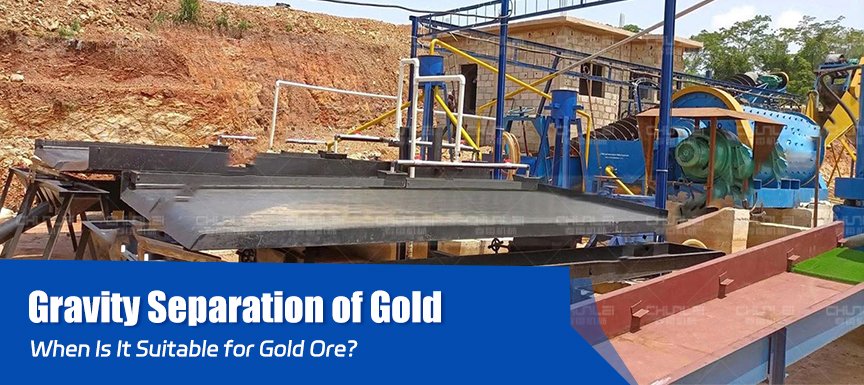
Gravity Separation for Gold: When Is It Suitable for Gold Ore?
800Many people immediately associate “gold ore” with gravity separation, yet not all gold deposits are suitable for recovery using gravity methods alone. Gravity separation is appropriate for liberated native gold or other heavy minerals that ex…
loading…
已经是到最后一篇内容了!