 Chunlei Mining Machinery

Jigging Separator
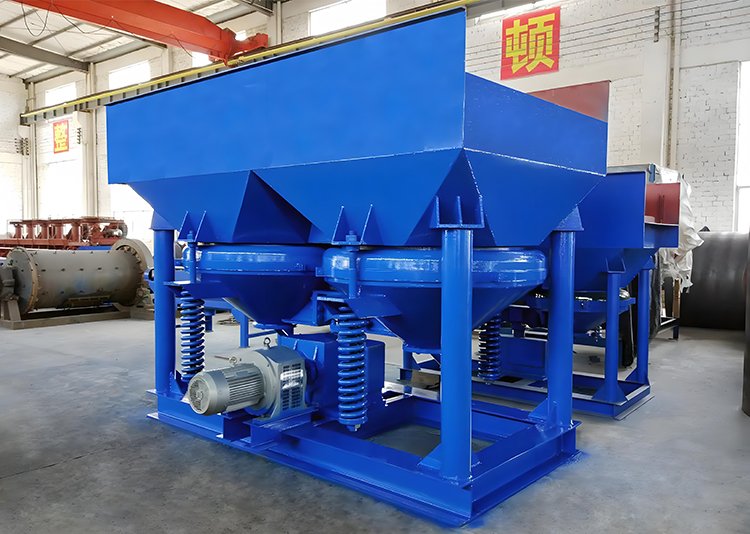
Jigging separator is a heavy separation equipment that utilizes the different settling speeds of minerals in the vertical alternating water flow to achieve the separation of light and heavy minerals.
- Ore feeding size :<25mm
- Power:1.5-8kW
- Processing Capacity:1~25t/h
What is Jigging Separator?
Jigging Separator is also called gold mineral jig, mineral jig machine. The jigger uses water as the mineral medium, and can separate the ore from the vein stone according to the weight ratio. Diaphragm, stroke and stroke frequency can be adjusted flexibly for gravity treatment of tungsten, hematite, tin, gold, magnetite, manganese and lead.
In actual production, jigs are typically used in conjunction with crushers, ball mills, spiral classifiers, spiral chutes, shaking tables, and thickeners to form a complete gravity separation process, improving mineral recovery rates and resource utilization efficiency.
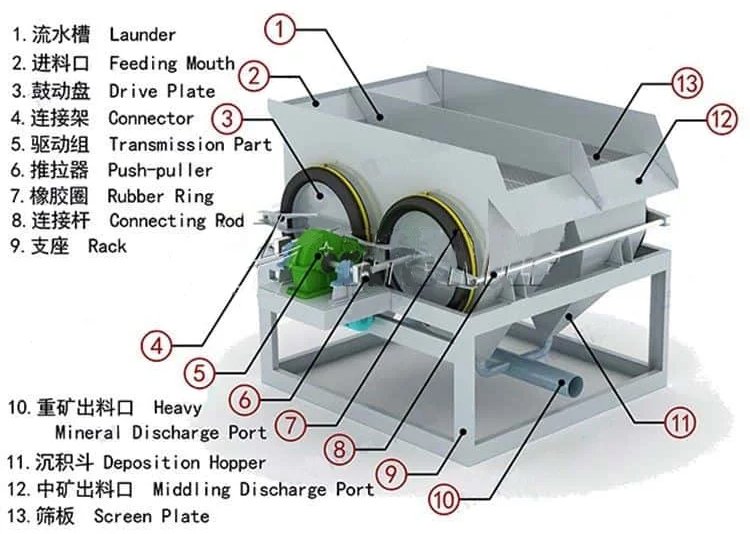
Structure of a Jig:
The design of a jig is not complex. It mainly consists of a body, screen plates, jigging chamber, transmission system, feeding device, and discharging device. These components work together to complete mineral separation.
- The jigging chamber is the core area of the equipment, where pulsating water flow separates mineral particles according to density.
- The transmission system controls the frequency and amplitude of the water flow pulsation; its stability determines the separation effect.
- The screen plates and feeding device determine the distribution of the slurry after entering the equipment. A well-designed system can reduce mineral loss and improve the recovery rate of valuable minerals.
Working Principle of Jigging Separator
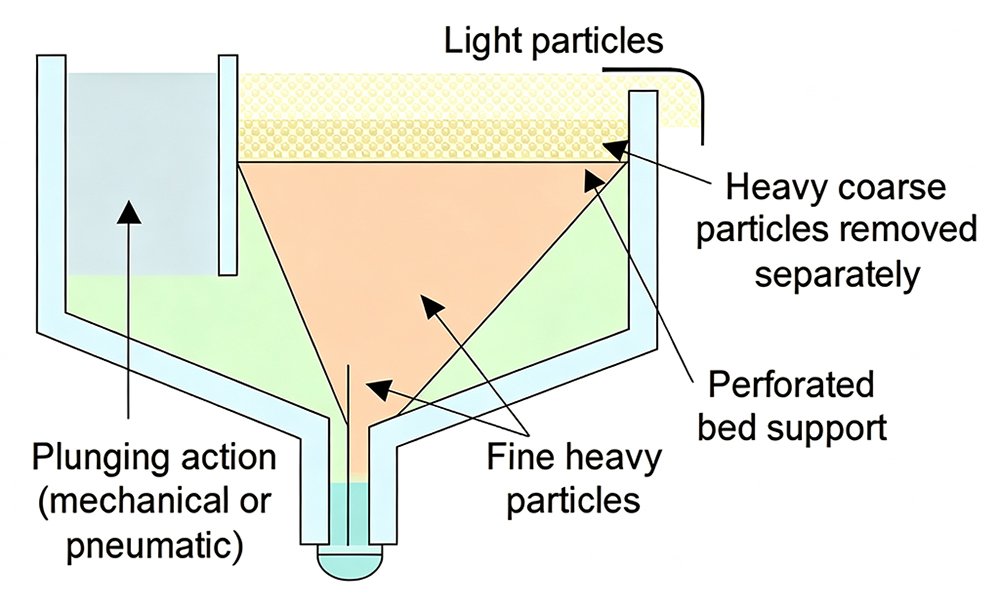
A jig is a gravity separation device that uses the density difference of minerals for separation. It primarily uses alternating upward and downward water flow to naturally stratify minerals of different densities within the tank, thus separating valuable minerals from waste rock.
The complete separation process consists of four steps:
- Uniform feeding: The crushed/grinded slurry is uniformly fed into the jig and spread evenly on a wear-resistant screen bed;
- Rapid upward water flow: The water inside the equipment continuously pulsates up and down, separating light and heavy minerals;
- Slow downward water flow: Heavier mineral particles sink quickly and accumulate at the bottom, while lighter gangue is discharged with the water flow;
- Layered discharge: After continuous separation, high-density minerals are discharged from the concentrate outlet, while lighter minerals enter the tailings, achieving effective recovery.
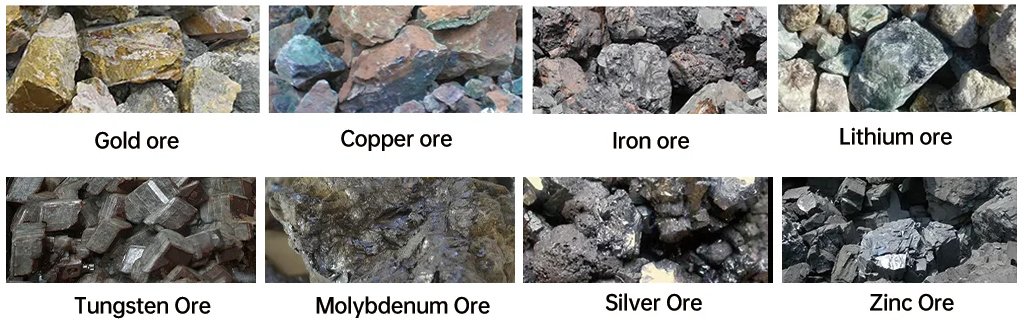
Jigs are particularly suitable for processing coarse-grained gold ore, placer gold ore, tin ore, tungsten ore, manganese ore, and other heavy minerals. Compared with other gravity separation equipment, it has advantages such as large processing capacity, low energy consumption and simple operation, and is often used in the roughing and pre-enrichment stages of gravity separation processes.
Why are jigs used in mineral processing?
A jig is a commonly used gravity separation device, often used in the roughing stage, to achieve natural stratification of valuable minerals and waste rock. Its biggest advantages are that it does not require complex reagents, has low operating costs, and high processing capacity. For ores containing coarse-grained heavy minerals, such as gold, tin, tungsten, and manganese ores, jigs can reduce production costs and improve recovery rates.
CHUNLEI can provide suitable jig configuration solutions based on different ore properties and production needs, helping customers achieve higher recovery rates, lower operating costs, and more stable beneficiation results.
What types of jigs are there?
Although different types of jigs operate on the same principle, they differ in how they generate pulsating water flow, resulting in different types.
Diaphragm Jig
Diaphragm jigs use the reciprocating motion of a rubber diaphragm to generate periodic water flow pulsations, causing light and heavy minerals to rapidly separate into layers within the tank. They are widely used in the separation of heavy minerals such as gold, tin, tungsten, and manganese ores.
Sawtooth Wave Jig
Sawtooth wave jigs use a special waveform of pulsating water flow, which reduces water flow disturbance and improves the separation effect of fine-grained minerals. They are commonly used for the recovery of fine-grained gold, tin, and other valuable heavy minerals.
Pneumatic Jig
Pneumatic jigs control water flow movement with compressed air and utilize an automated system to precisely adjust the pulsation frequency and amplitude. They are commonly used in industrial mineral processing scenarios where high separation accuracy is required.
Piston Jig
Piston jigs are a traditional type of jig that uses the motion of a mechanical piston to generate water flow pulsations. It is only used in the processing of certain specific minerals and coarse-grained materials.
What particle size ores are suitable for jigs to process?
Generally, jigs are best suited for ores ranging from 0.5 to 30 mm in size, with particularly good separation results for coarse-grained minerals of 1 to 10 mm. For example, placer gold, tin ore, tungsten ore, chromium ore, and manganese ore can all be pre-selected and enriched using jigs.
If your ore contains a large amount of fine mud or ultrafine particles, it is recommended to deslim, classify, or grind it first using a shaking table or spiral sluice before feeding it into the jig. This will result in a higher separation efficiency.
What factors affect the performance of a jig?
Many customers find that the same model of jig produces different separation results in different mines. In fact, the performance of a jig depends not only on the equipment itself but also on the ore properties, operating parameters, and production conditions.
First, ore properties are a crucial factor affecting jigging efficiency. The greater the density difference between minerals and gangue, the better the separation effect; ore particle size, mud content, and degree of liberation also directly affect the recovery rate.
Second, feed particle size and feed concentration need to be properly controlled. Particles that are too large or too fine will reduce separation efficiency; uneven feeding can also easily lead to concentrate loss.
Furthermore, operating parameters such as water flow velocity, stroke, number of strokes, and screen condition also affect the stratification effect of the jig. Proper parameter adjustment allows the equipment to perform at its best.
In short, to achieve good mineral processing results with a jig, in addition to selecting the appropriate equipment model, it is also necessary to optimize process parameters according to the characteristics of the ore.
How to Choose the Right Jig for Your Project?
Many of my clients, when choosing a jig, easily focus only on price or equipment size, ultimately leading to a mismatch between output and equipment. Choosing the right model is crucial to ensuring higher recovery rates and lower operating costs.
When selecting a jig, I recommend considering the following aspects:
- First, consider the ore type: Different minerals have different density differences, particle sizes, and dispersal patterns. For example, placer gold, tin, tungsten, and manganese ores require different jig configurations.
- Second, consider processing capacity: Select equipment of appropriate specifications based on daily or hourly output requirements. Avoid equipment that is too small, resulting in insufficient capacity, or equipment that is too large, leading to wasted investment.
- Pay attention to ore particle size: Jigs are more suitable for processing medium to coarse-grained heavy minerals. If the ore particle size is fine, it may be necessary to combine it with equipment such as spiral sluices or shaking tables to improve the separation effect.
- Integrate with the production process: If it is a complete concentrator construction, it is also necessary to integrate crushing, grinding, classification, and dewatering equipment into the overall design, rather than choosing a single jig.


What maintenance is required for a jig?
When processing ore over a long period, jigs experience wear and tear due to slurry erosion and continuous vibration. Proper daily maintenance not only ensures efficient sorting but also extends the equipment’s lifespan. During daily use, focus on checking the following aspects:
- Regularly check the screen plates: Screen plates are crucial components of the jig. Long-term impact from ore can cause wear or blockage, requiring timely cleaning or replacement.
- Uniform feeding: Regularly check the feeding system to maintain a uniform and stable feed, avoiding excessively high or low slurry concentration.
- Check the transmission system: Regularly check the operation of components such as the motor, reducer, and connecting rods, and replenish lubricating oil as needed.
- Clean internal debris: After shutdown, promptly clean any deposited sand from the tank to prevent it from affecting water flow and sorting efficiency.
- Check the water flow system: Keep the water inlet pipe unobstructed and ensure a stable pulsating water flow; this is crucial for the jig’s normal operation.
Jigging Machine Prices
The price of a jigging machine is not fixed. When choosing a jigging machine, avoid comparing only prices; focus on its separation effect and stability.
Small jigging machines have low investment costs and are suitable for small-scale production and experimental projects; large jigging machines have a large processing capacity, and the price will increase accordingly. If your project requires a complete gravity separation production line, you also need to consider the investment costs of crushing, screening, feeding, and dewatering equipment.
If you are unsure whether the equipment you choose is suitable for your project, you can contact CHUNLEI engineers. We will recommend suitable models based on your needs and provide the most professional gravity separation solution free of charge.
Technical Parameters of Jigging Separator
| Model | Jigging Chamber | Diaphragm | Feed size (mm) | Under-screen recharge(m3/t) | Charge water pressure (MPa) | Capacity (t/h) | Motor power (kW) | Overall size(mm) | Weight (kg) | ||
|---|---|---|---|---|---|---|---|---|---|---|---|
| Geometry | Area (m2) | Stroke (mm) | Strokes (n/min) | ||||||||
| JT-0.57 | 梯形 | 0.57 | 8.5~12 | 80~180 | <6 | 1~2 | > 0.05 | 1.5~3 | 1.5 | 1550X780X1530 | 610 |
| JT1-1 | 梯形 | 1.04 | 10~17 | <10 | 2~3 | 2.5~5 | 2.2 | 2270X1110X1890 | 900 | ||
| JT2-2 | 矩形 | 2.28 | 12~21 | <10 | 2~4 | 5~10 | 3 | 3225X1550X2050 | 1640 | ||
| JT3-1 | 梯形 | 3 | 12~30 | 50~125 | <10 | 3~6 | > 0.05 | 7.5~15 | 5.5 | 2745X2000X3030 | 3085 |
| JT4-2(1) | 矩形 | 4 | 25~57 | <25 | 4~8 | 8~20 | 7.5 | 4240X1990X2750 | 3098 | ||
| JT4-2A⑵ | 矩形 | 4 | 25~57 | <25 | 4~8 | 8~20 | 4X2 | 4240X1990X2750 | 3500 | ||
| JT5-2 | 梯形 | 4.86 | 12~30 | <10 | 3~6 | 12~25 | 7.5 | 3600X2000X2600 | 4500 | ||
Jigging Separator Machine FAQ
Q: Can jigging separator improve ore recovery rates?
A: Yes. Jigs separate minerals based on density differences, enabling the early recovery of coarse heavy minerals, reducing the pressure on subsequent grinding and beneficiation processes, and improving the overall recovery rate of valuable minerals.
Q: Are jigging separator suitable for large-scale beneficiation plants?
A: Yes. Jigs are characterized by large processing capacity and stable continuous operation, making them suitable for medium to large-scale gold, tin, tungsten, and other heavy mineral beneficiation production lines.
Q: Can jigging separator process ores with high mud content?
A: High mud content can affect mineral stratification. For high-mud ores, it is generally recommended to wash or deslim them before entering the jig for better separation results.
Q: Can jigging separator replace flotation equipment?
A: Jigs and flotation machines operate on different principles and are primarily used for heavy mineral recovery. For minerals with significant density differences, jigs can be effective gravity separation equipment; for minerals requiring chemical separation, flotation is usually still necessary.
Q: What is the water consumption of a jigging separator?
A: Water consumption varies depending on the jig size and the materials being processed. However, most modern jig systems are designed to recycle most of the process water, significantly reducing the need for fresh water.
Q: Can a jigging separator separate extremely fine particles?
A: Conventional jigs are best suited for separating particles from 50 mm to approximately 1 mm. For separating extremely fine particles (less than 1 mm), dedicated fine-particle shaking tables or other gravity separation methods (such as spiral thickeners) may be more efficient.
Q: What is the recovery rate of a shaking table separator?
A: Recovery rate depends heavily on the ore type and particle characteristics. For ores with good liberation and high density contrast, a properly calibrated shaking table separator can achieve recovery rates exceeding 90%.
Q: How long does a jigging separator need to run per day?
A: Jigs can operate continuously as needed. Actual operating time depends on mine output, equipment configuration, and maintenance schedule. Proper operation and regular maintenance can ensure long-term stable production.
Q: Why does the feed particle size of ajigging separator need to be controlled?
A: A suitable feed particle size helps minerals to fully separate, improving separation efficiency. If the particles are too coarse or too fine, it will affect the water flow and separation effect; therefore, it needs to be adjusted according to the ore properties.
Q: Can a jigging separator recover valuable minerals from tailings?
A: Yes. Jigs are commonly used for tailings reprocessing. By reseparating heavy minerals from tailings, residual valuable resources such as gold, tin, and tungsten can be recovered, improving resource utilization.
Q: What conditions are required for jigging separator installation?
A: Installing a jig requires a stable foundation, water source, power supply, and a reasonable feeding and discharging system. Large-scale projects usually require equipment layout design integrated with the overall mineral processing flow.
Q: How often do the jigging separator screen plates need to be replaced?
A: Screen plates are major wear parts. The replacement cycle depends on the ore hardness, abrasiveness, and operating time. Regularly checking the wear of the screen plates and replacing them promptly can avoid affecting the separation effect.
Q: What parameters are needed before purchasing a jigging separator?
A: We recommend providing the ore type, processing capacity (t/h), feed particle size, mineral density, target product requirements, and site conditions. Based on this information, the manufacturer can recommend a suitable model and design a reasonable process solution.
Related Products —
High Gradient Magnetic Separator
A variety of models are available | Get the free price list! The High Gradient Magnetic Separator (HGMS) is a new type of strong magnetic separator developed on the basis of general strong magnetic separa…
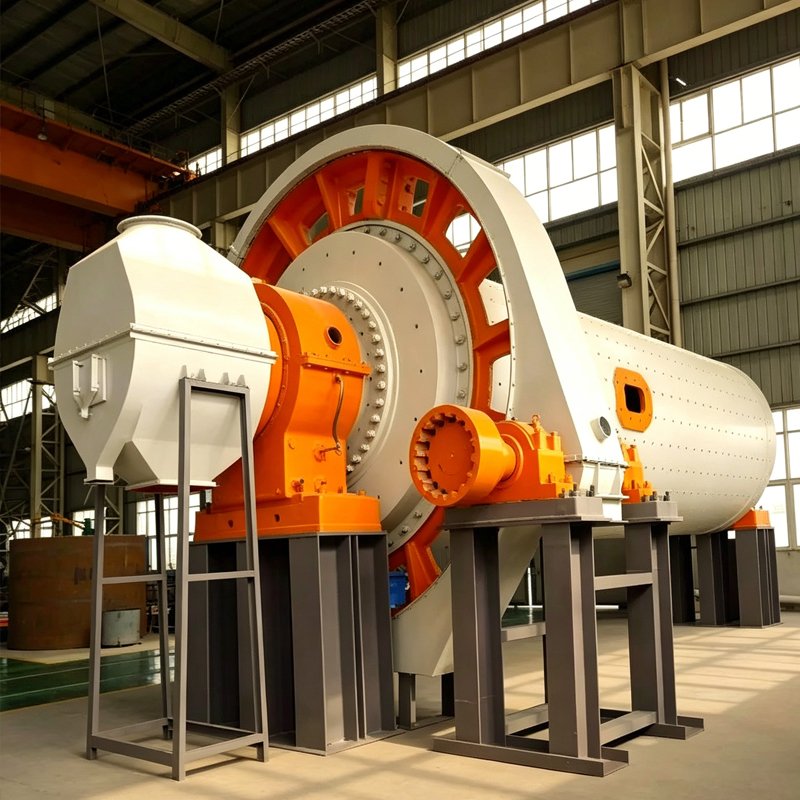
Ball Mill in Cement Industry
Ball Mill in Cement Industry offer capacities ranging from 10 to 500 tons per hour, capable of grinding raw materials—such as cement clinker, slag, gypsum, and limestone—into finished cement products that meet specific fineness requirements. T…
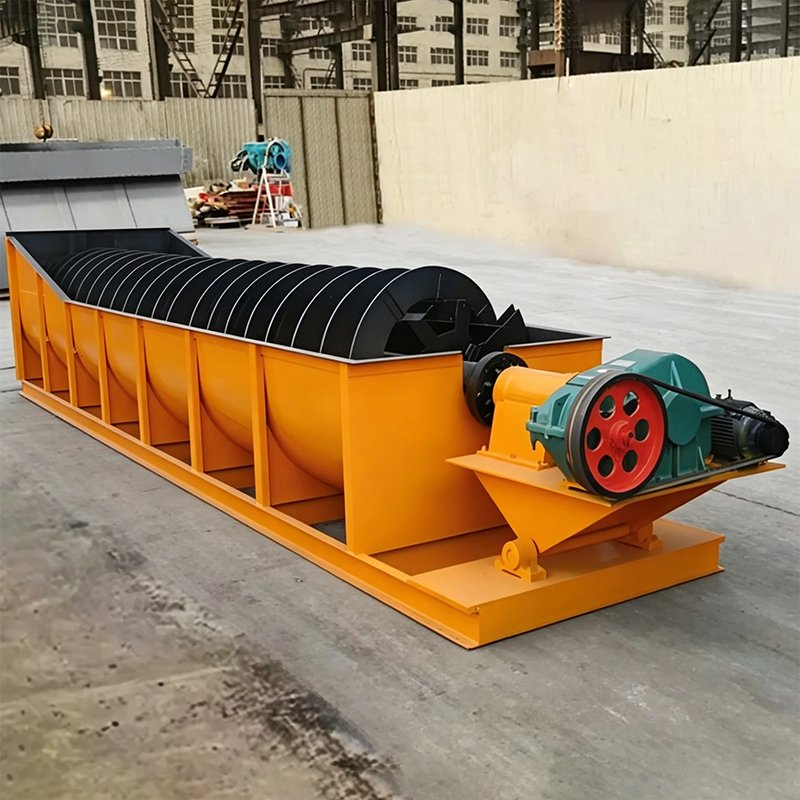
Submerged Spiral Classifier
Spiral classifier is a classifier with the spiral at the overflow end fully submerged under the liquid surface, commonly used in two-stage classification. In production lines such as mining, sand processing, and t…
Dewatering Screen
A variety of models are available | Get the free price list! A dewatering screen is a vibrating device that uses high-frequency vibration and an inclined screen surface to achieve solid-liquid separation of mineral…
Hydrocyclone
Hydrocyclone adopts involute feeding mode, this involute feeding mouth is conducive to increase the centrifugal force of the material, improve the classification effect, and greatly reduce the wear and tear of the feed box. The working…

loading…
已经是到最后一篇内容了!