 Chunlei Mining Machinery

Why are alluvial tin deposits the easiest type of tin deposit to process?
For grinding operators or gravity separation technicians, the greatest concern is not low ore grade, but rather fine mineral dissemination. In the case of primary (hard-rock) tin deposits, if the chosen beneficiation process is unsuitable, recovery rates often stagnate at 50%–60%. In contrast, alluvial (placer) tin deposits consist of cassiterite that is already naturally liberated. These deposits require neither crushing nor grinding; simple gravity separation can achieve total recovery rates of 60%–85%, with energy consumption representing only a small fraction of that required for hard-rock processing. This article provides a detailed analysis of why alluvial tin deposits are the easiest type of tin ore to process.
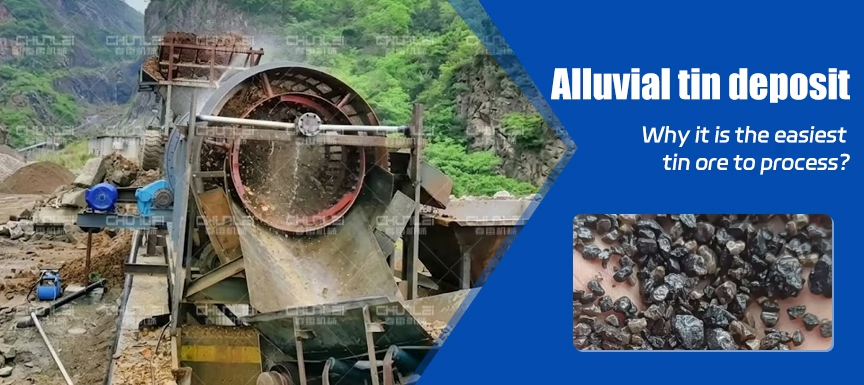
Why are alluvial tin deposits the most ideal type of tin ore for processing?
Alluvial tin deposits are essentially the “dream” feed for any processing plant. In lode (vein) tin deposits, cassiterite is locked within granite-hosted veins, requiring the rock to be crushed and ground to liberate the mineral. In contrast, the cassiterite in alluvial deposits has already been liberated and concentrated through eons of weathering, fluvial transport, and natural hydraulic sorting. You aren’t “extracting tin from rock”—you are simply sifting heavy cassiterite grains out of the sand.
1. Particle size naturally suited for gravity separation
The cassiterite particles in alluvial deposits typically range from 0.1 to 5 mm—the optimal size range for equipment like jigs, spiral concentrators, and shaking tables. No crushing or grinding is required.
2. Density differential allows for processing without chemical reagents
Cassiterite (SnO₂) has a specific gravity of 6.8–7.1 g/cm³, while quartz gangue is only about 2.65. This significant density difference is perfect for gravity separation, allowing tin to be recovered without the need for chemical reagents or flotation, while also minimizing environmental impact. This property makes the entire process both simple and cost-effective.
3. Minerals are already liberated before the plant is even built
In alluvial deposits, the valuable minerals are already liberated (typically with a liberation size greater than 100 mesh). A well-designed alluvial processing circuit generally requires no crushing or grinding—only washing, screening, and concentration. This single factor does more to reduce capital expenditure, energy consumption, and operating costs than any other variable.
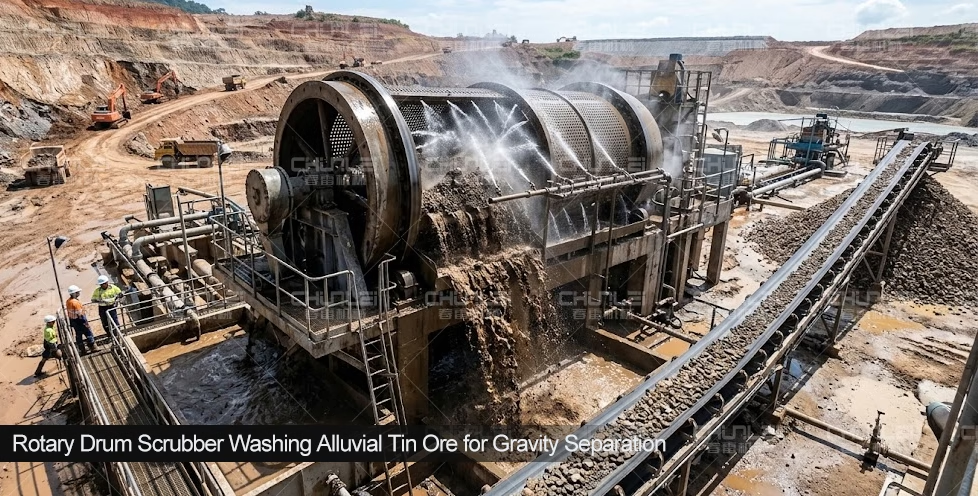
Overview of the Beneficiation Process for Alluvial Tin Ores
Due to the significant density difference between cassiterite (tin ore) and gangue minerals like quartz, the processing of alluvial tin ores relies primarily on gravity separation.
Step 1: Washing and Desliming—A Crucial Prerequisite
Alluvial tin ores often contain substantial amounts of sticky clay. If this is not thoroughly removed, it prevents proper stratification during the gravity separation process.
The raw ore is fed into a drum or trough-type ore washer, where it undergoes disintegration and preliminary screening. The washed product is typically split into two size fractions: material larger than 8 mm (+8 mm) proceeds to fine crushing (to handle coarse waste rock or cemented aggregates), while material smaller than 8 mm (-8 mm) moves on to further screening or directly to the roughing stage.
Desliming is carried out using a spiral classifier or a hydrocyclone; the resulting fine slimes are either processed separately or sent to the tailings stream.
Step 2: Screening and Classification—Categorizing Cassiterite by Particle Size
The purpose of screening is not to isolate the cassiterite itself, but to distribute the material—based on particle size—to the appropriate gravity separation equipment.
Cassiterite in alluvial deposits typically spans a range of particle sizes. Coarse particles (+2 mm) are best suited for treatment via jigs or coarse-material sluices; medium particles (0.5–2 mm) are processed using jigs or shaking tables; and fine particles (-0.5 mm) require the use of shaking tables or centrifugal concentrators.
If these sizes are fed into the separation equipment without prior classification, coarse particles may clog the screen plates, while fine particles may be lost to the tailings—resulting in losses at both ends of the size spectrum.
Step 3: Gravity Roughing—Capturing Coarse Particles via Jigs and Sluices
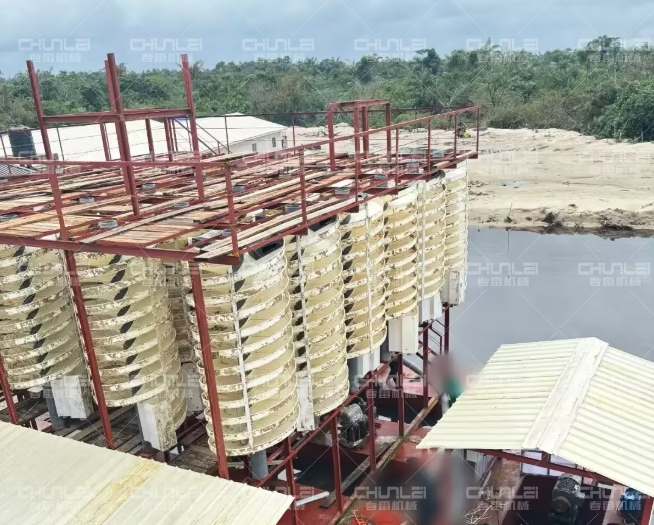
The objective of the roughing stage is to rapidly discard a large volume of low-density gangue (tailings), thereby reducing processing costs. For material smaller than 8 mm (or material that has been classified into narrow size ranges), spiral sluices or jigs are the preferred equipment.
As the ore slurry flows through a spiral sluice, the high-density cassiterite settles to the bottom and is captured, while the low-density gangue is carried away by the water flow. A jig is suitable for processing feed material with a coarser particle size and significant fluctuations in grade.
The primary purpose of this step is to remove the bulk of the coarse-grained cassiterite at the lowest possible cost, thereby easing the load on the subsequent fine-processing (refining) stage.
Step 4: Shaking Table Concentration—Final Separation of Fine-Grained Cassiterite
The rough concentrate proceeds to the shaking table concentration stage. Shaking tables are highly effective and consistent for recovering cassiterite in the -0.5 mm size fraction. After being pulped, the feed is distributed evenly across the table surface. Under the combined influence of a lateral water flow and a longitudinal differential motion, the cassiterite particles align along the riffles and move toward the concentrate discharge end, while the gangue minerals are washed away by the lateral water flow toward the tailings side.
For alluvial tin deposits, the upper particle size limit for the shaking table feed is generally kept below 2 mm, with an optimal range of -0.5 mm. If the +2 mm fraction has already been removed during the roughing stage (e.g., via jigging), the load on the shaking table is significantly reduced, leading to higher separation efficiency.
What equipment is needed for an alluvial tin processing plant?
The equipment configuration for an alluvial tin processing plant follows a key principle: tasks are divided based on particle size, rather than relying on a single “all-in-one” machine. For a typical gravity-separation processing line with a daily capacity of 200–500 tonnes, the core equipment includes the following:
| Process Step | Recommended Equipment | Key Parameters/Function |
| Ore Washing | Trommel scrubber or log washer | Handles sticky clay; breaks up cemented aggregates |
| Desliming | Hydrocyclone (Φ125/Φ75) or conical classifier | Removes -0.074 mm fine slimes to prevent interference with gravity separation |
| Screening | Double-deck circular vibrating screen | Separates material into +2 mm, 0.5–2 mm, and -0.5 mm size fractions |
| Roughing (+2 mm) | Large-particle separator or jig | Processes 2–20 mm coarse cassiterite; increases recovery by 15%–25% |
| Roughing (0.5–2 mm) | Jig or reciprocating sluice | Rapidly rejects tailings; produces a rough concentrate |
| Cleaning (-0.5 mm) | Shaking table (6-S type or “Yunxi” type) | Fine-tuning the separation of fine-grained cassiterite; critical for increasing concentrate grade |
| Fine Slime Recovery | Centrifugal concentrator or suspended-vibration conical concentrator | Recovers -0.074 mm ultra-fine cassiterite particles |
It must be emphasized that equipment selection must be aligned with the particle size distribution of the feed. A common error is to purchase a jig with a high processing capacity while overlooking the fact that the -0.5 mm fraction in the raw ore is excessively large; this leads to significant losses of fine-grained cassiterite during the jigging process. The correct approach is to first conduct a sieve analysis to determine the distribution of tin across various size fractions, and only then decide on the appropriate equipment configuration.
Actual Recovery Rates and Case Studies
The following data can serve as a benchmark:
- Overall Recovery Rate: In a well-designed alluvial tin processing circuit, with a concentrate grade of 40–70% SnO₂, tin recovery can reach 60–85% (Industry reference: JXSC Mining, Complete Guide to Alluvial Tin Ore Mining & Beneficiation).
- Roughing Stage: A side-stroke jig can recover 84–91% of the tin content during the roughing stage while rejecting 60–72% of the feed mass, achieving an enrichment ratio of 4–7 times for a feed grade of 0.2–0.4% Sn (Source: Fangcheng Mining Equipment).
- Cleaning Stage Case Study: In 2026, a processing plant handling fine tin slimes (−2 mm, 0.3% Sn) improved its overall recovery from 68% to 78% simply by replacing a single, general-purpose shaking table with a dedicated roughing-and-cleaning shaking table configuration (Source: Hengchang 6-S case study).
- The Lesson of Slimes: Many 500 tpd (tonnes per day) tin processing plants that neglect desliming and the recovery of fine particles end up losing 20–40% of their fine tin into the slime fraction (Industry troubleshooting reference).
FAQ
Q: What grade of concentrate can typically be achieved through the gravity separation of alluvial tin ore?
A: A standard gravity separation circuit (using jigs and shaking tables) can upgrade alluvial tin ore—which may have an initial grade of only 0.1%–0.5%—into a commercial-grade tin concentrate with a tin content ranging from 5% to 70% through a few physical separation steps.
Q: Are chemical reagents required for processing alluvial tin ore?
A: In 95% of cases, no chemicals are needed at all. The processing of alluvial tin ore relies entirely on physical gravity separation based on density differences; this process is pollution-free, facilitates environmental permitting, and entails low operating costs.
Q: Can spiral chutes completely replace jigs in an alluvial tin processing plant?
A: While spiral chutes are highly effective for processing fine-grained material (0.074–1 mm), jigs offer distinct advantages when handling coarser particles (1–15 mm) or managing high throughputs. The most efficient approach—yielding the highest recovery rates—is a combined circuit: using jigs for roughing, followed by spiral chutes or shaking tables for cleaning.
Q: Why is alluvial tin ore considered the “easiest” type of tin ore to process?
A: Because the cassiterite (tin ore) in alluvial deposits has already been liberated by natural weathering, and there is a significant density difference between the cassiterite and the quartz gangue. Alluvial tin processing bypasses the crushing and grinding stages entirely; gravity separation alone can achieve recovery rates of 60%–85%. This is far simpler and more cost-effective than processing lode (hard-rock) tin ore, which typically requires fine grinding and often flotation.
Q: What recovery rates can be achieved in an alluvial tin processing plant?
A: A well-designed alluvial tin circuit can typically achieve an overall recovery rate of 60%–85%, producing a concentrate with a grade of 40%–70% SnO₂. The roughing stage (using jigs) alone can capture 84%–91% of the total tin content, with the remainder—particularly fine-grained cassiterite—recovered during the cleaning stage.
Q: What equipment is required for processing alluvial tin ore?
A: The standard process flow is: Trommel scrubber (washing + screening) → Desliming (hydrocyclone/hydraulic classifier) → Jig (coarse separation, +1 mm) → Spiral chute (1–0.1 mm) → 6-S shaking table (fine particles, −0.1 mm) → Magnetic separation (to remove ilmenite) → Drying.
Q: How do alluvial tin deposits compare to primary (lode) tin deposits?
A: Primary tin ore has a higher head grade (0.1–2% vs. 0.01–1%) but requires three-stage crushing, rod/ball milling, and complex flotation. Furthermore, 20–40% of the fine tin is lost in the slimes, resulting in lower and more volatile recovery rates. In contrast, alluvial tin deposits—despite their lower head grades—allow for a shorter, more cost-effective, gravity-only processing circuit, achieving stable recovery rates of 60–85%.
Q: What is the primary reason for low recovery rates in alluvial tin processing plants?
A: The loss of fine tin in the slimes—caused by inadequate desliming and the absence of a dedicated recovery stage for fine particles (−0.1 mm). It is common for plants to lose 20–40% of their tin content in this manner; improving desliming and adding a circuit for fine particles (using shaking tables or spirals) is the most effective remedial measure.
Conclusion
Alluvial tin deposits are considered the “easiest to process” because geological processes have already handled the fragmentation and liberation of the ore. You simply need to use gravity separation to segregate the cassiterite (tin ore) from the waste rock based on their density differences. However, “easy to process” does not mean the process can be handled carelessly. Neglecting steps such as thorough ore washing and desliming, precise screening and classification, or the recovery of fine-grained slimes can quickly negate the inherent advantages of an alluvial tin deposit.
If you are currently evaluating an alluvial tin project, please feel free to contact the engineers at CHUNLEI. We are ready to provide you with expert guidance and tailored solutions.
Latest News

A Comprehensive Guide to Types of Tin Ore and Mineral Processing Techniques
800Tin ore beneficiation is not merely a matter of crushing and grinding the ore before feeding it into a jig or a shaking table. Even within a single tin mining project, the optimal beneficiation process can vary significantly depending on factor…
-
How is a 0.2% tin ore processed into a 60% concentrate?
800Many clients attempt to process ore containing 0.2% tin, only to find that—after a series of operations—the ore grade has failed to improve, while significant amounts of cassiterite remain in the tailings. Some clients try to compensate by inte…
-
What are the gravity separation process flows for tin ore?
800Having worked in the tin mining industry for many years, I’ve observed a recurring issue among clients: even when the raw ore has a high tin content and a substantial amount of processing equipment is employed, the final tin recovery rates rema…
-
Gravity Concentration vs. Flotation for Gold: Which Process Should You Choose?
800In gold beneficiation projects, many mining engineers face a critical question: Why does the final gold recovery rate consistently fall short of expectations, even when grinding fineness and reagent regimes are strictly maintained according t…
loading…
已经是到最后一篇内容了!