 Chunlei Mining Machinery

What is the difference between sulfide tin ores and oxide tin ores?
Those involved in tin ore processing have likely encountered this scenario: the raw ore has a decent tin content, yet after crushing, grinding, and beneficiation, the concentrate grade remains low, while a significant amount of tin is lost to the tailings—resulting in avoidable losses.
This is particularly true when dealing with a mixture of sulfide and oxide tin ores, which requires extra caution. Because these two types of ore possess different properties, they cannot simply be processed using the same method. Generally, sulfide tin ores require sulfide flotation, whereas oxide tin ores—primarily composed of cassiterite—are typically better suited for gravity separation.
So, how should one process these types of tin ores? What equipment is required? And how should the process flow be designed to minimize tin loss and maximize recovery? In the following sections, we will provide a clear explanation covering ore characteristics, beneficiation principles, process flow design, and equipment configuration.
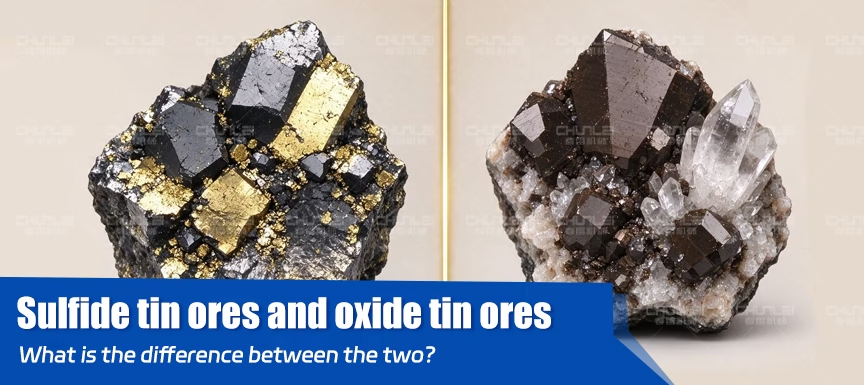
What is the difference between sulfide tin ores and oxide tin ores?
Before designing a beneficiation process for tin ore, it is essential to first determine the mode of occurrence of the tin within the raw ore. This is because the form in which tin exists directly influences the strategies for crushing, grinding, flotation, and gravity separation.
What are sulfide tin ores?
Sulfide tin ores are ores in which tin primarily occurs in the form of tin-bearing sulfides. Common tin-bearing minerals include:
- Stannite: Cu₂FeSnS₄
- Cylindrite: Pb₃Sn₄FeSb₂S₁₄
- Franckeite: A complex lead-tin-antimony sulfide
- Teallite: PbSnS₂
Such ores are frequently associated with other sulfides, including pyrite, chalcopyrite, sphalerite, and galena.
Key challenges in beneficiation:
- Tin-bearing sulfides may be intimately associated with other metal sulfides.
- Some tin minerals have a very fine grain size, requiring thorough liberation.
- Different sulfides often exhibit similar flotation characteristics, making their separation difficult.
- If the tin is primarily contained within tin-bearing sulfides, traditional gravity separation (typically used for cassiterite) cannot recover all of the tin.
Consequently, for sulfide tin ores, it is usually necessary to conduct a mineralogical analysis before determining whether to employ selective sulfide flotation, bulk (mixed) flotation, or other specialized separation processes.
What are oxidized tin ores?
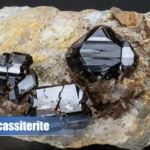
Oxidized tin ores primarily refer to ores in which tin occurs in the form of oxide minerals. The most industrially significant tin-bearing mineral among these is cassiterite, which has the chemical formula SnO₂.
Cassiterite has a high density—theoretically ranging from approximately 6.8 to 7.1 g/cm³—which is significantly higher than that of common gangue minerals such as quartz. Consequently, gravity separation is typically an effective method for processing these ores.
Key characteristics for mineral processing:
- Due to its high density, cassiterite is well-suited for enrichment via gravity separation.
- Coarse-grained and fully liberated cassiterite is generally easy to recover through gravity separation.
- Fine and ultra-fine cassiterite particles tend to be lost to the tailings or slime fractions.
- When cassiterite is intergrown with gangue minerals, proper grinding is required to achieve a higher degree of liberation.
- Some complex oxidized tin ores may require additional processing techniques, such as flotation, magnetic separation, or other auxiliary separation methods.
For oxidized tin ores where cassiterite is the primary mineral, typical processing workflows include crushing, screening, grinding, classification, gravity separation, and concentrate refining.
The main differences between sulfide tin ores and oxide tin ores:
| Comparison Item | Sulfide Tin Ores | Oxide Tin Ores |
| Primary Tin-Bearing Minerals | Stannite and other tin-bearing sulfides | Cassiterite (SnO₂) |
| Key Mineral Properties | Contain sulfur; often associated with metal sulfides | High-density oxide minerals |
| Common Associated Minerals | Pyrite, chalcopyrite, sphalerite, etc. | Quartz, feldspar, mica, and other gangue minerals |
| Primary Beneficiation Methods | Flotation and targeted comprehensive recovery | Gravity separation (primary), supplemented by flotation when necessary |
| Key Processes | Separation of sulfides; recovery of tin-bearing minerals | Liberation, size-based classification, and recovery of fine-grained cassiterite |
| Main Equipment | Ball mills, flotation machines, classification equipment, etc. | Crushers, jigs, shaking tables, spiral concentrators, etc. |
| Major Technical Challenges | Selective separation of various sulfides | Loss of fine-grained cassiterite and over-grinding |
It should be noted that actual ore deposits do not necessarily fall neatly into a single, specific type. Many primary tin deposits contain both cassiterite and tin-bearing sulfides, classifying them as complex, polymetallic, associated-mineral deposits. Consequently, the choice of a processing flowsheet cannot be determined solely based on the name of the ore.
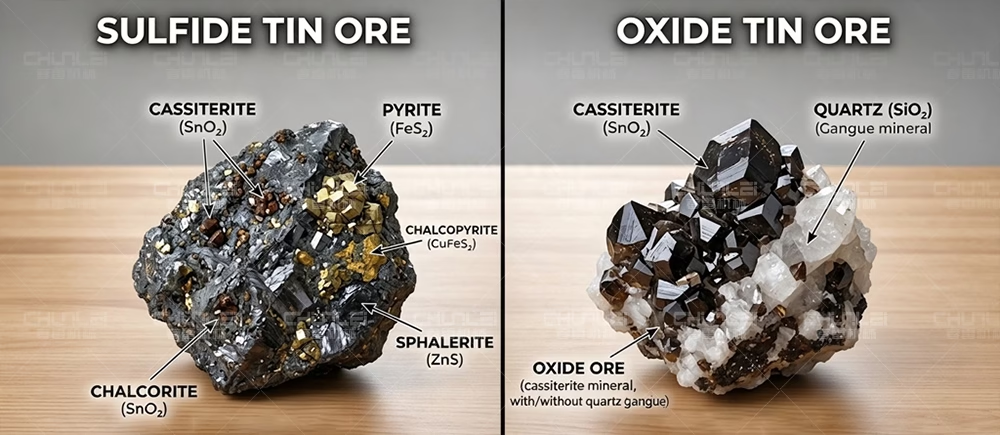
How to Process Tin Sulfide Ores? Common Beneficiation Flowsheets
The key to processing tin sulfide ores lies in first identifying the specific mineral(s) in which the tin is contained, and then determining a separation strategy based on the floatability, mineral association (intergrowth), and degree of liberation of the tin-bearing sulfides relative to other sulfides present.
It is important to note that not all tin sulfide ores are suitable for the same flotation flowsheet.
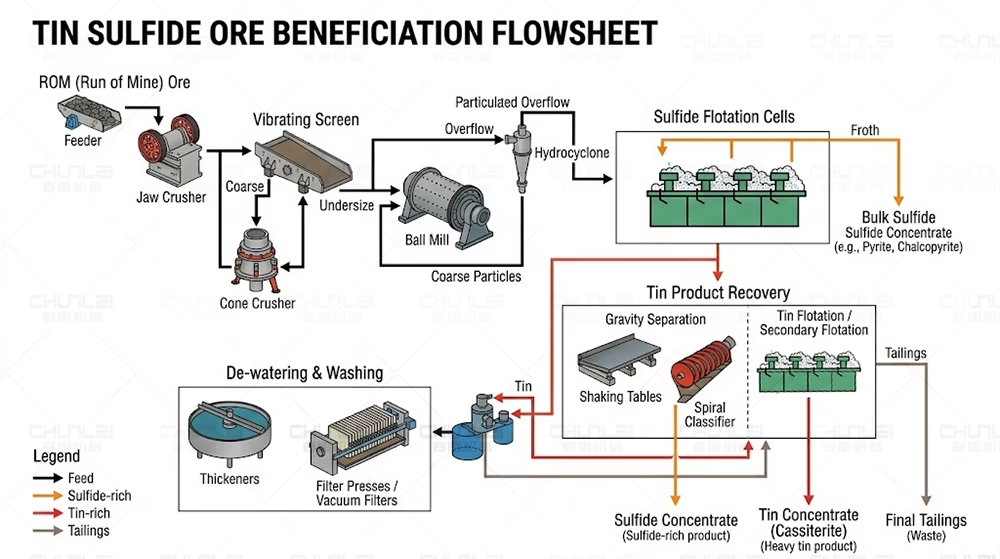
Step 1: Ore Crushing and Grinding
Tin sulfide ores typically exhibit complex mineral associations; therefore, crushing and grinding are essential to achieve sufficient liberation of the valuable minerals from the gangue.
Common equipment includes:
- Jaw Crusher: Used for primary crushing of run-of-mine ore.
- Cone Crusher: Used for secondary and tertiary (fine) crushing.
- Ball Mill: Used for further grinding.
- Spiral Classifier or Hydrocyclone: Used for particle size classification.
Particular attention must be paid to the fineness of the grind.
If the ore is under-ground, the tin-bearing minerals will not be sufficiently liberated from other sulfides. Conversely, if the ore is over-ground, an excessive amount of fine sludge (slimes) may be produced, which can impair flotation selectivity and hinder subsequent separation stages.
Consequently, optimal grinding conditions should be determined through particle size analysis of the ground product, mineral liberation studies, and flotation testing, rather than by simply applying a predetermined, fixed grinding fineness.
Step 2: Sulfide Flotation
Following the grinding and classification stages, the ore pulp enters the flotation circuit.
The primary objective of sulfide flotation is to separate target sulfides from gangue minerals or other sulfides, based on the distinct surface properties of the various minerals present.
Common flotation equipment includes:
- Mechanically agitated flotation machines
- Pneumatic (air-inflated) flotation machines
- Flotation conditioning tanks
- Reagent dosing and automated control systems
Depending on the mineral composition, one of two flotation strategies may be employed:
- Preferential (Selective) Flotation: When there is a significant difference in the selectivity of various sulfides, specific sulfides can be floated first, followed by the processing of the remaining pulp to recover tin-bearing minerals.
- Bulk Flotation Followed by Separation: In cases where copper, lead, zinc, or iron sulfides exhibit complex intergrowth, a bulk flotation process can be performed first, followed by a separation stage to obtain distinct concentrates.
Step 3: Recovery of Tin-Bearing Minerals
Tailings or relevant intermediate products resulting from sulfide flotation must undergo further processing to recover tin-bearing minerals.
The specific process depends on the mode of occurrence of the tin:
- If the tin-bearing minerals consist primarily of liberated cassiterite, gravity concentration can be used for enrichment.
- If the tin is primarily contained within tin-bearing sulfides, it is necessary to consider the separate recovery of these sulfide concentrates, followed by appropriate metallurgical treatment.
- If fine-grained cassiterite is present, it can be recovered through methods such as fine-particle gravity concentration or cassiterite flotation.
Therefore, the process flowsheet for tin-sulfide ores must be developed based on mineralogical analysis and tests to determine the distribution of tin within the products.
Step 4: Concentrate beneficiation and dehydration
After flotation and gravity separation, the intermediate concentrate obtained may still contain impurities such as sulfur, iron, copper, and lead.
According to the concentrate quality requirements, the following can be used:
- Featured flotation
- Magnetic separation and impurity removal
- Concentrate dehydration
- Filter and dry
Finally, tin-containing products that meet subsequent smelting requirements are obtained.
Typical process diagram of tin sulfide ore:
Raw ore → crushing → grinding → classification → sulfide flotation → diversion and recovery of tin-containing products → selection → dehydration
The above is a process logic diagram, which does not mean that all tin sulfide ores should adopt the exact same process.
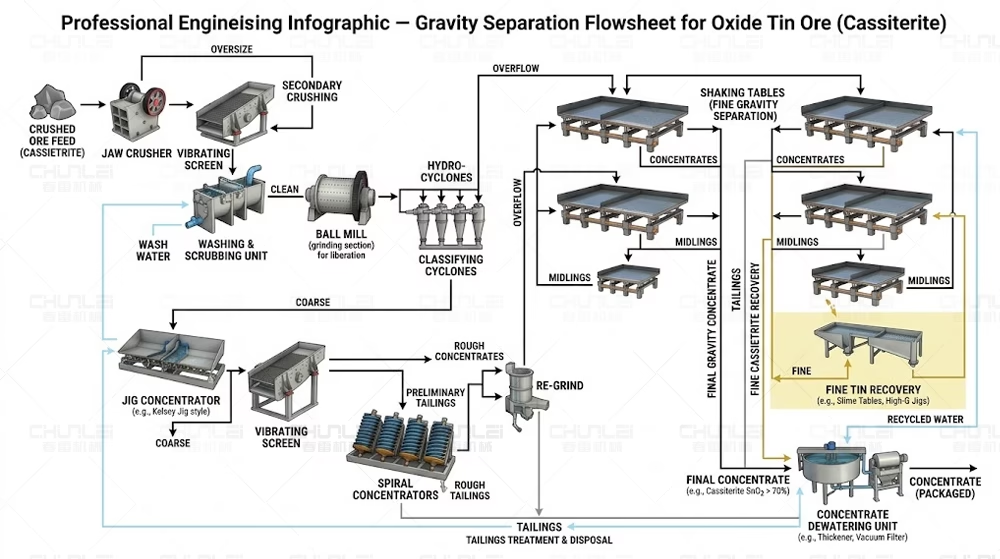
Step 1: Crushing and Screening
The run-of-mine ore first enters a crushing circuit, where large ore fragments are reduced to a size suitable for subsequent washing and grinding operations.
Common equipment includes:
- Jaw crushers
- Cone crushers
- Vibrating screens
- Trommel washers (rotary scrubbers)
For oxidized tin ores that are highly weathered or contain high levels of clay, particular emphasis should be placed on washing and screening.
The primary purpose of washing is to remove clay and fine slimes, thereby minimizing interference from these fine particles during gravity separation.
In cases involving alluvial (placer) tin deposits or loose, unconsolidated alluvial material, the process should focus on washing, screening, and gravity separation—avoiding unnecessary crushing and grinding.
Step 2: Grinding and Classification
In primary oxidized tin ores, cassiterite is frequently intergrown with gangue minerals such as quartz and feldspar; therefore, grinding is necessary to achieve a higher degree of mineral liberation.
However, given the high density of cassiterite, over-grinding can easily lead to the production of fine and ultra-fine particles, which complicates subsequent recovery.
Consequently, a strategy of staged grinding and staged beneficiation is recommended:
- Perform moderate grinding of the ore.
- Use classification to separate the already liberated cassiterite.
- Promptly recover the size fractions suitable for gravity separation.
- Return the unliberated, coarse-grained composite particles for further grinding.
- Subject the fine-grained fraction to separate beneficiation testing.
This approach helps minimize over-grinding and improves the recovery efficiency of cassiterite.
Step 3: Gravity Concentration
Gravity concentration is a key stage in the processing of oxidized tin ores.
Common equipment and their respective applications are as follows:
| Mineral Processing Equipment | Scope of Application | Primary Function | Equipment Advantages |
| Jig Separator | Coarse-grained minerals with significant density differences | Roughing and pre-concentration; early rejection of lightweight gangue | High throughput; suitable for initial enrichment |
| Spiral Chute | Fine-grained materials within a specific size range | Separation based on differences in mineral density | Simple structure; low operating costs |
| Shaking Table | Fine-grained heavy minerals of appropriate size | Cleaning/finishing (e.g., for cassiterite); increases concentrate grade | Intuitive separation process; allows for easy adjustment of grade and recovery rate |
| Centrifugal Concentrator | Certain fine-grained heavy minerals | Enhanced gravity separation; improves recovery of fine-grained minerals | Capable of recovering fine-grained cassiterite that is difficult to process effectively using conventional gravity separation equipment |
Step 4: Recycling of fine-grained cassiterite
This is a link that many tin oxide ore concentrators tend to overlook.
When the particle size of cassiterite is fine, the separation efficiency of ordinary gravity separation equipment may decrease, and part of the fine-grained cassiterite will be lost with the tailings.
For this type of problem, you can consider:
- Fine particle gravity separation equipment
- Fine grained cassiterite flotation
- Independent processing at granular level
- Tailings re-selection
Among them, cassiterite flotation needs to be tested based on the surface properties of the mineral, the chemical conditions of the slurry and the chemical system, and the chemical system for sulfide ore flotation cannot be simply copied.
Step 5: Concentrate beneficiation and dehydration
After the coarse concentrate has been refined several times, magnetic separation or other auxiliary separation technologies can be used according to the impurity composition.
Finally, tin concentrate is obtained through concentration, filtration and other equipment.
Typical process diagram of tin oxide ore:
Raw ore → Crushing → Ore washing → Screening → Grinding → Classification → Jig roughing → Spiral chute or shaking table selection → Fine-grained cassiterite recovery → Concentrate dehydration
It should be noted that for placer tin ore, the process may be simpler; for fine-grained primary cassiterite ore, a multi-stage grinding, gravity separation and flotation combination process may be required.
How should equipment be selected for sulfide tin ores and oxide tin ores?
Equipment selection should not be based solely on whether the ore is classified as a sulfide or an oxide. Instead, it must be determined by considering the ore’s specific characteristics, particle size distribution, degree of mineral liberation, and the results of beneficiation tests. Based on these factors, the appropriate equipment for crushing, grinding, separation, and dewatering can be configured.
The following is a comparison of typical equipment configurations for these two types of ore.
Comparison Table of Beneficiation Equipment for Sulfide Tin Ores and Oxide Tin Ores
| Comparison Item | Sulfide Tin Ores | Oxide Tin Ores |
| Primary Tin-Bearing Minerals | Cassiterite (often associated with sulfide minerals) | Primarily cassiterite |
| Main Associated Minerals | Pyrite, chalcopyrite, sphalerite, galena, etc. | Quartz, feldspar, calcite, limonite, etc. |
| Core Beneficiation Process | Combined flotation and gravity separation | Primarily gravity separation |
| Crushing Equipment | Jaw crushers, cone crushers | Jaw crushers, cone crushers |
| Grinding Equipment | Ball mills, rod mills | Rod mills, ball mills |
| Classification Equipment | Spiral classifiers, hydrocyclones | Spiral classifiers, hydrocyclones |
| Flotation Equipment | SF, JJF, and XCF/KYF-type flotation machines | Specialized flotation equipment may be configured based on the characteristics of fine-grained cassiterite |
| Jigging Equipment | Used for pre-enrichment of coarse-grained cassiterite | Jigs (suitable for recovering coarse-grained cassiterite) |
| Shaking Tables | Used for cleaning cassiterite and increasing concentrate grade | Used for cleaning cassiterite; particularly suitable for fine-grained material |
| Spiral Chutes | Used for gravity-based pre-enrichment of appropriately sized particles | Used for placer deposits and the recovery of appropriately sized cassiterite |
| Centrifugal Concentrators | Used for recovering ultra-fine cassiterite | Used for recovering fine and ultra-fine cassiterite |
| Desliming Equipment | Desliming cones, hydrocyclones, etc. | Desliming cones, hydrocyclones, etc. |
| Dewatering Equipment | Thickeners, filters, dewatering screens | Thickeners, filters, dewatering screens |
Key Recommendations for Equipment Selection:
- Sulfide-Tin Ores: Prioritize a combined process—flotation to remove sulfide minerals, followed by gravity separation to recover cassiterite—to prevent sulfides from compromising the quality of the tin concentrate.
- Oxidized Tin Ores: Prioritize gravity separation equipment, such as jigs and shaking tables. Depending on the particle size of the cassiterite, incorporate centrifugal concentrators to improve the recovery rate of fine-grained cassiterite.
- Complex Associated Ores: Based on the mineral dissemination patterns and liberation characteristics, consider a strategy involving staged grinding, staged separation, and a combined flotation-gravity separation process.
Important Note: While cassiterite has a high density, fine-grained particles are easily lost with the mineral slimes. In practical plant operations, focus should extend beyond mere equipment throughput capacity; critical factors such as feed particle size, classification efficiency, the degree of cassiterite liberation, and the tin grade of the tailings must also be carefully evaluated. It is highly recommended to conduct ore characterization analysis and beneficiation testing before finalizing equipment models and configuration schemes.
How do the beneficiation outcomes for sulfide tin ores compare to those for oxide tin ores?
For sulfide tin ores, the process typically requires the separation of sulfides from cassiterite, followed by the recovery of tin through a combination of methods such as gravity separation and flotation. In the case of oxide tin ores, where cassiterite is the primary target for recovery, gravity separation is generally the more suitable approach.
However, actual beneficiation results cannot be determined solely by the ore type. An optimal processing scheme must be established through beneficiation testing, taking into account factors such as tin grade, mineral grain size (dissemination size), mineral composition, and the degree of mineral liberation.
Comparison table of beneficiation effects between tin sulfide ore and tin oxide ore
| Comparison Category | Sulfide Tin Ores | Oxidized Tin Ores |
| Primary Tin-Bearing Minerals | Sulfide tin minerals such as stannite and kesterite; cassiterite may also be present | Primarily cassiterite (SnO₂) |
| Mineral Composition | Generally complex; often associated with sulfides of copper, lead, zinc, iron, and arsenic | Mainly composed of cassiterite and gangue minerals such as quartz and feldspar |
| Mineral Intergrowth Characteristics | Often characterized by complex intergrowths and fine-grained dissemination | Depends on the deposit type; placer deposits are usually easier to liberate, while primary deposits may feature finer dissemination |
| Primary Beneficiation Methods | Flotation, gravity separation, and combined processes | Primarily gravity separation; magnetic separation or flotation may be used when necessary |
| Grinding Requirements | Generally requires fine grinding to liberate tin-bearing minerals from sulfides | Determined by the grain size of the cassiterite; over-grinding and sliming must be avoided |
| Beneficiation Difficulty | Relatively high | Generally low for placer tin deposits; higher for fine-grained primary oxidized tin ores |
| Equipment Configuration | Ball mills, flotation machines, shaking tables, magnetic separators, etc. | Screening equipment, jigs, spiral chutes, shaking tables, magnetic separators, etc. |
| Reagent Consumption | Generally high; requires the selection of specific collectors, modifiers, etc., based on the types of sulfides present | Low reagent consumption during gravity separation; reagents may be required during flotation stages |
| Tin Recovery Rate | Highly influenced by mineral intergrowth relationships, the degree of liberation, and losses of fine particles | Better recovery is generally easier to achieve with coarse-grained, easily liberated ores |
| Investment and Operating Costs | Complex processes; equipment and reagent costs are typically higher | Simple gravity separation circuits generally entail lower investment and operating costs |
Tin oxide ores are not necessarily easier to process than tin sulfide ores. In particular, primary cassiterite ores with fine-grained dissemination may require processes such as staged grinding, classification-based gravity separation, and the recovery of fine particles.
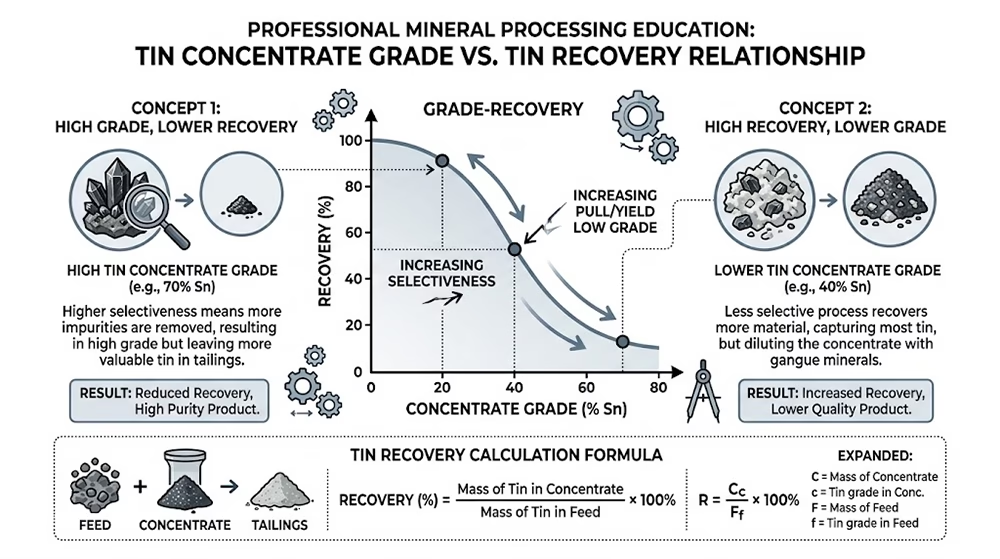
How can the overall recovery rate of sulfide and oxide tin ores be improved?
The key to improving the overall recovery rate of sulfide and oxide tin ores lies in developing a rational, multi-stage beneficiation process tailored to the distinct dissemination characteristics, particle size distributions, and amenability to processing of each mineral type. By employing separate treatment streams for sulfide and oxide ores, utilizing a combination of gravity separation and flotation, and optimizing both grinding and reagent regimes, it is possible to minimize tin loss while enhancing the grade of the tin concentrate and the overall recovery rate.
Key optimization measures include:
- Analysis of raw ore properties: Determining the content, dissemination size, and paragenetic relationships of the sulfide and oxide tin minerals to provide a foundation for process design.
- Preferential flotation of sulfide ores: Using appropriate collectors and depressants to selectively recover sulfide tin minerals and other associated valuable metals.
- Gravity recovery of oxide tin ores: Leveraging the high density of cassiterite by employing equipment such as jigs, shaking tables, and spiral concentrators to recover both coarse and fine cassiterite particles.
- Combined gravity separation and flotation: Implementing a hybrid process for fine, ultra-fine, and refractory oxide tin ores to reduce the loss of fine-grained tin.
- Optimization of grinding and classification: Controlling grinding fineness to prevent over-grinding and the formation of excessive slimes, thereby improving the degree of liberation for tin minerals.
- Enhanced recovery from middlings and tailings: Subjecting middlings and tailings to classification and further processing to recover tin minerals that were not fully liberated or effectively concentrated during the initial stages.
Sulfide and Oxide Tin Ores FAQ
Q1: What are the common challenges encountered during the beneficiation of sulfide tin ores?
A: Common challenges include complex mineral composition, intimate intergrowth between tin minerals and sulfides, fine dissemination size, and high impurity levels in the final concentrate. To address these issues, it is necessary to carefully control the grinding fineness and employ effective separation techniques—such as flotation, gravity separation, or a combination of both—to separate the various minerals.
Q2: Why is it difficult to achieve complete recovery of cassiterite from oxide tin ores?
A: The primary reason is that some cassiterite particles are extremely fine and tend to report to the tailings along with the slimes. Furthermore, when cassiterite is intergrown with gangue minerals, conventional gravity separation methods may fail to achieve adequate liberation. Strategies such as classified recovery, gravity separation of fine particles, and the reprocessing of middlings can be used to minimize tin losses.
Q3: What process should be used for oxide tin ores with a high slime content?
A: For oxide tin ores with a high slime content, a pretreatment process—incorporating ore washing, scrubbing, classification, and desliming—is recommended. Subsequently, the material should be processed using equipment such as jigs, shaking tables, or centrifugal concentrators, tailored to the specific characteristics of each particle-size fraction, to improve cassiterite recovery.
Q4: Are flotation reagents required for the beneficiation of sulfide tin ores?
A: Yes, it is generally necessary to select appropriate collectors, frothers, and modifiers based on the types and surface properties of the sulfide minerals present. Since reagent regimes vary significantly depending on the specific ore, flotation tests must be conducted to determine the types, dosages, addition sequences, and flotation durations. Care should be taken to avoid excessive reagent use, which could negatively impact the recovery of tin minerals.
Q5: What should be considered during the crushing of oxide tin ores?
A: During the crushing of oxide tin ores, a balance must be struck between achieving mineral liberation and preventing over-grinding (excessive size reduction). If the crushed product is too coarse, it increases the burden on subsequent grinding stages; conversely, if it is over-crushed, a large quantity of fine cassiterite particles may be produced, making gravity recovery more difficult. It is advisable to configure jaw crushers, cone crushers, and screening equipment appropriately, taking into account the ore’s hardness, dissemination size, and the required processing capacity.
Q6: How can impurities such as iron, copper, and lead be removed from sulfide-based tin ores?
A: The separation method should be selected based on the type and occurrence mode of the impurity minerals. For sulfides like chalcopyrite, galena, and sphalerite, selective flotation may be employed; for certain iron-bearing minerals, magnetic separation or other appropriate beneficiation techniques can be used. The specific process should be determined based on mineralogical analysis and beneficiation testing.
Q7: Why do tin ore beneficiation processes typically require multi-stage grinding and multi-stage separation?
A: Cassiterite has a high density but relatively low hardness; over-grinding can easily produce fine-grained cassiterite that is difficult to recover. Implementing multi-stage grinding and separation allows for the timely recovery of liberated coarse-grained cassiterite, thereby reducing over-grinding and metal loss, while also lowering the load on downstream grinding and separation equipment.
Q8: Do tailings from sulfide or oxide tin ores still hold any recovery value?
A: It is possible. Tailings may contain residual fine-grained cassiterite, incompletely liberated tin-bearing composite particles, or other valuable metals. Through particle size analysis, tin grade testing, and mineralogical study of the tailings, one can determine whether they warrant further processing—potentially using fine-particle gravity separation, flotation, or other suitable recovery techniques.
Q9: How can beneficiation costs be reduced when processing low-grade oxide tin ores?
A: For low-grade oxide tin ores, the focus should be on minimizing unnecessary grinding, reagent consumption, and losses to tailings. Techniques such as pre-screening, ore washing, classification, and coarse-particle pre-concentration (to discard waste rock) can reduce the volume of material entering the grinding circuit. Additionally, employing appropriate gravity separation equipment tailored to specific particle size fractions can enhance effective processing capacity and lower the production cost per unit of concentrate.
Q10: Can a combined beneficiation process be used for ores containing both sulfide and oxide tin minerals?
A: Yes. If the raw ore contains both sulfide and oxide tin minerals, a combined process—integrating flotation and gravity separation—can be considered. For example, a portion of the sulfide minerals can first be separated via flotation, followed by the recovery of cassiterite using jigs, shaking tables, or centrifugal concentrators. The specific process sequence should be determined based on the mode of occurrence of the tin minerals, their grain size distribution, and experimental results.
Conclusion
The primary difference between sulfide tin ores and oxide tin ores lies in the specific minerals in which the tin is contained; consequently, the mineral processing methods must also differ.
For sulfide tin ores, the focus is typically on flotation and subsequent metal recovery. For oxide tin ores, gravity separation is generally the primary method, with careful attention also paid to the recovery of fine-grained cassiterite.
It is a common misconception that more equipment automatically leads to better results. In reality, success depends on employing the right process and ensuring that the equipment is well-matched to that process—this is the key to increasing tin recovery rates and minimizing resource waste.
Which processing method is best suited for your tin ore? Please feel free to contact us and provide details about your ore; we would be happy to help you analyze and determine the most appropriate processing solution!
Latest News

What equipment is required for the beneficiation of alluvial tin ore?
800Having worked in alluvial tin ore processing for many years, I have found that such deposits are indeed often easier to process than primary (lode) tin deposits. Through long-term natural weathering and the action of flowing water, much of the …
-
Why are alluvial tin deposits the easiest type of tin deposit to process?
800For grinding operators or gravity separation technicians, the greatest concern is not low ore grade, but rather fine mineral dissemination. In the case of primary (hard-rock) tin deposits, if the chosen beneficiation process is unsuitable, reco…
-
A Comprehensive Guide to Types of Tin Ore and Mineral Processing Techniques
800Tin ore beneficiation is not merely a matter of crushing and grinding the ore before feeding it into a jig or a shaking table. Even within a single tin mining project, the optimal beneficiation process can vary significantly depending on factor…
-
How is a 0.2% tin ore processed into a 60% concentrate?
800Many clients attempt to process ore containing 0.2% tin, only to find that—after a series of operations—the ore grade has failed to improve, while significant amounts of cassiterite remain in the tailings. Some clients try to compensate by inte…
loading…
已经是到最后一篇内容了!