 Chunlei Mining Machinery
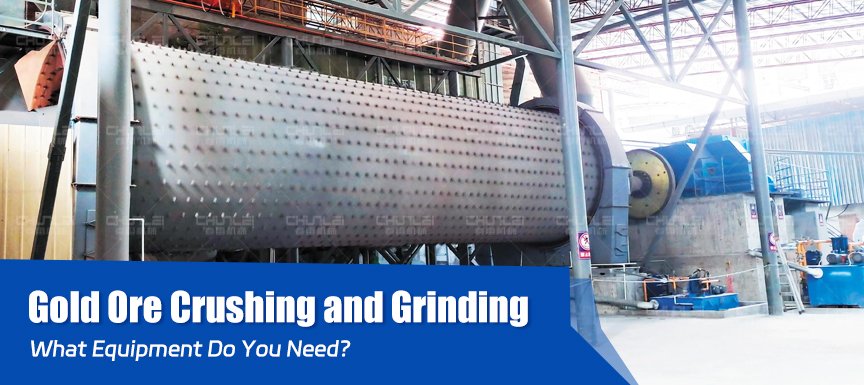
Gold Ore Crushing and Grinding: What Equipment Do You Need?
When designing a gold ore processing line, my clients often ask which crushers and mills to purchase. However, the equipment selection should actually be based on a thorough understanding of the ore characteristics.
Issues in many projects do not stem from insufficient equipment capacity; rather, they often arise because the crushed product from the initial stage is too coarse, placing an excessive load on the ball mill. Alternatively, over-grinding—undertaken in pursuit of higher gold liberation—can lead to increased energy consumption and severe slime formation, ultimately hindering downstream recovery.
Therefore, one should not focus on individual pieces of equipment in isolation when planning gold ore crushing and grinding; instead, the entire crushing, grinding, and classification circuit should be considered holistically. This ensures that the equipment is truly compatible with both the ore characteristics and the subsequent beneficiation process.
Why do gold ores require crushing and grinding?
The gold within the ore does not necessarily exist as particles visible to the naked eye.
Some ores contain relatively coarse, free-milling gold, while other gold is intimately associated with quartz, sulfides, or other gangue minerals; crushing and grinding are required to gradually liberate these gold particles.
The process can be summarized simply as follows:
Large run-of-mine ore → Crushing to reduce particle size → Grinding to promote mineral liberation → Classification to control particle size → Gold recovery via gravity separation, flotation, or leaching.
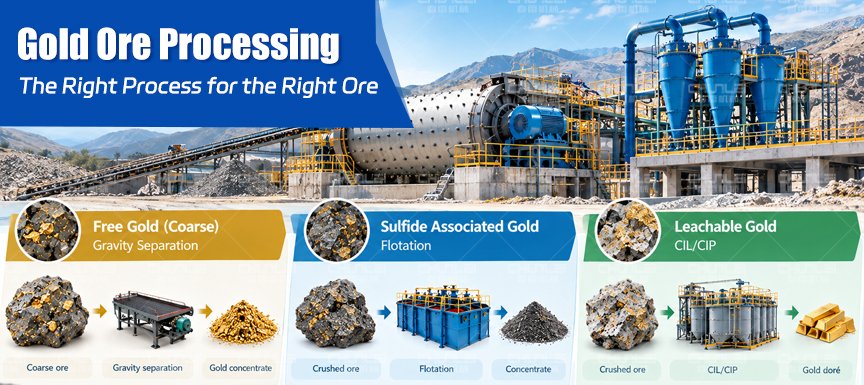
The specific configuration depends on the nature of your ore. For coarse, free-milling gold, it may be more appropriate to perform gravity separation at an early stage; if the gold is primarily associated with sulfides, flotation is usually considered; if the ore is amenable to leaching, the process proceeds to CIL (Carbon-in-Leach) or CIP (Carbon-in-Pulp).
Therefore, when undertaking a gold mining project, do not rush to ask “what size ball mill should I buy.” First, clarify the ore characteristics and the mode of gold occurrence; only then can the appropriate equipment and process flow be determined.
Basic Process Flow for Gold Ore Crushing and Grinding
The typical process flow for hard-rock gold ore can be simplified as follows:
Run-of-Mine (ROM) Ore → Jaw Crusher → Cone Crusher → Vibrating Screen → Ball Mill → Hydrocyclone → Gold Recovery
However, not every project requires the exact same equipment configuration.
For example:
- If the ore is relatively soft, complex multi-stage crushing may not be necessary;
- If the maximum feed size is small, the primary crushing setup can be simplified;
- If the gold mineral liberation size is coarse, ultra-fine grinding may not be required;
- Requirements for the ground product’s particle size also vary depending on whether subsequent processing involves flotation, gravity separation, or leaching.
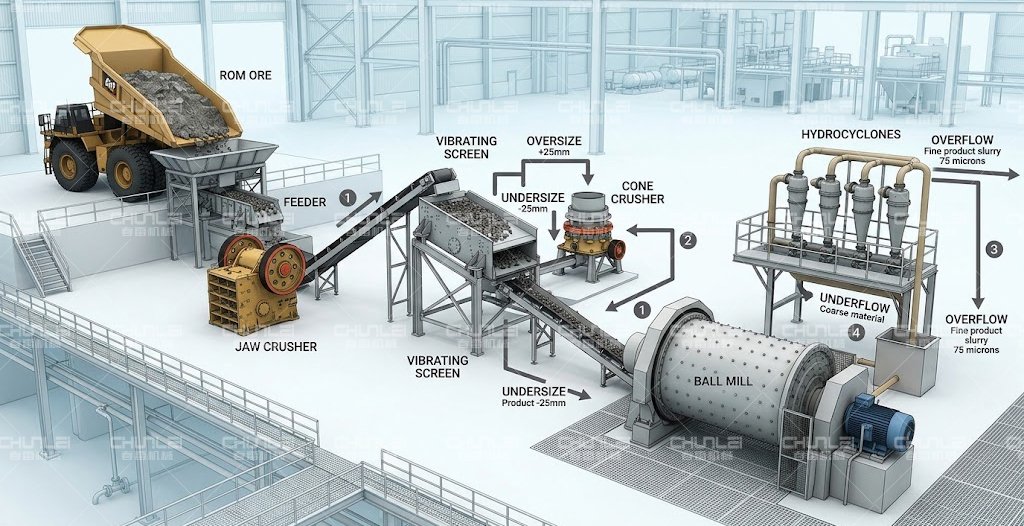
Step 1: Primary Crushing – Jaw Crusher
Run-of-mine ore typically has a large particle size and cannot be fed directly into a ball mill.
The Jaw Crusher handles the first stage of coarse crushing, reducing large ore chunks to a suitable particle size range.
When selecting a crusher for hard-rock gold ore, the focus should not be solely on “maximum throughput”; instead, consider the following factors:
- Maximum feed size
- Ore hardness and compressive strength
- Clay and moisture content
- Target output size
- Actual processing capacity
- Feed requirements of downstream secondary crushing equipment
If the product from primary crushing remains too coarse, it places excessive strain on the subsequent cone crusher and ball mill.
Step 2: Secondary and Tertiary Crushing – Cone Crusher
After gold ore undergoes primary crushing, a cone crusher is typically employed if further particle size reduction is required.
Its primary function is to further reduce the particle size of the material before it enters the grinding circuit, thereby ensuring a more stable feed for the ball mill.
Why shouldn’t the ball mill process large ore fragments directly?
Because the ball mill is designed primarily for fine grinding.
If the ore entering the ball mill is too coarse, several issues may arise, such as increased mill load, reduced grinding efficiency, and higher energy consumption.
Therefore, the crushing stage should handle the task of reducing large particle sizes, while the ball mill focuses on the liberation of minerals—a process that requires grinding.
Step 3: Screening—Controlling Particle Size for the Grinding Mill
Vibrating screens serve as a crucial link between the crushing and grinding stages.
The primary functions of screening are:
- Controlling the particle size of material entering the next crushing stage;
- Promptly routing material of the correct size to the grinding circuit;
- Returning oversized particles to the crusher;
- Stabilizing the feed to the ball mill.
Therefore, high crusher capacity does not necessarily guarantee high overall production line capacity.
If the screening area is insufficient, screen aperture configuration is improper, or screening efficiency drops, large quantities of coarse material may continuously recirculate, ultimately limiting the actual output of the entire production line.
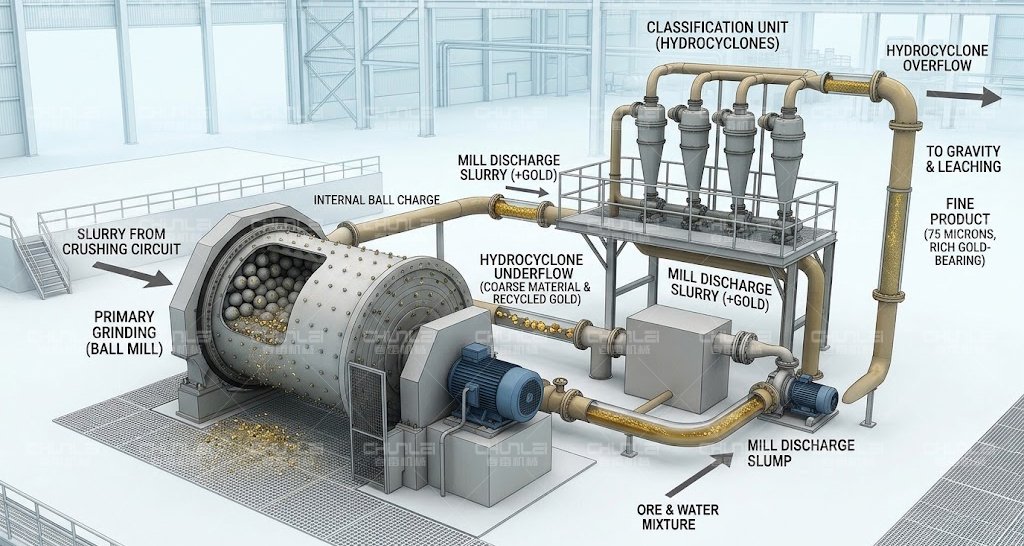
Step 4: Grinding — Ball Mill
While crushing merely reduces the size of the ore, the ball mill is responsible for further grinding the material to achieve mineral liberation.
For many hard-rock gold deposits, the ball mill serves as the primary grinding equipment following the crushing stage.
In gold ore processing, the ball mill operates as an integral part of the complete flowsheet—alongside crushing, classification, and subsequent stages such as gravity separation, flotation, and CIP/CIL—rather than as an isolated piece of equipment.
What factors should be considered when selecting a ball mill?
Key considerations include:
| Selection Factors | Key Considerations | Impact on Ball Mill Selection |
| Processing Capacity | t/h、t/d | Determines ball mill specifications and installed power |
| Ore Hardness | Bond Work Index, ore hardness | Harder ore generally requires greater grinding capacity and power |
| Feed Particle Size | Maximum particle size, P80 | Affects ball mill specifications and upstream crushing requirements |
| Target Fineness | P80, -200 mesh, etc. | Determines equipment configuration for the grinding circuit and grinding time |
| Ore Properties | Abrasiveness, clay content, density, etc. | Affects liner and grinding ball consumption, as well as operational stability |
| Wet vs. Dry Grinding | Wet / Dry Grinding | Determines the configuration of the ball mill and auxiliary equipment |
| Grinding Method | Open-circuit or closed-circuit | Closed-circuit grinding usually requires integration with hydrocyclones or classifiers |
| Downstream Processing | Gravity separation, flotation, CIL/CIP, etc. | Different recovery processes have varying requirements for grinding fineness |
| Installation Conditions | Site, power supply, feed/discharge methods | Affects equipment dimensions, power, and auxiliary design |
| Budget and Operating Costs | Equipment investment, energy consumption, wear parts | Influences the final choice of model and configuration |
When using a ball mill for gold ore, one should not simply aim for the finest possible grind; instead, the grinding process should be based on the liberation size of the gold minerals and the requirements of the downstream recovery process.
If the ore has already achieved a sufficient degree of liberation, further grinding may merely increase energy consumption and generate excessive fine sludge.
Step 5: Classification – Hydrocyclone
Hydrocyclones primarily utilize centrifugal force to classify mineral slurry; coarse particles are typically discharged via the underflow, while fine particles exit through the overflow to proceed to the next stage of the process. Classification performance is influenced by factors such as feed pressure, slurry concentration, particle size, and equipment dimensions.
It is commonly integrated with a ball mill to form a closed-circuit grinding system.
The fine, product-grade material discharged from the ball mill enters the hydrocyclone, while the coarse fraction is returned to the ball mill for further grinding. This setup minimizes over-grinding and ensures consistent control over the particle size of the material proceeding to gravity separation, flotation, or leaching stages.
How should equipment be matched to different types of ore?
No single crushing and grinding configuration for gold ore suits every mine.
The actual selection of equipment should begin with the properties of the ore.
| Ore Characteristics | Primary Crushing | Grinding | Key Focus Areas |
| High-hardness quartz-type gold ore | Jaw + Cone Crusher | Ball Mill | Grinding energy consumption, wear parts, feed particle size |
| Gold ore with high clay content | Jaw + Washing/Screening + Crusher | Ball Mill | Desliming, clogging, screening efficiency |
| Coarse free gold | Jaw/Crusher + Screen | Depends on liberation degree | Avoid over-grinding; proceed to gravity separation early |
| Sulfide-associated gold | Multi-stage crushing | Ball Mill + Classification | Liberation size and flotation requirements |
| Fine-grained disseminated gold | Multi-stage crushing | Ball Mill + Hydrocyclone | Liberation degree, classification efficiency |
| Ores suitable for CIL/CIP | Jaw + Cone等 | Ball Mill + Classification | Particle size required for leaching and slurry conditions |
A crucial point to note here is that the final grinding fineness cannot be determined in isolation from the subsequent recovery process.
Comparison of Crushing and Grinding Equipment
| Equipment | Primary Task | Typical Location | Key Advantages | Key Limitations |
| Jaw Crusher | Primary (coarse) crushing | Front end of crushing circuit | Simple structure; suitable for large, hard rock blocks | Not suitable for fine crushing |
| Cone Crusher | Secondary/tertiary crushing | Secondary/tertiary crushing stages | Suitable for continuous crushing of hard rock | Requires proper control of feed and discharge |
| Vibrating Screen | Screening and classification | Crushing stage | Controls product particle size; reduces ineffective recirculation | Susceptible to aperture clogging and high clay content |
| Ball Mill | Fine grinding; promotes mineral liberation | Grinding stage | Wide range of applications; enables closed-circuit grinding | Energy consumption and media wear require careful control |
| Hydrocyclone | Slurry classification | Downstream of ball mill | High classification efficiency; compact footprint | Sensitive to pressure, concentration, and structural parameters |
How do you determine the appropriate grinding size for gold ore?
Determining the right grinding size for gold ore is not simply a matter of “the finer, the better”; rather, it depends on whether the gold minerals have been sufficiently liberated and on the recovery process to be used subsequently.
| Key Factors | What to Focus On | Impact on Grinding Fineness |
| Gold Dissemination Size | Coarse-grained vs. fine-grained gold | Finer gold particles and tighter dissemination usually require finer grinding |
| Gold-Gangue Association | Is the gold encapsulated by quartz, sulfides, etc.? | Severe encapsulation requires further grinding for liberation |
| Ore Hardness | Grindability | Hard ores require more grinding energy to reach the target fineness |
| Gold Mineral Liberation Degree | Gold liberation status at various particle sizes | Aiming for an economically optimal degree of liberation |
| Downstream Recovery Processes | Gravity separation, flotation, CIL/CIP, etc. | Different processes require different feed particle sizes |
| Risk of Over-grinding | Sliming, increased fine slimes, and gold loss | Excessive grinding may reduce downstream separation efficiency and increase energy consumption |
When selecting a ball mill for gold ore, it is best not to simply tell the manufacturer the desired grind size (mesh); instead, you should also provide data on processing capacity, raw ore particle size, ore hardness, gold dissemination characteristics, the target recovery process, and test results. This ensures a more reliable determination of the required grinding fineness and ball mill specifications.
How should one evaluate a complete gold ore crushing and grinding setup?
When assessing a complete gold ore crushing and grinding configuration, one should not simply look at the number of crushers or ball mills used; instead, the focus should be on how the particle size is reduced step-by-step and whether the process creates suitable conditions for subsequent gold recovery.
| Stage | Key Equipment | Primary Function | Key Focus Areas |
| Feeding | Vibrating feeder, ore bin | Uniform and stable ore feeding | Maximum raw ore particle size, feed rate |
| Primary Crushing | Jaw crusher | Coarse crushing of large raw ore blocks | Maximum feed size, processing capacity, discharge particle size |
| Secondary/Tertiary Crushing | Cone crusher, impact crusher, etc. | Further particle size reduction | Product particle size, production capacity, circulating load |
| Screening | Vibrating screen | Control of crushed product particle size | Screen aperture size, screening efficiency |
| Fine Product Storage | Ore bin, conveyor | Buffering between crushing and grinding | Storage capacity, feed stability |
| Grinding | Ball mill | Further grinding of ore to finer size | Throughput, ore hardness, target fineness |
| Classification | Hydrocyclone | Separation of qualified fines from coarse material | Classification particle size, circulating load |
| Sand Return | Conveying/pumping system | Return of coarse particles to the ball mill | Circulation stability, pumping capacity |
| Grinding Product | Cyclone overflow | Feed for downstream beneficiation | P80, gold mineral liberation degree |
5 Common Mistakes in Gold Ore Crushing and Grinding
1. Selecting equipment based solely on throughput
“I need to process 500 tons per day, so just give me a 500-ton-per-day machine.”
This approach is too simplistic.
One must also consider ore hardness, feed size, target particle size, and the circulating load of the entire process.
2. Assuming finer grinding is always better
The goal of grinding is mineral liberation, not simply achieving the smallest possible particle size.
Over-grinding increases energy consumption and can generate excessive fines, which interferes with downstream separation.
3. Focusing only on the ball mill while ignoring the crushing stage
If the particle size of the material entering the ball mill is inconsistent, maintaining stable mill operation becomes difficult.
Therefore, crushing and grinding must be designed as an integrated system.
4. Neglecting classification equipment
Proper matching of the ball mill and hydrocyclones is crucial.
Without effective classification, the grinding circuit is prone to over-grinding or under-grinding.
5. Directly copying the flowsheet of another mine
This is a risky practice in real-world projects.
Even if two operations are both classified as “gold mines,” factors such as ore hardness, gold dissemination characteristics, clay content, and downstream recovery methods can differ significantly.
Different ores require different processing flows.
FAQ
Q: What crusher is best for gold ore?
A: For hard-rock gold ore, a common approach is to use a jaw crusher for primary crushing, followed by a cone crusher configured according to particle size requirements. The final equipment combination must be determined based on ore hardness, maximum feed size, and the target product particle size.
Q: Is a ball mill necessary for gold ore grinding?
A: Not necessarily. Whether a ball mill is used depends on the ore properties and the subsequent recovery process. Ball mills are a common choice for hard-rock gold ores that require fine grinding to facilitate the liberation of gold minerals.
Q: How fine should gold ore be ground?
A: There is no one-size-fits-all answer. The grinding fineness should be determined based on the gold’s dissemination size and liberation characteristics, as well as the requirements of the gravity separation, flotation, or leaching processes.
Q: Why is a hydrocyclone used with a ball mill?
A: It is primarily used to control the particle size of the ground product. Particles that meet the size specifications proceed to the next stage, while coarse particles are returned to the ball mill for further grinding, thereby creating a closed-circuit grinding system.
Q: Can the crushing and grinding circuit be designed without testing the ore?
A: A preliminary plan can be created, but determining the final equipment models, grinding fineness, and recovery process is best done using actual ore test data. Factors such as hardness, gold dissemination characteristics, and grindability vary significantly and directly impact equipment selection.
Conclusion
Gold ore crushing and grinding operations must effectively address three key issues:
First, crushing must be stable.
The process involves progressively reducing the particle size of large ore blocks to create optimal feed conditions for the subsequent grinding stage.
Second, grinding must achieve appropriate mineral liberation.
The goal is not simply to grind as finely as possible, but to determine the particle size that balances liberation efficiency, recovery rates, and energy consumption.
Third, classification must be stable.
Equipment such as hydrocyclones is used to control the product size, ensuring that the material meets specifications while avoiding both over-grinding and under-grinding.
If you are planning a gold ore crushing and grinding production line, please provide us with details regarding the run-of-mine (ROM) particle size, target output, and ore characteristics. Based on your project requirements, CHUNLEI can help you select the appropriate crushers, ball mills, and classification equipment, as well as provide comprehensive recommendations for the process configuration. Contact us today!
Latest News

How to Select the Right Gold Processing Plant for Your Ore
800When selecting a gold processing plant, simply assuming that a full suite of equipment is all that is needed can lead to issues such as low recovery rates, high energy consumption, and failure to meet production targets.Different ores require d…
-
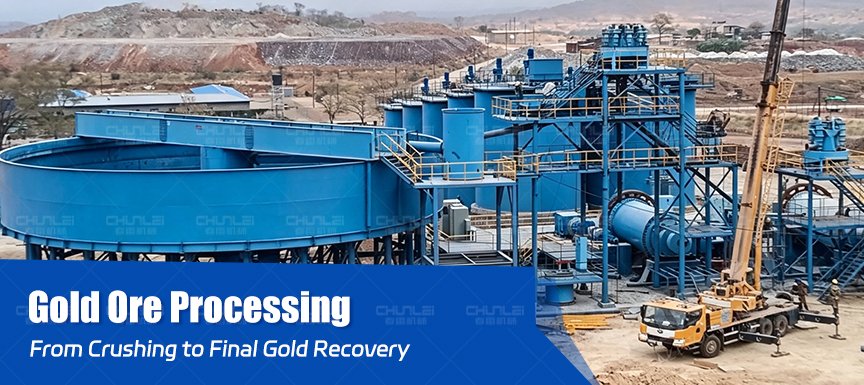
Gold Ore Processing: From Crushing to Final Gold Recovery
800A gold processing plant is not merely a simple assembly of crushers, ball mills, and gold recovery equipment; rather, the goal is to determine the optimal process flow based on factors such as mineral composition, gold particle size,…
-
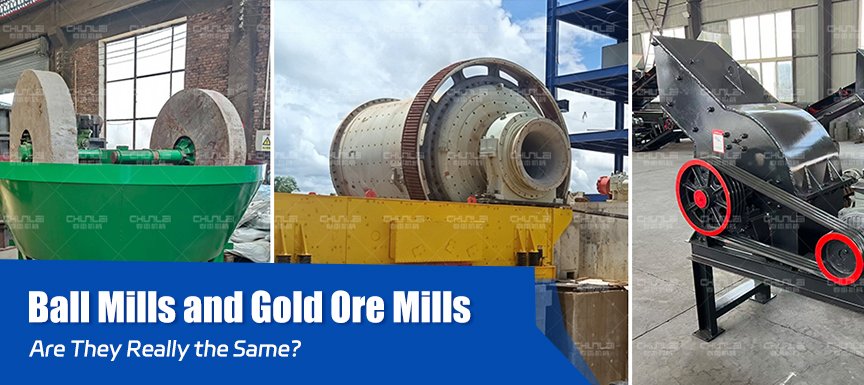
Ball Mills and Gold Ore Mills: Are They Really the Same?
800When searching for gold ore grinding equipment, customers often encounter various terms such as “Ball Mill,” “Gold Mill,” “Gold Milling Machine,” and “Gold Ore Grinding Machine.” Many buyers assume that a “Gold Mill” is a specialized mill de…
-
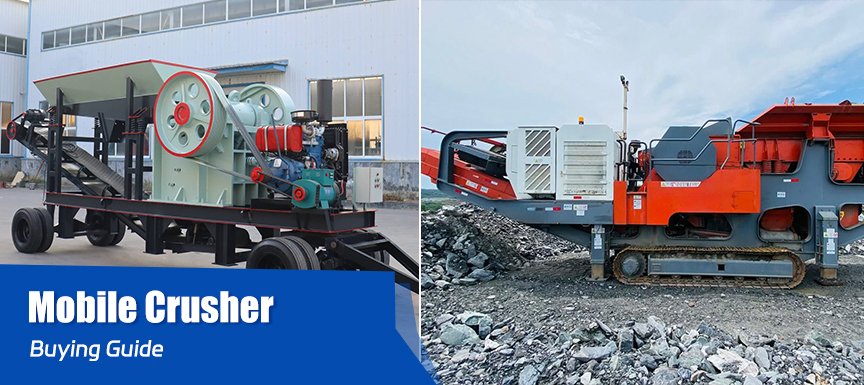
Mobile Crusher Buying Guide: Wheeled or Tracked?
800Many customers focus solely on portability when purchasing a mobile crusher, viewing it merely as the acquisition of a single piece of equipment. In reality, selecting the wrong model can lead to either insufficient output or excessive wear and…
loading…
已经是到最后一篇内容了!