 Chunlei Mining Machinery

Flotation Foam Problems: Causes, Diagnosis, and Solutions
In the flotation process, foam may seem insignificant, but its quality directly affects concentrate grade, metal recovery rate, and reagent costs.
In actual production, many concentrators encounter similar problems: too much foam, too sticky, and difficult to dissipate; sometimes too little foam, failing to carry away useful minerals; and sometimes, the foam appears normal, but the concentrate grade continues to decline, and tailings losses increase.
When encountering these situations, don’t rush to adjust the reagents, as it doesn’t necessarily mean the flotation machine is malfunctioning.
To control foam effectively, the key is not blindly adding or reducing reagents, but rather identifying the root cause of the problem. Below, we will discuss common causes and practical solutions from the perspectives of ore, grinding, reagents, and flotation equipment.
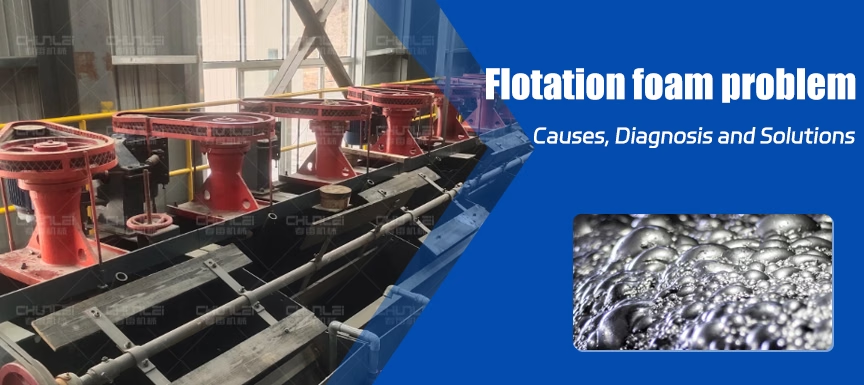
What constitutes normal flotation froth?
The froth formed from copper sulfide ores, lead-zinc ores, gold ores, and clay-bearing ores varies significantly due to differences in mineral surface properties, particle size distribution, and reagent response.
To determine if the froth is normal, it is recommended to focus on observing three aspects:
- Mineral adhesion: Can useful mineral particles effectively adhere to the bubble surface and enter the froth layer?
- Froth stability: Can the froth maintain appropriate stability to transport mineral particles to the concentrate cell?
- Froth drainage capacity: Can the froth effectively drain excess water, reducing the mechanical entrainment of gangue fine particles?
| Foam Performance | Possible Process Issues | Priority Inspection Items |
| Rapid Foam Bursting | Insufficient Foam Stability | Foaming Agent, Aeration Rate, Water Quality |
| Excessively Long-Lasting Foam | Insufficient Drainage | Foaming Agent Dosage, Fine Sludge, Foam Layer Depth |
| Excessively Large, Uneven Bubbles | Abnormal Gas Dispersion | Aeration System, Agitator, Reagents |
| Wet Foam, High Concentrate Content | Possible Gangue Entrainment | Concentrate Grade, Water Recovery Rate |
| Stable Foam but Low Recovery Rate | Mineral Liberation or Surface Chemical Abnormalities | Grinding Particle Size, Mineral Liberation Degree, Tailings Grade |
It is important to note that the above are clues for troubleshooting, not conclusions about the fault that can be drawn solely from appearance. Excessively low foam stability may cause useful minerals to detach, while excessively high stability may increase the entrainment of hydrophilic gangue.
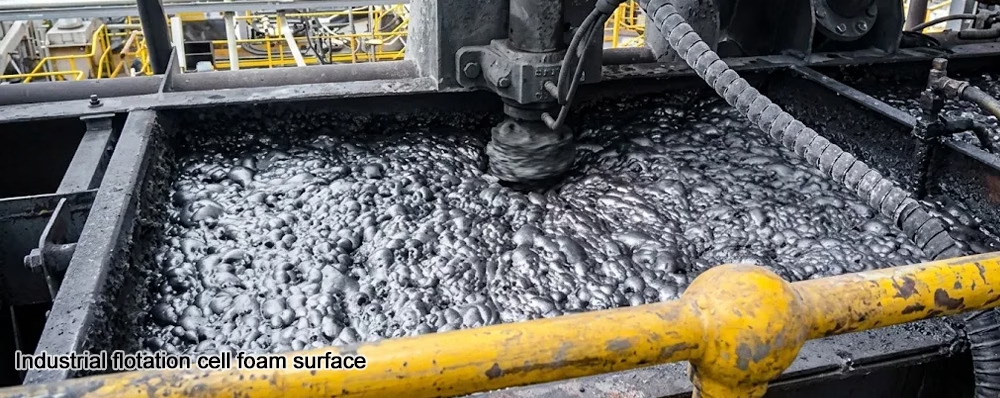
Main Causes of Flotation Foam Problems
Flotation foam is a crucial factor affecting concentrate grade, mineral recovery, and flotation efficiency. Excessive foam stability, rapid bursting, excessively large bubbles, or insufficient foam volume are generally related to ore properties, reagent formulation, pulp conditions, and equipment operating status.
The main causes include the following seven aspects:
1. Changes in Ore Characteristics
Changes in the mineral composition, oxidation level, and clay content of the raw ore may affect mineral surface properties, bubble adhesion, and foam stability.
2. Improper Reagent Dosage
Excessive frother may lead to overly stable foam, while insufficient frother can easily cause bubble bursting. Inappropriate dosages of collectors and depressants can also affect flotation selectivity.
3. Incorrect Grinding Fineness
Insufficient grinding leads to incomplete mineral liberation, while over-grinding produces a large amount of fine slime, increasing pulp viscosity and affecting foam drainage and mineral separation.
4. Abnormal Pulp Density and pH
Excessively high pulp concentration can affect bubble dispersion, while changes in pH can alter mineral surface properties and reagent effectiveness.
5. Improper Airflow and Bubble Distribution
Insufficient aeration reduces the number of effective bubbles, while excessive aeration can cause pulp disturbance, and overly large bubbles can reduce mineral particle collection efficiency.
6. Flotation Equipment Problems
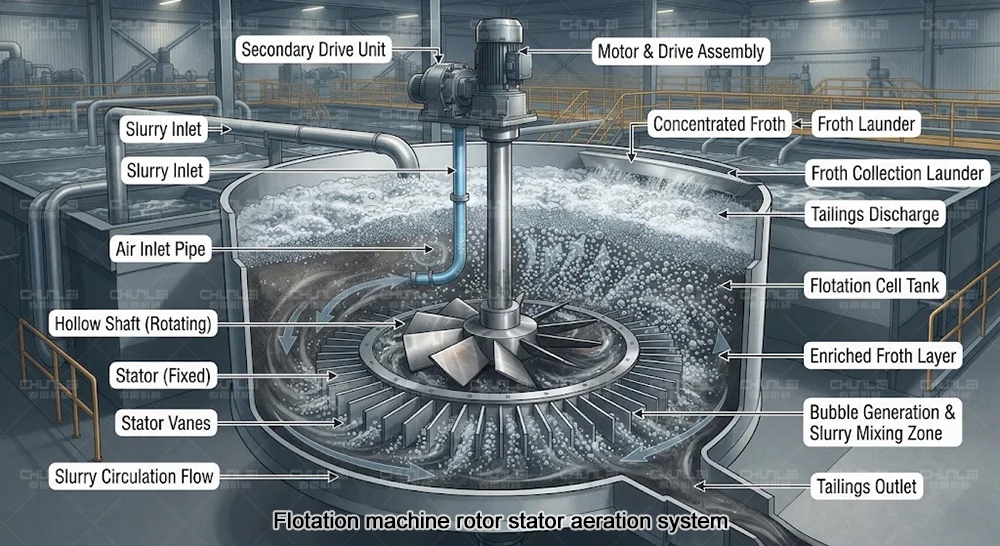
Impeller and stator wear, blockage in aeration lines, and malfunctions in the froth scraper can all affect bubble formation, pulp circulation, and froth collection.
7. Incorrect Pulp Level and Froth Depth
Fluid level fluctuations or excessively shallow or deep froth layers can affect froth drainage, concentrate grade, and recovery of valuable minerals.
Abnormal froth in flotation is usually the result of multiple factors working together. When troubleshooting, the focus should be on checking the ore properties, reagent dosage, grinding fineness, slurry conditions, aeration system, and equipment operating status, and the root cause should be determined in conjunction with the concentrate grade and recovery rate.
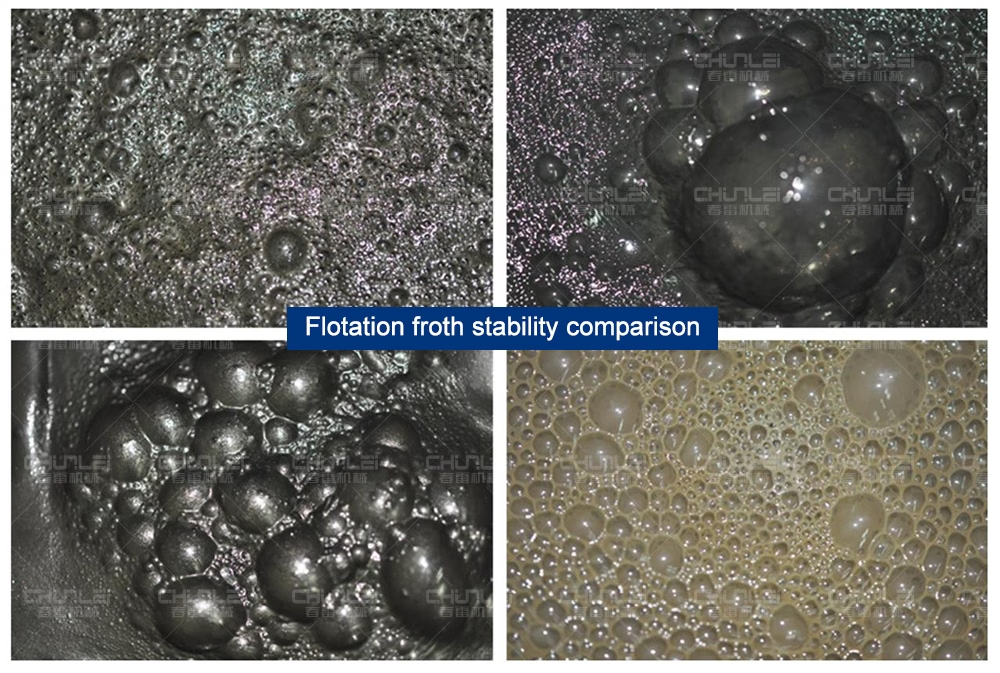
How to Diagnose Flotation Foam Problems: 7 Practical Steps
Simply observing foam color, thickness, or bubble size cannot accurately determine flotation efficiency.
A more reliable method is to combine foam observation with production data to establish a troubleshooting process from anomaly identification to root cause verification.
Step 1: Identify the Specific Manifestations of Foam Anomalies
First, determine the type of problem:
- Excessive Foam: The foam layer is too thick, easily overflowing.
- Insufficient Foam: Insufficient mineralization foam, making it difficult to form a stable concentrate layer.
- Unstable Foam: Bubbles rapidly coalesce and burst.
- Sticky Foam: Difficult drainage, foam does not dissipate easily.
- Excessively Large Bubbles: Uneven bubble distribution.
- Normal Foam but Decreased Recovery: May indicate mineral liberation or reagent response problems.
Observe and record under similar conditions and at the same location whenever possible.
Step 2: Determine which flotation stage the anomaly occurred in.
Distinguish between rougher, cleaner, and scavenger flotation.
The objectives of each stage are different:
| Flotation Stage | Main Objectives | Key Observation Indicators |
| Roughing | Recover as many useful minerals as possible | Recovery rate, tailings grade |
| Cleaning | Improve concentrate grade | Concentrate grade, gangue entrainment |
| Scavenging | Recover residual useful minerals | Tailings metal loss |
For example, an increase in foam in roughing is not necessarily a bad thing, but if the foam in fine cleaning is too persistent, it may affect the grade of the concentrate.
Step 3: Check Raw Ore Properties and Feed Changes
Record the following before and after the anomaly:
- Raw ore grade.
- Ore type and blending ratio.
- Composition of valuable minerals and main gangue.
- Degree of ore oxidation.
- Particle size distribution of grinding products.
- Fine slime content.
Focus on determining whether the foaming anomaly occurred simultaneously with changes in the source of the raw ore or ore properties.
Step 4: Check Grinding and Classification Indicators
Focus on checking the operating status of the ball mill and classification equipment.
If the grinding fineness suddenly decreases, it may indicate insufficient liberation of valuable minerals; if the fine particle content increases significantly, the effects of over-grinding and slime need to be considered.
It is recommended to combine particle size analysis and mineral liberation testing, rather than judging the grinding effect solely based on the grinding equipment’s operating time.
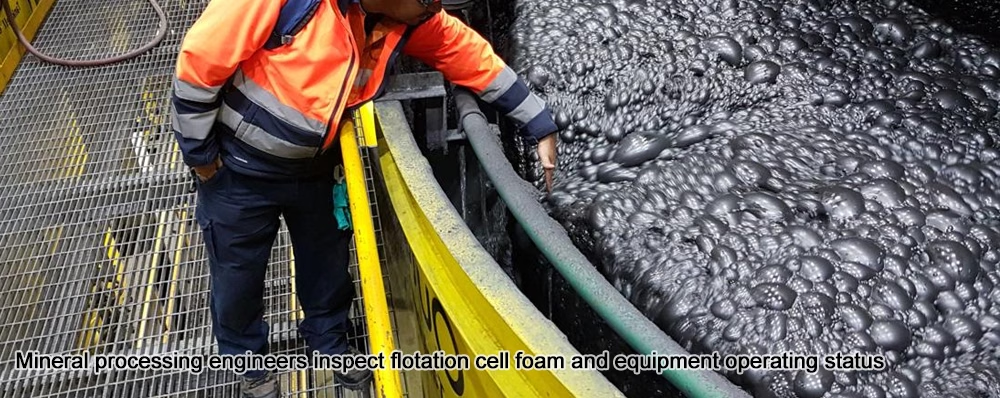
Step 5: Check the Reagent System
Record the actual consumption of each reagent, not just the set dosage.
Key areas to check:
- Collector dosage.
- Frother dosage.
- Inhibitor and activator dosage.
- pH adjuster dosage.
- Reagent concentration.
- Dosage sequence and dosing points.
If foaming issues occur after reagent batch or preparation system adjustments, prioritize verifying reagent supply stability.
Step 6: Check the Flotation Machine Operating Status
Compare abnormal equipment with normal equipment:
- Is the aeration rate consistent?
- Is the liquid level stable?
- Are the impeller and stator functioning normally?
- Is the stirring abnormal?
- Is the frothing mechanism working properly?
- Is the concentrate discharge unobstructed?
Do not blindly increase the aeration rate without checking. Increasing the aeration rate does not necessarily improve mineral recovery.
Step 7: Make Small-Scale Adjustments and Verify Results
Adjust only one major variable at a time, keeping other conditions stable.
For example:
First check the actual amount of frother added, then adjust based on the test results; do not change the frother, collector, pH, and aeration rate simultaneously.
Record after adjustment:
- Concentrate grade.
- Tailure grade.
- Metal recovery rate.
- Concentrate yield.
- Foam drainage and stability.
- Reagent consumption.
Only when the improvement in foam is consistent with the improvement in mineral processing indicators can the adjustment be considered effective.
Flotation Foam Problems and Solutions Comparison Table
The following table can be used as a reference for daily inspections and troubleshooting in mineral processing plants.
| Abnormal Phenomena | Prior Suspected Causes | Suggested Solutions |
| Rapid Foam Bursting | Insufficient Frothing Agent Supply, Unstable Gas Flow | Check Dosing and Aeration Systems |
| Excessive Foam | Excessive Frothing Agent, Changes in Ore Properties | Verify Reagent Consumption, Conduct Condition Tests |
| Sticky Foam | Increased Fine Sludge, Poor Foam Drainage | Check Grinding Fineness, Foam Layer Depth |
| Excessively Large Bubbles | Uneven Aeration, Abnormal Frothing Agent | Check Gas Path and Equipment Operating Status |
| Decreased Concentrate Grade | Gangite Entrainment, Decreased Reagent Selectivity | Check Water Recovery Rate, Reagent Regime |
| Increased Tailings Grade | Insufficient Mineral Liberation, Inadequate Collection | Check Particle Size, Mineral Liberation, and Reagents |
| Simultaneous Abnormalities in Multiple Flotation Cells | Changes in Raw Ore, Water Quality, or Reagent System | Investigate Common Upstream Conditions |
| Abnormalities in a Single Flotation Cell | Local Mechanical or Control Failure | Check Impeller, Stator, Gas Path, and Liquid Level |
When should reagents be adjusted?
When anomalies are related to changes in ore properties, water quality, reagent formulation, or dosage, reagent regime validation should be prioritized.
However, it is important to note that reagent adjustments should be verified through laboratory flotation tests or controlled industrial trials, not solely based on the appearance of froth.
When should flotation equipment be overhauled?
When a single unit exhibits a significant anomaly while adjacent units are operating normally, the following should be carefully checked:
- Impeller wear.
- Stator damage.
- Aeration system blockage.
- Abnormal agitation.
- Level control malfunction.
When is it necessary to optimize the entire flotation process?
If the recovery rate remains low after reagent adjustments and equipment maintenance, further evaluation of the entire mineral processing process is required.
This includes:
- Is the grinding product particle size appropriate?
- Is the valuable mineral sufficiently liberated?
- Does the flotation time meet the mineral kinetic requirements?
- Are the roughing, cleaning, and scavenging configurations well-matched?
- Does the flotation equipment’s processing capacity meet the actual feed rate?
- Is the metal distribution in the concentrate and tailings reasonable?
It is not recommended to directly increase the number of flotation machines or replace them with larger equipment without a process evaluation.
Industrial Case Study: The Problem of Excessively Persistent Foam in Copper-Sulfur Flotation
The following is a hypothetical process case used to illustrate diagnostic methods; it is not actual production data from a mine.
Problem Background
At a copper-sulfur ore beneficiation plant, after a change in the raw ore blending ratio, the froth in the roughing stage gradually became more persistent, the concentrate yield increased, but the copper concentrate grade decreased.
Initially, on-site personnel believed it was due to excessive frother dosage and planned to directly reduce the dosage.
However, engineers believed it was necessary to first confirm whether there was an increase in fine mud and an increase in water recovery rate.
Cause Investigation
After comparing process data, the following possible factors were identified:
- The new blending contained a high content of fine particles in some ores.
- The proportion of fine mud in the grinding product increased.
- The froth drainage capacity decreased.
- The fine gangue entrainment in the concentrate increased.
Therefore, the problem cannot be simply attributed to excessive frother.
Optimization Measures
The following measures are recommended:
- Check the operating status of the ball mill and classifier.
- Mineral liberation analysis was performed on different particle sizes.
- The combination regime of frother and collector was re-validated.
- The depth of the froth layer and the aeration rate in the rougher were examined.
- The concentrate water recovery and gangue entrainment were compared.
Key Lessons Learned from the Case Study
This case study illustrates that excessively persistent froth in flotation is not necessarily a reagent problem.
The froth state can also change when ore properties and grinding particle size change.
The correct approach is to first identify the process changes and then optimize accordingly, rather than directly increasing or decreasing reagents.
How to determine if froth optimization is truly effective?
To determine if froth optimization in flotation is truly effective, one cannot only look at the appearance of the froth; a comprehensive assessment must be made considering the froth state, concentrate indicators, recovery rate, and production stability.
Key Indicators:
- Froth State: The froth should be uniform in size, moderately stable, and have good fluidity, without significant splashing or excessive viscosity.
- Concentrate Grade: Increased concentrate grade indicates improved enrichment of valuable minerals.
- Recovery Rate: Increased recovery rate of valuable minerals reduces the loss of valuable metals.
- Froth Layer Thickness: The froth layer should be stable, with smooth froth scraping, avoiding excessively thick or thin layers.
- Production Stability: Reasonable reagent consumption, reduced fluctuations in flotation indicators, and normal equipment operation.
Comparison Before and After Optimization: It is recommended to compare data before and after optimization using the same ore conditions and production load.
| Comparison Items | Effective Performance |
| Foam State | More uniform and stable |
| Concentrate Grade | Improved or met target |
| Recovery Rate | Improved or remained stable |
| Tailure Grade | Decreased |
| Reagent Consumption | Reasonable or reduced |
| Production Fluctuations | Reduced |
Final Judgment Criteria
Optimization effectiveness must simultaneously meet the following conditions:
- Significantly improved foam condition;
- Improved concentrate grade and recovery rate;
- Reduced loss of valuable minerals in tailings;
- No significant increase in reagent costs;
- Sustained stability of production indicators.
Special Note: More stable foam does not necessarily mean better results. Excessively stable foam may increase gangue entrainment, thus reducing concentrate grade.
Five Common Mistakes in Flotation Foam Optimization
In actual mineral processing, some seemingly simple operations can actually cause more serious process problems.
Mistake 1: More foam means higher recovery
This is a common misconception.
Increased foam quantity only indicates a change in bubble and foam state; it does not necessarily mean an increased recovery rate of useful minerals.
If gangue entrainment increases, it may lead to a decrease in concentrate grade.
Correct approach: Simultaneously check concentrate grade, tailings grade, metal recovery rate, and concentrate yield.
Mistake 2: Continuously increasing frother due to unstable foam
Unstable foam may be caused by insufficient frother, or it may be related to the aeration system, process water, ore properties, and equipment operating conditions.
Correct approach: First check reagent preparation, actual addition amount, and gas dispersion, then conduct reagent condition tests.
Mistake 3: The finer the grinding, the better
Over-grinding can produce a large amount of fine mud, increasing gangue entrainment and reagent consumption.
Correct Practice: Determine a reasonable grinding fineness based on mineral dissemination characteristics, grain size distribution, and degree of liberation.
Error 4: Using the same froth control parameters for all flotation cells.
Roughing, cleaning, and scavenging processes have different objectives; therefore, froth depth, aeration rate, and reagent regimes may not be the same.
Correct Practice: Determine operating parameters based on the flotation stage, ore properties, and equipment design.
Error 5: Observing only froth, not testing tailings.
Even if the froth appears stable, a continuously rising tailings grade may indicate that valuable minerals are not being effectively recovered.
Correct Practice: Combine on-site froth observations with laboratory tests, production data, and metal balance analysis.
How to Establish a Long-Term and Effective Flotation Foam Control System?
Establishing a long-term and effective flotation foam control system focuses on the following six aspects:
- Establish Control Standards: Clearly define the reasonable ranges for foam color, size, thickness, and stability.
- Stabilize Process Parameters: Control pulp concentration, aeration rate, liquid level, grinding particle size, and reagent dosage.
- Strengthen Daily Monitoring: Regularly observe the foam state and record changes in production parameters and indicators.
- Standardize Abnormal Handling: Analyze and adjust promptly for issues such as excessively large, viscous, or easily broken foam.
- Strengthen Personnel Management: Standardize operating procedures and enhance employee training and on-site management.
- Continuously Optimize and Improve: Continuously optimize control parameters based on concentrate grade, recovery rate, and reagent consumption.
Establish a standardized, regulated, and continuously optimized foam control mechanism to achieve stable foam, stable production, and stable indicators.
FAQ
Q1: What is the reason for excessive flotation foam?
Excessive flotation foam may be related to excessive dosage of frother, changes in ore properties, increase in fine mud, changes in aeration volume, and insufficient foam drainage.
It is recommended to check the actual chemical consumption, slurry properties and aeration system first, and then determine whether the foaming agent dosage needs to be adjusted.
Q2: Why is the flotation foam very stable but the concentrate grade is very low?
Stable foam does not mean good mineral sorting selectivity.
Possible reasons include excessive foaming agent dosage, fine-grained gangue entrainment, insufficient mineral dissociation, reduced collector selectivity, and unreasonable slurry pH.
Focus should be placed on checking the concentrate water recovery rate, particle size distribution, mineral composition and pharmaceutical system.
Q3: How to deal with the rapid collapse of flotation foam?
First check the foaming agent preparation concentration, metering pump, drug delivery pipeline and dosing point.
Then check the aeration stability, circulating water quality and slurry properties.
If only a single piece of equipment is experiencing rapid foam collapse, that equipment’s aeration and agitation system should also be checked.
Q4: Will the flotation foam problem affect the metal recovery rate?
meeting.
When the foam is too unstable, the useful minerals attached to the bubbles may fall off before entering the concentrate tank; when the foam is too stable, gangue entrainment may increase and the concentrate grade may be reduced.
The final extent of the impact needs to be confirmed through concentrate and tailings assays and metal balances.
Q5: How to judge whether the flotation machine needs maintenance or adjustment of chemicals?
If the abnormalities are concentrated in a single flotation machine, priority should be given to checking the aeration system, impeller, stator, liquid level control and bubble scraping mechanism.
Conclusion
If you encounter problems with flotation froth, don’t rush to add reagents or blindly increase the aeration rate.
More froth isn’t necessarily a good thing, and less froth isn’t necessarily a bad thing. We recommend identifying the problem first and then making targeted adjustments, rather than operating blindly.
If you encounter similar problems at your flotation site, please contact us! Tell us about the situation, and we’ll help you analyze the causes and find a more suitable optimization solution to make flotation production more stable and efficient.
Latest News

Small-Scale Gold Processing Plant: A Complete Guide to Equipment and Processes
800Setting up a small-scale gold processing plant sounds simple, but choosing the wrong equipment can lead to increasingly higher operating costs and negatively impact gold recovery rates. Many clients initially focus only on capacity, equipment…
-
The Role of Cyanide in Gold Mining: Process Flow and Mineral Processing Management
800In gold ore processing, cyanide is a commonly used leaching agent; it directly influences the gold leaching rate, overall recovery, and production costs. However, cyanide leaching is not merely a matter of adding chemicals—factors such as ore c…
-
How should you choose equipment for pre-desliming in gravity separation?
800Many operators struggle with low recovery rates when using shaking tables, sluice boxes, or centrifugal concentrators—even when the equipment itself is high-quality—only to find that valuable minerals are being lost in the tailings. The root ca…
-
How can the mineral processing method be preliminarily determined based on the appearance of tin ore?
800When you receive a batch of tin ore samples, what should you look at first? Is it the color, the particle size, or the clay content? While these visual characteristics can provide some initial insights, relying solely on the naked eye is not …


loading…
已经是到最后一篇内容了!