 Chunlei Mining Machinery

How should you choose equipment for pre-desliming in gravity separation?
Many operators struggle with low recovery rates when using shaking tables, sluice boxes, or centrifugal concentrators—even when the equipment itself is high-quality—only to find that valuable minerals are being lost in the tailings. The root cause is almost certainly a failure to perform proper pre-desliming. Fine clay (slimes) is the greatest enemy of gravity separation: it coats mineral particles, increases the viscosity of the pulp, blinds the surface of the separation equipment, and disrupts the stratification process—rendering even the best gravity separation machinery ineffective.
So, how exactly should you select desliming equipment? Should you opt for a hydrocyclone, a desliming screen, or a spiral classifier? There is no single “correct” answer; the choice depends on factors such as the ore’s particle size distribution, clay content, processing capacity, and the subsequent mineral processing flow. Let’s explore how to make the right equipment selection for your specific needs.
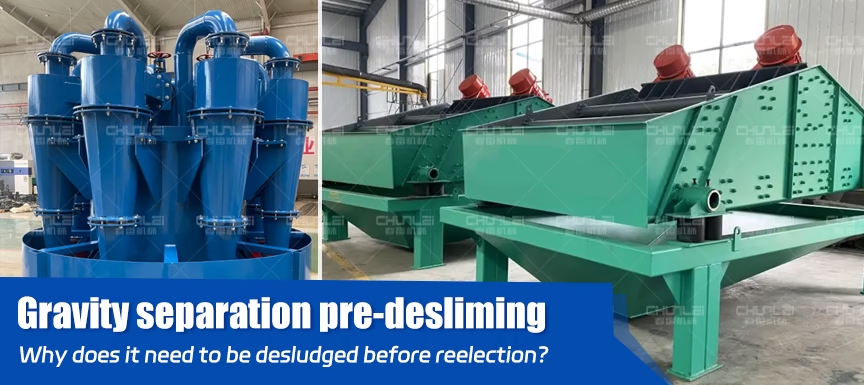
Why is pre-desliming necessary before gravity separation?
Gravity separation relies primarily on density differences between minerals. However, if the pulp contains a significant amount of fine slime, it can interfere with the proper stratification and movement of mineral particles.
This is particularly critical when processing heavy minerals—such as those containing tin, tungsten, gold, or tantalum-niobium—where an excess of fine slime can lead to the following issues:
- Impaired separation efficiency: Fine slime increases the viscosity of the pulp, disrupting the stratification of coarse and fine particles.
- Reduced concentrate grade: Fine slime and gangue minerals can easily report to the final concentrate.
- Operational disruptions: Fine material may cause screen blinding or unstable pulp flow.
- Increased production costs: Reduced efficiency in downstream separation processes, along with higher water consumption and an increased burden on downstream treatment stages.
Therefore, pre-desliming is not merely about separating solids from liquids; it is about removing the specific fine slimes that hinder gravity separation while retaining mineral particles that have economic value.
It should be noted that the particle size threshold for desliming cannot be determined by experience alone. If the valuable minerals themselves are already very fine, excessive desliming could inadvertently lead to the loss of these metals.
What are the common gravity selection pre-desliming equipments?
At present, the common desliming equipment before gravity separation mainly includes hydrocyclone, desliming screen, spiral classifier and hydraulic classification equipment. Their working principles are different, and their applicable particle size ranges and slurry conditions are also different.
1. Hydrocyclone
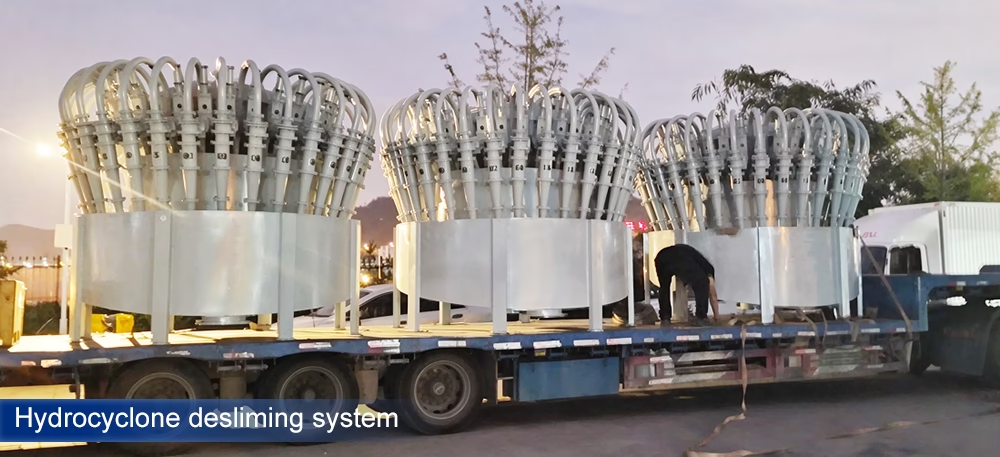
Hydrocyclones mainly use centrifugal force to classify slurry. The slurry enters the cyclone along the tangent line under pressure. Coarse and heavier particles are usually discharged from the underflow port, while finer particles are discharged more with the overflow.
Applicable situations:
- The fine mud content in the slurry is relatively high.
- Finer-grained classification and desliming are required.
- Subsequently, we will connect jigs, shakers and other re-selection equipment.
- The production line has a large processing capacity and requires continuous operation.
Key points in selection: Focus on the feeding pressure, cyclone diameter, underflow opening and overflow pipe size, and actual classification particle size.
2. Desliming Screen
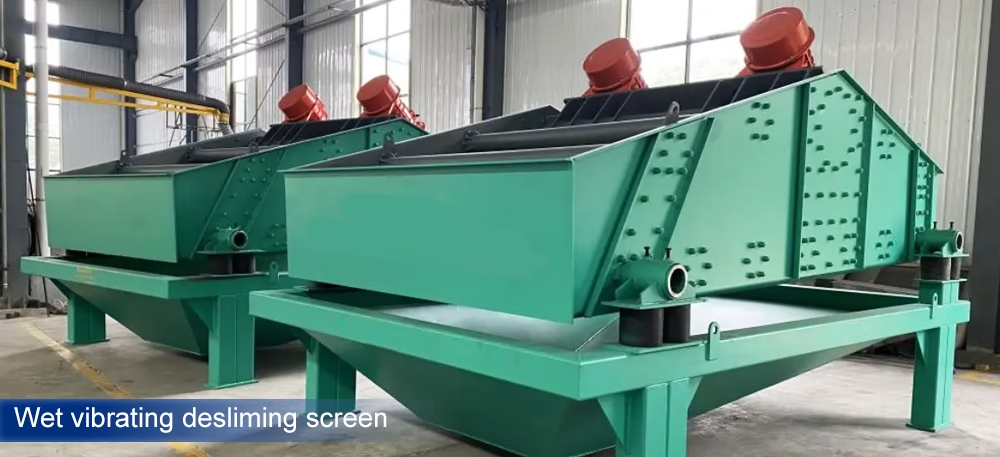
A desliming screen performs particle size separation primarily through a screen mesh. Under conditions of water spraying or wet screening, fine slimes and water pass through the screen apertures, while coarser particles remain on the screen surface and are conveyed forward.
Applications:
- The raw ore contains a significant amount of sand and coarse particles.
- Washing or screening is required prior to crushing or gravity separation.
- Coarse slime aggregates and fine-grained materials need to be removed.
- There is a need to separate and process ore fractions of different particle sizes.
Selection Criteria: Key factors include feed particle size, aperture size, screen surface area, throughput capacity, and the wear resistance of the screen mesh.
Note: Standard desliming screens cannot replace hydraulic classification equipment designed for fine particles. When dealing with large quantities of ultra-fine slimes, such screens are typically used in conjunction with equipment like hydrocyclones.
3. Spiral Classifier
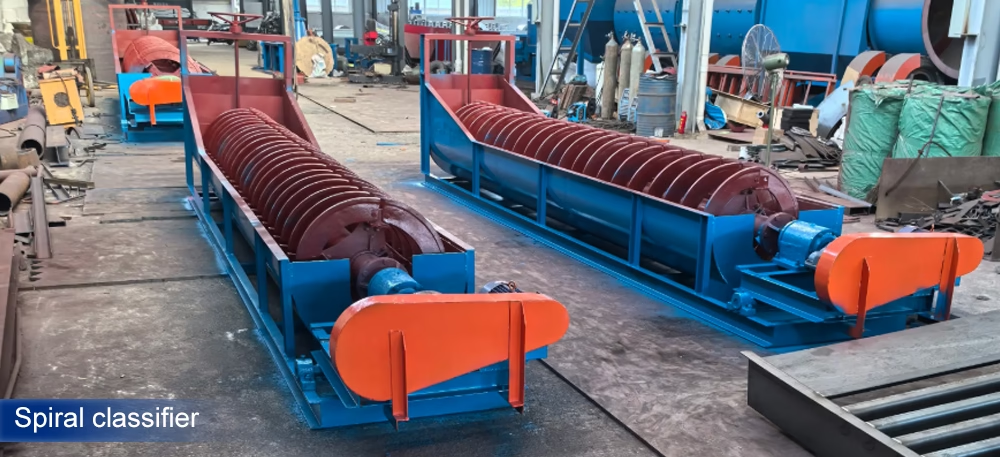
The spiral classifier uses the difference in sedimentation speed of mineral particles in water for classification. The coarser particles are discharged by the screw conveyor after settling, while the fine particles are discharged with the overflow.
Applicable situations:
- The slurry contains a certain proportion of coarse and fine particles.
- Continuous grading and washing are required.
- It is expected to be used in conjunction with grinding, classification or gravity separation processes.
Key points in selection: Pay attention to slurry concentration, processing capacity, classification particle size, tank size and spiral diameter.
What are the differences between various desliming devices?
When selecting equipment, one should not focus solely on price and processing capacity; it is also essential to consider the minimum particle size of the slime that can be handled, as well as the risk of losing valuable minerals in the process.
Below is a comparison of several common types of equipment:
| Device type | Main function | Applicable materials | Main features |
| Hydrocyclone | Fine particle classification and desliming | Fine-grained slurry | High grading efficiency and small footprint |
| Desliming screen | Wet screening and mineral washing | Medium coarse grained ore | Simple structure and easy maintenance |
| Spiral classifier | Classification of coarse and fine particles | Medium coarse grain pulp | Continuous operation with grading function |
Which equipment is best suited for your ore?
- Large mud clump scene: For situations such as placer tin ore, weathered placer gold, and laterite ore with a lot of clay and mud clumps, it is preferred to use a cylinder washing machine or a spiral scrubber to break up the mud clumps and then remove the mud.
- Fine-grained slurry scenario: When secondary fine mud generated by grinding, such as tungsten ore, tin ore, and fine-grained gold ore, needs to be removed from fine mud below 74 microns, a cyclone is the first choice to complete desliming or primary enrichment.
- Low-cost scenario: For small and medium-sized mineral processing projects with limited budget and stable slurry, desludging buckets, cone classifiers, and hydraulic classifiers can be used to operate on pure gravity sedimentation, with low power consumption and minimal maintenance.
- High-precision scenario: When there are requirements for classification accuracy and screen gap controllability, and when it is necessary to avoid fine underflow, a high-frequency fine screen can be used with a hydrocyclone to complete specific gravity classification.
In actual production, a combination of two types of equipment can also be used, such as a desliming screen combined with a hydrocyclone to first remove coarse mud and sand, and then process the fine mud.
How to Select Desliming Equipment Based on Ore Characteristics?
The suitability of the chosen equipment depends primarily on the nature of the ore itself. It is recommended to focus on the following five aspects:
- Look at the raw ore particle size
First understand the maximum feeding particle size of the ore, as well as the proportion of coarse, medium and fine particles.
If there are many coarse particles in the raw ore, you can give priority to the desliming screen; if there are many fine-grained slurries, you need to focus on hydrocyclones or hydraulic classification equipment. - Look at the mud content and mud properties
Some ores only have a small amount of soil attached to the surface and can be processed through water spraying and screening; some ores contain a large amount of clay, which easily forms mud when exposed to water, and ordinary screening may not be able to meet the requirements.
In this case, it may be necessary to scrub and wash the ore first, and then perform graded desliming. - Look at the particle size of useful minerals
This is very important.
For example, cassiterite, tungsten minerals, and gold minerals, some of the useful minerals in the ores may have been fine-grained. If the desliming particle size is not set appropriately, fine-grained useful minerals may overflow into the tailings.
Therefore, it is best to conduct particle size screening analysis, mineral composition analysis and desliming test before selection to determine whether the fine mud contains recoverable minerals. - Look at the actual processing volume
The equipment processing capacity cannot only be selected according to ideal working conditions, but also considers the slurry concentration, ore feeding fluctuations and continuous operation requirements of the production line.
If the processing capacity of the production line is large, multiple cyclones can be considered in parallel, or a combination of screening and classification can be used. - See the subsequent reselection of equipment.
The desliming equipment does not work alone and must be matched with the subsequent re-selection equipment.
For example:
◎ In the subsequent use of jig machines, attention should be paid to the selected particle size and the stability of the slurry.
◎ In the subsequent use of a shaking table, focus should be placed on controlling the ore particle size, concentration and fine mud content.
◎ In the subsequent use of spiral chute, attention should be paid to the selected particle size composition and slurry flow rate.
Core principle: The desliming equipment should serve for subsequent re-selection, rather than simply pursuing the larger the desliming volume, the better.
What should be considered when selecting pre-desliming equipment for gravity separation circuits?
In many mineral processing plants, equipment fails to deliver the expected performance—not because of poor quality, but because the initial selection process was not sufficiently thorough.
Pay special attention to the following points:
- Do not rely solely on the rated processing capacity.
The stated processing capacity of a piece of equipment does not necessarily equate to its actual capacity for a specific ore. Factors such as pulp density, particle size distribution, and clay/sludge content can significantly affect operational performance. - Do not overlook the loss of fine-grained valuable minerals.
Effective desliming does not automatically guarantee high metal recovery. It is essential to analyze the content of valuable minerals in both the overflow and underflow streams and to conduct a thorough metal balance analysis. - Consider equipment wear and maintenance costs.
If the ore pulp contains a high proportion of hard particles—such as quartz—components like cyclone liners, pipelines, and screens are prone to wear.
When selecting equipment, evaluate the use of wear-resistant materials, the replacement costs for high-wear parts, and the ease of routine maintenance. - Do not ignore water supply and pulp density.
Desliming equipment requires stable feed conditions. An insufficient water supply, fluctuations in pulp density, or pipeline blockages can all compromise classification efficiency. - Conduct mineral processing tests whenever possible.
If the ore characteristics are complex, it is advisable to perform small-scale desliming tests first. Observe the product particle size, metal distribution, and desliming efficiency under various equipment configurations and classification conditions before finalizing the selection of industrial-scale equipment.
Pre-desliming Equipment for Gravity Concentration FAQ
Q: What is pre-desliming equipment for gravity concentration?
A: Pre-desliming equipment is used prior to gravity concentration processes to remove fine slimes, clays, and certain fine-grained impurities from the ore pulp. This minimizes the negative impact of slimes on the subsequent gravity separation performance and improves the recovery efficiency of valuable minerals.
Q: Why is pre-desliming necessary before gravity concentration?
A: Fine slimes in the ore pulp can cause mineral particles to adhere to one another, lead to unstable pulp density, and impair the separation precision of gravity concentration equipment. Pre-desliming improves feed conditions by reducing interference from fine slimes.
Q: What are some common types of pre-desliming equipment for gravity concentration?
A: Common equipment includes ore washers, trommel screens (cylindrical screens), spiral classifiers, hydrocyclones, and desliming cones. The choice of equipment depends on the specific characteristics of the ore, its particle size distribution, and the required processing capacity.
Q: For which types of ore is pre-desliming equipment suitable?
A: It is primarily used for ores with high clay or slime content—such as alluvial tin, alluvial gold, tungsten, and tantalum-niobium ores—as well as other ores requiring gravity concentration, especially those containing significant amounts of clay and fine-grained slimes.
Q: How should one select the appropriate pre-desliming equipment?
A: Selection should be based on factors such as the ore’s clay/slime content, feed particle size, pulp density, processing capacity, and the particle size distribution of the valuable minerals. For ores with high clay content, the equipment’s washing and scrubbing capabilities must also be considered.
Q: Can pre-desliming lead to the loss of valuable minerals?
A: It is possible. If the desliming cut-size (the particle size threshold for removal) is not set correctly, some fine-grained valuable minerals may be lost along with the overflow or the removed slimes. Therefore, ore sieve analysis and desliming tests should be conducted before selecting equipment to determine an optimal cut-size.
Q: How is the processing capacity of pre-desliming equipment determined?
A: It is primarily determined based on the total volume of raw ore to be processed, the ore’s clay/slime content, the pulp density, and the required desliming efficiency. During the actual selection process, it is also necessary to consider variations in ore properties and the feed requirements of the downstream gravity separation equipment.
Q: Where should pre-desliming equipment be positioned within a gravity separation circuit?
A: It is typically installed after preliminary processing stages—such as ore washing or screening—and before the gravity separation equipment. The exact placement should be determined based on the ore characteristics and the overall beneficiation flowsheet, ensuring that the particle size and pulp density of the feed entering the gravity separation equipment meet the required specifications.
Q: What are the consequences of ineffective pre-desliming?
A: Inadequate desliming allows a large volume of fine slimes to enter the gravity separation equipment, which interferes with mineral stratification and particle settling, thereby reducing separation efficiency. Conversely, excessive desliming may lead to the loss of fine-grained valuable minerals, negatively impacting the final concentrate recovery rate.
Q: How can the operational efficiency of pre-desliming equipment be improved?
A: First, control the feed particle size and pulp density. Second, optimize the equipment’s operating parameters, and conduct regular inspections of screens, slime discharge outlets, and components prone to wear. Additionally, desliming conditions should be adjusted in a timely manner to account for fluctuations in the slime content of the ore.
Conclusion
There is no single, fixed method for selecting desliming equipment; the choice depends primarily on the specific characteristics of your ore. If the ore contains a high proportion of fine slimes, hydrocyclones are a suitable option; for ores with a higher content of coarse particles, desliming screens may be preferred. In cases where continuous classification is required, spiral classifiers or other hydraulic classification equipment can also be considered.
However, selecting equipment based solely on model specifications is insufficient. You must also account for factors such as ore particle size distribution, clay/slime content, and the distribution of valuable minerals. The goal is to achieve thorough removal of fine slimes while minimizing the loss of valuable minerals.
If you are currently planning a gravity separation production line—or if your existing equipment is failing to provide effective desliming—please share the details of your ore and your target processing capacity with us. We can help you determine the most appropriate equipment and process flow, ensuring you avoid the pitfalls of selecting the wrong machinery, which could otherwise compromise your downstream mineral processing results.
Unsure which desliming equipment is best for your ore? Contact us today for professional selection advice!
Latest News

How can the mineral processing method be preliminarily determined based on the appearance of tin ore?
800When you receive a batch of tin ore samples, what should you look at first? Is it the color, the particle size, or the clay content? While these visual characteristics can provide some initial insights, relying solely on the naked eye is not …
-
Which types of tin ore are the most difficult to process?
800Not all tin ores are easy to process. For some alluvial (placer) tin deposits, a simple combination of washing, screening, and gravity separation is often sufficient to produce a high-quality tin concentrate. Primary (lode) tin deposits, howeve…
-
How can the recovery rate of tin from high-sludge oxidized alluvial tin ores be effectively improved?
800When dealing with oxidized alluvial tin ores containing high levels of sludge (fine clay/silt), many processing plants initially consider adding more jigs or shaking tables, or increasing the processing capacity of their existing equipment. I…
-
What is the difference between sulfide tin ores and oxide tin ores?
800Those involved in tin ore processing have likely encountered this scenario: the raw ore has a decent tin content, yet after crushing, grinding, and beneficiation, the concentrate grade remains low, while a significant amount of tin is lost to t…
loading…
已经是到最后一篇内容了!