 Chunlei Mining Machinery
Gold Ore Processing: From Crushing to Final Gold Recovery
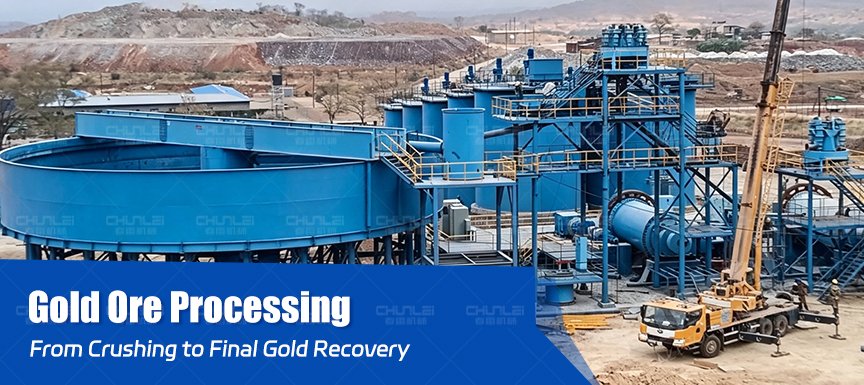
Gold Ore Processing: Why the Process Flow Matters More Than Individual Equipment
A gold processing plant is not merely a simple assembly of crushers, ball mills, and gold recovery equipment; rather, the goal is to determine the optimal process flow based on factors such as mineral composition, gold particle size, ore hardness, liberation characteristics, and gold recovery properties.
Even if two gold ores share the same gold grade, they may require different processing methods due to differences in their constituent materials.
Simply using larger crushers or ball mills does not necessarily improve gold recovery rates. The objective is to achieve sufficient mineral liberation while avoiding over-grinding, and then to direct the liberated gold into the appropriate recovery stage.
A typical gold ore processing workflow generally follows this sequence:
Ore Characterization → Crushing → Grinding and Classification → Gravity Separation/Flotation → Leaching → Gold Recovery → Tailings Management
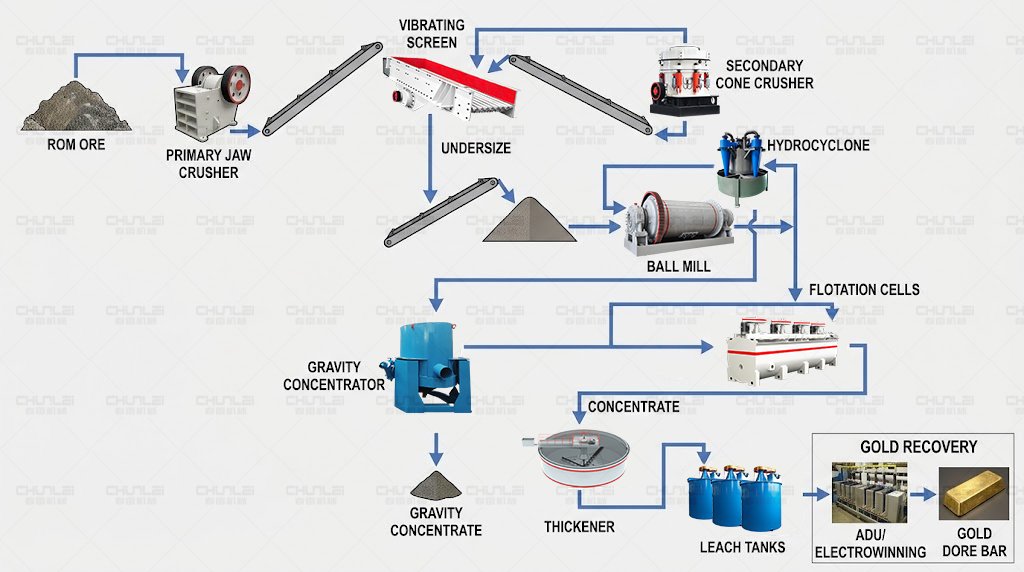
Gold Ore Processing Flowchart
The gold ore processing workflow typically comprises the following stages:
Run-of-mine ore → Primary crushing → Secondary/tertiary crushing → Grinding → Classification → Gravity separation → Flotation and/or leaching → Gold recovery → Tailings treatment
However, not every gold mining project requires all of these steps.
For instance, with easily processed ores containing coarse native gold, gravity separation equipment can be integrated into the grinding circuit for early-stage gold recovery; for sulfide gold ores, flotation may be required to produce a gold-bearing sulfide concentrate; and for refractory gold ores, a pre-treatment step might be necessary prior to conventional cyanide leaching.
Start with the Gold Ore, Not the Equipment
Before selecting equipment, it is essential to first determine the mode of occurrence of the gold within the ore.
This is one of the most critical steps in gold ore processing, as mineralogical characteristics directly influence subsequent decisions regarding crushing and grinding sizes, as well as the gold recovery method.
Gold Particle Size
Gold may exist in the ore in the following forms:
- Coarse-grained native gold
- Fine-grained liberated gold
- Gold associated with sulfides
- Gold encapsulated within sulfides
- Ultra-fine or sub-microscopic gold
Coarse-grained native gold is typically suitable for gravity separation, whereas fine-grained gold or gold encapsulated by other minerals usually requires further grinding for liberation, and potentially flotation or leaching.
Ore Hardness and Grindability
Hard ores require more energy for crushing and grinding.
Key factors to consider include:
- Feed particle size
- Bond Work Index
- Abrasiveness
- Moisture content
- Target product particle size
- Processing capacity
Therefore, a ball mill should be selected based on the specific grinding task, rather than simply choosing a model based on its nominal rated capacity.
Relationship Between Gold and Other Minerals
Start by asking a fundamental question:
Where exactly is the gold located?
If the gold is primarily associated with sulfides such as pyrite or arsenopyrite, crushing and grinding alone may not sufficiently expose the gold; further concentration via flotation or other methods may be required.
For refractory gold ores, depending on the ore properties, pretreatment methods such as bio-oxidation, pressure oxidation, or roasting may be necessary prior to cyanidation leaching.
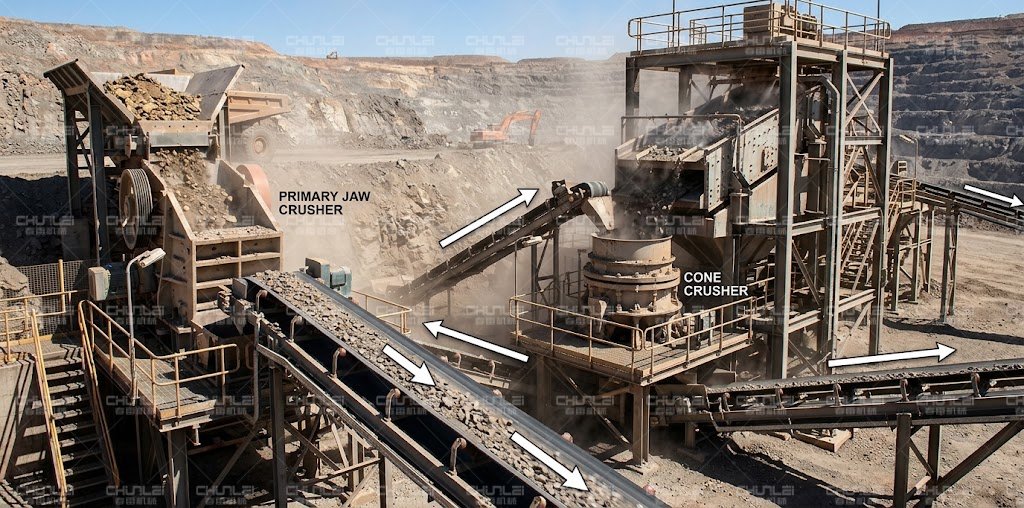
Coarse crushing: reduce raw ore particle size
Coarse crushing is to break large pieces of raw ore into particle sizes suitable for subsequent fine crushing and grinding. It is usually the first crushing process after gold ore enters the concentrator.
Jaw crusher is used for coarse crushing
Jaw crusher is often used for coarse crushing of gold ore because it can handle larger feed materials and stably crush the raw ore to the particle size required for the next stage.
Equipment selection mainly depends on:
- Maximum feeding particle size
- processing power
- Ore hardness
- Abrasiveness of ore
- Discharge particle size
Why does excessive crushing cause problems?
If the ore is broken too finely during the crushing stage, energy consumption will increase and unnecessary fine particles will be produced.
A more reasonable method is to determine the target crushed product particle size according to the requirements of the grinding circuit, so that the ball mill can obtain stable and appropriate feed materials.
Secondary and Tertiary Crushing: Controlling Feed Size for the Grinding Circuit
After primary crushing, ore typically requires secondary or even tertiary crushing.
Cone crushers are a common choice for this stage.
By operating in a closed-circuit configuration with vibrating screens, oversized material is returned to the crusher for further reduction, while material meeting the target size proceeds to the next stage.
Key Considerations
For gold ore crushing systems, the following factors require attention:
Feed size → Reduction ratio → Screening efficiency → Circulating load → Final crushed product size
A typical crushing flowsheet might look like this:
Jaw crusher → Vibrating screen → Cone crusher → Vibrating screen → Fine ore bin
The specific configuration must be determined based on ore characteristics and the feed requirements of the grinding circuit.
For example, a published gold processing case study utilizes a jaw crusher for primary crushing, followed by secondary and tertiary cone crushers, with screening used to control the material entering the grinding circuit to a P80 of approximately 6–8 mm.
Grinding and Classification: The Critical Stage for Mineral Liberation
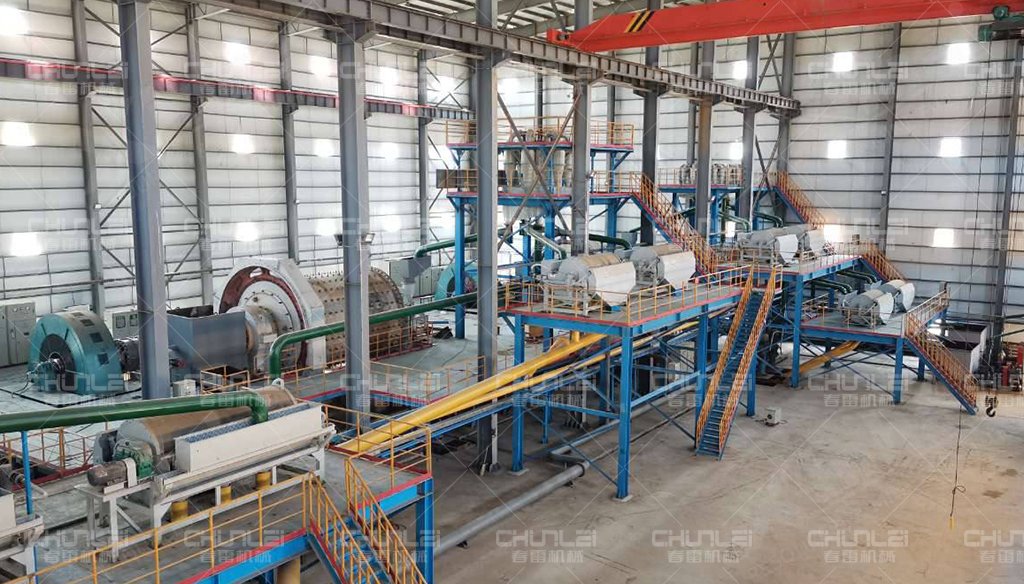
While crushing prepares the feed material, grinding determines the extent of mineral liberation—a key factor in gold recovery rates.
A typical grinding circuit includes:
Fine ore bin → Feeder → Ball mill → Hydrocyclone → Cyclone overflow → Downstream recovery
Cyclone underflow is returned to the ball mill for further grinding, while overflow meeting the target particle size proceeds to the downstream recovery stage.
Why is grinding size important?
Grinding ore finer is not always better; the goal is to expose sufficient gold while avoiding over-grinding.
If the grind size is too coarse, gold may remain encapsulated within gangue or sulfide minerals.
If the grind is too fine, energy consumption increases and excessive fines (slimes) are produced, which can interfere with downstream separation processes.
Therefore, determining the target grind size through testing is crucial.
P80 is a key grinding metric.
P80 indicates the particle size at which approximately 80% of the material passes through.
For example:
P80 = 75 μm
This means that approximately 80% of the product has a particle size smaller than 75 μm.
Do not simply adopt a grind size used at another gold mine for your own operation. Different ores vary in mineral composition and gold occurrence characteristics, requiring different liberation sizes.
Gravity Separation: Recovering Native Gold as Early as Possible
Gravity separation is generally well-suited for gold that exists in a relatively coarse, liberated state.
Common equipment includes:
- Jigs
- Centrifugal concentrators
- Shaking tables
Other gravity separation equipment selected based on the specific flowsheet
The core concept is simple:
Recover the gold as early as possible once it has been liberated.
If coarse native gold continues to circulate within the grinding circuit, it may undergo unnecessary regrinding.
Consequently, some gold mines install gravity separation equipment near the grinding and classification circuit.
When is gravity separation suitable?
Gravity separation is worth considering if test work indicates a significant proportion of gravity-recoverable gold in the ore.
However, the fact that gold has a high density does not mean that gravity separation is suitable for all gold ores.
The key question that must be answered is:
At the actual particle size, exactly how much gold can be recovered via gravity separation?
Flotation: Suitable for gold associated with sulfides
When gold primarily co-exists with sulfide minerals such as pyrite, flotation can be a key recovery method.
Instead of processing the entire ore body directly, gold-bearing sulfides can first be concentrated via flotation, followed by further processing of the concentrate.
A simplified flowsheet is:
Grinding → Pulp conditioning → Roughing → Cleaning → Gold-bearing concentrate
The flotation concentrate may subsequently require regrinding and leaching, or pretreatment if the ore is refractory.
Why might regrinding be necessary?
In addition to the valuable gold-bearing sulfides, the rougher concentrate may contain other minerals.
Regrinding can further improve the degree of mineral liberation, creating favorable conditions for downstream processing.
The goal is not simply to produce the finest possible concentrate, but to achieve the degree of liberation required for the next processing stage.
Comparison of gravity separation and flotation
| Comparison Factor | Gravity Separation | Flotation |
| Best Suited For | Coarse-grained/native gold | Fine-grained gold or gold associated with sulfides |
| Basic Principle | Density difference | Difference in surface properties |
| Grinding Requirements | Generally moderate | Usually requires controlled liberation |
| Typical Products | Gravity concentrate | Gold-bearing concentrate |
| Main Limitations | Effectiveness may decrease for fine-grained gold | Influenced by mineral properties and reagent conditions |
In actual production, the two methods are not mutually exclusive; instead, they can be used in combination.
Gold Leaching: Recovering Residual Leachable Gold
Following gravity separation and/or flotation, if the ore is amenable to leaching, additional gold can be recovered through this process.
Cyanide leaching is widely used in conventional gold processing circuits, including CIL and CIP processes.
CIL Gold Processing
CIL stands for Carbon-in-Leach.
In the CIL process, gold enters the cyanide-bearing solution and is simultaneously adsorbed onto activated carbon.
Simplified process flow:
Milled slurry → Leaching → Gold dissolution → Activated carbon adsorption → Gold-loaded carbon
What is the difference between CIP and CIL?
CIP – Carbon-in-Pulp
Leaching and activated carbon adsorption take place in separate stages.
CIL – Carbon-in-Leach
Leaching and activated carbon adsorption occur within the same series of tanks.
The specific choice depends on ore characteristics, leaching kinetics, carbon adsorption properties, and the overall process design.
What factors can cause a drop in gold leaching recovery?
Common causes include:
- Insufficient liberation
- Gold encapsulated by sulfides
- Inadequate leaching time
- Insufficient oxygen levels
- Excessive reagent consumption
- Interference from “preg-robbing” minerals
- Unsuitable particle size
- Refractory ore characteristics
Therefore, low recovery does not necessarily mean the problem lies within the leaching tanks.
The issue may have originated as early as the crushing or grinding stages.
Refractory gold ores require distinct processing strategies.
For some gold ores, achieving satisfactory recovery rates via conventional cyanidation is difficult because the gold is encapsulated by other minerals or chemically shielded.
Typical refractory characteristics include:
- Gold associated with pyrite
- Gold associated with arsenopyrite
- Gold encapsulated by other sulfides
- Presence of carbonaceous matter or “preg-robbing” minerals
In such cases, a pre-treatment step may be required.
Common pre-treatment methods for refractory gold ores
Based on test results, the following options may be considered:
Flotation → Concentrate → Fine grinding → Bio-oxidation / Pressure oxidation / Roasting → Leaching → Gold recovery
The specific process route should be determined by beneficiation test work, rather than selecting equipment first and then forcing the ore to suit that equipment.
Final Gold Recovery
Once the gold has fully dissolved and been adsorbed onto activated carbon, the process enters the final gold recovery stage.
Depending on the specific process flow, subsequent steps may include:
Gold-loaded carbon → Desorption → Gold-bearing solution → Electrowinning → Smelting → Gold sludge/Gold bullion
The specific workflow depends on the scale of the processing plant and the process design.
It is important to note:
Extracting gold from ore is not synonymous with obtaining a final, marketable gold product.
A processing plant may achieve excellent leaching results, yet attention must still be paid to the handling of gold-loaded carbon, desorption, electrowinning, smelting, and solution management.
How is gold recovery calculated?
Gold recovery should be analyzed based on the entire process rather than evaluating a single piece of equipment in isolation.
A basic formula is:
Gold recovery (%) = Amount of gold recovered ÷ Amount of gold in feed × 100
In mass balance calculations, the following can also be used:
Gold recovery (%) = (C × Gc) ÷ (F × Gf) × 100
Where:
F = Feed mass
Gf = Gold grade of the feed
C = Mass of concentrate/product
Gc = Gold grade of concentrate/product
For the entire processing plant, one can compare the gold entering the system with the gold in the final product to analyze gold losses.
Example
Assume:
Feed mass = 100 t
Run-of-mine (ROM) gold grade = 2 g/t Au
Gold content in ROM = 200 g
If the final recovered gold amount is 160 g:
Recovery = 160 ÷ 200 × 100 = 80%
The remaining 40 g of gold did not end up in the final recovered product, so the cause needs to be investigated further.
The more important question is:
Where exactly did that 40 g of gold go?
It could be present in:
- Crushing losses
- Grinding circuit
- Gravity separation tailings
- Flotation tailings
- Leach residue
- Solution losses
- Gold-loaded carbon processing
In this scenario, systematic sampling and metal balance analysis are more valuable than simply looking at equipment parameters.
How can gold recovery rates be improved without simply grinding the ore finer?
When faced with a drop in recovery rates, the immediate reaction for many is to grind the ore finer. However, this is not always effective; over-grinding can generate excessive fines and increase energy consumption, potentially hindering downstream recovery.
The key factors to focus on are:
- Examine the mode of gold occurrence: Treatment methods differ depending on whether the gold is free-milling, encapsulated in sulfides, or fine-grained.
- Determine the optimal liberation size: The goal is “adequate liberation,” not “the finer, the better.”
- Optimize classification: Check hydrocyclones, slurry density, and circulating loads to prevent over-grinding or the carry-over of coarse particles to downstream stages.
- Match the recovery process: Consider gravity separation for free gold, flotation for sulfide-hosted gold, and processes like CIL/CIP for ores suitable for leaching.
- Balance recovery rates and energy consumption: Identify the grinding size that is economically optimal.
What does a complete gold ore processing workflow look like?
The common gold ore processing workflow can be summarized as follows:
Run-of-mine (ROM) ore → Crushing → Screening → Grinding → Classification → Gravity Separation/Flotation/Leaching → Gold Recovery → Tailings Treatment
Specifically:
- Crushing: Using equipment such as jaw crushers and cone crushers to reduce large raw ore chunks to a suitable particle size.
- Screening: Controlling the particle size of crushed products; material meeting specifications proceeds to grinding, while oversized material is returned for further crushing.
- Grinding: Using ball mills to grind the ore finely, ensuring full liberation of gold minerals from the gangue.
- Classification: Using hydrocyclones to control the particle size of the ground product; coarse particles are returned to the ball mill.
- Gold Recovery: Selecting the process based on the mode of gold occurrence:
- Free gold or coarse-grained gold → Gravity separation
- Gold associated with sulfides → Flotation
- Leachable ore → Leaching processes such as CIL (Carbon-in-Leach) or CIP (Carbon-in-Pulp)
- Concentrate/Gold Sludge Treatment: Further enrichment and extraction of gold.
- Tailings Treatment: Thickening, dewatering, or dry stacking to reduce tailings management costs.
CHUNLEI Friendly Reminder: The workflow is not fixed; the specific crushing, grinding, and subsequent recovery processes are determined based on ore properties, gold dissemination size, and the mode of occurrence. If you are unsure how to configure the production line, please consult CHUNLEI engineers immediately; we will provide a high-quality, customized solution for free based on your specific situation.
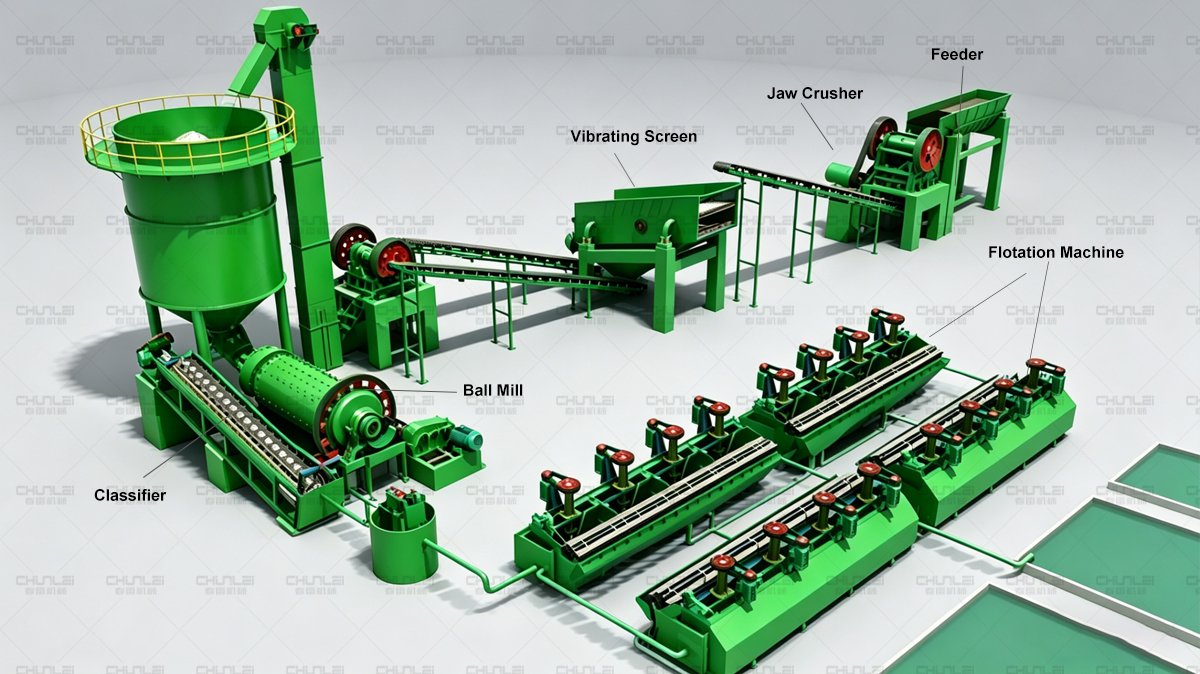
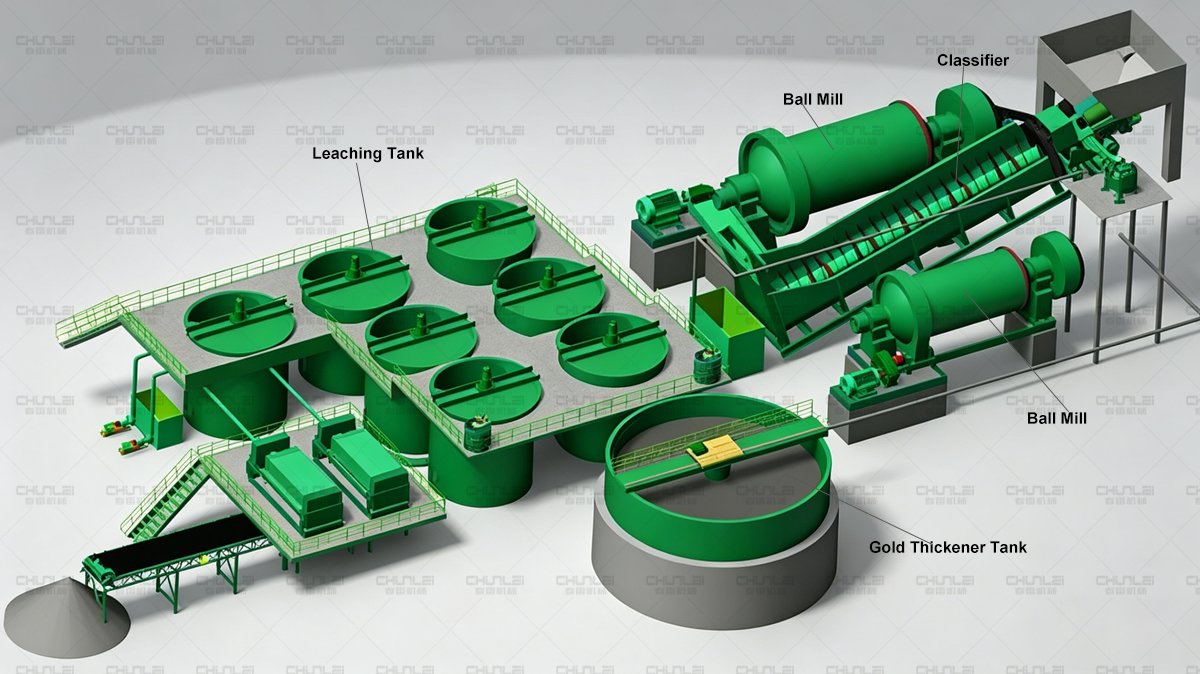
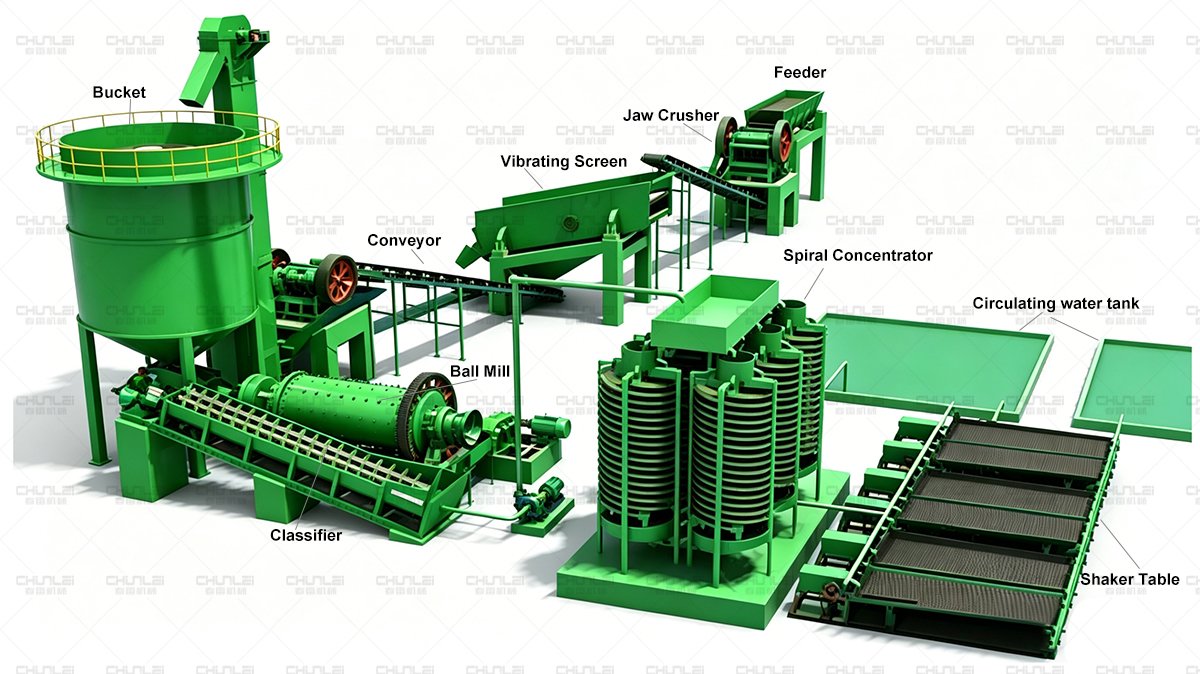
Case Analysis: Why do different ores require different grinding parameters?
The goal of grinding is not simply “the finer, the better,” but rather to achieve the degree of mineral liberation required for subsequent beneficiation processes.
Different ores vary in mineral composition, hardness, mineral dissemination size, and the downstream beneficiation methods employed; consequently, the required grinding fineness differs.
Simply put:
- Coarse mineral dissemination → Liberation is achieved at a coarser particle size; over-grinding is unnecessary.
- Fine dissemination of valuable minerals → Finer grinding is required to liberate the valuable minerals from the gangue.
- Hard ore → More grinding energy is needed to reach the same fineness; grinding parameters must be adjusted based on equipment capacity.
- Different downstream beneficiation methods → Varying particle size requirements (e.g., flotation, gravity separation, and magnetic separation have different requirements for feed particle size).
- Over-grinding can reduce recovery rates → It generates excessive fines, increases energy consumption, and may even impair the performance of subsequent flotation or gravity separation.
Therefore, in practical mineral processing, a more rational approach follows this logic:
Ore properties → Liberation size → Grinding fineness → Classification parameters → Downstream beneficiation → Final recovery rate
For example, regarding gold ores: some allow for the liberation of gold particles at a coarser size, whereas ores where gold-bearing minerals are tightly intergrown with gangue may require finer grinding.
The core objective is not to target a fixed mesh size, but to determine grinding parameters that balance sufficient liberation, the avoidance of over-grinding, and economic viability.
Common Mistakes in Gold Processing
Mistake 1: Selecting equipment before conducting ore testing
Crushers and ball mills cannot compensate for a flawed recovery process.
Better approach: Conduct ore characterization and beneficiation tests first.
Mistake 2: Blindly adopting the grind size used by another gold mine
A P80 value used at another mine does not necessarily suit your ore.
Better approach: Determine the gold liberation size through testing.
Mistake 3: Assuming finer grinding is always better
Over-grinding increases energy consumption and may negatively affect downstream separation.
Better approach: Grind only to the point where adequate liberation is achieved.
Mistake 4: Ignoring coarse native gold
If the ore contains coarse free gold, sending it directly to flotation or leaching may result in missed opportunities for early gravity recovery.
Better approach: Assess the proportion of gravity-recoverable gold within the grinding circuit.
Mistake 5: Assuming low recovery rates are always due to the leaching system
Gold may be lost prior to the leaching stage.
Better approach: Conduct a metal balance analysis across the entire beneficiation process.
Mistake 6: Treating refractory gold ore as standard, easily leachable ore
If gold is encapsulated in sulfides, conventional cyanide leaching may fail to achieve expected recovery rates.
Better approach: Identify refractory characteristics early and evaluate appropriate pre-treatment processes.
FAQ
Q: What is the first step in gold ore processing?
A: Typically, ore characterization and beneficiation testing are conducted before proceeding to the crushing stage. Before finalizing the process flow, it is essential to understand the mineral composition, gold particle size, ore hardness, and the mode of gold occurrence.
Q: What equipment is commonly used for grinding gold ore?
A: Depending on the processing scale, feed size, and ore characteristics, ball mills or SAG mills may be used. Hydrocyclones are commonly employed to control the particle size of the ground product.
Q: How fine does gold ore need to be ground?
A: There is no single grinding size applicable to all gold mines. The required P80 depends primarily on the degree of gold liberation and the mode of gold occurrence. Some gold ores can be processed at coarser sizes, whereas refractory or finely disseminated gold ores may require finer grinding.
Q: Can gravity separation recover all the gold?
A: No. Gravity separation is particularly effective for recovering native gold—especially relatively coarse gold—that responds well to gravity-based methods. Fine-grained or encapsulated gold may require flotation, leaching, or other processing methods.
Q: Why is the recovery rate still low even after grinding the gold ore very finely?
A: Fine grinding does not guarantee high recovery rates. Gold may remain encapsulated within sulfides; alternatively, recovery may suffer due to excessive fineness, poor flotation or leaching performance, or the refractory nature of the ore itself. Therefore, it is necessary to evaluate the entire recovery process rather than focusing solely on the grinding size.
Conclusion
When undertaking a gold mining project, don’t start by asking, “Which ball mill or crusher is the best?”
Ultimately, it all depends on your specific ore.
Factors such as ore hardness, the mode of gold occurrence, the required grind fineness, and the downstream processing method—whether gravity separation, flotation, or leaching—will all influence the final recovery rate.
Therefore, bigger equipment isn’t necessarily better, nor is finer grinding always the ideal choice. The right solution is a process tailored to your ore that consistently improves mineral liberation and recovery rates.
If you are unsure about the best approach for crushing, grinding, and beneficiation for your gold mine, simply provide us with details regarding the ore type, processing capacity, run-of-mine particle size, and target recovery rate. CHUNLEI can then help you determine the appropriate process flow and equipment configuration based on your specific conditions. Contact us today!
Latest News

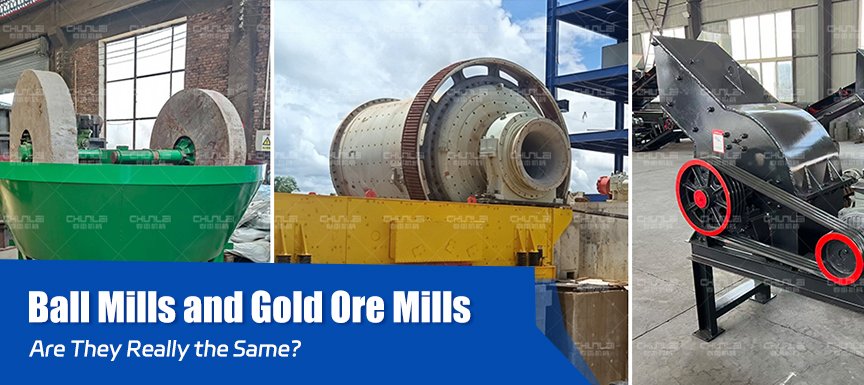
Ball Mills and Gold Ore Mills: Are They Really the Same?
800When searching for gold ore grinding equipment, customers often encounter various terms such as “Ball Mill,” “Gold Mill,” “Gold Milling Machine,” and “Gold Ore Grinding Machine.” Many buyers assume that a “Gold Mill” is a specialized mill de…
-
Mobile Crusher Buying Guide: Wheeled or Tracked?
800Many customers focus solely on portability when purchasing a mobile crusher, viewing it merely as the acquisition of a single piece of equipment. In reality, selecting the wrong model can lead to either insufficient output or excessive wear and…
-
Jaw Crushers and Impact Crushers: Turnkey Solutions for Concrete Recycling
800Demolishing old buildings and roads generates vast amounts of waste concrete; direct landfilling not only consumes valuable space but also incurs high transportation costs. The real challenge lies in transforming this waste concrete into reusab…
-
A Comprehensive Analysis of Ball Mill Energy Consumption Per Ton
800In mineral processing plants, ball mills are significant consumers of electricity. When calculating costs, many clients focus solely on motor power; however, this figure alone does not reveal the actual electricity consumed per ton of ore proce…

loading…
已经是到最后一篇内容了!