 Chunlei Mining Machinery
Ball Mills and Gold Ore Mills: Are They Really the Same?
When searching for gold ore grinding equipment, customers often encounter various terms such as “Ball Mill,” “Gold Mill,” “Gold Milling Machine,” and “Gold Ore Grinding Machine.”
Are these actually the same type of equipment?
Many buyers assume that a “Gold Mill” is a specialized mill designed exclusively for gold ore, but that is not entirely the case.
In many projects, a “Gold Ball Mill” is simply a standard ball mill used for grinding gold ore. What truly matters is not whether the name includes the word “Gold,” but whether the equipment meets the specific requirements regarding ore characteristics, processing capacity, feed size, target grind size, and the needs of downstream processes such as gravity separation, flotation, or leaching.
Even if two machines are both labeled “Gold Mill,” differences in configuration can lead to vastly different actual processing capacities and grinding results.
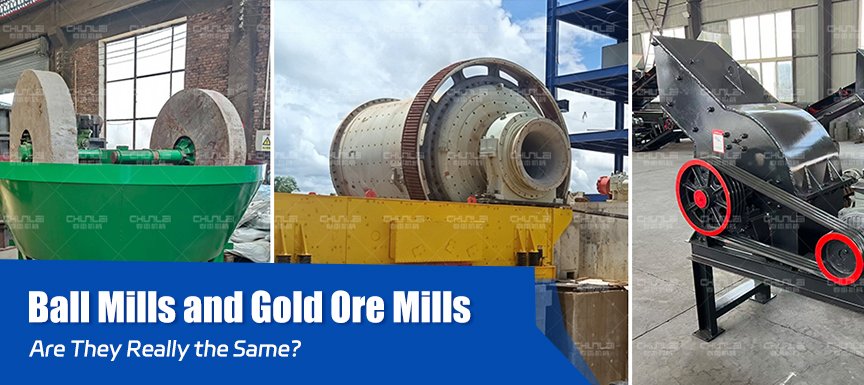
What exactly is the difference between a Ball Mill, a Gold Mill, and a Gold Milling Machine?
“Ball Mill” refers to a type of equipment.
A Ball Mill is a piece of equipment that uses grinding media to crush and grind ore.
Once ore enters the rotating drum, grinding media—such as steel balls—move along with the drum, exerting impact and grinding forces on the ore to gradually reduce it to the required particle size.
Ball mills are not designed exclusively for gold ore; they can also be used for:
- Gold ore
- Copper ore
- Iron ore
- Lead-zinc ore
- Limestone
- Cement clinker
- Minerals such as quartz
Therefore, “Ball Mill” is a category of equipment, not a machine dedicated to a specific type of ore.
What is a “Gold Mill”?
“Gold Mill” generally refers to equipment used for grinding gold ore. For instance, when a ball mill is used in gold ore processing, it can be referred to as a “Gold Ball Mill.”
Why is the term “Gold Milling Machine” more likely to cause confusion?
“Gold Milling Machine” does not refer specifically to a ball mill.
Depending on the manufacturer and the market, a “Gold Milling Machine” could refer to:
- A Ball Mill
- A Wet Pan Mill
- A Hammer Mill
- A Rod Mill
- Other equipment used for crushing or grinding gold ore
Therefore, when you see the term “Gold Milling Machine,” do not rush to assume what the equipment is; instead, look at the specific equipment structure and working method.
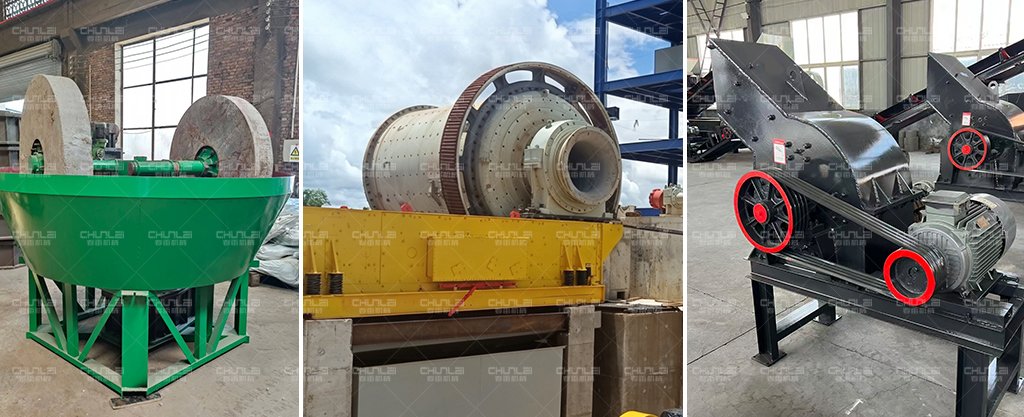
You can use the table below for a quick overview:
| Name | More Precise Understanding | Does it specifically refer to a ball mill? |
| Ball Mill | Type of ball mill equipment | Yes |
| Gold Ball Mill | Ball mill used for gold ore | Yes |
| Gold Mill | General term for gold ore grinding equipment | Not necessarily |
| Gold Milling Machine | General term for gold ore grinding equipment | Not necessarily |
| Gold Ore Grinding Machine | Gold ore grinding equipment | Not necessarily |
| Gold Processing Equipment | Gold processing equipment | No |
Therefore, when many customers search for “gold milling machine,”
it does not necessarily mean they intend to buy a ball mill.
The problem they are actually trying to solve might simply be: “What equipment should I use to grind my gold ore to the appropriate particle size?”
Why do gold ores require grinding?
Crushing and grinding are distinct processes that address different stages of the operation.
Gold ore processing typically involves: coarse crushing → medium/fine crushing → grinding → classification → gravity separation/flotation/leaching.
The initial crushing stages primarily serve to reduce large ore chunks into smaller sizes.
Grinding further reduces the particle size, ensuring that gold particles are more fully liberated from the gangue or other minerals.
A typical process flow is: run-of-mine ore → jaw crusher → cone crusher → ball mill → hydrocyclone → gravity separation/flotation/leaching.
In many gold processing circuits, the ball mill does not operate in isolation; instead, it works in conjunction with classification equipment to form a grinding-classification circuit.
Technical documentation on gold processing shows that after crushing, the material proceeds to grinding and classification, followed by subsequent stages—such as gravity separation, flotation, or leaching—depending on the specific ore type.
Finer grinding is not necessarily better.
Some clients mistakenly believe that “the finer the gold ore is ground, the higher the gold recovery rate.” This is a misconception.
If the target particle size already meets the requirements for downstream processing, excessive grinding can lead to increases in:
- Electricity consumption
- Steel ball consumption
- Liner wear
- Pump and hydrocyclone loads
- Circulating loads
- Production of fine slimes (due to over-grinding)
Therefore, the critical question to answer is: “To what extent do the gold particles need to be liberated?” rather than simply pursuing the finest possible grind.
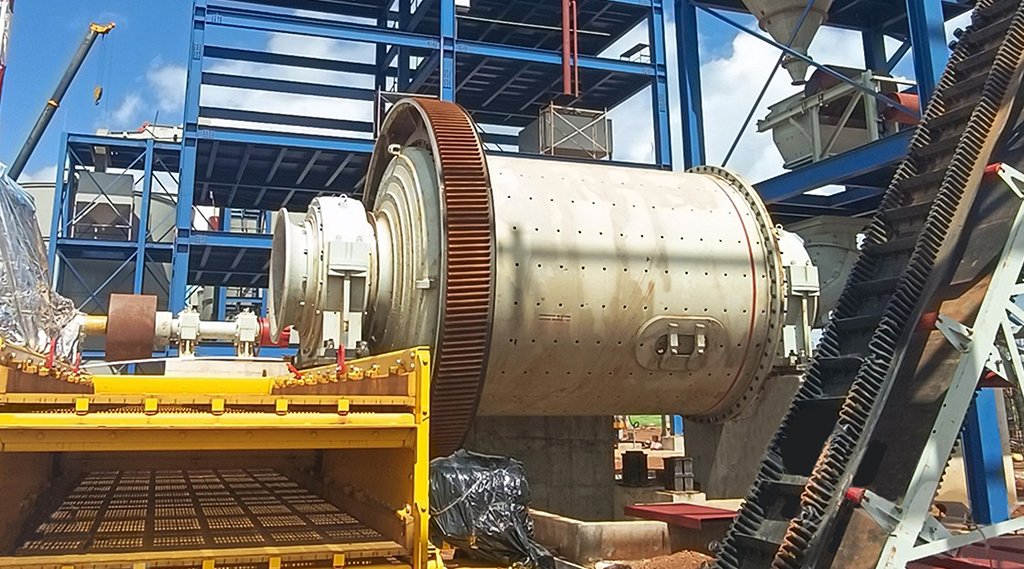
Under what circumstances is a ball mill suitable for a gold mining project?
If your gold mining project requires a stable processing throughput and necessitates further grinding of crushed ore to achieve the optimal particle size for subsequent gravity separation, flotation, or leaching, a ball mill is usually a strong candidate for consideration.
Key factors to consider include:
- Requirement for continuous production: Medium-to-large gold mining projects typically require stable, continuous grinding equipment, making ball mills a suitable choice.
- Need for fine mineral liberation: If gold particles are tightly bound to gangue minerals (such as quartz or sulfides) and require further grinding to liberate the gold, ball mills are commonly used.
- High processing throughput: Ball mills should be prioritized when the project involves defined hourly processing requirements (t/h) rather than small-scale, intermittent production.
- Integration with classification equipment: Ball mills are often operated in a closed-circuit configuration with equipment like hydrocyclones; coarse particles are returned to the mill for further grinding, while properly sized fine material proceeds to the next stage.
- Downstream flotation or leaching: These processes often have specific requirements regarding grind size, and ball mills serve effectively as the primary grinding equipment.
However, ball mills are not mandatory for every gold mining operation. For small-scale projects, soft ores, low throughput requirements, or processes utilizing specialized gravity separation, alternatives such as wet mills or hammer mills may be more appropriate. The final choice depends on factors such as ore hardness, processing throughput, feed particle size, and the target grind size.
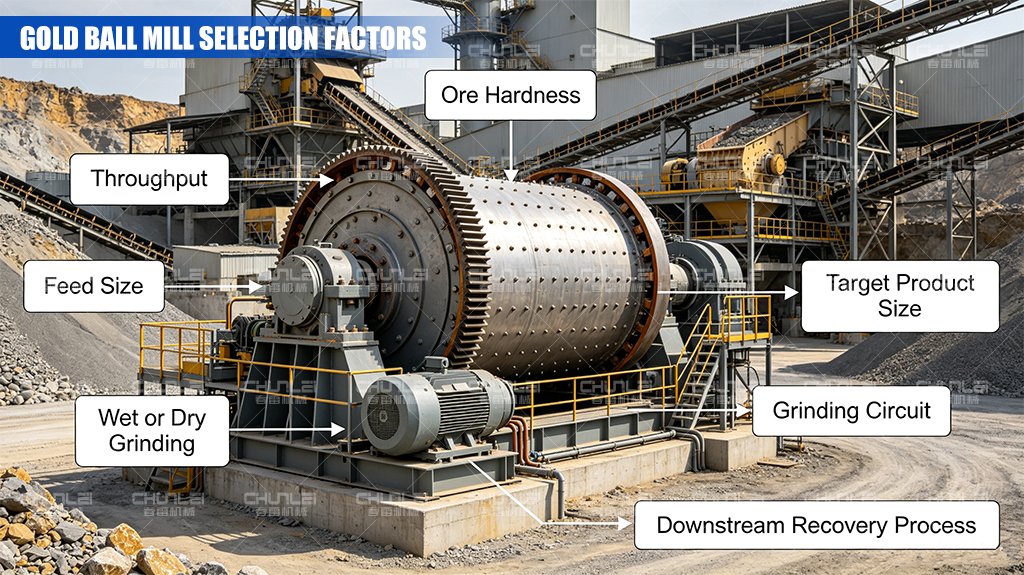
How exactly should you choose a gold ore ball mill?
When selecting a gold ore ball mill, don’t immediately ask about model sizes or prices. First, clarify the ore characteristics and processing conditions, then determine the mill specifications; this helps avoid over-investment. Focus on the following key parameters:
| Key Parameters | What to Focus On | Impact on Equipment Selection |
| Throughput | t/h or t/d | Determines ball mill specifications and quantity |
| Feed Particle Size | Particle size entering the ball mill after crushing | Affects grinding load |
| Ore Hardness | Hardness, Bond Work Index, abrasiveness | Higher hardness/resistance to grinding places greater demands on equipment |
| Target Particle Size | e.g., P80 of 75 μm, 150 μm, etc. | Finer sizes generally require more grinding energy |
| Grinding Method | Wet or dry | Gold ore processing typically prioritizes wet grinding |
| Downstream Processes | Gravity separation, flotation, CIL, CIP, etc. | Determines the required grinding fineness |
| Classification Method | Hydrocyclones, etc. | Affects grinding efficiency and circulating load |
Do not simply opt for the “largest ball mill” first, nor should you select a model based solely on the label “gold ore.” It is usually more cost-effective and reliable to first clearly determine the ore characteristics and daily processing tonnage, and then match the ball mill, hydrocyclones, and downstream processing equipment accordingly.
How does a ball mill compare to other gold milling machines?
| Comparison Criteria | Ball Mill | Wet Pan Mill | Hammer Mill | Rod Mill |
| Equipment Positioning | Fine Grinding | Wet Grinding | Crushing/Milling | Coarse Grinding |
| Continuous Production | Suitable | Depends on equipment and process | Depends on equipment | Suitable |
| Gold Mining Application | Widely used | Common in small-scale projects | Specific ores | Specific processes |
| Fine Grinding Capability | High | Moderate | Depends on equipment | Relatively coarse |
| Large and medium-scale projects | Common | Less common | Less common | Available |
| Key Selection Factors | Throughput + Particle size | Ore + Process | Ore + Particle size | Particle size + Process |
When purchasing equipment, the key question isn’t “Which machine is the best?” but rather “Which machine is best suited to my ore and process?”
How is a typical gold ore grinding circuit configured?
Gold ore grinding cannot be viewed in isolation—focusing solely on the ball mill; instead, crushing, grinding, classification, and downstream beneficiation processes must be considered as an integrated system.
A common flowsheet for hard-rock gold ore looks like this:
Run-of-mine (ROM) ore → Jaw crusher → Cone crusher → Vibrating screen → Ball mill → Hydrocyclone → Gravity separation/Flotation/Leaching
1. Jaw crusher: Initial processing of large ore blocks
ROM ore typically has a large particle size; a jaw crusher is used first for primary crushing to reduce the ore size to a range manageable by downstream equipment.
2. Cone crusher: Further reduction of feed size
After primary crushing, the material passes through a cone crusher for secondary and tertiary (medium-to-fine) crushing, providing a relatively consistent feed for the ball mill.
3. Vibrating screen: Controlling feed size for the ball mill
After screening, material meeting the size specifications proceeds to the next stage, while coarser material is returned to the crusher for further processing.
4. Ball mill: Primary fine grinding
The ball mill further grinds the crushed ore to liberate gold minerals from the gangue (waste rock) as much as possible.
Note: Finer grinding is not always better; the final particle size should be determined based on the subsequent gravity separation, flotation, CIL, or CIP processes.
5. Hydrocyclone: Classification
The slurry discharged from the ball mill enters the hydrocyclone:
- Coarse particles → Returned to the ball mill for further grinding
- Fine particles (meeting specifications) → Proceed to downstream beneficiation
This creates a closed-circuit grinding system, allowing for more stable control of product particle size and reducing over-grinding.
6. What are the downstream processes?
This depends on the specific characteristics of the gold ore:
- Gravity separation: Suitable for recovering some coarse-grained gold;
- Flotation: Commonly used for sulfide-bearing gold ores or ores requiring enrichment;
- CIL/CIP: Suitable for gold ores amenable to cyanide leaching;
- Gravity separation + Flotation/Leaching: Combined circuits used for certain complex gold ores.
Why do some gold mine ball mills fail to meet their design output?
If a ball mill’s actual output is significantly lower than the design value, do not rush to the conclusion that the “ball mill model is too small.”
Check the following areas first.
| Cause | Specific Manifestation |
| Ore harder than design specifications | Actual ore hardness and Bond Work Index exceed design values; grinding rate slows down |
| Feed too coarse | Upstream crushing is inadequate; ball mill requires more energy to process large particles |
| Target particle size too fine | Throughput per unit of time decreases in order to achieve finer product size |
| Unstable feed rate | Fluctuating feed volume causes constant changes in ball mill load, making it difficult to maintain stable output |
| Improper steel ball grading | Balls that are too large or too small can impair impact and grinding efficiency |
| Severe liner wear | Alters steel ball movement patterns, reducing grinding efficiency |
| Improper slurry density | Excessively dilute or thick slurry affects both grinding and discharge |
| Low cyclone classification efficiency | Large amounts of coarse particles return to the ball mill, resulting in excessive circulating load |
| Equipment mismatch | Insufficient capacity of feeders, pumps, or cyclones limits the entire grinding circuit |
5 Common Pitfalls When Buying a Gold Milling Machine
Pitfall 1: Searching only for “Gold Mill Price”
Price can serve as a screening criterion, but it shouldn’t be the only one.
If cheap equipment fails to meet throughput requirements, the costs of adding more machinery or modifying the process later could end up being much higher.
Pitfall 2: Focusing only on maximum output
The maximum output stated by the manufacturer does not necessarily reflect your actual output.
Factors such as ore hardness, feed particle size, product particle size, and the grinding method all influence actual performance.
Pitfall 3: Ignoring ore hardness
Even with gold ore, variations in ore characteristics may require different ball mill configurations.
Pitfall 4: Ignoring classification equipment
The ball mill must be properly matched with auxiliary equipment like hydrocyclones and pumps.
Spending your entire budget on a “large ball mill” does not guarantee higher overall production line output.
Pitfall 5: Comparing only the purchase price
What you should really compare is:
Equipment price + installation + auxiliary equipment + wear parts + energy consumption + maintenance + transportation
In other words, the project’s long-term operating costs.
FAQ
Q: Is a gold mill the same as a ball mill?
A: Not necessarily. “Gold mill” is a general term for gold ore grinding equipment, whereas a “ball mill” is a specific type of grinding machine. When used for gold ore, it can be referred to as a “gold ball mill.”
Q: Can a standard ball mill be used for gold ore?
A: Yes. Ball mills are not limited to gold ore; they are widely used for other ores and industrial materials. The key is to select the right model based on factors such as ore hardness, processing capacity, feed size, and target particle size.
Q: What is the difference between a gold mill and a gold milling machine?
A: “Gold mill” usually emphasizes the application concept of “gold ore grinding equipment,” while “gold milling machine” is a broader term used in searches and product listings that may encompass various types of equipment, such as ball mills or wet mills.
Q: What size ball mill do I need for gold ore?
A: The model cannot be determined based solely on the fact that it is for “gold ore.” To determine the appropriate ball mill specifications, you need to provide details such as processing capacity, feed particle size, ore hardness, target product particle size, and the grinding method.
Q: Is finer grinding always better for gold recovery?
A: No. Grinding needs to achieve a sufficient degree of gold mineral liberation, but excessive grinding can increase energy consumption, wear and tear, and circulating loads. The optimal final particle size should be determined based on the downstream beneficiation process and actual test results.
Conclusion
If you are looking for a ball mill or a gold milling machine, don’t rush to check the price just yet.
When selecting a ball mill for a gold mining project, the choice depends primarily on the ore characteristics, processing capacity, feed particle size, and target fineness, as well as the subsequent classification and beneficiation processes.
If you are working on a gold mining project and are unsure how to choose the right equipment, please contact the engineers at CHUNLEI, we will provide you with the most cost-effective solution tailored to your specific needs.
Latest News

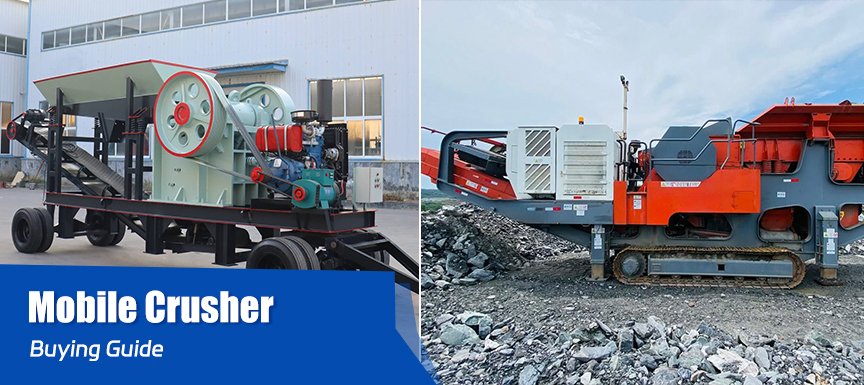
Mobile Crusher Buying Guide: Wheeled or Tracked?
800Many customers focus solely on portability when purchasing a mobile crusher, viewing it merely as the acquisition of a single piece of equipment. In reality, selecting the wrong model can lead to either insufficient output or excessive wear and…
-
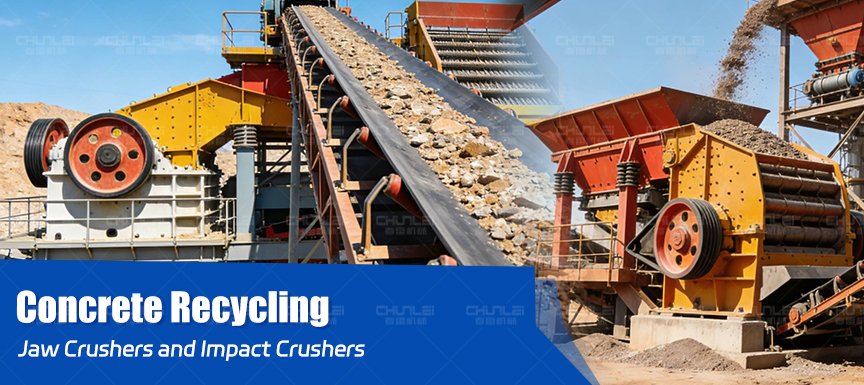
Jaw Crushers and Impact Crushers: Turnkey Solutions for Concrete Recycling
800Demolishing old buildings and roads generates vast amounts of waste concrete; direct landfilling not only consumes valuable space but also incurs high transportation costs. The real challenge lies in transforming this waste concrete into reusab…
-
A Comprehensive Analysis of Ball Mill Energy Consumption Per Ton
800In mineral processing plants, ball mills are significant consumers of electricity. When calculating costs, many clients focus solely on motor power; however, this figure alone does not reveal the actual electricity consumed per ton of ore proce…
-
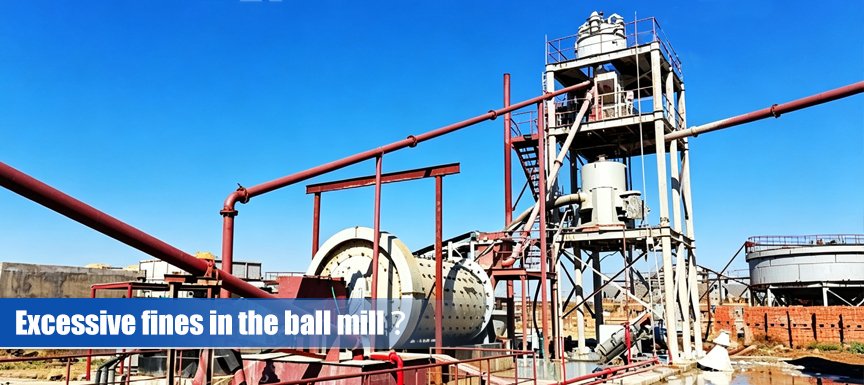
Why Does A Ball Mill Produce Excessive Fines?
800The production of excessive fines in a ball mill—a phenomenon known as over-grinding—often leads to various downstream issues, such as increased power consumption, greater difficulty in subsequent mineral processing, and accelerated wear of com…

loading…
已经是到最后一篇内容了!