 Chunlei Mining Machinery


Wheel sand washing machine
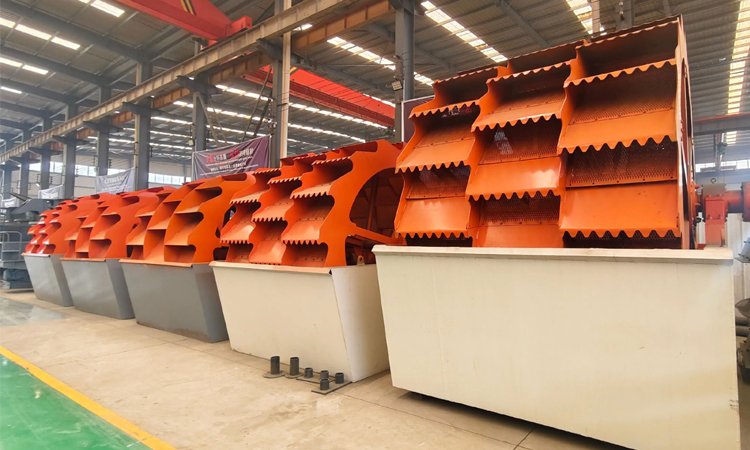
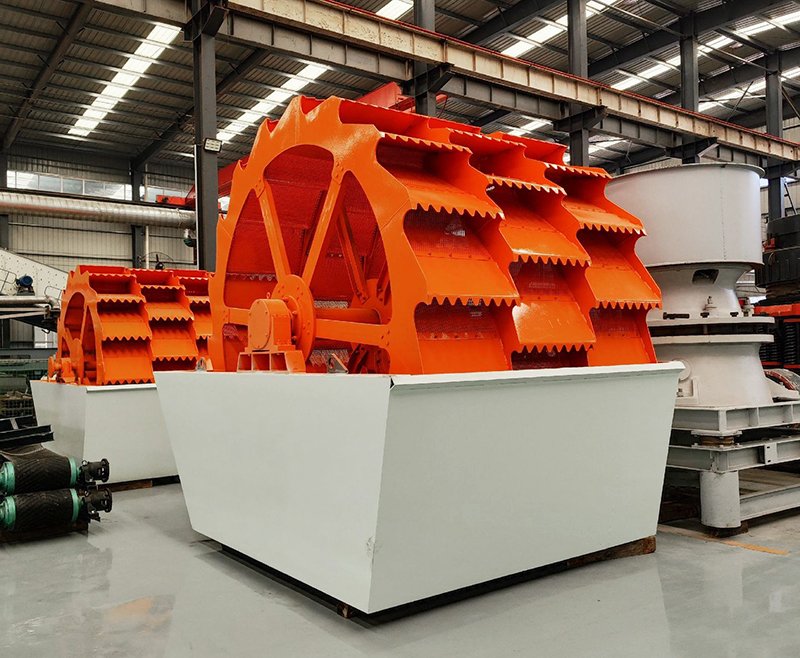
Wheel Sand Washing Machine is a kind of sand washing equipment used with sand making machine. It has high washing degree, reasonable structure, large handling capacity, small power consumption, and less sand loss in the sand washing process.
- Bucket diameter:2200-3500mm
- Capacity:15-300t/h
- Applicable materials: It is used for washing various construction sand and gravel materials such as river pebbles, quartz sand, granite, basalt, river sand, artificial sand and so on.
What is Wheel sand washing machine?
Wheel-type sand washing machines (also commonly known as bucket wheel sand washing machines) are mainstream water washing equipment widely used in sand and gravel production lines, mines, and aggregate processing plants. They can wash and separate stone powder and mud from materials such as river sand, manufactured sand, quartz sand, and crushed stone. This equipment consumes little water, has minimal fine sand loss, and is easy to maintain, making it a cost-effective choice for small and medium-sized sand plants, mobile production lines, and water-scarce areas.
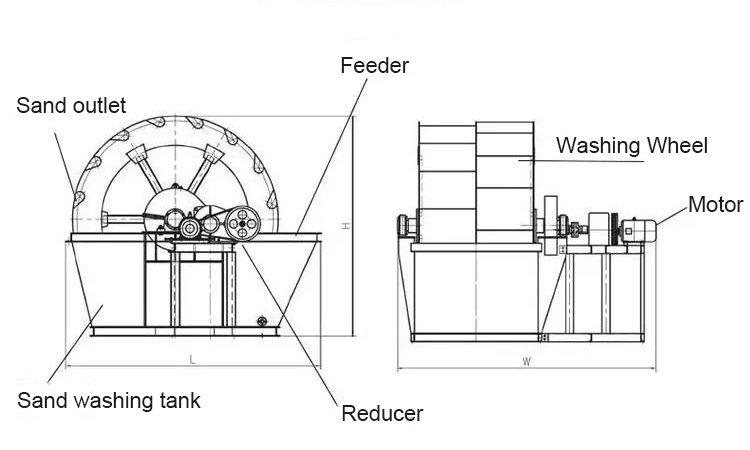
The wheel-type sand washing machine consists of a machine body, motor, blades, reducer, drive shaft, washing tank, feed inlet, and discharge outlet. It is a vertical bucket-type water washing equipment that uses rotating bucket wheels to achieve sand and gravel washing, impurity removal, and preliminary dewatering. It adopts a water circulation structure and, compared to spiral sand washing machines, occupies less space and consumes less water overall.
Working Principle of Wheel sand washing machine
When working, the power unit drives the impeller to rotate slowly through the triangle belt, reducer, gear deceleration, sand and gravel from the feed tank into the wash tank, tumbling under the impeller and grinding each other to remove the impurities covering the surface of the sand and gravel, and at the same time destroying the water vapor layer of the sand particles, in order to facilitate dewatering; and at the same time, add water to form a strong water flow, in a timely manner will be the impurity and the specific gravity of the small foreign matter away, and from the overflow port wash tank discharge to complete the cleaning process.

Why Choose CHUNLEI Wheel Sand Washing Machine?
CHUNLEI wheel sand washing machines are specifically designed for washing manufactured and natural sand. They offer advantages such as high-efficiency washing, minimal fine sand loss, stable operation, and convenient maintenance, helping you improve the quality of your finished sand and reduce operating costs.
CHUNLEI Wheel Sand Washing Machine Advantages:
- High Washing Efficiency: Effectively removes mud, stone powder, and impurities from sand and gravel, improving the cleanliness of the finished sand.
- Reduced Fine Sand Loss: Optimized impeller structure design increases fine sand recovery rate and reduces resource waste.
- Low Energy and Water Consumption: Lower operating costs, meeting energy conservation and environmental protection requirements.
- Long Wear-Resistant Lifespan: Key components use high-quality wear-resistant materials, reducing the frequency of replacement of vulnerable parts.
- Convenient Maintenance: Simple equipment maintenance reduces downtime and maintenance costs.
- Customized Solutions: Single/double/multi-bucket configurations, mobile bases, and enhanced wear-resistant features can be customized based on processing capacity, material characteristics, and site conditions.
- Comprehensive After-Sales Service: Installation guidance, technical support, and spare parts supply are provided to ensure long-term stable operation of the equipment.
- Extensive Project Experience: Products have been implemented in hundreds of sand quarries and mining projects worldwide, adapting to various complex working conditions.
What materials can a wheel-type sand washer process?
Wheel-type sand washers are mainly used for cleaning, dewatering, and removing impurities from medium- and fine-grained sand and gravel materials. They are widely used in manufactured sand production lines, sand and gravel plants, and mineral processing.
Applicable materials include:
- Natural sand and gravel: river sand, lake sand, sea sand (to remove surface silt and floating impurities);
- Manufactured sand and gravel: artificial sand made from crushed granite, basalt, and limestone;
- Non-metallic minerals: quartz sand, feldspar sand (for building materials and the glass industry);
- Other materials: small-diameter crushed stone, mineral processing tailings, and recycled building aggregates.
Wheel-type sand washers are particularly suitable for processing sand and gravel materials with low to medium mud content and uniform particle size. For materials with high mud content, using them in conjunction with a spiral sand washer or a fine sand recovery system will result in better cleaning and recovery effects.
What impurities can a wheel-type sand washing machine remove from sand?
The wheel-type sand washing machine relies on the dual action of water flow and material friction to efficiently remove various common impurities from sand and gravel. It is suitable for sand standards used in the construction, building materials, and glass industries:
- Soil and mud clumps: including surface soil, clumps of mud, and bottom silt;
- Dust and stone powder: fine stone powder and suspended dust adhering to the surface of manufactured sand and crushed stone;
- Lightweight floating debris: low-density floating matter such as leaves, grass roots, plastic scraps, and dead branches;
- Fine mud-sand mixture: fine mud mixed in the sand.
This equipment cannot remove stones, metal blocks, large hard debris, or stubborn impurities embedded within the sand and gravel. If the raw material contains many large stones, it is recommended to install a vibrating screen at the front end of the washing process for pre-screening to improve the washing quality and equipment operational stability.
Is the wheel sand washing machine suitable for processing materials with high mud content?
Wheel sand washing machines are not suitable for cleaning materials with high mud content. For materials with high mud content and hard mud clumps, relying only on a single wheel-type sand washing machine is prone to problems such as incomplete cleaning, excessive mud content in the finished product, and residual mud clumps. It will also accelerate blade wear and increase the probability of blockage of the overflow port.
High mud content material treatment plan:
- Mildly high mud content (15%-25%): The wheel-type sand washing machine is equipped with a front-mounted vibrating screen to pre-screen out large mud balls and debris. At the same time, the water circulation flow is increased and a multi-stage settling tank is added to improve the mud removal effect;
- Severely high mud content (>25%) and hard mud balls: Priority is given to using a spiral sand washing machine, or the “wheel sand washing machine + spiral sand washing machine” combination process can be used for graded cleaning;
- Additional suggestions: In high mud-containing conditions, the frequency of inspections needs to be increased, and the silt in the sink and overflow port needs to be cleaned regularly to avoid equipment failure.
Are wheel-type sand washing machines suitable for small-scale sand and gravel production lines?
Absolutely! Wheel-type sand washing machines are the mainstream supporting equipment for small-scale sand and gravel production lines and mobile sand yards.
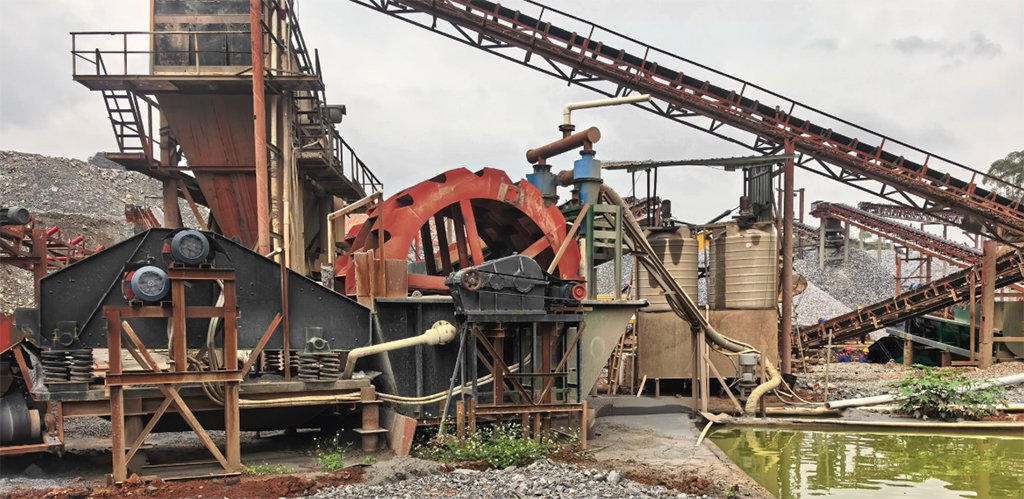
Compared to large-scale sand washing equipment, wheel-type sand washing machines are not only easier to install and maintain, but also have lower energy consumption, lower water consumption, and less fine sand loss, helping to reduce costs and improve quality. For manufactured sand production lines with a capacity requirement of 20–100 tons/hour, wheel-type sand washing machines are usually an economical and efficient choice.
If your project involves small to medium-scale sand and gravel production, wheel-type sand washing machines can achieve a higher return on investment while ensuring sand washing effects.
Can wheel sand washing machine be used with fine sand recovery machine?
Yes, wheel sand washing machines are usually recommended to be used together with fine sand recovery machines. During the sand washing process, part of the fine sand will be lost with the wastewater. Using a fine sand recovery machine can effectively recover this part of the lost fine sand and increase the output of finished products.
Through combined use, it can not only reduce the loss of fine sand and improve the yield of finished products, but also reduce the cost of cleaning the sedimentation tank, realize the recycling of water resources, and improve the overall production efficiency.
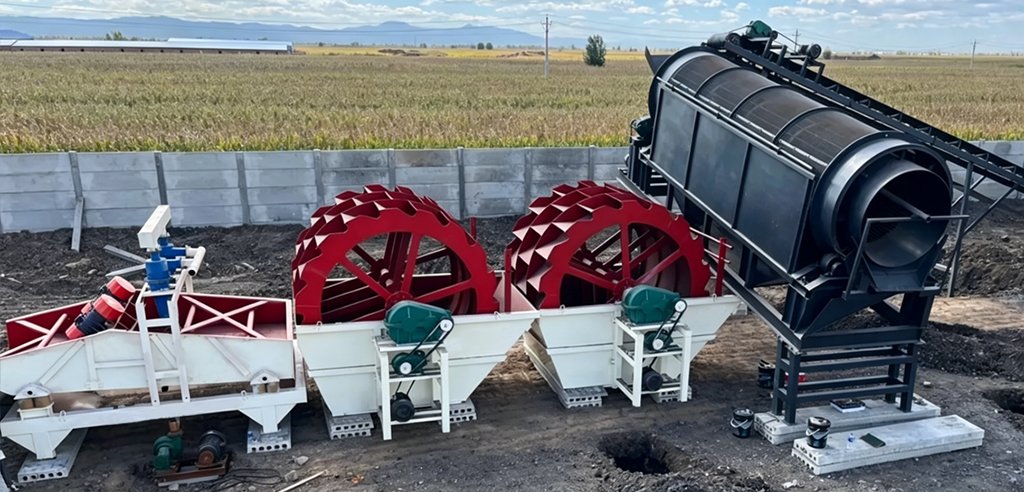
Advantages of wheel sand washing machine + fine sand recovery machine:
- Reduced fine sand loss, increased finished sand output
- Improved finished sand gradation and quality
- Reduced resource waste, increased economic efficiency
- Reduced sedimentation tank siltation, reduced maintenance costs
- Realized water recycling, more energy-efficient and environmentally friendly
For manufactured sand production lines with high requirements for finished sand quality, the combination of a wheel-type sand washing machine and a fine sand recovery machine has become an efficient and economical solution.
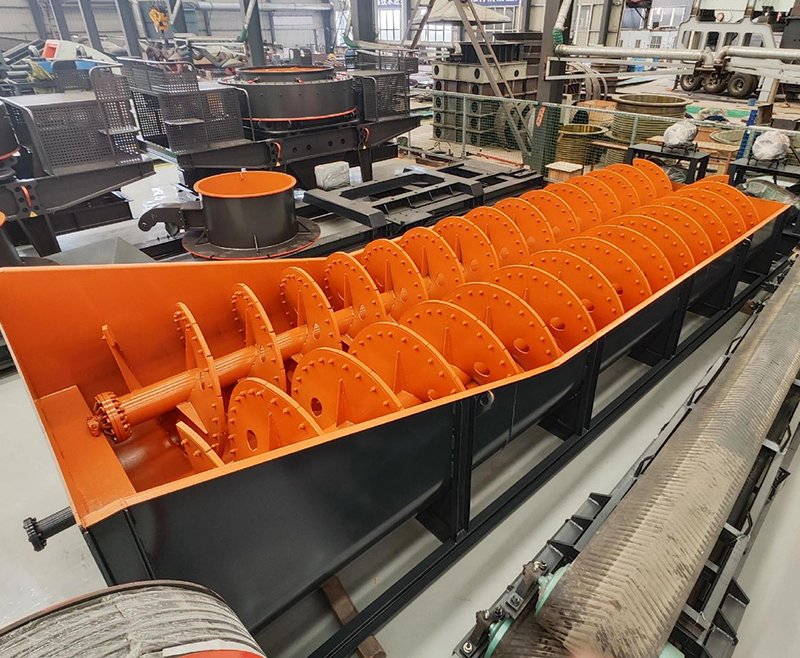
What are the differences between wheel sand washing machines and spiral sand washing machines?
Both are mainstream sand washing equipment, but they differ significantly in structure, water consumption, production capacity, and operation and maintenance. The appropriate model should be selected based on the specific operating conditions.
| Comparison Items | Wheeled Sand Washer | Spiral Sand Washer |
| Structure | Vertical bucket type, compact structure, small footprint | Horizontal long trough type, large footprint |
| Water Consumption | Low, supports water circulation, saves 30%-50% | Higher water consumption, average water circulation effect |
| Fine Sand Loss | Low loss rate, uniform finished product gradation | Fine sand is easily lost with water flow |
| Cleaning Capacity | Suitable for materials with low to medium mud content | Strong cleaning power, suitable for materials with high mud content and hard mud lumps |
| Maintenance Difficulty | Few vulnerable parts, simple maintenance | Many spiral blades and bearings, large maintenance workload |
| Investment Cost | Low purchase and operating costs | High equipment price, high energy consumption in the later stage |
| Applicable Scenarios | Small and medium-sized production lines, mobile stations, water-scarce areas | Large sand plants, high mud content raw material production lines |
Selection recommendations: For those who prioritize water conservation, fine sand retention, and low cost, choose a wheel-type sand washing machine; for those with high mud content in the raw materials and requiring extremely high washing cleanliness, choose a spiral sand washing machine.
How to Choose the Right Wheel Sand Washing Machine Model?
Choosing the right wheel sand washing machine requires a comprehensive evaluation based on material characteristics, processing capacity, and production needs. Proper selection not only improves washing efficiency but also reduces operating costs and maintenance expenses. The following factors should be considered during selection:
- Processing Capacity: Determine the required hourly sand and gravel output (tons/hour).
- Material Type: Different materials such as manufactured sand, river sand, and quartz sand have different equipment configuration requirements.
- Mud Content: Materials with high mud content may require a fine sand recovery system or other sand washing equipment.
- Feed Size: Ensure the material particle size meets the equipment design requirements.
- Finished Sand Quality Requirements: Select the appropriate model based on cleanliness and fine sand recovery rate requirements.
- Site Conditions: Consider installation space, power supply configuration, and production line layout.
- Environmental Requirements: Consider the availability of a fine sand recovery machine and a circulating water system to reduce water consumption and fine sand loss.
If you are unsure about the specific model, you can contact CHUNLEI engineers to recommend the most suitable wheel-type sand washing machine solution to achieve the best return on investment.
Does a wheel-type sand washer result in significant fine sand loss?
Under normal circumstances, a wheel-type sand washer experiences relatively little fine sand loss. Compared to spiral sand washers, wheel-type sand washers utilize an impeller-lifting structure, which better retains the fine sand component in the finished sand during the washing process.
However, excessive water supply, improper impeller speed, or high fine sand content in the material can lead to some fine sand loss. To address this, a fine sand recovery machine can be integrated into the sand washing production line. This effectively recovers lost fine particles, improving yield and economic efficiency.
Anti-loss optimization solutions:
- Reasonably control the water flow speed to prevent excessively fast water flow from carrying away fine sand;
- Use arc-shaped anti-loss blades;
- Equip with a sedimentation tank or fine sand recovery machine to fully recover lost fine sand.
Technical Parameters of Wheel sand washing machine
| Model | Capacity(t/h) | Motor power(kw) |
| XS2308 | 15-40 | 4 |
| XS2711 | 20-65 | 5.5 |
| XS3014 | 50-100 | 7.5 |
| XS3220 | 80-200 | 11 |
| XS3227 | 100-260 | 15 |
| XS4215 | 200-300 | 15 |
Wheel sand washing machine ordered by Customer
Chunlei Machinery has been engaged in mining machinery manufacturing for more than 30 years, with a wealth of experience in building websites and customer cases, served customers all over the world!


Wheel Sand Washing Machine Price
The price of a wheel sand washing machine is affected by the impeller diameter, number of buckets, wear-resistant configuration, mobile base, and water circulation system. Overseas trade reference prices (main unit only, excluding sea freight and installation):
- Small single bucket (15-50 tons/hour): US$3000-5000;
- Medium-sized single/double bucket (50-120 tons/hour): US$6000-8000;
- Large multi-bucket (120-300 tons): US$9000-15000.
Wheel sand washing machine FAQ
Q1: What is the overall production and installation cycle for the equipment?
A: Production takes 15-30 days, sea freight takes 2-4 weeks, and on-site installation takes 3-5 days.
Q2: What materials can a wheel-type sand washing machine process?
A: It can process medium and fine-grained materials such as river sand, manufactured sand, quartz sand, crushed stone, mineral processing tailings, and recycled building aggregates.
Q3: What impurities can a wheel-type sand washing machine remove from sand?
A: It can remove soil, mud clumps, stone powder, dust, and floating debris such as leaves and grass roots. It cannot remove large hard stones or stubborn internal impurities.
Q4: Is a wheel-type sand washing machine suitable for processing materials with high mud content?
A: Suitable for conventional materials with a mud content ≤15%; for mud content of 15%-25%, a pre-screen can be used; for mud content >25%, a spiral sand washing machine is recommended.
Q5: Is a wheel-type sand washing machine suitable for small-scale sand and gravel production lines?
A: It’s very suitable. The equipment has a small footprint, is easy to install, and has low operation and maintenance costs, making it the preferred choice for small sand plants and mobile production lines.
Q6: Can a wheel sand washing machine be used in conjunction with a fine sand recovery machine?
A: Yes. The combination effectively recovers fine sand from overflow wastewater, improving raw material utilization while achieving wastewater recycling, resulting in greater environmental friendliness.
Q7: What is the difference between a wheel sand washing machine and a spiral sand washing machine?
A: Wheel sand washing machines save water, have less fine sand loss, and are simple to operate and maintain, making them suitable for small and medium-sized production lines and water-scarce areas; spiral sand washing machines have strong cleaning capabilities and are suitable for raw materials with high mud content.
Q8: Does a wheel sand washing machine result in a large amount of fine sand loss?
A: The loss rate under normal operating conditions is 5%-8%. Using a fine sand recovery machine can further reduce losses.
Q9: Can a wheel sand washing machine be used with a dewatering screen?
A: Yes, the moisture content of the finished sand can be controlled below 8% after combination.
Q10: What is the price of a wheel sand washing machine?
A: Small: $3000-$5000; Medium: $5000-$8000; Large: $9000-$15000. Optional accessories are priced separately.
Q11: Does the equipment support mobile operation?
A: Yes, a customizable mobile base is available.
Q12: What are the feed particle size requirements?
A: It is recommended that the feed particle size be ≤10mm. Large materials can easily cause jamming and blade wear.
Summary
When selecting a wheel-type sand washing machine, you need to consider the hourly capacity, the mud content of the material, and site conditions to determine the appropriate model. If there are high requirements for fine sand recovery rate and environmental standards, a fine sand recovery machine can be added; if deep dewatering is required, a dewatering screen can be added to create an integrated production line.
Don’t just compare unit prices when purchasing; focus on the wear resistance of the blades and the transmission sealing performance to reduce future failure costs. Contact CHUNLEI engineers for customized equipment solutions and accurate quotes.
Related Products —
Shaking Table
The shaking table mainly consists of eight parts: bed head, motor, slope adjuster, bed surface, ore tank, water tank, rifling strip and lubrication system. According to the position of feeding device, shaking table can be divided into right…
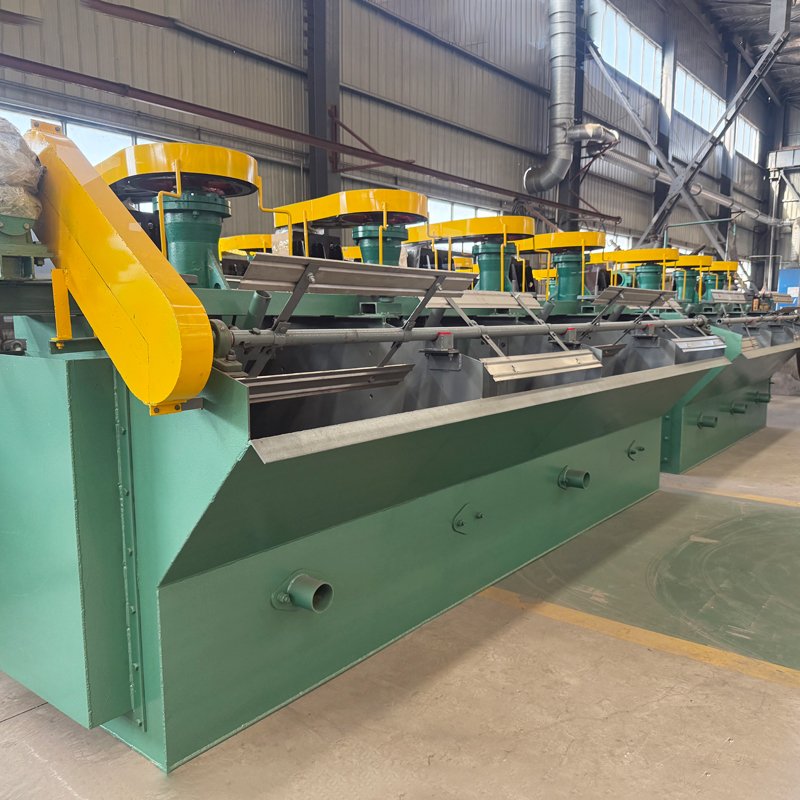
Flotation Machine
Flotation machine is a self-absorbing, self-absorbing pulp type mechanical agitation flotation equipment.It is widely used in the flotation operation of nonferrous metals, black metals and nonmetals. Flotation m…
Ceramic Filter Press
Ceramic Filter Press is a kind of high-efficiency and energy-saving filtration equipment relying on vacuum suction and capillary action to realize solid-liquid separation, which is widely used in mining, metallurgy, chemical industry, en…
Thickener
The Thickener, with built-in degassing tank and sawtooth external overflow weir, prevents solid particles from attaching to air bubbles, improves localized suction phenomenon, and substantially increases the sedimentation area; at the same …
Rod Mill
Rod mill is divided into dry rod mill and wet rod mill, dry rod mill is a kind of dry rod mill equipment with fine discharging granularity, wet rod mill is a grinding machine with steel rods as grinding media, mainly used for coarse grin…


loading…
已经是到最后一篇内容了!