 Chunlei Mining Machinery

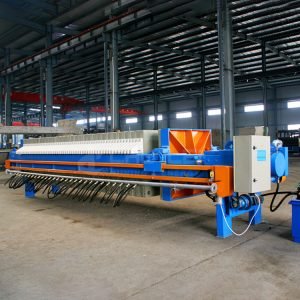
Thickener
The Thickener, with built-in degassing tank and sawtooth external overflow weir, prevents solid particles from attaching to air bubbles, improves localized suction phenomenon, and substantially increases the sedimentation area; at the same time, it changes the traditional horizontal feeding to inclined feeding, which fundamentally eliminates the problem of feeding clogging. At present, it has been widely used in the concentration and purification of liquid containing solid particles in chemical industry, building materials and sewage treatment.
- Tank body diameter :3600-20000mm
- Tank height:1700-4400mm
- Power:0.8-5.5kW
What is Thickener?
The Thickener, also called high-efficiency thickener, is a gold mining equipment used for the separation of gold leach solution Guye. It adopts a brand-new mechanical structure, which greatly strengthens the flocculating effect of flocculant on solid particles. At the same time, the new flocculant adding system increases the particle size of settled solid particles, which in turn accelerates the settling speed; compared with the traditional conventional thickener, the thickener is more efficient, with the unit processing capacity increased by 2-3 times, and saving 30% energy consumption, which can effectively deal with all kinds of mineral sludge, waste water and waste residue.
Chunlei’s Thickener for mining increases settling speed by 2–3x while cutting energy use by 30%. It is designed for mineral sludge and wastewater treatment.


Working Principle of High Efficiency Thickener
High-efficiency thickener working principle: the slurry in the high-efficiency thickener equipment before entering the degassing device to remove most of the gases contained, from the feed pipe into the mixing device, the slurry in the mixing device and the appropriate amount of flocculant mixing, the formation of a good flocculation state, and then, from the bottom of the diffusion of its surroundings into the concentration of the bottom of the pool of the preformed high-concentration sedimentation mud layer. At this time, the flocculated slurry (floc) to the bottom of the pool precipitation; slurry water through the sediment layer to rise. Here, the sediment layer plays a filtering role, preventing the rise of fine particles of mineral sludge. The slurry that has not been fully flocculated will continue to contact with the flocs when it reaches the sediment layer, so that the flocs will continue to grow. Finally, with the help of the center drive device to drive the rake frame, the concentrated material will be pushed to the center discharge port discharge, slurry water from the overflow port.


Advantages of CHUNLEI Thickener:
- Adding flocculants promotes the aggregation and expansion of fine sludge, accelerating sedimentation and separation;
- Built-in inclined plates shorten the sedimentation path and expand the effective sedimentation area;
- Integrates flocculation, clarification, and compression separation processes, enhancing the efficiency of concentrated ore processing;
- Standard configuration includes a complete set of fully automatic control modules, saving labor costs;
- Achieves high underflow density and clear overflow;
- Constructed with high-quality materials, ensuring durability;
- Custom production is available to meet specific factory needs.
Applications
Thickeners are widely used in mining, tailings treatment, metallurgy, chemical, environmental protection, and sand washing industries. They are primarily used for slurry thickening, solid-liquid separation, and circulating water recovery, effectively increasing underflow concentration and reducing the load on subsequent dewatering equipment.
Applicable materials include gold ore, copper ore, iron ore, lead-zinc ore, lithium ore, graphite, fluorite, phosphate rock, quartz sand, kaolin, tailings slurry, and various industrial slurries.
Thickeners are typically used in conjunction with hydrocyclones, slurry pumps, filter presses, and other equipment, and are widely applied in gold and copper ore beneficiation plants, tailings dry discharge systems, and sand washing production lines to achieve efficient thickening, water-saving recovery, and environmentally friendly production.

How to Choose the Right Thickener Model?
When selecting a thickener, consider the processing capacity, material characteristics, underflow concentration, and production process. A suitable model not only improves efficiency but also reduces operating costs.
During the selection process, we recommend focusing on the following aspects:
- Processing Capacity: Select the appropriate thickener diameter and model based on the hourly processing capacity (t/h).
- Material Characteristics: Slurry concentration, particle size, settling properties, and mineral composition all affect the thickening effect.
- Underflow Concentration Requirements: Determine the required underflow concentration based on subsequent processes such as filter press, tailings discharge, or concentrate dewatering.
- Application Scenarios: Different operating conditions, such as concentrate thickening, tailings treatment, and sand washing water recovery, have different equipment configuration requirements.
- Automation Requirements: Automatic dosing, level control, and PLC intelligent control systems can be selected according to project needs to improve operating efficiency.
Quick Selection Comparison Table
| Daily Slurry Processing Capacity | Recommended Models | Common Diameter Specifications |
| <1000m³ | Hydraulic Center Drive Thickener | Φ3m / Φ6m / Φ9m |
| 1000–5000m³ | Peripheral Roller / Rack Thickener | Φ12m / Φ15m |
| 5000m³ 以上 | Large Peripheral Rack / Deep Cone Thickener | Φ18m / Φ24m / Φ30m |
Are thickeners suitable for dry tailings disposal? How much can they increase the slurry concentration?
Thickeners are essential pre-treatment equipment for dry tailings stacking. Direct feeding of tailings into screens or filter presses without a thickener will reduce subsequent production capacity and exacerbate filter cloth or screen clogging.
- Concentration Increase: Original tailings feed of 5%–20% can be steadily increased to 35%–55% after treatment by a standard thickener; deep cone mills can reach up to 65%.
- Tailings Compatible Types: Suitable for various flotation tailings from gold, copper, iron, lithium, coal washing, and quartz sand, as well as washing sand tailings.
- Core Values of Dry Stacking:
- Reduces the processing load of downstream dewatering equipment by over 40%, reducing the frequency of consumable replacements;
- Overflow water is clear, with over 90% returnable to flotation and sand washing processes, saving water intake costs;
- Reduces the amount of water entering the tailings dam, lowering the environmental risks of dam failure and leakage;
- Limitations: A standalone thickener cannot produce dry material; it must be paired with a dewatering screen or hydraulic filter press to complete the final dry stacking.
What is the achievable underflow concentration of a thickener?
The underflow concentration of a thickener is not fixed and is affected by various factors such as ore properties, particle size, and slurry concentration. Generally, the underflow concentration of a thickener can reach 50%–70% (solid mass concentration). For some easily settling materials, even higher underflow concentrations can be achieved after process optimization.
CHUNLEI can provide professional thickener selection and process optimization solutions based on your material characteristics and process requirements to improve underflow concentration and settling efficiency, providing a stable high-concentration slurry for subsequent filter press dewatering, tailings dry discharge, or concentrate treatment.
What equipment is needed for a complete slurry thickening system?
A complete thickening system includes not only a thickener but also supporting conveying, dosing, dewatering, and recirculation equipment to collectively achieve slurry thickening, solid-liquid separation, and circulating water recovery, improving the overall operating efficiency of the production line.
Core Supporting Equipment:
- Slurry Pump: Stablely delivers the slurry to the thickener.
- Flocculant Preparation and Addition System: Promotes rapid sedimentation of mineral particles, improving thickening efficiency.
- Thickener: Performs slurry thickening and solid-liquid separation; it is the core equipment of the entire system.
- Underflow Pump: Delivers high-concentration slurry to a filter press or tailings treatment system.
- Filter Press (Optional):** Further dewaters, enabling dry tailings discharge or concentrate dewatering.
- Recirculation Tank: Collects overflow water from the thickener, enabling the recycling of production water.
- PLC Automatic Control System (Optional): Enables intelligent monitoring of liquid level, concentration, and equipment operating status, improving automation levels.
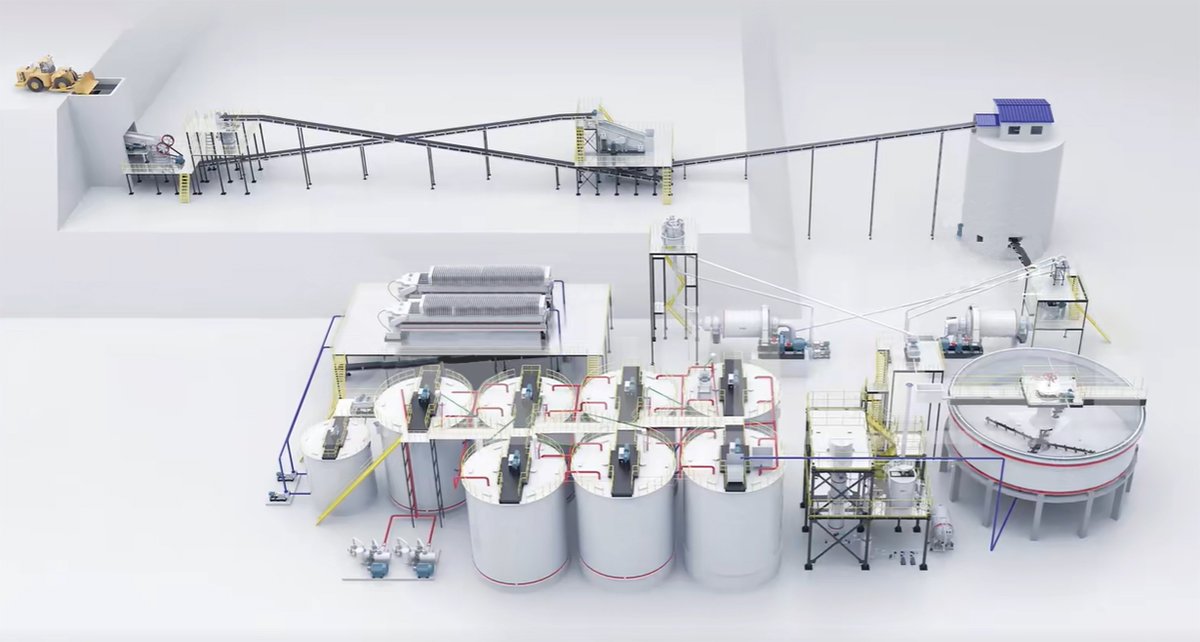
Typical Process Flow:
Slurry → Slurry Pump → Flocculant Addition System → Thickener → Underflow Pump → Filter Press (or Tailings Treatment) → Thickener Overflow Water → Return Water Tank → Return to Production Line for Recycling.
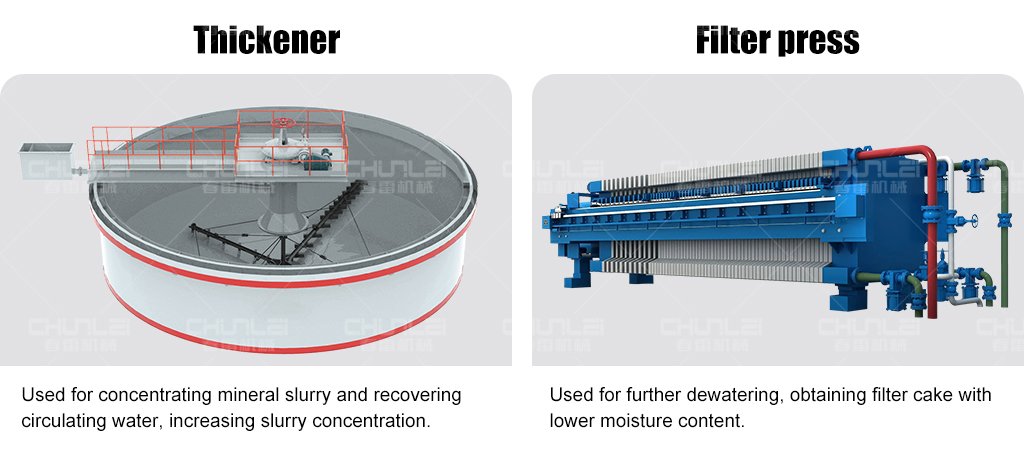
What is the difference between a thickener and a filter press?
Both thickeners and filter presses are commonly used solid-liquid separation equipment in mineral processing, but they differ in some aspects. Thickeners are primarily used for slurry concentration and recycling of circulating water, increasing the slurry concentration; filter presses, on the other hand, are used for further dewatering to obtain a filter cake with lower moisture content. The two types of equipment are usually used together, rather than as substitutes for each other.
| Comparison Items | Thickener | Filter Press |
| Main Functions | Concentrate slurry, increase underflow concentration | Deeply dewater, reduce filter cake moisture content |
| Working Principle | Use gravity settling and flocculation to achieve solid-liquid separation | Use mechanical pressure to expel liquid, achieving solid-liquid separation |
| Processing Objects | Low-concentration slurry | High-concentration slurry or concentrated underflow |
| Dewatering Effect | Removes most free water, increasing slurry concentration | Removes more water, forming a dry filter cake |
| Underflow Concentration | Generally 50%–70% | Filter cake moisture content can typically be reduced to 10%–25% (depending on the material) |
| Water Recycling Effect | Recovered clarified water can be directly recycled. | The filtrate is clear and can be returned to the production system. |
| Operating Mode | Continuous Operation | Intermittent Operation (some models can achieve automatic circulation) |
| Applicable Processes | Concentrate concentration, tailings concentration, sand washing water recovery | Tailings dry discharge, concentrate dewatering, sludge dewatering |
| Can it be used alone? | Can be used alone, and is also often used as a pretreatment device for filter presses. | Generally used in conjunction with a thickener for better dewatering effect. |
| Typical Application Industries | Mining, metallurgy, chemical, sand washing, environmental protection | Mining, chemical, ceramics, tailings treatment, sludge dewatering |
Factors Affecting Concentration Efficiency
- Flocculant Dosage: Insufficient dosage results in fine mud not agglomerating and overflowing; excessive dosage increases floc cost, leading to loose flocs and slower settling.
- Feed Flow Fluctuations: Sudden high flow rates impact the settling layer, disrupting stratification and causing mud to be carried into the clear water.
- Rake Rotation Speed: Excessive speed stirs up the concentrated ore at the bottom, muddying the clear water at the top; insufficient speed causes mud to accumulate at the bottom, resulting in rake compression.
- Material Particle Size and Viscosity: High proportion of -400 mesh ultrafine particles and high slurry viscosity significantly reduce settling velocity.
- Rake Tooth Wear: Worn rake teeth result in incomplete scraping of mud, forming a dead mud layer at the bottom and reducing the effective settling area.
- Underflow Discharge Control: Insufficient discharge leads to excessive slurry accumulation at the bottom, causing a surge in rake load; excessive discharge results in insufficient underflow concentration.
- Slurry Temperature: Low temperatures increase viscosity, significantly reducing particle settling velocity.
Technical Parameters of High Efficiency Thickener
| Model | Tank inside diameter (mm) | Tank height (mm) | Settling area(m2) | Rake speed(r/min) | Rake lifting height(mm) | Drive motor model | Drive motor power(kW) | Lifting motor model | Lifting motor power(kW) | Rigid trough body weight(kg) | Weight (kg) |
| GX-3.6 | 3600 | 1700 | 10.2 | 1.1 | 200 | Y100L-6 | 1.5 | Y100L-6 | 1.5 | 2829 | 6650 |
| GX-5.18 | 5182 | 2134 | 21 | 0.4 | 300 | Y132S-6 | 3 | PZ0.8AB | 0.8 | 5342 | 10460 |
| GX-6 | 6000 | 2500 | 28.3 | 0.8 | 300 | Y132M1-6 | 4 | Y132S-8 | 2.2 | 6506 | 10573 |
| GX-7.5 | 7500 | 2800 | 44.1 | 0.427 | 300 | Y132M2-6 | 5.5 | Y132S-8 | 2.2 | 10258 | 17320 |
| GX-9 | 9000 | 2800 | 63.6 | 0.427 | 300 | Y132M2-6 | 5.5 | Y132S-8 | 2.2 | 15980 | 23680 |
| GX-12 | 12000 | 3600 | 110 | 0.35 | 300 | Y132M-4 | 7.5 | Y100L1-4 | 2.2 | 25589 | 42756 |
| GX-15 | 15000 | 4000 | 177 | 0.15 | 300 | YCT200-4B | 7.5 | Y112M-6 | 2.2 | 36050 | 59000 |
| GX-18 | 18000 | 4400 | 254 | 0.13 | 400 | YCT200-4B | 7.5 | YTC752A-44 | 5.5 | 52485 | 73296 |
| GX-20 | 20000 | 4400 | 314 | 0.13 | 400 | YCT200-4B | 7.5 | YTC752A-44 | 5.5 | 59365 | 76020 |
Common Faults and Solutions
1. Overflowing and turbidity, clear water containing a large amount of fine mud: Causes: Imbalanced flocculant ratio, excessive feed impact, excessive rake speed, worn rake teeth and mud accumulation;
Solutions: Adjust the dosage of flocculant, install a buffer feed cylinder, reduce rake frame speed, replace with wear-resistant rake teeth.
2. Low underflow concentration, failing to meet dry discharge standards: Causes: Excessive underflow pump discharge, insufficient settling and compression time, insufficient feed concentration;
Solutions: Reduce the underflow pump frequency, extend the settling cycle, add a hydrocyclone for pre-concentration at the front end.
3. Rake frame overload alarm, frequent rake shutdowns: Causes: Untimely underflow discharge, large debris falling into the pool, long-term accumulation and compaction of slurry;
Solutions: Increase the underflow conveying flow rate, regularly clean the pool to remove impurities, activate the automatic hydraulic rake lifting function.
4. Abnormal noise and accelerated wear of transmission gears: Causes: Insufficient lubrication, slurry splashing corroding the gears;
Solutions: Regularly add special grease, install mud-blocking protective plates.
5. Frequent blockage in the underflow pipeline: Causes include excessively high slurry concentration and sediment buildup in the pipeline during shutdown.
Solution: Intermittent low-flow circulation flushing; drain residual slurry from the pipeline during shutdown.
FAQ – High Efficiency Thickener
Q: Can a thickener be used for tailings dry stacking?
A: It is an essential pre-treatment device for tailings dry stacking, concentrating 5%–20% dilute tailings to 35%–65%, significantly reducing the load on downstream dewatering equipment.
Q: Can the overflow water from the thickener be recycled?
A: Under normal dosing conditions, the overflow solids content is extremely low and can be directly returned to the flotation and sand washing processes, significantly reducing mine water intake.
Q: What is the highest concentration that the thickener underflow can achieve?
A: 35%–48% for ordinary flat pools; 50%–65% for deep cone high-efficiency thickeners.
Q: What is the optimal feed concentration range for the thickener?
A: Standard 8%–25%. Below 5%, it is recommended to use a hydrocyclone for pre-concentration.
Q: Can a thickener alone produce dry tailings?
A: No, it only produces flowing concentrated slurry. A dewatering screen or filter press must be used for dry stacking.
Q: How should a thickener and hydrocyclone be combined in the process?
A: Low-concentration tailings are first thickened; the overflow fine sludge from the thickening process can be fed into a hydrocyclone for secondary recovery of fine sand.
Q: Which comes first, the thickener or the filter press?
A: The thickener is placed at the front end for pretreatment, and the filter press is used for deep dewatering at the back end.
Q: Is flocculant required for the thickener?
A: Flocculant must be added to fine-grained tailings and lithium slurry, otherwise the overflow will become severely turbid. For high-concentration slurry made from coarse sand and gravel, a small amount can be added or none at all.
Q: Can the thickener be treated with anti-corrosion coatings to cope with acidic slurry?
A: Custom anti-corrosion coatings are available with 316 stainless steel, epoxy, and rubber linings.
Q: How to solve the problem of rapid wear of the thickener rake teeth?
A: Replace with thickened polyurethane rake teeth, and add a buffer feed cylinder inside the tank to reduce slurry erosion.
Q: What diameter thickener should be selected for small mines?
A: For daily flow rates below 1000m³, a center-driven thickener with a diameter of Φ3~Φ30m is recommended.
Q: Does the thickener set include an underflow pump?
A: The standard configuration does not include an underflow slurry pump, but it can be supplied as a complete set.
Q: What mineral sample parameters are required before purchasing the thickener?
A: Hourly slurry flow rate, feed concentration, material particle size, slurry pH, and target underflow concentration.
Related Products —
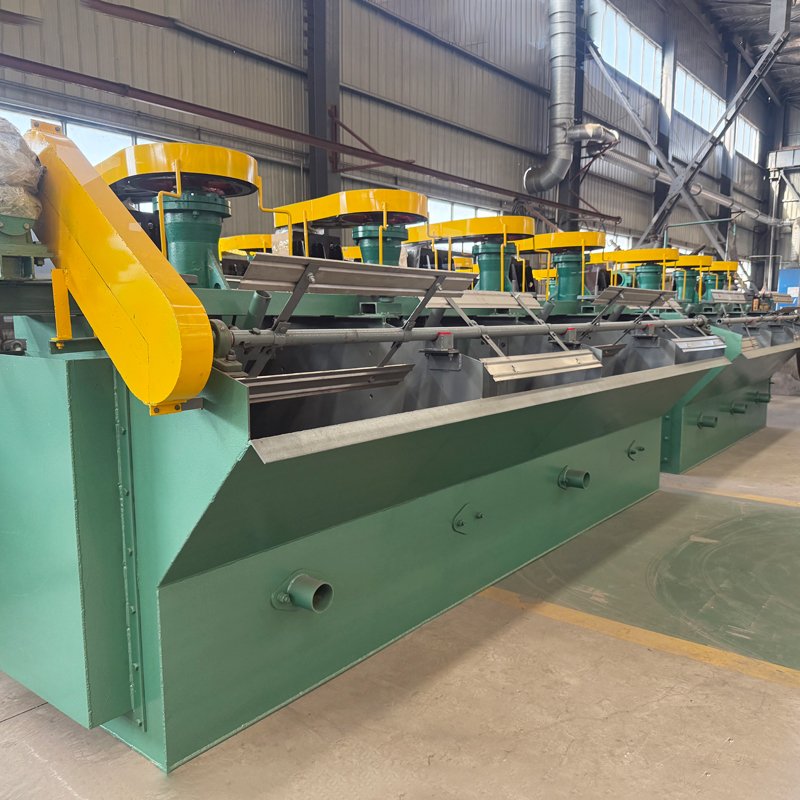
Flotation Machine
Flotation machine is a self-absorbing, self-absorbing pulp type mechanical agitation flotation equipment.It is widely used in the flotation operation of nonferrous metals, black metals and nonmetals. Flotation m…
Shaking Table
The shaking table mainly consists of eight parts: bed head, motor, slope adjuster, bed surface, ore tank, water tank, rifling strip and lubrication system. According to the position of feeding device, shaking table can be divided into right…
Ball Mill
Maximize gold recovery and reduce grinding costs with CHUNLEI gold ball mill. Our equipment ranges in capacity from 0.5 tons/hour to 200 tons/hour and is suitable for a variety of ores, including gold, copper, iron, and quartz. Energy-effic…
High Gradient Magnetic Separator
A variety of models are available | Get the free price list! The High Gradient Magnetic Separator (HGMS) is a new type of strong magnetic separator developed on the basis of general strong magnetic separa…
Hydraulic Filter Press
A variety of models are available | Get the free price list! Hydraulic filter press, also called automatic hydraulic filter press, is a dewatering equipment that utilizes slurry pump pressure to make the liquid com…


loading…
已经是到最后一篇内容了!