 Chunlei Mining Machinery


Fine Sand Recycling Machine
Fine sand recycling machine is also known as tailing sand recycling machine, fine sand extraction machine, fine sand collection machine, sediment separator, mud separator, sand-water mixture processing system and so on.
- Processing water volume:30-650mm
- Power of sand pump:11-55kw
- Applicable materials: Cobblestone, basalt, granite, limestone, iron ore, river rock.
What is Fine Sand Recycling Machine?
The fine sand recovery machine (also known as a fine sand recovery unit or tailings recovery machine) is an integrated system designed specifically for wet sand washing production lines to recover and dewater fine sand.
Installed downstream of the sand washer, the machine utilizes a combination of hydrocyclone-based centrifugal classification and a vibrating dewatering screen to recover fine sand that would otherwise be lost in the waste slurry. This process minimizes sand loss and yields recovered sand with controllable moisture content, making it suitable for direct sale as finished aggregate; simultaneously, it reduces the load on sedimentation ponds and alleviates pressure regarding environmental discharge compliance.
If you are new to fine sand recovery machines, please provide details regarding your raw material characteristics, product specifications, site conditions, production budget, hourly output requirements, and any other specific needs. Our professional engineers will then recommend a suitable model at a reasonable price tailored to your requirements.
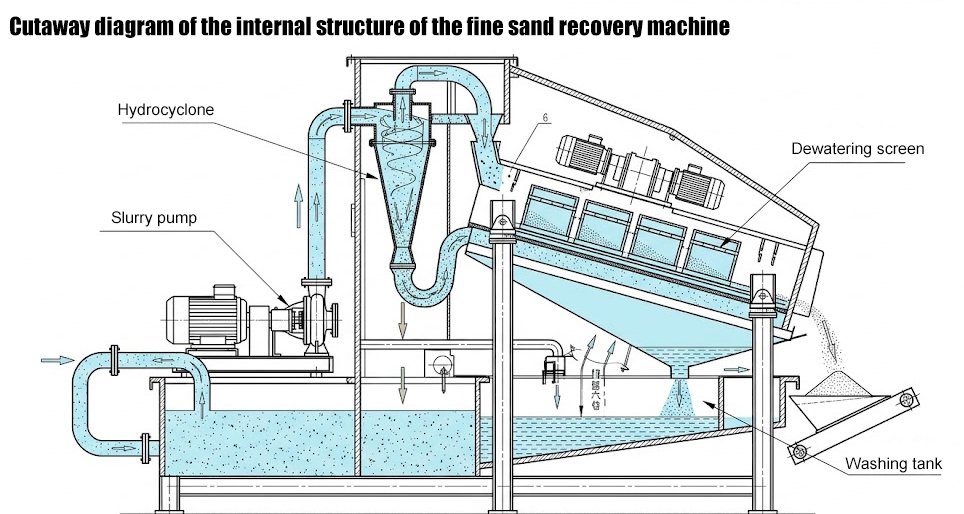
Core structure of the fine sand recovery machine
| Component Name | Material | Core Function | Remarks |
| Hydrocyclone | Cast steel housing, polyurethane lining | Centrifugal classification of slurry; separation of fine sand and silt/mud | Can be configured as a single unit or multiple units in parallel |
| Slurry Pump (Sand Pump) | Wear-resistant alloy for flow-path components | Pressurizes and transports the sand-water mixture from the washing tank to the hydrocyclone | Power core of the entire system |
| Linear Vibrating Dewatering Screen | Bent steel screen body, polyurethane screen mesh | Vibratory dewatering of the concentrated fine sand discharged from the hydrocyclone | Screen mesh is a high-frequency wear part |
| Vibration Motor | Cast steel housing | Provides excitation force for the dewatering screen | Installed symmetrically in pairs |
| Washing Tank (Slurry Storage Tank) | Welded steel plate | Collects the sand-water overflow slurry discharged from the sand washer | Impurities settling at the bottom require periodic cleaning |
| Return Box & Piping | Welded steel pipe | Returns unrecovered slurry to the washing tank for recirculated processing | Enables closed-loop circulation |
| Main Frame | Welded structural steel | Supports all components; serves as the base for the entire machine | Treated for rust prevention and corrosion resistance |
Working Principle of Fine Sand Recycling Machine
The primary function of the fine sand recovery machine is to recover fine sand that would otherwise be lost with wastewater, thereby minimizing sand loss.
The typical workflow is as follows:
Sand-washing wastewater → Slurry pump → Hydrocyclone → Fine sand settling → Dewatering via vibrating screen → Recovery of finished sand
Specifically, after the sand-laden slurry enters the system, the slurry pump feeds the mixture into the hydrocyclone. The cyclone utilizes centrifugal force for classification: coarser and heavier sand particles settle downward and are discharged through the underflow outlet, while fine silt and water are discharged through the overflow outlet.
The separated sand enters the dewatering screen, where vibration removes excess moisture, ultimately yielding reusable fine sand.

Advantages of the CHUNLEI Fine Sand Recovery Machine
- Minimizes fine sand loss: Under optimal operating conditions, it recovers over 85% of usable fine sand from sand-washing wastewater, increasing total output, improving sand gradation, and optimizing the fineness modulus.
- Reduces sedimentation tank maintenance: Early recovery of large quantities of fine sand minimizes siltation in sedimentation tanks, thereby lowering labor and equipment costs associated with desilting.
- Direct sale of recovered sand: The dewatered sand has low moisture content and requires no prolonged air-drying in storage yards, allowing it to be sold directly as commercial aggregate.
- Compact design and easy retrofitting: Existing sand-washing lines can be retrofitted without extensive civil engineering work; the unit integrates seamlessly with current sand-washing machines.
- Wear-resistant components: Features include polyurethane cyclone liners and polyurethane dewatering screens that withstand slurry erosion, extending the service life of wear parts.
- Customization available: Configurations range from single to multiple parallel cyclones based on slurry flow rates; suitable for both stationary plants and mobile sand-washing equipment, with options for 415V/60Hz motors for overseas markets.
How fine a sand particle can the fine sand recovery machine recover?
Fine sand recovery machines are primarily used to recover fine sand particles from sand-washing wastewater. The actual recovery particle size depends on factors such as the hydrocyclone, screen specifications, feed concentration, and material properties. Generally speaking, the machine recovers fine sand that would otherwise be lost during conventional sand washing, rather than just capturing coarser grains.
If the raw material contains a high proportion of fine sand (around 0.075 mm), we recommend conducting a material analysis before finalizing the cyclone and screen configuration. There is no fixed recovery rate; it is best to select the specific model based on your raw material’s particle size distribution and the sand-washing volume.
If you provide us with details regarding processing capacity, raw material silt content, and finished sand specifications, CHUNLEI can help you determine the most suitable fine sand recovery machine model.
What is the recovery rate of the fine sand recovery machine?
The recovery rate for fine sand typically ranges from 85% to 95%, with actual performance depending on material particle size, slurry concentration, and equipment configuration. To determine the specific recovery rate, we require data on the raw material’s particle size distribution and the parameters of the sand-washing production line; we can then select the appropriate equipment and design a solution tailored to your actual operating conditions.
Can a fine sand recovery machine be integrated into an existing sand washing production line?
Yes. A fine sand recovery machine can usually be retrofitted directly into an existing sand washing line; there is no need to build an entirely new production line.
A common configuration is:
Sand washer tailwater → Slurry pump → Hydrocyclone → Dewatering screen → Fine sand recovery
If a sand washer is already on-site, you simply need to select a suitable fine sand recovery machine based on factors such as tailwater volume, fine sand content, processing capacity, and available installation space.
Two key points require special attention during the retrofit:
- Do not select a model based solely on the sand washer’s output; also consider the quantity and concentration of sand in the tailwater.
- Verify on-site space and piping layout in advance, particularly the connections between the pump, hydrocyclone, and dewatering screen.
In short, if your sand washing line suffers from issues like significant fine sand loss, high sand content in the tailwater, or low recovery rates of the finished product, installing a fine sand recovery machine is usually a straightforward solution.
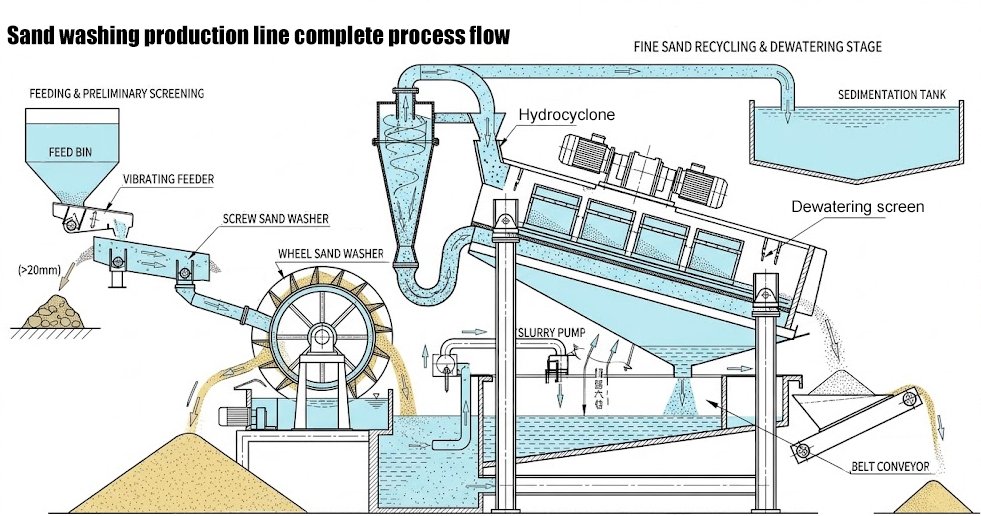
Placement of the fine sand recovery machine within a sand washing production line
Typical complete wet sand washing process: Raw material → Vibrating feeder → Crushing and sand-making equipment → Wheel-bucket or spiral sand washer → Fine sand recovery machine → Finished sand stockpile; sludge and wastewater are directed to a sedimentation tank or wastewater treatment system.
Fine Sand Recovery Machine vs. Standard High-Frequency Dewatering Screen
Both types of equipment are suitable for use in sand and gravel production lines, but they address different issues. High-frequency dewatering screens primarily handle dewatering, whereas fine sand recovery machines focus on both preventing fine sand loss and dewatering.
| Comparison Item | Fine Sand Recovery Machine | Standard High-Frequency Dewatering Screen |
| Primary Function | Recovers fine sand from tailings water while simultaneously dewatering | Primarily dewaters sand materials |
| Fine Sand Recovery | Effective at recovering fine sand from wastewater | Limited ability to recover fine sand that has already entered the wastewater |
| Working Method | Slurry pump + hydrocyclone + dewatering screen | Relies primarily on vibrating screening and dewatering |
| Suitable Materials | Sand-washing wastewater; fine sand from manufactured sand production | Sand material that has already been screened |
| Finished Product Moisture Content | Allows for further dewatering | Dewatering is the primary function |
| Typical Applications | Sand-washing production lines; tailings sand recovery | Sand and gravel dewatering; finished sand processing |
| Equipment Investment | Generally higher; configuration is relatively complex | Structure is relatively simple; investment cost is lower |
| Selection Criteria | Fine sand content; wastewater volume; processing capacity | Sand volume; moisture content; screening particle size |
How do you choose?
- If the tailings contain significant amounts of fine sand and sand loss is severe → Prioritize a fine sand recovery machine.
- If the main issue is high moisture content in the finished sand → A standard high-frequency dewatering screen may suffice.
- If you want to recover fine sand while also reducing the moisture content of the finished product → Consider a combination of a fine sand recovery machine and a dewatering screen.
How do you choose the right fine sand recovery machine model?
When selecting a fine sand recovery machine, consider the following aspects:
- Processing Capacity: Ensure the equipment has a capacity margin based on the hourly throughput; avoid long-term operation at full load.
- Fine Sand Content: Varying fine sand levels in the tailings water require different cyclone configurations and screening capacities.
- Slurry Concentration and Water Volume: Even with a sand throughput of 100 t/h, differences in slurry water content necessitate different equipment selections.
- Recovery Particle Size: If the primary goal is recovering finer sand, focus on matching the hydrocyclone diameter, quantity, and operating pressure.
- Finished Product Moisture Content: If the recovered sand is to be stockpiled or transported immediately, pay attention to the dewatering screen specifications and dewatering performance.
- Raw Material Properties: For materials with high clay content or high abrasiveness, prioritize the wear resistance of the cyclones, slurry pumps, and screen meshes.
- Existing Sand Washing Line Output: When adding a fine sand recovery machine to an existing line, match it to the actual slurry discharge volume of the current sand washer rather than just the washer’s rated tonnage.
In summary, output determines equipment size, slurry volume dictates cyclone configuration, recovery particle size determines classification requirements, and moisture content determines the dewatering screen setup.


What is the price of a fine sand recovery machine, and what factors influence it?
There is no single fixed price for fine sand recovery machines that applies to every project. Complete systems on the market can range from tens of thousands of dollars to significantly higher, depending primarily on processing capacity, configuration, and the level of automation.
Specific pricing is determined by factors such as processing volume, raw material silt content, fine sand particle size, existing sand washing equipment, and the target moisture content of the finished product. If you share your project details and requirements with us, we can configure the equipment based on your actual operating conditions and provide a more accurate proposal and quote.
What problems commonly occur during the operation of fine sand recovery machines, and how should they be maintained?
After prolonged operation, common issues typically arise in components such as the hydrocyclone, slurry pump, dewatering screen, and screen mesh.
- Decreased fine sand recovery: Check the cyclone operating pressure, feed concentration, and whether the screen mesh is clogged or damaged.
- Cyclone clogging: Promptly clear the feed inlet and underflow nozzle to prevent mud clumps or large particles from entering.
- Slurry pump wear: Regularly inspect the impeller, pump casing, and mechanical seal; replace them promptly if significant wear is detected.
- Dewatering performance decline: Check screen tension, screen aperture clogging, and the operating status of the vibration motor.
- Screen mesh damage or clogging: Clean the screen surface regularly and replace damaged mesh immediately to avoid compromising the quality of the finished sand.
- Abnormal equipment vibration: Inspect the vibration motor, bearings, and fasteners to prevent operating the equipment while a fault exists.
Routine maintenance is not complex; the key is regular inspection. Especially during continuous production at sand and gravel plants, it is recommended to focus on cyclone pressure, pump operating status, screen wear, and equipment vibration levels.
If you notice significant fine sand loss, a drop in recovery volume, or poor dewatering performance, please provide us with details regarding your processing volume, material silt content, and equipment operating conditions. CHUNLEI can help identify the source of the problem and offer recommendations for equipment adjustments.
Technical Parameters of Fine Sand Recycling Machine
| Model | Impeller diameter(mm) | Sieve plate specifications (mm) | Separator specifications | Processing water volume | Feed particle size (mm) | Sand production volume (t/h) | Total power(kw) | Weight(kg) | Overall dimensions (mm) including pump and motor |
| LZ26-35-1224 | 2600 | 1200*2400 | FX350 | ≤100 | ≤10 | 50-80 | 28.4 | 4935 | 5800*5200*2750 |
| LZ26-55-1530 | 2600 | 1500*3000 | FX250*2 | ≤120 | ≤10 | 80-100 | 33.5 | 5392 | 5800*5560*2750 |
| LZ30-55-1530 | 3000 | 1500*3000 | FX250*2 | ≤120 | ≤10 | 80-100 | 39 | 7328 | 6700*5560*3100 |
| LZ30-55-1530J | 3000 | 1500*3000 | FX300*2 | ≤150 | ≤10 | 80-120 | 47 | 7500 | 6700*5560*3600 |
| LZ30-75-1836 | 3000 | 1800*3600 | FX300*2 | ≤200 | ≤10 | 100-140 | 63 | 9761 | 7331*5560*3370 |
| LZ30-120-1842 | 3000 | 1800*4200 | FX350*2 | ≤300 | ≤10 | 100-140 | 82 | 10565 | 7950*5560*3370 |
| LZ30-75-1836D | 3000 | 1800*3600 | FX300*4 | ≤200 | ≤10 | 100-140 | 59 | 9669 | 7420*5560*3670 |
| LZ30-75-1842D | 3600 | 1800*4200 | FX350*2 | ≤200 | ≤10 | 100-140 | 59 | 10615 | 8020*5560*3670 |
| LZ36-100-1836D | 3600 | 1800*3600 | FX350*2 | ≤240 | ≤10 | 100-140 | 70 | 13363 | 8120*5560*4100 |
| LZ36-100-1842D | 3600 | 1800*4200 | FX250*4 | ≤240 | ≤10 | 100-140 | 70 | 14040 | 8590*5560*4100 |
| LZ36-100-1836J | 3600 | 1800*3600 | FX250*4 | ≤240 | ≤10 | 120-160 | 74 | 13634 | 8120*5560*4100 |
| LZ36-100-1842J | 3600 | 1800*4200 | FX250*4 | ≤240 | ≤10 | 120-160 | 74 | 14180 | 8590*5560*4100 |
| LZ36-100-1848J | 3600 | 1800*4800 | FX250*4 | ≤240 | ≤10 | 120-160 | 74 | 14630 | 9190*5560*4100 |
| LZ36-100-2442J | 3600 | 1800*4200 | FX250*4 | ≤240 | ≤10 | 150-200 | 81 | 15120 | 8680*6450*4100 |
| LZ36-120-2448J | 3600 | 2400*4800 | FX300*4 | ≤300 | ≤10 | 150-200 | 97 | 15480 | 9280*6450*4100 |
Conclusion
If your sand washing production line suffers from issues such as significant fine sand loss, low recovery rates for the finished product, high sand content in wastewater, or excessive moisture in sand stockpiles, a fine sand recovery machine may be a solution worth considering.
CHUNLEI can help you select the appropriate fine sand recovery machine model—and configure the matching hydrocyclone, slurry pump, and dewatering screen—based on your processing capacity, material type, fine sand and silt content, and existing sand washing equipment. Contact us now!
Fine Sand Recycling Machine FAQ
Q: Can a fine sand recovery machine be used independently as a sand washer?
A: No. It is designed solely for recovering and dewatering fine sand from waste slurry; it lacks ore-washing capabilities and must be used in conjunction with a spiral sand washer or a wheel-bucket sand washer.
Q: Can existing sand washing production lines be retrofitted with a fine sand recovery machine?
A: Yes, most existing lines can be retrofitted; it is only necessary to verify the elevation of the sand washer’s overflow outlet and the total flow rate of the wastewater slurry, and to properly connect the piping.
Q: Can a fine sand recovery machine be used on a mobile sand washing station?
A: Yes; a lightweight, integrated version can be created with the entire unit mounted on a mobile chassis. This requires matching the mobile station’s slurry pump and motor with custom specifications.
Q: Why does the moisture content of the recovered fine sand sometimes fluctuate significantly?
A: It primarily depends on the silt content of the raw slurry, the condition of the cyclone’s underflow nozzle, and the vibration status of the dewatering screen. Higher silt content makes dewatering more difficult and increases moisture content; the priority is to control the silt content during the initial sand washing stage.
Q: Can a fine sand recovery machine solve the problem of sand loss during the washing process?
A: Yes. The machine is designed to separate and recover fine sand from washing wastewater, thereby reducing sand loss and increasing the yield of finished sand.
Q: Why does a sand washing production line need a fine sand recovery machine?
A: If large amounts of fine sand are discharged along with the slurry, it results in material loss and places increased pressure on sedimentation tanks and tailings treatment systems. Installing a fine sand recovery machine allows this usable fine sand to be recovered and returned to the production line.
Q: Is a fine sand recovery machine suitable for manufactured sand production lines?
A: Yes. The production of manufactured sand typically generates wastewater containing fine sand; the recovery machine captures these fine particles, making it suitable for wet-process sand making and washing lines.
Q: What is the difference between a fine sand recovery machine and a dewatering screen?
A: They serve different functions. Dewatering screens primarily handle dewatering and screening, whereas fine sand recovery machines use hydrocyclones to first concentrate and classify the sand slurry before using the dewatering screen to recover and dewater the fine sand; consequently, they are better suited for addressing fine sand loss in sand-washing wastewater.
Q: Can a fine sand recovery machine perform desliming simultaneously?
A: It can achieve separation of fine sand from sludge to a certain extent, but the actual desliming efficiency depends on the raw material’s silt content, particle size distribution, and the hydrocyclone configuration. If the raw material has a high silt content, sand-washing and desliming equipment should be appropriately configured during the design phase.
Q: Can the sand discharged from the fine sand recovery machine be used immediately?
A: This generally depends on the intended use and moisture content of the finished sand. After recovery and dewatering, the material can go directly to the finished sand stockpile or the next processing stage; however, if there are strict requirements regarding gradation or silt content, further screening or processing may be necessary.
Q: Why does sand loss occur during the operation of a fine sand recovery machine?
A: Common causes include fluctuations in feed concentration, abnormal hydrocyclone operation, clogged or damaged screens, and a mismatch between the equipment selection and the actual material. When sand loss occurs, one should first check the slurry concentration and feed rate, followed by an inspection of the hydrocyclone and dewatering screen.
Q: Can the fine sand recovery machine operate continuously?
A: Yes. Fine sand recovery machines are typically designed for continuous operation and can be integrated into a continuous production line alongside sand washers, screening equipment, and conveyors. However, continuous operation requires regular inspection of critical components such as pumps, hydrocyclones, screens, and bearings.
Q: Does the fine sand recovery machine require a large footprint?
A: Fine sand recovery machines have a relatively compact structure, making them generally easier to plan for than constructing large, separate settling ponds or complex fine sand treatment systems. However, the actual dimensions depend on processing capacity, equipment configuration, and site layout.
Q: What parameters need to be provided before purchasing a fine sand recovery machine?
A: It is recommended to provide details on the sand-washing production line’s output, raw material type, fine sand content, silt content, feed particle size, slurry concentration, and on-site installation conditions. The more complete the parameters, the easier it is to determine the appropriate model and configuration for the fine sand recovery machine.
Related Products —
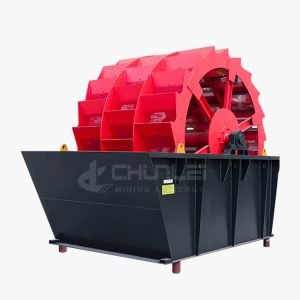
Wheel Sand Washing Machine
Wheel Sand Washing Machine is a kind of sand washing equipment used with sand making machine. It has high washing degree, reasonable structure, large handling capacity, small power consumption, and less sand loss in the sand washing proc…
High Gradient Magnetic Separator
A variety of models are available | Get the free price list! The High Gradient Magnetic Separator (HGMS) is a new type of strong magnetic separator developed on the basis of general strong magnetic separa…
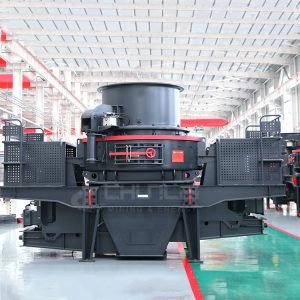
Sand Making Machine
The impact sand making machine (vertical shaft impact crusher) is a core piece of equipment in the fields of sand and gravel aggregate processing and ore shaping, and is particularly suitable for the sand-making and sha…
BLL Spiral Chute
BLL spiral chute, also known as spiral chute separator, is a heavy separation equipment that utilizes the inertial centrifugal force generated by the slurry in the spiral rotary motion to realize the separation of light and heavy minerals. …
Ceramic Filter Press
Ceramic Filter Press is a kind of high-efficiency and energy-saving filtration equipment relying on vacuum suction and capillary action to realize solid-liquid separation, which is widely used in mining, metallurgy, chemical industry, en…



loading…
已经是到最后一篇内容了!