 Chunlei Mining Machinery

50 TPH Placer Gold Washing Plant
For mine owners looking to build small to medium-sized placer gold washing plants, a 50 TPH (50 tons per hour) washing plant is a good option. However, a rated capacity of 50 tons per hour does not guarantee that actual production will reach that output, nor does it guarantee that all gold will be recovered.
In actual projects, the clay content, stone size, gold grain size, and moisture content of the ore all affect the washing effect and recovery rate. Ores with high clay content, fine gold grains, and flake gold often struggle to meet the requirements of ordinary washing and screening equipment.
Therefore, designing a 50 TPH placer gold washing plant requires more than just considering equipment output; it’s crucial to rationally configure washing, screening, gravity separation, and tailings treatment equipment based on the ore characteristics.
Below, we will discuss the equipment configuration and process design of a 50 TPH placer gold washing plant from the perspective of actual production.
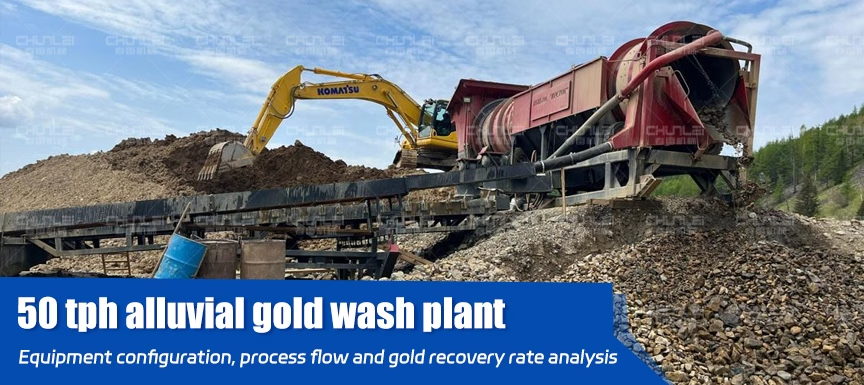
Table of Contents:
- Placer Gold Ore Properties: 5 Key Indicators to Analyze Before Equipment Configuration
- Equipment List for a 50 TPH Placer Gold Washing Plant
- Configuration of Basic Placer Gold Washing Equipment for 50 TPH
- Complete Process Flow of a 50 TPH Placer Gold Washing Plant
- Rotary Screen vs. Rotary Scrubber: How to Choose for a 50 TPH Placer Gold Washing Plant?
- How to Match Gravity Separation Equipment for a 50 TPH Placer Gold Washing Plant?
- Gold Recovery Rate in Placer Gold Washing Plants: What Factors Cause Gold Loss?
- 50 TPH Placer Gold Washing Plant Layout Design
- What factors determine the investment cost of a 50 TPH (50 tons per hour) placer gold washing plant?
- FAQ
- Conclusion
Placer Gold Ore Properties: 5 Key Indicators to Analyze Before Equipment Configuration
The biggest difference between a placer gold washing plant and a conventional sand and gravel washing production line lies in its ultimate goal: not simply washing and grading, but separating valuable gold particles from a large amount of gravel.
Therefore, when designing a 50 TPH placer gold washing plant, the first step is to analyze the ore properties.
1. Feed Particle Size Distribution
Placer gold ore typically contains materials of different particle sizes:
- Large gravel and pebbles
- Medium-coarse sand
- Fine sand
- Silt and clay particles
- Natural gold particles of different sizes
- Particle size distribution directly affects the feeding system, drum screen aperture, screening efficiency, and the selection of gravity separation equipment.
For example, if the proportion of large gravel in the ore is high, a grid screen and a larger feed opening need to be considered; if the proportion of fine sand is high, the recovery of fine gold particles should be a key focus.
2. Clay Content
Clay is one of the important factors affecting the effectiveness of placer gold washing.
When ore contains highly viscous clay clumps, gold particles may be trapped inside these clumps. If the washing intensity is insufficient, the gold particles cannot be fully released and may be discharged with the oversize or tailings.
It is recommended to determine washing requirements through the following tests:
- Observe the dispersion of the raw ore in water.
- Determine the clay and fine mud content in different particle sizes.
- Conduct washing tests using a drum screen or scrubbing machine.
- Check whether the clay clumps are sufficiently broken down after washing.
- Analyze whether residual gold particles are present in the oversize and tailings.
If the raw ore has strong cohesiveness, a scrubbing machine should be prioritized for evaluation, rather than simply increasing the processing capacity of the drum screen.
3. Gold Particle Size Distribution
This is a key indicator for determining the combination of gravity separation equipment.
Place gold can exist in the form of coarse-grained gold, flake gold, fine-grained gold, and micro-grained gold.
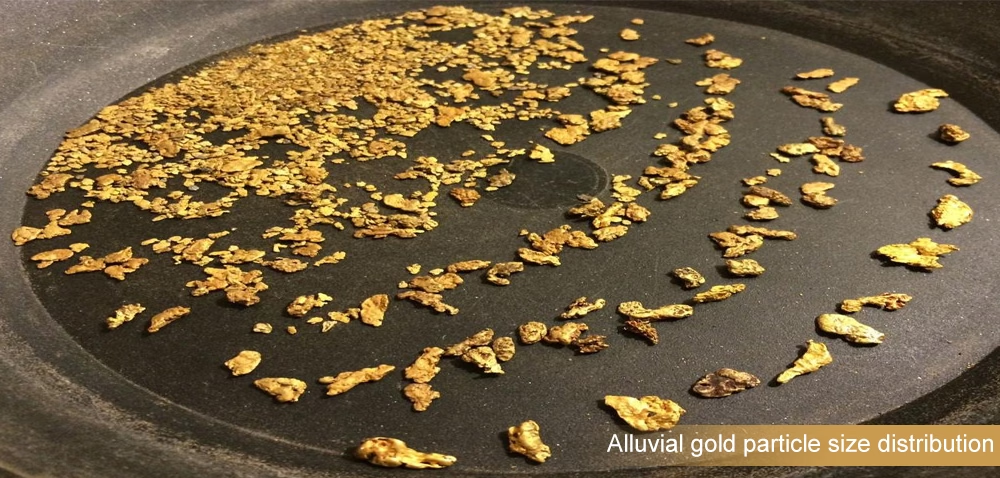
Equipment selection differs depending on the gold particle size:
| Gold Grain Characteristics | Main Processing Considerations | Evaluable Equipment |
| Coarse Gold, Gold Nuts | Preventing Washout, Ensuring Full Capture | Grain Separation After Screening, Jigging, Sluice Box |
| Medium Gold Grain Separation | Stable Stratification and Grain Separation | Spiral Sluice Box, Jigging |
| Fine Gold Grain Separation | Controlling Water Flow and Classification Particle Size | Centrifugal Concentrator, Fine Grain Separation Equipment |
| Micro-Fine Gold Grain Separation | Assessing Gravity Separation Limits and Mineralogical Characteristics | Enhanced Gravity Separation or Other Applicable Processes |
Special attention should be paid to the fact that the settling and movement behavior of flake gold is different from that of spherical particles of the same size, and the recycling equipment cannot be determined solely based on the particle size.
4. Gold Liberation
Place gold is generally a secondary sedimentary deposit, with much of the gold grain already released from the primary ore through natural weathering, transportation, and deposition.
However, not all gold-bearing materials are in a completely free state.
If the gold grains are still attached to clay clumps, ferrous cement, or other mineral aggregates, the liberation effect of washing and scrubbing needs to be considered.
If the gold is actually encased in hard rock or sulfide minerals, conventional placer gold washing plants may not be suitable, and additional crushing, grinding, and corresponding beneficiation processes may need to be designed.
5. Ore Moisture Content and Slurry Properties
Moisture content affects material flowability, feed stability, and screening efficiency.
For systems using hydraulic conveying and gravity separation, slurry concentration, flow rate, and water pressure also need to be controlled.
The following should be determined separately in the engineering design:
- Natural moisture content of the raw ore
- Washing water replenishment
- Gravity separation feed concentration
- Equipment operating water pressure
- Tailure drainage situation
Recommendation: Before purchasing a 50 TPH placer gold washing and beneficiation equipment, at least representative ore samples should be obtained, and particle size analysis, clay washing tests, and gold particle size analysis should be completed. For projects with high recovery requirements, particle size fraction gold grade and gravity separation tests should also be conducted.
Equipment List for a 50 TPH Placer Gold Washing Plant
A complete 50 TPH placer gold washing plant typically consists of a feeding, washing, screening, gravity separation, concentrate cleaning, and water circulation system.
Not all projects require all equipment. The equipment combination should be determined based on the ore properties and the actual processing capacity of each process.
Main Equipment and Functions
| Equipment Name | Main function |
| Feed Hopper | Receiving raw ore |
| Vibrating Feeder | Stable feed |
| Grizzly Screen | Intercepting oversized materials |
| Trommel Screen | Ore washing and particle size classification |
| Trommel Scrubber | Breaking clay lumps |
| Vibrating Screen | Further screening |
| Jig Concentrator | Recovering heavy minerals of suitable particle size |
| Gold Sluice Box | Capturing free gold |
| Centrifugal Concentrator | Enhancing fine gold gravity separation |
| Shaking Table | Concentrate beneficiation |
| Water Pump | Water supply and slurry transportation |
| Settling Pond | Solid-liquid separation and water recycling |
| Tailings Discharge System | Tailure treatment |
Configuration of Basic Placer Gold Washing Equipment for 50 TPH
For a placer gold ore processing capacity of 50 tons/hour (50 TPH), it is recommended to adopt a modular, gravity-based basic placer gold washing production line.
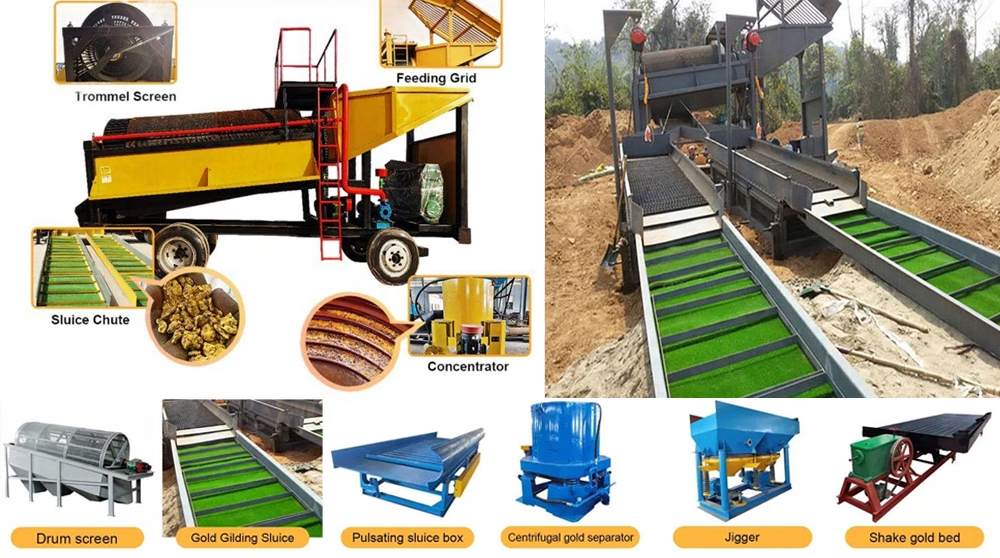
| Item No. | Equipment Name | Recommended Specifications | Quantity | Main Use |
| 1 | Raw Ore Feed Hopper | 3–5 m³, with grid screen | 1 set | Raw ore receiving, intercepting large stones |
| 2 | Vibrating Feeder | 600–800 mm | 1 unit | Uniform feeding control |
| 3 | Drum Washing Screen | Φ1200–1300 × 3000–4000 mm | 1 unit | Ore washing, screening, grading |
| 4 | High-Pressure Washing System | Water spray pipe and nozzle | 1 set | Washing mud, releasing placer gold |
| 5 | Fixed Gold Panning Sluice | 1.2 × 6 Approximately m | 2 lines | Recovering coarse and partially fine gold particles |
| 6 | Centrifugal Concentrator | STLB Series, selected by processing capacity | 1 unit | Enhanced fine gold recovery |
| 7 | Shaking Table | 6-S type or equivalent | 1 unit | Concentrate beneficiation, improving gold grade |
| 8 | Tailings Sluice Box | Based on site design | 1 set | Tailings discharge |
| 9 | Sand Pump/Clean Water Pump | Selected based on head and flow rate | 2–3 units | Water supply and slurry conveying |
| 10 | Conveyor | 500–650 mm | 1–2 units | Transportation of large waste rock and tailings |
| 11 | Sedimentation Tank | 2–3 stages | 1 set | Mud and sand sedimentation, circulating water utilization |
| 12 | Electrical Control System | Power distribution cabinet and cables | 1 set | Centralized equipment control |
The above is a basic preliminary configuration, not the final construction drawing. For the selection of 50 TPH equipment, you can refer to the equivalent configuration of Φ1200×3000 mm drum screen and double chute on the market, but the actual configuration must be verified based on ore samples and screening tests.
Complete Process Flow of a 50 TPH Placer Gold Washing Plant
A 50 TPH (50 tons of raw ore per hour) placer gold washing plant is mainly used for pre-crushing treatment, screening, washing, gravity separation, gold recovery, and tailings discharge of placer gold mines.
The recommended gravity gold separation process is: drum screen washing + high-pressure water washing + jig + gold sluice + shaking table concentrator.
This scheme is suitable for muddy placer gold mines, riverine placer gold mines, alluvial placer gold mines, and some weathered placer gold mines. Specific equipment configuration needs to be adjusted according to the mud content, gold particle size, and ore moisture content of the raw ore.
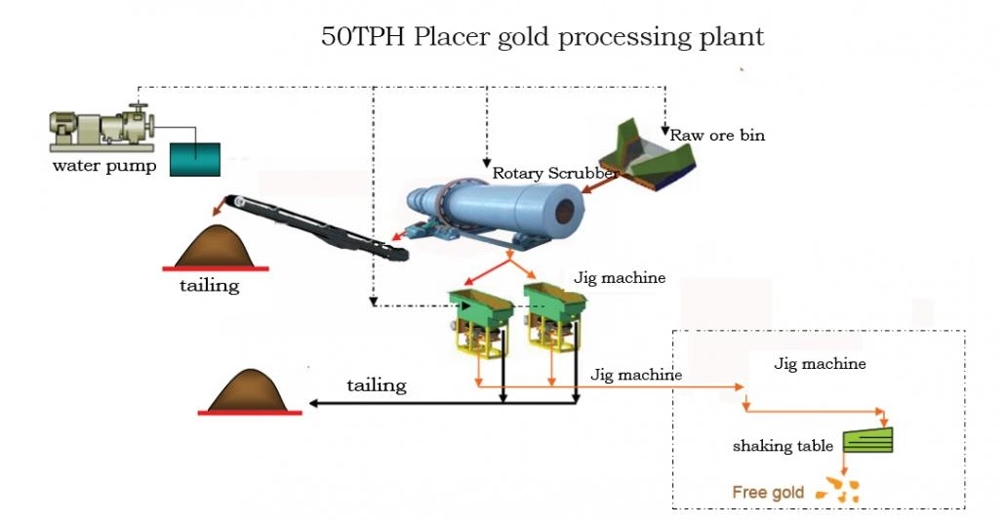
Detailed Description of Each Process Section:
Step 1: Raw Ore Feeding
Raw ore is typically fed into the feed hopper using excavators, loaders, or transport vehicles.
The main task of the feeding system is to maintain a stable feed rate, preventing sudden large feed surges that could clog the drum screen or overload the gravity separator.
Key considerations for a 50 TPH system:
- Effective volume of the feed hopper.
- Maximum feed particle size.
- Adjustment range of the vibrating feeder.
- Grate screen spacing.
- Feed height and loader operating space.
If the ore contains large pebbles or boulders, a suitable grate screen should be installed at the front end to prevent oversized materials from entering subsequent equipment.
Step 2: Washing & Scrubbing
The main task of washing is to thoroughly disperse the soil, fine mud, and clay clumps adhering to the surface of the gravel, releasing the trapped gold particles.
Depending on the ore properties, a drum washing screen or a drum scrubbing machine can be used.
Step 3: Screening and Particle Size Classification
After washing, the material enters the screening system.
The main purposes of screening include:
- Discharging large pieces of waste rock that do not need to enter the gravity separation system.
- Controlling the feed particle size of the gravity separation equipment.
- Reducing the throughput of downstream equipment.
- Improving the separation conditions for materials of different particle sizes.
Step 4: Gravity Concentration
A key difference between placer gold and ordinary sand and gravel is that gold has a higher density, therefore it can be separated using gravity differences.
Common equipment includes:
- Gold sluice boxes.
- Jigs.
- Centrifugal concentrators.
- Spiral sluice boxes and other suitable gravity separation equipment.
These devices are not simply a matter of having more; rather, they need to be combined according to the material particle size, slurry flow rate, and target gold particle size.
Step 5: Concentrate Cleaning
Primary gravity separation usually yields gold-bearing concentrate, but the concentrate may still contain magnetite, black sand, and other high-density minerals.
Therefore, a shaking table can be used for further refining.
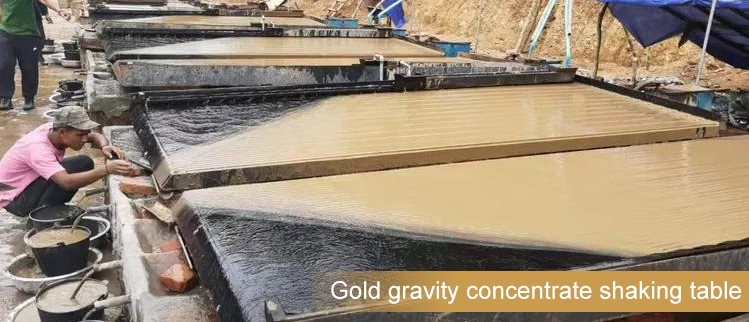
Shaking tables are mainly suitable for pre-concentrated materials, rather than directly processing all the raw ore in a 50 TPH production line.
By controlling the feed concentration, feed flow rate, flushing water volume, and shaking table stroke, native gold can be further separated from other heavy minerals.
Step Six: Tailings & Water Recycling
The tailings after gravity separation need to enter a dedicated discharge and management system.
Design considerations should include:
- Tailings discharge volume.
- Tailings moisture content.
- Fine sludge settling properties.
- Effective volume of settling tank.
- Return water pump capacity.
- Impact of water quality on equipment operation.
Gold recovery should not be considered alone, while the detection of residual metals in the tailings and the stability of the water recycling system should not be ignored.
Rotary Screen vs. Rotary Scrubber: How to Choose for a 50 TPH Placer Gold Washing Plant?
This is one of the most common technical questions in equipment procurement.
While rotary screens and rotary scrubbers may look similar, their primary functions are not entirely the same.
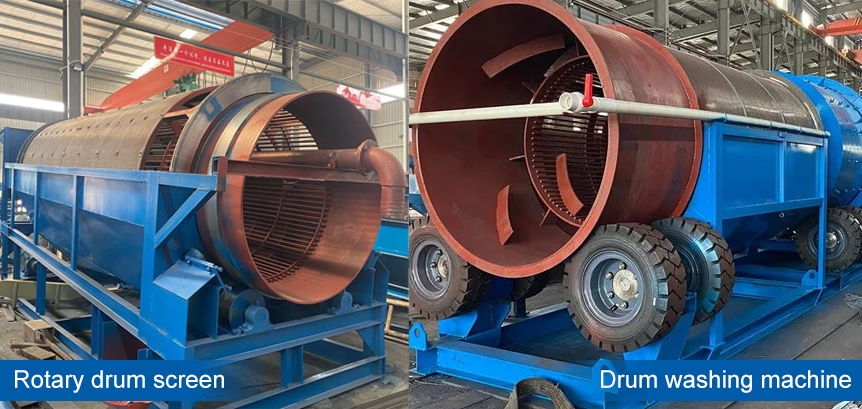
Rotary Screen: Primarily used for ore washing and screening/classification.
Rotary Scrubber: Primarily used for enhanced mechanical scrubbing and breaking down clay clumps.
| Comparison Indicators | Drum Screen | Drum Scrubber |
| Main Functions | Ore Washing, Screening | Enhanced Scrubbing, Desliming |
| Applicable Ore | Loose Gravel | Strongly Cohesive Gravel |
| Clay processing capacity | Depends on clay properties | Generally more suitable for strong clays |
| Process complexity | Relatively simple | Generally higher |
| Water and power requirements | Depends on configuration | Generally requires more adequate washing conditions |
| Main design factors | Particle size distribution, sieve aperture, feed rate | Clay properties, scrubbing intensity, residence time |
In what situations should a drum screen be prioritized?
If the raw ore mainly consists of loose sand, gravel, and a small amount of clay, and the ore is easily dispersed in water, then a drum screen solution can be prioritized.
The advantages are a relatively simple system, fewer pieces of equipment, and relatively easy maintenance.
In what situations should a scrubbing machine be considered?
If the raw ore contains a large amount of sticky clay, ordinary water spraying cannot effectively break up the clay clumps. It is recommended to evaluate a drum scrubbing machine through scrubbing tests.
The value of a scrubbing machine lies in increasing the release of gold particles from clay clumps, preventing gold-bearing clay clumps from entering waste rock or tailings.
Can a combination of scrubbing machine and drum screen be used?
Yes.
For placer gold deposits with high clay content, an evaluable process is: Raw ore feed → drum scrubbing → screening → gravity separation.
This allows for clay disintegration first, followed by using screening equipment to control the particle size of the gravity feed.
Whether two separate devices are ultimately needed depends on whether the scrubbing equipment has sufficient screening capacity, the results of ore washing and beneficiation tests, and the project budget.
How to Match Gravity Separation Equipment for a 50 TPH Placer Gold Washing Plant?
The equipment configuration for a 50 TPH placer gold washing plant should be based on the core criteria of processing capacity, placer gold particle size, gold mineral distribution characteristics, and raw ore mud content. A gravity separation process flow of “screening and washing—classification and desliming—roughing and recovery—fine cleaning and purification” should be adopted.
For a processing capacity of 50 tons of placer gold ore per hour, it is recommended to configure equipment such as drum washing machines or vibrating screens, spiral classifiers, jigs, sluices, shaking tables, and centrifugal concentrators. By complementing the advantages of different gravity separation equipment, the plant can achieve graded recovery of coarse, fine, and ultrafine gold particles, ensuring processing capacity while improving gold recovery rate and reducing the risk of gold loss in tailings.
Gold Recovery Rate in Placer Gold Washing Plants: What Factors Cause Gold Loss?
Gold loss in placer gold washing plants mainly stems from the following eight aspects:
- Excessively fine gold particles: Fine and micro-fine gold particles are easily carried into the tailings by the water flow.
- Insufficient washing: Clay encapsulates the gold, preventing it from being fully released.
- Excessively high water flow velocity: Gold is washed away by the water flow and enters the tailings.
- Improper screening: Clogged, damaged, or unsuitable screen sizes cause gold loss.
- Improper chute design: Inappropriate slope, length, baffles, and gold-catching media.
- Improper equipment parameters: Mismatched operating parameters of equipment such as jigs, shaking tables, and centrifuges.
- Excessive feed rate: Overloading the equipment reduces gold recovery efficiency.
- Improper concentrate processing: Gold loss occurs during cleaning, transfer, dehydration, and smelting.
50 TPH Placer Gold Washing Plant Layout Design
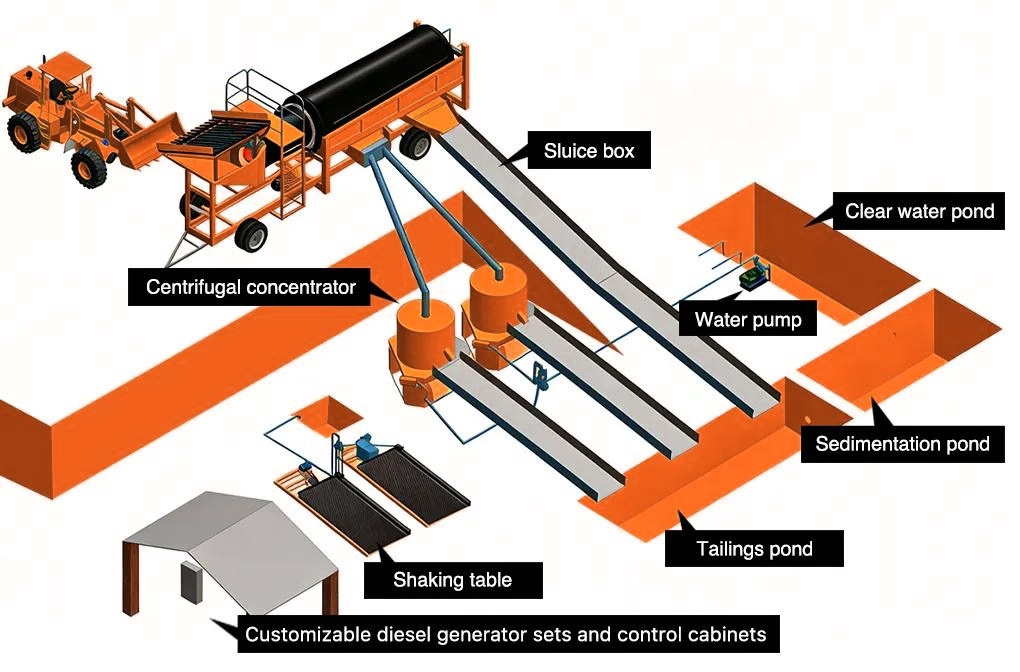
A well-planned layout reduces secondary material handling, simplifies piping and conveying systems, and improves maintenance efficiency.
A 50 TPH placer gold washing plant can be divided into five main areas.
Raw Material Receiving Area
This area should be close to the ore transport road for convenient continuous feeding by loaders or excavators.
Key Planning Areas:
- Raw ore stockpile.
- Feed channel.
- Feed hopper location.
- Large waste rock processing area.
- Loader turning space.
Washing & Screening Area
Washing equipment should be located as close as possible to the feeding system to avoid repeated transfer of raw ore between equipment.
Space should be reserved for drum screen maintenance, screen replacement, and waste rock discharge.
Gravity Recovery Area
Gravity recovery equipment requires stable feeding and hydraulic conditions.
Sluices, jigs, and centrifugal concentrators should be rationally arranged according to material distribution and water flow direction.
A safe area for concentrate collection and storage should also be provided.
Water Management Area
The water management area can be located in an area convenient for the operation of the return water pump, and the location of the sedimentation tank should be determined based on the site topography.
Unnecessary pipeline distances should be minimized, while considering the conditions for sedimentation tank dredging and maintenance.
Tailings Discharge Area
The tailings discharge channel should be separated from the equipment maintenance channel to avoid tailings accumulation affecting equipment operation.
What factors determine the investment cost of a 50 TPH (50 tons per hour) placer gold washing plant?
The investment cost of a 50 TPH (50 tons of raw ore per hour) placer gold washing plant is not solely determined by equipment prices, but is influenced by a variety of factors including ore properties, beneficiation processes, equipment configuration, site conditions, and the degree of automation.
Different mining areas have different topography, gold content, gold particle size, and clay content, which will lead to variations in the required washing equipment and supporting facilities. Therefore, when developing an investment budget, it is necessary to combine actual ore samples and production requirements to rationally design the entire placer gold washing production line in order to effectively control project investment costs while ensuring gold recovery rates.
The main factors affecting the investment cost of a 50 TPH placer gold washing plant include:
- Ore Properties and Conditions
- Gold content and gold particle distribution in the raw ore.
- Gold particle size, shape, and embedment characteristics.
- Mud content, clay content, and sand/gravel ratio in the raw ore.
- Whether crushing, screening, washing, or desliming is required.
- Mineral Processing Technology and Production Line Design
- Whether to use a drum screen, vibrating screen, or washing machine.
- Whether to configure scrubbing machines and desliming equipment.
- Process combination and quantity of gravity separation equipment.
- Whether secondary cleaning is required to improve gold recovery rate.
- Core Equipment Configuration
- Feeder, vibrating screen, drum screen.
- Washing machine, sluice, jig.
- Centrifugal concentrator, shaking table, and other cleaning equipment.
- Tailings treatment and gold recovery auxiliary equipment.
- Equipment Material and Manufacturing Standards
- Ordinary carbon steel or wear-resistant steel.
- Equipment processing capacity and structural design.
- Configuration of wear-resistant liners, screens, and other vulnerable parts.
- Equipment brand, processing quality, and service life.
- Site and Infrastructure
- Site leveling and equipment foundation construction.
- Water tanks, sedimentation tanks, and circulating water system.
- Power supply system, generator, and power distribution facilities.
- Raw ore storage yard, concentrate area, and tailings storage area.
- Automation and Control System
- Manual operation or automated control.
- Electrical control cabinet and sensor configuration.
- Feeding, water supply, and equipment linkage control.
- Production monitoring and safety protection system.
- Transportation, Installation, and Commissioning Costs
- Equipment transportation and loading/unloading costs.
- On-site installation and piping connections.
- Electrical installation and production line commissioning.
- Technical guidance and personnel training.
- Project Operation and Supporting Costs
- Water, electricity, and fuel consumption.
- Wages of operators and maintenance personnel.
- Replacement of vulnerable parts, screens, and wear-resistant parts.
- Equipment maintenance and routine repair costs.
FAQ
Q1: How much raw ore can a 50 TPH placer gold washing plant process per hour?
A: 50 TPH indicates a design capacity of 50 tons of raw ore per hour. Actual continuous processing capacity depends on ore particle size, clay content, feed stability, washing efficiency, and equipment utilization. Rated capacity does not equal long-term actual output.
Q2: What are the main equipment requirements for a 50 TPH placer gold washing plant?
A: Common equipment includes feed hoppers, vibrating feeders, drum screens, scrubbers (configured as needed), sluices, jigs, centrifugal concentrators, shaking tables, water pumps, and water circulation systems.
However, not all projects require all equipment. The final configuration should be determined based on the properties of the raw ore, gold particle size, and gravity separation test results.
Q3: Should a drum screen or a scrubber be chosen for a placer gold washing plant?
A: If the raw ore is mainly loose gravel with a low clay content, a drum screen is preferred.
If the raw ore contains a large amount of sticky mud, a stronger mechanical scrubbing action is required; a drum scrubber can be evaluated.
For high-clay ores, a combination of scrubbing and screening equipment can also be considered.
Q4: Can a 50 TPH placer gold washing plant recover fine-grained gold?
A: Yes, but the appropriate gravity separation equipment needs to be selected based on the particle size, shape, degree of liberation, and slurry conditions of the fine-grained gold.
For fine-grained gold suitable for gravity recovery, a centrifugal separator can be evaluated. For already enriched fine-grained concentrate, shaking table refining can be used.
Actual recovery results need to be verified through ore sample testing and tailings analysis.
Q5: What is the typical gold recovery rate of a placer gold washing plant?
A: There is no uniform recovery rate applicable to all placer gold mines.
The actual recovery rate is affected by gold particle size, gold particle shape, clay content, washing efficiency, screening conditions, and the compatibility of the gravity separation equipment.
It is recommended to calculate the actual metal balance by taking representative samples of the raw ore, concentrate, and tailings, rather than directly using the recovery rate data in the equipment’s promotional materials as the guaranteed value for project design.
Q6: Can a 50 TPH placer gold washing plant use circulating water?
A: Yes. A circulating water system can usually be established through sedimentation tanks, clarification facilities, and return water pumps.
However, if the raw ore contains a large amount of fine clay, the water may remain turbid for a long time, requiring an assessment of settling performance and whether additional flocculation or thickening treatment facilities are needed.
Whether the circulating water can meet production requirements needs to be determined through water balance and water quality testing.
Q7: What is the difference between a mobile and stationary 50 TPH placer gold washing plant?
A: Mobile plants are more suitable for mining areas requiring frequent relocation, while stationary plants are more suitable for projects with stable ore sources and long-term production.
When choosing, factors such as the service life of the mining area, road conditions, equipment relocation costs, water source location, and future expansion needs should be comprehensively considered.
Q8: What is the most important information before purchasing 50 TPH placer gold washing equipment?
A: The most important information is the properties of the raw ore and the particle size distribution of the gold particles.
It is recommended to prioritize preparing:
- Raw ore particle size analysis.
- Clay content and washing tests.
- Gold particle size distribution.
- Raw ore grade and grade by particle size fraction.
- Water and power supply conditions.
- Project site and processing capacity.
This information is more helpful in determining a suitable equipment solution than simply providing a processing capacity of 50 TPH.
Conclusion
Setting up a 50 TPH placer gold washing and processing production line isn’t about having more equipment; the key is selecting the right equipment and combining it appropriately to ensure stable gold recovery.
Do you have a 50 TPH placer gold project? Feel free to send us photos of your ore, ore samples, or on-site videos. We’ll help you analyze your ore conditions and recommend suitable equipment configurations and production line solutions, saving you time, effort, and money! Contact us now!
Latest News

Flotation Foam Problems: Causes, Diagnosis, and Solutions
826In the flotation process, foam may seem insignificant, but its quality directly affects concentrate grade, metal recovery rate, and reagent costs. In actual production, many concentrators encounter similar problems: too much foam, too sticky, and …
Small-Scale Gold Processing Plant: A Complete Guide to Equipment and Processes
837Setting up a small-scale gold processing plant sounds simple, but choosing the wrong equipment can lead to increasingly higher operating costs and negatively impact gold recovery rates. Many clients initially focus only on capacity, equipment pric…
The Role of Cyanide in Gold Mining: Process Flow and Mineral Processing Management
821In gold ore processing, cyanide is a commonly used leaching agent; it directly influences the gold leaching rate, overall recovery, and production costs. However, cyanide leaching is not merely a matter of adding chemicals—factors such as ore char…
How should you choose equipment for pre-desliming in gravity separation?
813Many operators struggle with low recovery rates when using shaking tables, sluice boxes, or centrifugal concentrators—even when the equipment itself is high-quality—only to find that valuable minerals are being lost in the tailings. The root cause…
loading…
已经是到最后一篇内容了!
We offer you one-stop solutions: online consultation --- customized solutions --- fast delivery --- comprehensive after-sales service