 Chunlei Mining Machinery
Jaw Crushers and Impact Crushers: Turnkey Solutions for Concrete Recycling
Demolishing old buildings and roads generates vast amounts of waste concrete; direct landfilling not only consumes valuable space but also incurs high transportation costs. The real challenge lies in transforming this waste concrete into reusable recycled aggregate.
However, waste concrete often contains contaminants such as rebar, bricks, soil, and even hard rock fragments. Choosing the wrong equipment can lead to frequent clogging, rapid wear and tear, and poor particle shape in the final product.
A common recycling setup involves using a jaw crusher for primary (coarse) crushing and an impact crusher for secondary (fine) crushing and shaping, complemented by iron removal and screening equipment.
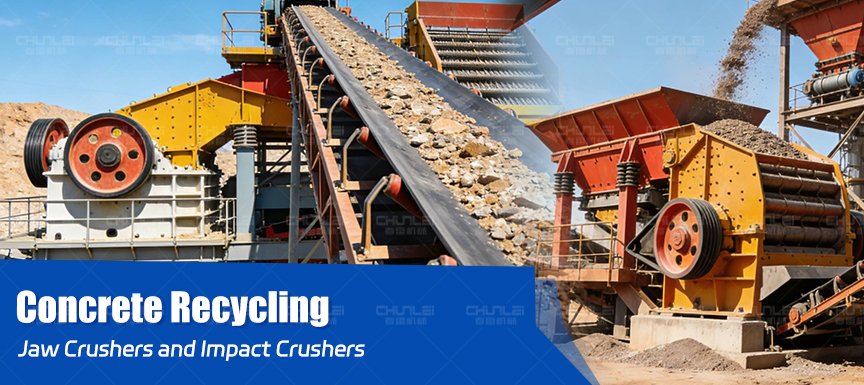
Why is the proper selection of a crusher essential for concrete recycling?
Waste concrete is not as “clean” as natural stone; the raw material may contain a mix of the following:
- Large chunks of waste concrete
- Rebar and wire
- Bricks and masonry blocks
- Soil, sand, and debris
- Original natural aggregates
- Small amounts of hard rock
Therefore, the equipment must not only possess sufficient crushing capacity but also account for feed size, rebar handling, product particle size, aggregate shape, and intended end-use. When selecting a crusher, one cannot focus solely on the purchase price; an unsuitable choice can easily lead to issues such as material clogging, rapid equipment wear, and poor product shape.
What roles do jaw crushers and impact crushers play?
In concrete recycling, choosing between a jaw crusher and an impact crusher is not a simple matter of picking one over the other; instead, they typically handle different stages of the process. The jaw crusher is responsible for breaking large chunks of concrete into smaller pieces, while the impact crusher handles further crushing and improves the shape of the aggregate.
The two machines have different operational focuses.
| Comparison Item | Jaw Crusher | Impact Crusher |
| Primary Function | Coarse crushing; breaking down large chunks | Fine crushing; shaping |
| Typical Position | Primary crushing stage | Secondary/subsequent crushing stage |
| Feed Material | Large chunks of waste concrete with significant impurities | Concrete that has already undergone coarse crushing |
| Rebar Compatibility | Relatively suitable as front-end equipment, though iron removal is still required | More sensitive to rebar; iron removal should generally be performed beforehand |
| Product Particle Shape | Relatively coarse; may contain elongated or flaky particles | Generally superior shape; closer to cubic |
| Key Advantages | Simple structure; durable; suitable for large feed sizes | High reduction ratio; combines crushing with shaping |
| Role in Recycling Line | “Breaking large chunks down into smaller pieces” | “Refining small material into a finer, higher-quality product” |
For standard waste concrete recycling projects, a common processing workflow is:
Waste concrete → Jaw crusher → Iron removal → Impact crusher → Vibrating screen → Recycled aggregate
However, if the raw material contains a significant amount of hard, highly abrasive materials—such as granite or basalt—this standard configuration cannot be applied directly; one must account for the wear-related costs of the impact crusher or even incorporate additional equipment, such as a cone crusher. CHUNLEI’s jaw crushers are primarily used for the primary crushing of large material blocks, whereas impact crushers are suitable for subsequent medium-to-fine crushing and shape shaping.
Jaw Crusher: Solving Large Blocks of Concrete
The demolished concrete blocks are usually large in size and irregular in shape, and some contain debris such as steel bars and bricks.
The jaw crusher is mainly responsible for front-end coarse crushing. Through the compression between the movable jaw and the fixed jaw, the large concrete is broken into materials suitable for the next stage of processing.
Why is the jaw crusher usually chosen for primary crushing?
Mainly because it is more suitable for processing:
- Large pieces of waste concrete
- reinforced concrete
- Concrete block and brick mixture
- Demolition waste with large variations in size
If the maximum size of your raw materials is relatively large, directly letting the impact crusher undertake the first-level coarse crushing will usually cause serious losses and unnecessary investment.
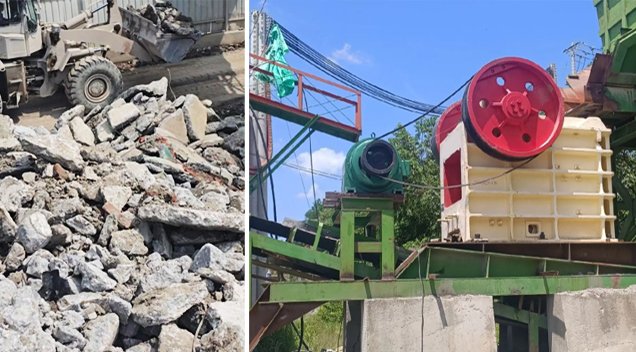
Impact Crusher: Fine Crushing and Aggregate Shaping
After primary crushing by a jaw crusher, concrete blocks are reduced in size, but the product may still contain a significant number of flaky or elongated particles, and the particle shape may lack uniformity. Impact crushers are typically employed in the secondary or tertiary crushing stages, primarily to perform further fine crushing and shaping.
The impact crusher utilizes a high-speed rotor to drive blow bars, striking the material at high velocity and forcing it to collide with impact plates, thereby achieving further breakage and shaping.
It is particularly suitable for applications where specific particle shape requirements exist for recycled aggregates.
Examples include:
- 5–20 mm recycled aggregate
- 20–40 mm road base material
- Recycled concrete aggregate
- Manufactured sand and fine aggregates
The advantage of the impact crusher lies in its ability to improve particle shape in addition to crushing the material.
However, there is an important consideration:
If the waste concrete contains significant amounts of high-hardness rock—such as granite or basalt—CHUNLEI recommends installing a cone crusher upstream of the impact crusher; otherwise, the wear on the impact crusher’s blow bars will increase significantly.
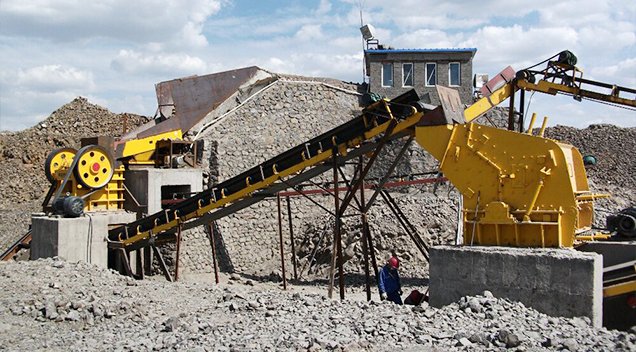
Complete Concrete Recycling Process: Jaw Crusher + Impact Crusher
For standard waste concrete, the basic process is straightforward:
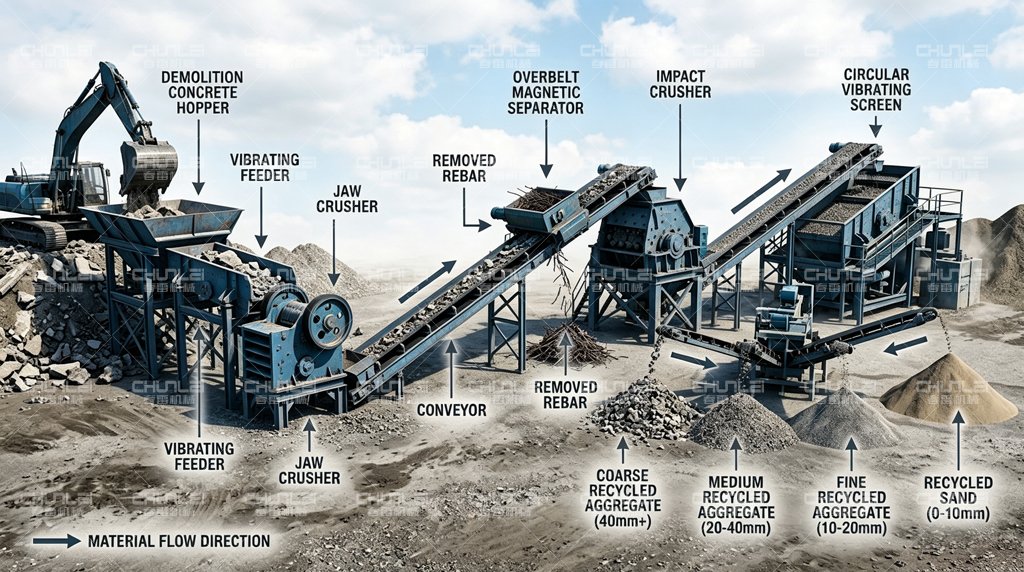
Waste Concrete → Feeding → Jaw Crusher → Iron Removal → Impact Crusher → Vibrating Screen → Recycled Aggregate
Step 1: Feeding
Waste concrete is first fed into a vibrating feeder.
The feeder’s role goes beyond simple material delivery; it ensures a continuous, uniform feed rate, thereby minimizing crusher idling or sudden overloads.
Step 2: Primary Crushing (Jaw Crusher)
Large chunks of concrete enter the jaw crusher.
After this primary crushing stage, the material size is significantly reduced, creating suitable feed conditions for the subsequent impact crusher.
Step 3: Iron Removal
This is a crucial step in the concrete recycling line.
Large amounts of metal—such as rebar and wire—must be prevented from entering the impact crusher.
Therefore, magnetic separation or iron removal equipment is installed between the jaw crusher and the impact crusher.
This helps reduce:
- Abnormal wear on blow bars
- Crushing chamber blockages
- Metal contamination in the final product
- Unplanned downtime
Step 4: Fine Crushing and Shaping (Impact Crusher)
The iron-free material enters the impact crusher.
Product particle size is adjusted by modifying the gap between the impact plates, while the impact action simultaneously improves the shape of the aggregate.
Step 5: Vibrating Screening
Finally, a vibrating screen separates the recycled aggregate into different particle sizes.
For example, sizes can be categorized according to project requirements, such as:
0–5 mm, 5–20 mm, and 20–40 mm
Specific product specifications are determined based on local market demands and end-use applications.
How do you choose the right solution for different concrete recycling projects?
Not every project is suited to the exact same production line.
Option 1: Standard Waste Concrete
If the raw material consists primarily of standard demolition concrete with relatively consistent hardness, consider this setup:
Vibrating Feeder + Jaw Crusher + Iron Remover + Impact Crusher + Vibrating Screen
This is a straightforward two-stage crushing solution.
Option 2: Mixed, High-Hardness Old Concrete
If the waste source is complex and frequently contains materials such as:
- Granite
- Basalt
- Diabase
- Large, hard aggregates
then simply copying the “Jaw Crusher + Impact Crusher” configuration is not ideal.
Consider this approach:
Jaw Crusher → Iron Removal → Cone Crusher → Impact Crusher → Vibrating Screen
Assign the more demanding crushing tasks to the cone crusher, and use the impact crusher for final shaping.
Option 3: On-Site Recycling at Demolition Sites
If the client does not operate a permanent recycling plant but instead faces situations such as:
- Moving from site to site
- Scattered road construction locations
- Limited space at construction sites
- A desire to avoid building large, permanent foundations
then a mobile crushing station is a more suitable choice.
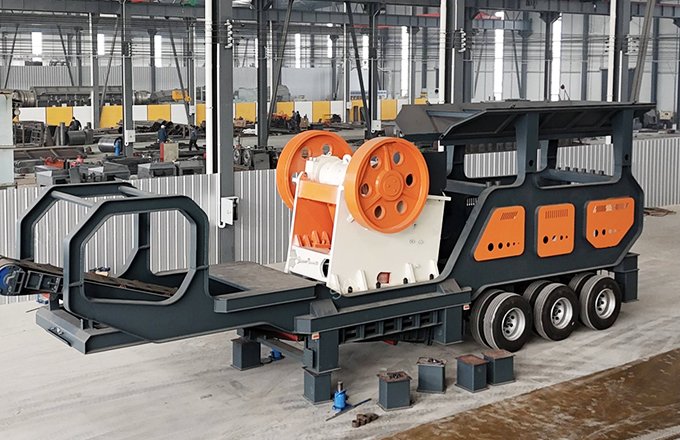
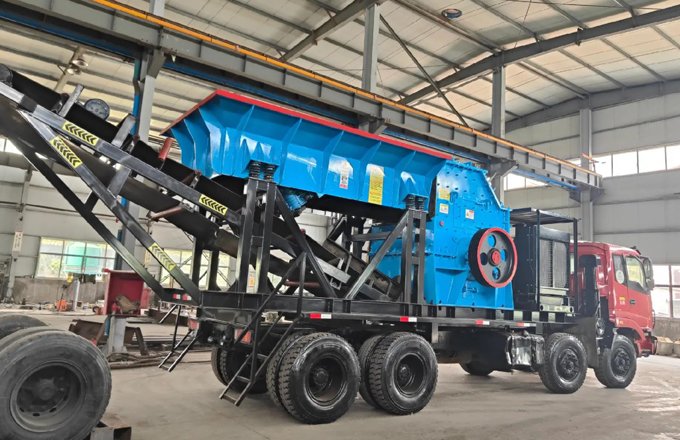
CHUNLEI’s mobile jaw crusher integrates feeding, crushing, screening, and conveying modules onto a mobile chassis, making it ideal for mines, quarries, and on-site construction waste processing; a mobile impact crusher can then be used for subsequent fine crushing and shaping.
Are mobile jaw crushers and impact crushers suitable for on-site recycling?
If your project requires frequent relocation, mobile equipment offers distinct advantages.
With traditional stationary setups, you have to consider:
Foundations → equipment installation → conveyor lines → site layout → dismantling and reinstallation.
In contrast, mobile equipment can move directly to the vicinity of the construction site for crushing, thereby reducing the need to transport waste concrete back and forth.
| Aspect | Stationary Crushing Line | Mobile Crushing Station |
| Equipment Relocation | Inconvenient | Flexible |
| Infrastructure | Usually required | Can reduce or eliminate the need for permanent foundations |
| On-site Processing | General | Better suited |
| Multi-project Relocation | Higher cost | More convenient |
| Long-term Fixed Production | Better suited | Requires project-specific assessment |
| Construction Waste Recycling | Suitable for fixed recycling plants | Particularly suitable for demolition sites |
CHUNLEI currently offers wheeled and tracked mobile crushing solutions and can configure combinations of jaw crushers, impact crushers, cone crushers, and screening equipment based on project requirements.
How can you avoid common pitfalls when selecting equipment for a concrete recycling project?
The biggest mistake in concrete recycling projects isn’t choosing equipment with insufficient individual unit capacity; rather, it is focusing solely on price and theoretical output without first assessing actual feed conditions. Based on experience with past projects, it is best to clarify the following points before making a purchase:
- Assess the feed material first: Determine the maximum size of the concrete blocks, the amount of rebar present, and whether there are contaminants like bricks, soil, or stones.
- Don’t rely solely on tonnage ratings: Nominal equipment output does not equal your actual output; selection must also account for feed particle size, discharge requirements, and material properties.
- Consider rebar handling: If there is a significant amount of rebar, you need to plan for manual pre-treatment, pre-screening, or magnetic separation at the front end; otherwise, tangling and clogging are likely to occur.
- Don’t mix and match jaw and impact crushers haphazardly: Jaw crushers handle primary coarse crushing of large blocks, while impact crushers handle further fine crushing and shaping; they serve different functions.
- Don’t overlook screening: Insufficient screening capacity causes large particles to recirculate constantly, dragging down the entire line’s output.
- Account for high-hardness materials separately: If the waste concrete contains large amounts of highly abrasive materials like granite or basalt, you cannot simply select an impact crusher based on a standard concrete processing plan.
- Define finished product specifications in advance: Deciding whether to produce 0–5 mm, 5–10 mm, or larger-sized recycled aggregates directly influences the configuration of crushing and screening equipment.
In short, before purchasing, clarify the following: what the feed material is, its maximum size, the rebar content, the required output volume, and the desired final particle size. Addressing these questions before selecting equipment helps you avoid common pitfalls more effectively than simply comparing price quotes.
FAQ
Q1: Which is better for concrete recycling: a jaw crusher or an impact crusher?
They serve different purposes. Jaw crushers are better suited for the primary (coarse) crushing of large concrete chunks, while impact crushers are better for secondary (fine) crushing and aggregate shaping. For most standard waste concrete projects, combining the two often makes the overall process easier to manage than using just one type of equipment.
Q2: Can an impact crusher crush waste concrete directly?
Yes, but it depends on the feed size and the condition of the raw material. For large chunks of reinforced concrete, the standard practice is to use a jaw crusher for primary crushing before feeding the material into an impact crusher. CHUNLEI impact crushers are primarily designed for medium-to-fine crushing and shaping.
Q3: What should be done if the concrete contains rebar?
It is recommended to install magnetic separation or iron-removal equipment after the primary crushing stage to separate out as much rebar and other ferromagnetic debris as possible before the material enters the impact crusher.
Q4: Is a combination of jaw crusher and impact crusher mandatory for concrete recycling?
Not necessarily. If the raw material is very hard or contains a significant amount of hard rock, a cone crusher might be considered. If the equipment needs to be moved between different demolition sites, mobile jaw and impact crushers are viable options. The specific solution depends on the raw material, production capacity, and requirements for the finished product.
Q5: Are mobile crushing stations suitable for concrete recycling?
They are ideal for projects requiring on-site crushing, reduced transportation, and frequent relocation. However, for long-term, large-scale stationary recycling plants, a fixed production line may offer better cost-efficiency; a full life-cycle cost analysis is recommended to determine the best choice.
Conclusion
When selecting equipment for a concrete recycling project, the key is not simply to chase the lowest price, but to ensure that machinery—such as crushers, iron removers, and screening units—is truly matched to the material characteristics and production capacity requirements.
If you are working on a concrete recycling project, please share details such as the maximum feed size of the waste concrete, rebar content, target output, and required product specifications. Based on this information, we can help you determine the optimal configuration of jaw crushers, impact crushers, and screening equipment. Contact CHUNLEI today!
Latest News

A Comprehensive Analysis of Ball Mill Energy Consumption Per Ton
800In mineral processing plants, ball mills are significant consumers of electricity. When calculating costs, many clients focus solely on motor power; however, this figure alone does not reveal the actual electricity consumed per ton of ore proce…
-
Why Does A Ball Mill Produce Excessive Fines?
800The production of excessive fines in a ball mill—a phenomenon known as over-grinding—often leads to various downstream issues, such as increased power consumption, greater difficulty in subsequent mineral processing, and accelerated wear of com…
-
Magnesite Mining and Processing: 2026 Profitability Strategy
800Investing in magnesite is a high-demand venture within the refractory raw materials market. Profitability, however, does not hinge solely on the size of reserves; it requires comprehensive planning that integrates mineralogical analysis, benefi…
-
How Do You Select Ball Mill Liners Based On Ore Hardness?
800During ball mill operations, operators often encounter a common issue: liner replacement frequency increases without a corresponding improvement in grinding efficiency—or even with a rise in energy consumption per ton of ore. The problem often …

loading…
已经是到最后一篇内容了!